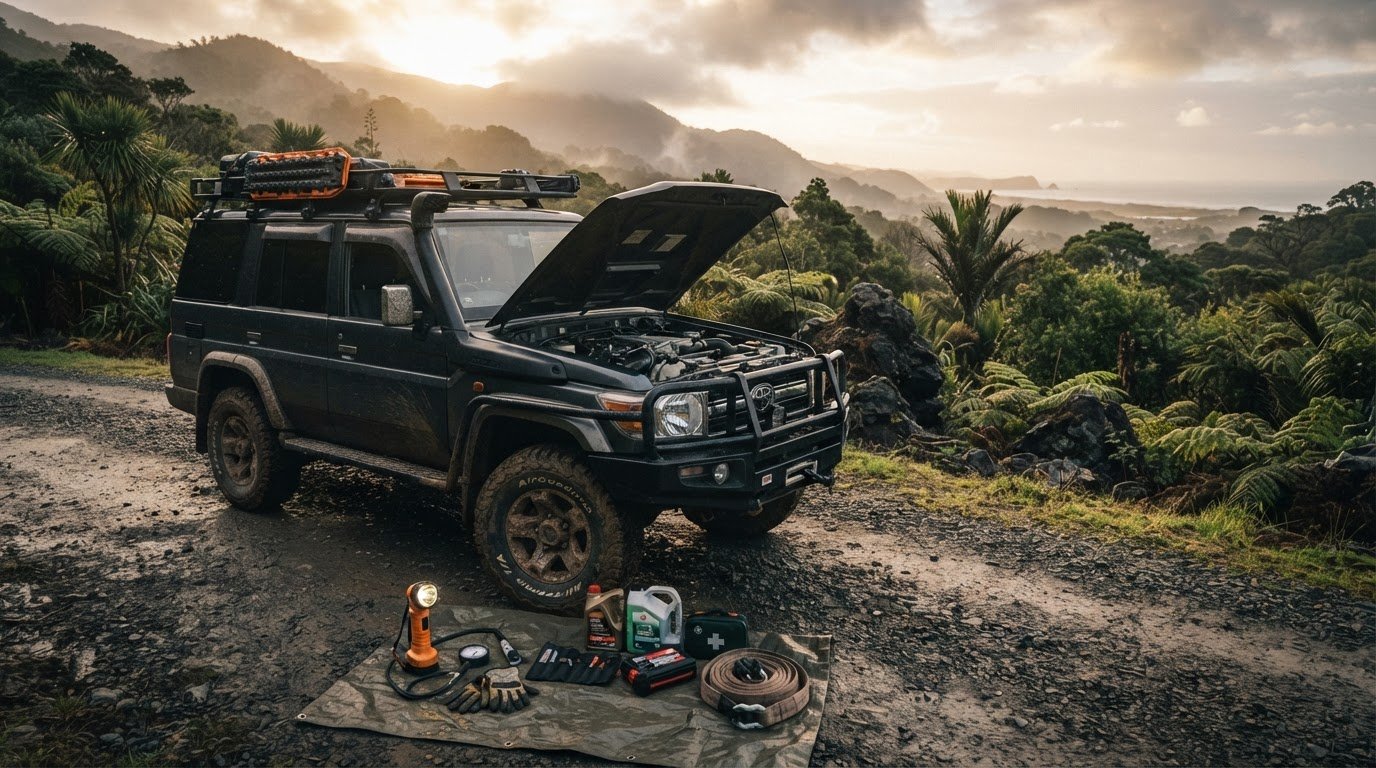
A recovery kit can help if your vehicle gets stuck, but it won’t prevent a mechanical failure. Before heading from Auckland into a remote New Zealand area, check what could go wrong and whether your 4×4 is ready for the route. Knowing how to avoid off-road breakdowns starts with prevention: identify vehicle issues early and make driving decisions that suit the terrain and conditions.
This guide covers practical checks before departure, from tyres and fluids to symptoms that need attention. It also explains how load, terrain, weather and vehicle capability affect breakdown risk on the track. You’ll learn how to prepare without confusing routine maintenance with safe off-road driving, and when specialist 4×4 servicing can support trip planning. No preparation can guarantee a trouble-free journey, but a methodical approach can reduce avoidable risks and help you respond sensibly when conditions change.
Key Takeaways
- Separate risks that preparation may reduce from sudden failures that can’t always be prevented.
- Use a system-based inspection to spot visible issues, and have a qualified mechanic assess symptoms you can’t diagnose.
- Learn how to avoid off-road breakdowns by adapting speed, route and driving decisions to the terrain and conditions.
- Plan for route changes, group communication and a return time before leaving Auckland.
- Follow the vehicle’s maintenance schedule, and arrange a focused 4×4 assessment if use is demanding or new symptoms appear.
How off-road breakdowns happen: risks to consider on New Zealand trips
An off-road breakdown means the vehicle can no longer function or make safe progress away from ordinary road conditions. It might be a 4×4 that won’t start, a tyre problem that makes continued travel unsafe, or a vehicle that can’t tackle the terrain without risking damage or injury. The term covers different vehicles and uses, as this overview of off-road vehicle types and uses illustrates.
Inspection, maintenance and sound driving decisions can reduce some risks. Others, such as sudden component failure or an unexpected change in conditions, can’t always be anticipated. The aim of how to avoid off-road breakdowns is to reduce preventable problems, not to assume every incident can be avoided. A minor fault can become harder to manage when you’re far from assistance, the route is difficult or communications are unreliable.
Breakdown prevention reduces the chance of trouble; recovery planning prepares you to respond if trouble happens anyway. Both belong in a responsible trip plan.
Which failure risks deserve attention before leaving?
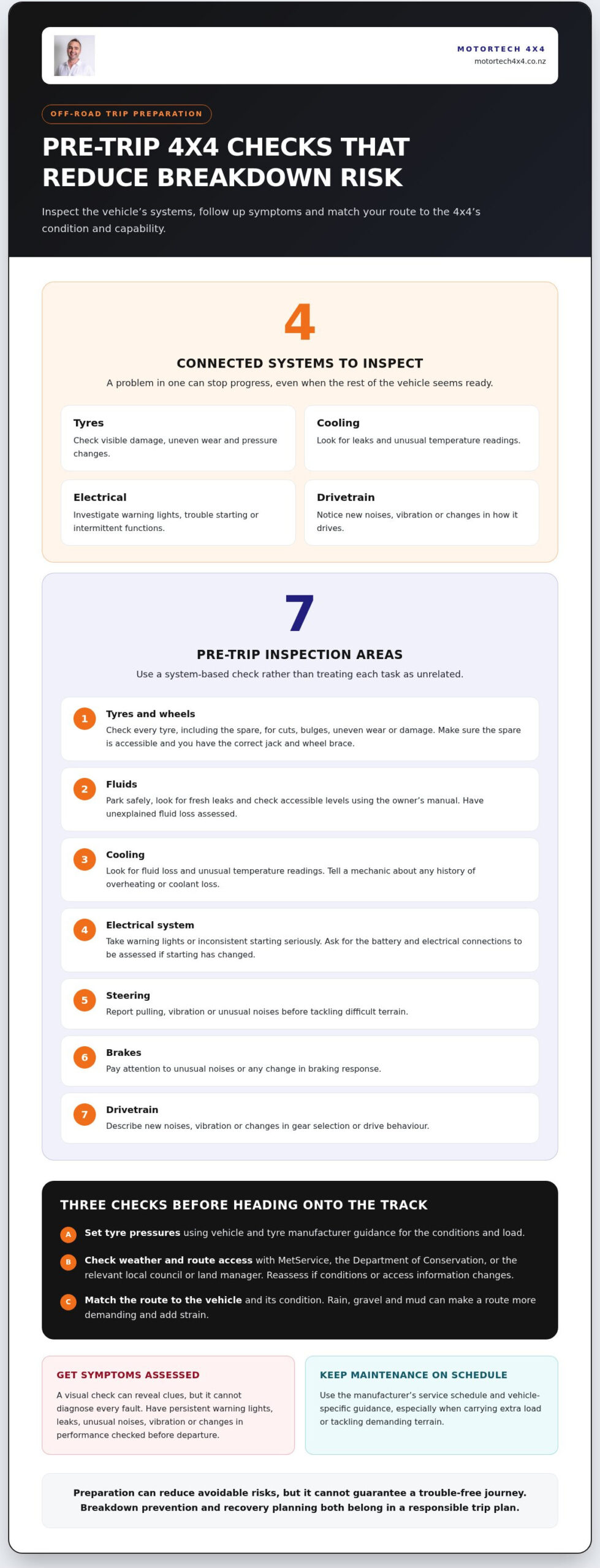
Focus on four connected systems. Tyres need to suit the route and be in sound condition. The cooling system must manage engine heat under load. Electrical systems support starting and other vehicle functions. The drivetrain, including the transmission and associated components, needs to be in suitable condition for the work ahead. A problem in one system can stop progress even when the rest of the vehicle seems ready.
- Tyres: Look for visible damage, uneven wear and any change in pressure.
- Cooling: Check for signs of leaks and unusual temperature readings.
- Electrical: Treat warning lights, trouble starting or intermittent functions as reasons to investigate.
- Drivetrain: Notice new noises, vibration or changes in how the vehicle drives.
A visual check can reveal clues, but it can’t diagnose every underlying fault. Don’t dismiss a leak, warning light, persistent noise or change in performance just because the vehicle still drives. Have concerns assessed before departure, especially if the trip will place sustained demands on the 4×4.
Why New Zealand conditions change the preparation picture
Conditions can shift between Auckland and the track. A route that looks manageable in dry weather may become more demanding after rain. Gravel can reduce grip and increase vibration, while mud can slow progress and add strain. On a remote route, you may have fewer practical options if a fault develops, particularly where mobile coverage is limited. Starting in Auckland doesn’t mean the whole trip will remain close to urban services.
Before setting out, check current weather and route access with authoritative sources such as MetService, the Department of Conservation or the relevant local council or land manager. Reassess if conditions or access information change. Choose a route that suits the vehicle’s condition and capability, not just the intended destination. That judgement is central to how to avoid off-road breakdowns while recognising that preparation reduces risk, but can’t remove uncertainty.
Pre-trip 4×4 checks that reduce mechanical breakdown risks
A useful pre-trip inspection follows the vehicle’s systems instead of treating checks as unrelated tasks. Start with what you can safely see and assess. Arrange a qualified mechanical inspection for symptoms, overdue maintenance or checks that need specialist equipment. Use the manufacturer’s service schedule and vehicle-specific guidance as your baseline, especially if the 4×4 will carry extra load or tackle demanding terrain.
Before an off-road journey, inspect tyres and wheels, fluids, cooling, electrical systems, steering, brakes and the drivetrain.
Inspect tyres, wheels and essential fluids
Check every tyre, including the spare, for visible cuts, bulges, uneven wear or other damage. Set pressures according to the vehicle and tyre manufacturer’s guidance for the conditions and load. Don’t rely on a pressure that suited a different trip. Make sure the spare is accessible and that you have suitable equipment to change a wheel safely, such as the correct jack and wheel brace.
- Tyres and wheels: Check the tread and sidewalls for damage, and look for loose components.
- Fluids: Park safely, look for fresh leaks and check accessible fluid levels using the procedure in the owner’s manual.
- Service items: Review the service history and schedule. Don’t top up or handle fluids unless you know the specified product and safe procedure.
A low fluid level or a fresh mark beneath the vehicle needs attention, not just a wipe before departure. Some leaks are difficult to spot, so have unexplained fluid loss assessed rather than assuming it’s minor.
Check cooling, electrical and drivetrain condition
Look for warning lights, fluid loss and changes in how the vehicle starts, sounds or responds. You can note symptoms, but don’t try to diagnose faults beyond your experience. If the engine has overheated, a warning light stays on, or you notice an unusual noise, vibration or leak, have the vehicle assessed before tackling difficult terrain.
- Cooling: Tell the mechanic about any history of overheating or coolant loss.
- Electrical: Ask for the battery and electrical connections to be assessed, particularly if starting has become inconsistent.
- Steering and brakes: Report pulling, vibration, unusual noises or changes in braking response.
- Drivetrain: Describe new noises, vibration or changes in gear selection or drive behaviour.
These symptoms can have different causes, so a professional assessment is more useful than guessing or replacing parts without diagnosis. Motortech 4X4 provides specialist 4×4 servicing inspections to help identify maintenance concerns before a demanding trip. That’s a practical step in how to avoid off-road breakdowns, while recognising that even a well-maintained vehicle can develop a sudden fault.
Off-road driving decisions that help prevent avoidable failures
Mechanical preparation is only part of the equation. Your route and your response to the terrain affect how much strain reaches the tyres, suspension, steering and drivetrain. A measured approach is more useful than trying to maintain momentum at all costs. It’s an important part of how to avoid off-road breakdowns, especially when conditions differ from what you expected.
Match the route to the vehicle and conditions
Assess the route against the vehicle’s actual capability and condition, its load and the driver’s experience. A track that’s manageable when dry may become difficult after rain, and a water crossing can change in depth or flow. Check access restrictions, weather and current track conditions with the relevant land manager or local authority before departure. Don’t rely on an old description or assume a route is still open and passable.
Compare your options before committing. A suitable, familiar route leaves room to reassess, while pressing on into unfamiliar terrain can leave fewer safe choices. If the ground, water or weather exceeds your plan, turning back is a sound decision, not a failure. A modification or accessory may change a vehicle’s setup, but it doesn’t make every route suitable. Suspension, tyres and other equipment still need to suit the vehicle, load and intended use.
Reduce avoidable strain while driving
Use smooth, deliberate steering, throttle and braking inputs. Sudden acceleration or sharp corrections on loose ground can unsettle the vehicle. Wheelspin can add heat and wear without improving progress. Repeated attempts at an obstacle can strain tyres and drivetrain components or expose the vehicle to impacts. Pause, assess the line and choose a safer alternative rather than applying more force by default.
- On uneven ground: Choose a controlled line and speed that let the vehicle respond steadily, rather than charging at an obstacle.
- As conditions change: Stop somewhere safe to reassess grip, visibility and the route ahead. Don’t let schedule pressure dictate your next move.
- At water crossings: Don’t enter if you can’t judge whether the crossing suits the vehicle and conditions. Wait, seek reliable local information or turn around.
- With tyre pressures: Follow vehicle, tyre and track-specific guidance. Don’t copy another driver’s setting without considering your own vehicle and conditions.
Keep passengers informed when the plan changes, and make sure other vehicles in the group understand the decision before proceeding. Recovery gear, including a winch, can support a recovery plan, but it doesn’t replace route judgement or careful driving. Modifications and added equipment don’t remove the need to stay within the vehicle’s capability. If the risk is unclear, stop and reassess before a small concern becomes a bigger problem.
A practical New Zealand off-road trip plan and pre-departure checklist
A dependable trip plan covers more than vehicle readiness. It accounts for route access, changing conditions, communication gaps and what the group will do if progress stops. Use this sequence before leaving Auckland or another urban centre. It turns preparation into clear decisions instead of relying on recovery equipment after something goes wrong.
- Choose a suitable route. Match it to the vehicle, its load and the group’s experience. Identify alternatives and possible turnaround points.
- Check current conditions. Review weather forecasts, track access and local guidance. For tracks on public conservation land, consult the Department of Conservation for relevant information.
- Assess the vehicle. Complete the pre-trip checks and address unresolved symptoms or maintenance concerns before departure.
- Brief the group. Make sure passengers and drivers understand the route, likely challenges, communication arrangements and how you’ll decide what to do if conditions change.
- Set a return plan. Agree on a realistic return time and share your itinerary and expected return time with a trusted person who isn’t on the trip.
Keep the vehicle assessment separate from the trip plan. A mechanically prepared 4×4 still needs a route and communications plan, while a detailed itinerary won’t resolve a vehicle fault. This distinction is central to how to avoid off-road breakdowns without mistaking preparation for a guarantee.
Build a route and communication plan
Check the latest access and weather information close to departure, then reconsider your plans if it changes. Mobile coverage may be limited or unavailable on remote routes, so agree on check-in times and what should happen if you miss one. Tell your trusted contact which route you intend to take, who is travelling and when you expect to return. Update them if your plans change.
Prepare for delays without relying on recovery
Carry communication equipment and basic emergency provisions suited to the route, group and likely delay. Before setting out, agree what you’ll do if the vehicle can’t continue or conditions deteriorate: where you’ll wait, how you’ll communicate and when you’ll turn back rather than press on. Touring preparation can include planning for comfort and unexpected delays; the Essential Camping Gear 2026 guide offers related guidance.
If a demanding trip is approaching and your 4×4 needs a professional assessment, book specialist 4×4 servicing as part of your preparation. Servicing can help identify maintenance concerns, while sensible route choices and a clear contingency plan remain essential.
How regular 4×4 servicing supports more dependable off-road trips
Routine servicing helps keep maintenance on track, but a vehicle used on rough terrain or for long, demanding trips may need a focused assessment too. Off-road use can place different demands on tyres, suspension, cooling, brakes and drivetrain components than everyday driving. A service history and a clear description of how you use the vehicle give a mechanic useful context when assessing its condition.
Servicing can identify wear or faults that need attention and reduce avoidable risk. It can’t predict every sudden failure or guarantee a breakdown-free trip. Pair maintenance with suitable route choices, careful driving and a contingency plan. Together, these steps support a more dependable journey.
When should an off-road vehicle receive a specialist assessment?
Follow the vehicle manufacturer’s service schedule and operating guidance. A focused assessment is sensible before a demanding trip if maintenance is overdue, the vehicle has sustained damage, or you’ve noticed a warning light, leak, unusual noise, overheating history or change in performance. Describe the planned trip too. Its duration, terrain, load and how you usually drive the 4×4 can help shape a relevant maintenance discussion.
Motortech 4X4 is an Auckland-based specialist workshop offering 4×4 servicing and vehicle services. If you’ve recently fitted equipment or changed how the vehicle is used, include that information when discussing its maintenance needs. Motortech 4X4 also supplies and installs off-road equipment, including suspension kits, bullbars and snorkels.
Turn inspection findings into a maintenance plan
Address safety-critical faults and unresolved symptoms first. A concern affecting braking, steering, tyres or reliable engine operation deserves priority over cosmetic work or convenience upgrades. Ask for findings to be recorded, then use them alongside the manufacturer’s guidance to plan follow-up maintenance. This helps distinguish an immediate repair from an item to monitor or attend to before the next demanding trip.
That’s the practical value of specialist servicing in how to avoid off-road breakdowns: it supports informed decisions about vehicle condition without suggesting that an inspection removes every risk. Keep service records with your trip notes, and revisit them when the route, load or vehicle use changes.
If your 4×4 is due for maintenance or you want to discuss its readiness for off-road use, book or discuss 4×4 servicing with Motortech 4X4. A methodical assessment is a useful step before taking on demanding conditions.
Make your next trip a reason to plan ahead
Your 4×4’s needs can change as your trips do. A new load, different equipment or more frequent use on rough terrain can affect what deserves attention at the next service. Note changes in how the vehicle is used, along with new noises or performance concerns, so those details can inform its maintenance.
That’s a practical way to approach how to avoid off-road breakdowns: build vehicle care into trip planning while accepting that no inspection can eliminate every risk. Motortech 4X4 is an Auckland-based specialist workshop offering 4×4 servicing and mechanical services for 4×4 vehicles and other vehicle brands.
Prepare your 4×4 with specialist servicing from Motortech 4X4 before your next demanding journey. A considered plan can help you set off with greater confidence and make sound decisions along the way.
Frequently Asked Questions
Can you prevent every off-road breakdown?
No. How to avoid off-road breakdowns is about lowering preventable risks, not eliminating every possibility. A component can fail suddenly even if the vehicle has been maintained, and conditions can change without warning. Focus on what you can influence: keep up with servicing, investigate symptoms, choose routes suited to your 4×4 and make conservative decisions if something feels wrong. Leave room in your plans for delays or a change of route.
Is a current WoF enough to prepare a 4×4 for off-road travel?
No. A current Warrant of Fitness indicates that the vehicle met applicable inspection requirements at the time it was checked, but it isn’t a substitute for scheduled maintenance or an assessment before a demanding trip. Off-road use can place different demands on a vehicle than everyday driving. Check its service history, condition and manufacturer guidance, especially if you’re carrying extra equipment or planning rough terrain beyond your usual use.
Can a snorkel prevent all water-related engine damage?
No. A snorkel can raise the engine’s air intake, but it doesn’t make a vehicle waterproof or make every crossing safe. Water may still enter through other openings or damage electrical and mechanical components. A crossing’s depth, flow and surface can also change. Don’t enter water unless you can judge it as suitable for your vehicle and conditions. If you’re uncertain, wait or choose another route.
How should I plan an off-road trip if mobile coverage is limited?
Plan on being out of coverage. Before leaving Auckland, save route information for offline access and give a trusted person your itinerary, group details and expected return time. Agree when you’ll check in and what they should do if you don’t. For remote trips, consider communication equipment suited to the area and make sure the group knows how to use it. Don’t rely on a mobile phone as your only way to communicate.
What should I do if a warning light appears before an off-road trip?
Identify the warning using the owner’s manual, and don’t ignore it just because the vehicle still seems to drive normally. Some warnings require prompt attention; others may indicate a developing fault that needs diagnosis. If the light is red, flashing or accompanied by unusual noise, heat or reduced performance, stop safely and follow the manual’s instructions. Postpone the trip until the issue has been assessed and you understand whether the vehicle is safe to use.
Should I take a 4×4 on a track after it has been sitting unused?
Not without checking its condition first. A vehicle can develop issues while parked, and time-based servicing may still be due even if it has travelled little. Before a track trip, check for flat or damaged tyres, visible leaks, battery or starting problems and warning lights. Review the service schedule and arrange an assessment if the vehicle’s history is unclear, it has been stored for an extended period or anything seems different during a cautious test drive.