
What if the part of your 4×4 that needs attention isn’t the new upgrade, but a standard component working harder because of it? Learning how to maintain your modified 4×4 means looking beyond routine service intervals. A suspension lift, larger tyres, added accessories or a GVM upgrade can change how components work together, while off-road trips add extra wear to suspension, brakes, fluids and drivetrain parts.
It’s understandable to wonder what to inspect, how often to check it and whether a change could affect roadworthiness. A repeatable maintenance routine helps you spot early signs of wear, keep useful records and make servicing decisions with more confidence. This guide covers practical checks for upgraded and standard components, including what to look over after demanding trips and how to match maintenance to your vehicle’s use. It also explains when specialist 4×4 servicing can assess modifications alongside connected systems. For Auckland owners, Motortech 4X4 services modified vehicles, including those with suspension and GVM upgrades, and considers the whole vehicle.
Key Takeaways
- Learn how to maintain your modified 4×4 by assessing upgrades alongside the standard components they can affect.
- Use practical checks after installation and demanding trips to spot loose mounts, leaks, warning lights and unusual noises.
- Adjust maintenance priorities to how you drive, whether that’s commuting, touring, towing or regular off-road use.
- Build a reliable routine around manufacturer guidance, modification records and documented inspections, rather than assumed universal intervals.
- Recognise when interconnected modifications, recurring faults or safety concerns call for specialist 4×4 servicing in Auckland.
How modifications change your 4×4 maintenance priorities
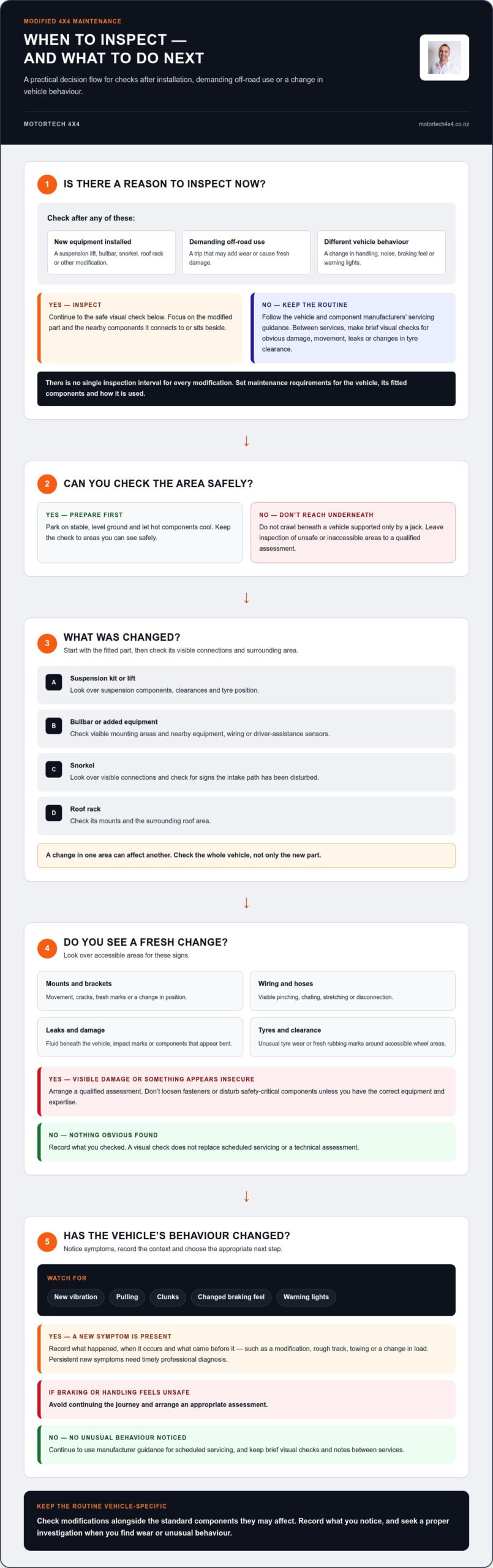
A modified 4×4 has aftermarket changes that can alter what needs attention during routine maintenance. A suspension lift, bullbar, snorkel or roof rack changes more than the vehicle’s appearance. It adds components and connections to consider alongside the original equipment. The right checks depend on what’s fitted, how it’s installed and how you use the vehicle. There isn’t one inspection interval that suits every modification.
Think of how to maintain your modified 4×4 as a whole-vehicle question, not just a checklist for new parts. A suspension change may affect tyre clearance and steering geometry; added equipment can also influence mounting points, wiring routes or access to nearby components. Understanding how four-wheel drive systems operate provides useful context, but inspection priorities still need to reflect your vehicle’s particular setup.
Which modifications can change what you inspect?
Start with the part that’s been changed, then consider what it connects to or sits beside. A suspension kit makes suspension components, clearances and tyre position relevant inspection points. A bullbar means checking its visible mounting areas and nearby equipment. With a snorkel, look over its visible connections and check for signs that the intake path has been disturbed. A roof rack calls for a check of its mounts and the surrounding roof area.
These are prompts, not a universal service schedule. For suspension design and component context, the complete suspension systems guide provides further background. Follow the instructions for your vehicle and fitted components when setting maintenance requirements.
Why whole-vehicle checks matter
Upgrades can change loads, clearances or how systems work together. A tyre may rub where it didn’t before; steering may feel different after suspension work; a bullbar or other added equipment may sit near wiring or driver-assistance sensors. These examples don’t mean a fault is inevitable. They show why checking only the modified part can miss an issue elsewhere in the system.
Connected systems need joint inspection because a change in one area can affect the condition or operation of another.
Use scheduled servicing and owner checks for different purposes. Servicing should follow the vehicle and component manufacturers’ guidance; don’t substitute a generic interval based only on the presence of modifications. Between services, make brief visual checks for obvious damage, movement, leaks or changes in tyre clearance. After installation, demanding driving or a notable change in handling, noise or warning lights, inspect what you safely can and record what you notice. If you see wear or unusual behaviour, arrange a proper investigation rather than guessing at the cause.
What to inspect on a modified 4×4 after installation and use
A focused visual check can help you catch changes before they become harder to diagnose. Inspect after new equipment is installed, after demanding off-road use, and whenever the vehicle behaves differently. This doesn’t replace scheduled servicing or a technical assessment. It gives you a practical way to notice fresh damage, movement or warning signs early.
Check visible components and their mounting points
Park on stable, level ground and let hot components cool before looking over accessible areas. Check for visible damage, loose-looking brackets, disturbed wiring or hoses, fluid leaks, and signs that parts are rubbing or contacting one another. Pay particular attention to equipment affected by the recent installation or trip, such as suspension components, accessories and nearby connections.
- Mounts and brackets: Look for movement, cracks, fresh marks or a change in position.
- Wiring and hoses: Check for pinching, chafing, stretching or disconnection where visible.
- Leaks and damage: Note fluid beneath the vehicle, impact marks or components that appear bent.
- Tyres and clearance: Look for unusual wear or fresh rubbing marks around accessible wheel areas.
Keep the inspection to what you can see safely. Don’t crawl beneath a vehicle supported only by a jack, and don’t loosen fasteners or disturb safety-critical components unless you have the correct equipment and expertise. If something appears damaged or insecure, leave it for a qualified assessment rather than trying to diagnose it by touch or guesswork.
Notice changes in handling, noise or dashboard warnings
Pay attention to new vibrations, pulling, clunks, changes in braking feel or warning lights. These signs don’t identify a cause by themselves, but they can help pinpoint when a problem began. Record what you noticed, when it occurs and what preceded it, such as a modification, rough track, towing or a change in load. That context can make a professional diagnosis more useful.
Persistent new symptoms deserve timely professional diagnosis, not repeated driving in the hope they’ll disappear. If braking or handling feels unsafe, avoid continuing the journey and arrange an appropriate assessment.
Maintenance planning should reflect the vehicle, fitted components and actual conditions rather than a universal timetable. SAE International’s paper on maintenance schedule development for off-road vehicles offers relevant technical context for condition-based planning. For an expert assessment of a modified vehicle, explore Auckland 4×4 servicing and modification support. Motortech 4X4 provides Auckland 4×4 servicing and mechanical work, including support for modified vehicles and connected systems.
Match modified 4×4 maintenance to driving conditions
Maintenance priorities depend on how you use the vehicle, what’s fitted and the conditions it encounters. A 4×4 that spends most of its time commuting may face different demands from one regularly towing, touring or driving off-road. Use the comparison below as a prompt for what to review, not a universal service schedule. Follow your vehicle and component manufacturers’ instructions, and adjust your checks to actual use.
| Use pattern | Maintenance priorities |
|---|---|
| Daily commuting | Consider frequent short trips, stop-start traffic and urban road conditions. Check for changes in tyre wear, braking feel and fluid condition as part of the vehicle’s normal maintenance plan. |
| Touring | Before longer journeys, review tyre condition, load distribution and the security of touring equipment. Check again after a trip if rough roads, dust or weather have affected the vehicle. |
| Towing | Account for sustained load and the demands placed on the vehicle. Check towing equipment, tyres and braking behaviour, and use manufacturer guidance for servicing requirements. |
| Frequent off-road use | After challenging tracks, inspect exposed components for impact damage, packed mud, grit or signs of fluid leakage. Pay particular attention to areas affected by water, sand or rocks. |
Daily driving compared with touring and towing
Short urban trips around Auckland can mean repeated stop-start driving, while longer journeys keep the vehicle working under different conditions. Neither pattern creates a one-size-fits-all service interval. If your routine changes, such as moving from commuting to regular towing, review the maintenance plan against the vehicle and accessory manufacturers’ instructions.
Before setting off with a touring load or trailer, check that equipment is secure and the load is distributed appropriately. Review tyre condition and pressures in line with the vehicle’s guidance and the load being carried. Camping gear can also change how the vehicle is packed, so the vehicle-based camping gear guide can help you plan what travels with you. If the new use brings unfamiliar noises, handling changes or warning lights, arrange an inspection rather than assuming the vehicle simply needs time to adjust.
Off-road use, mud and coastal conditions
Mud and grit can collect around underbody components, wheel areas and other exposed parts. After a demanding track, look for packed debris, fresh scrapes and visible damage. Where conditions permit, clean affected areas using methods suitable for the specific vehicle and components. Don’t assume one washing approach is right for every sensor, electrical connection or aftermarket accessory.
Wet or coastal trips add another reason to check exposed areas for contamination or damage. Inspect accessible electrical connections and underbody areas visually, without disturbing sealed components or working beneath an unsupported vehicle. If the vehicle has been driven through water, sustained an impact or developed a new symptom, use the manufacturer’s guidance and seek a technical assessment where needed. Matching checks to real conditions is central to how to maintain your modified 4×4 without relying on unsupported universal intervals.
Build a repeatable maintenance routine for your modified 4×4
A written routine turns maintenance from a vague reminder into a record you can act on. It also helps connect a new symptom with recent work, added equipment or a change in how the vehicle is used. A practical approach to how to maintain your modified 4×4 starts with the instructions for the vehicle and each fitted component, then adds consistent inspections and clear records.
- 1. Consult the manuals. Start with the vehicle owner’s manual and the instructions supplied for each modification. Use them to understand relevant maintenance requirements and component-specific checks. If guidance differs between the vehicle and an accessory, keep both references available for a servicing discussion rather than choosing an interval by assumption.
- 2. Record the modifications. Note what was fitted, when it was installed and any available component or installation documentation. Include changes to suspension, wheels and tyres, accessories or vehicle systems. A clear record helps you and a technician understand how the current setup differs from the original vehicle.
- 3. Inspect safely and consistently. Use a repeatable visual check suited to the vehicle and its equipment. Look for visible damage, leaks, movement, rubbing or changes since your last check. Keep to accessible areas and don’t get beneath an unsupported vehicle or disturb parts you’re not equipped to assess.
- 4. Document what you find. Add the date and odometer reading, what you checked, any work completed and anything unusual. For a symptom, record when it occurs and what the vehicle was doing beforehand. This makes patterns easier to recognise and gives a workshop useful context.
- 5. Escalate concerns. Arrange a professional assessment for safety-related changes, leaks, warning lights, persistent unusual noises or recurring faults. Don’t rely on repeated visual checks to diagnose a mechanical or electronic problem.
Set inspection timing without guessing at intervals
Service timing should follow vehicle guidance and actual use, not a universal interval for every modified 4×4. Follow the vehicle and component manufacturers’ maintenance instructions, then consider whether demanding use, a new load or an unusual symptom warrants an earlier assessment. A change in use doesn’t automatically set a new service interval, but it’s a reason to review the applicable guidance and check for emerging concerns.
Keep records and know when to book a service
Keep modification details, service records and symptom notes together, whether in a logbook or digital file. Before a service, share relevant entries so the assessment can consider the vehicle as a complete system. For questions about modification-related roadworthiness, refer to current NZTA WoF guidance and verify the requirements that apply to your vehicle. Auckland owners can book modified 4×4 servicing with Motortech 4X4, where mechanical servicing considers upgrades alongside connected vehicle systems.
When specialist modified 4×4 servicing in Auckland makes sense
Routine checks help you notice change, but they can’t always explain what’s causing it. A specialist assessment makes sense when modifications interact, a fault keeps returning, or a safety-related symptom appears. For example, a change in steering after suspension work may need the suspension, tyres and steering components considered together, rather than treating each part in isolation.
Motortech 4X4 is an Auckland specialist workshop providing 4×4 servicing and mechanical work for modified vehicles. Its work with suspension kits, GVM upgrades, bullbars, snorkels, wheels and tyres, and ADAS calibration supports a whole-vehicle approach. This is useful when a concern involves both an upgrade and the standard systems around it.
What a specialist assessment can help identify
A technician can use your description of the symptom to guide an assessment of relevant modifications and connected vehicle systems. A recurring noise, warning light or change in handling can have more than one possible cause, so the modification history and when the symptom occurs provide useful context. ADAS calibration is relevant where work or diagnosis affects driver-assistance systems, rather than being an automatic step for every service.
Consider booking an assessment if you notice:
- A fault or unusual noise that returns after initial checks.
- A change in steering, braking or vehicle stability after work or a demanding trip.
- A warning light, leak or visible concern involving a modified or connected component.
- An issue where accessories, suspension or vehicle electronics may be interacting.
These are reasons to investigate, not a diagnosis. A workshop can assess the symptoms and relevant systems, then explain the findings and suitable next steps without assuming the modification itself is at fault.
Prepare useful information before your service
A concise history helps make a service discussion more focused. Bring available modification details and service records, and describe the symptom in practical terms: when it began, how often it happens and what the vehicle was doing at the time. Note whether it occurs under load, on a particular road surface, after recent work or only in certain conditions.
Also explain how you plan to use the 4×4, such as commuting, towing or regular off-road trips. That context helps connect maintenance concerns with the vehicle’s actual demands. A clear record of changes over time can be more useful than trying to recall every detail during the appointment.
If you’re unsure how to maintain your modified 4×4 or a concern needs a workshop assessment, Motortech 4X4 provides Auckland 4×4 servicing and mechanical support for modified vehicles. Book or discuss 4×4 servicing and bring your modification and service history to help frame the conversation.
Keep your 4×4 ready for what’s next
Your vehicle’s setup and the way you use it can change over time. Treat maintenance as an ongoing part of owning a modified 4×4: keep records current, review your plans when the vehicle’s use changes, and get advice if a new concern affects confidence behind the wheel. That steady approach makes how to maintain your modified 4×4 a practical habit, not a one-off checklist.
When you want a workshop to consider your modifications alongside the vehicle’s mechanical needs, Motortech 4X4 brings Auckland-based 4×4 servicing, mechanical services and modification expertise together. Share your vehicle’s history and what you’re planning next to make the service discussion more useful.
Arrange specialist 4×4 servicing in Auckland and get ready to enjoy your next journey with greater confidence.
Frequently Asked Questions
How often should you service a modified 4×4?
Follow the servicing intervals in your vehicle’s owner manual and the maintenance instructions for each fitted component. There isn’t one interval that suits every modified 4×4. Regular towing or frequent off-road use may justify reviewing the schedule and seeking advice sooner if the vehicle develops a symptom. Keep service dates and odometer readings together so you can track upcoming work and discuss the vehicle’s actual use with your Auckland 4×4 workshop.
Can I maintain a modified 4×4 myself?
Yes, you can carry out suitable owner checks and basic tasks if you have the skills, tools and manufacturer instructions to do them safely. Keep to work you understand, such as checking fluid levels or looking for visible tyre damage. Repairs involving brakes, steering, suspension, electrical systems or work beneath a vehicle need appropriate equipment and expertise. Don’t rely on a home inspection to confirm a safety-critical fault is fixed.
Does a lift kit mean my 4×4 needs different maintenance?
A lift kit can change which components deserve attention, but it doesn’t automatically set a new service interval. After installation, note any new steering feel, vibration or tyre contact, and check the vehicle’s and kit manufacturer’s care instructions. For example, uneven tyre wear could have several causes and shouldn’t be corrected by guesswork. If you’re unsure how to maintain your modified 4×4, include the lift details in your next service discussion.
What should I check after taking a modified 4×4 off-road?
Once the vehicle is parked safely and cool, look for obvious impact damage, packed debris, fresh fluid spots and changes in tyre condition. Check accessible underbody areas without crawling beneath a vehicle that isn’t properly supported. After deep water, use the vehicle manual to guide any additional checks, as inspection needs depend on the vehicle and exposure. If you notice a new noise, leak or warning light, arrange an assessment before further demanding use.
Can a modified 4×4 still pass a New Zealand WoF?
Yes, a modified 4×4 may pass a WoF if the vehicle meets the applicable inspection requirements and any required modification certification is in place. A WoF is an inspection at a point in time, not a substitute for servicing or a guarantee that every modification is suitable. Check current NZTA guidance for your vehicle and alteration, particularly if the work affects safety or roadworthiness. Keep relevant certification records with your vehicle documents.
Can modifications affect a vehicle’s warranty?
A modification doesn’t necessarily cancel cover for every part of a vehicle, but warranty decisions depend on the manufacturer’s terms and the issue being claimed. A fault connected to an alteration may be treated differently from a problem with an unrelated original component. Keep installation records, component documentation and service history, and review the warranty wording before work begins. For clarity, ask the vehicle manufacturer how its terms apply to the specific modification and concern.