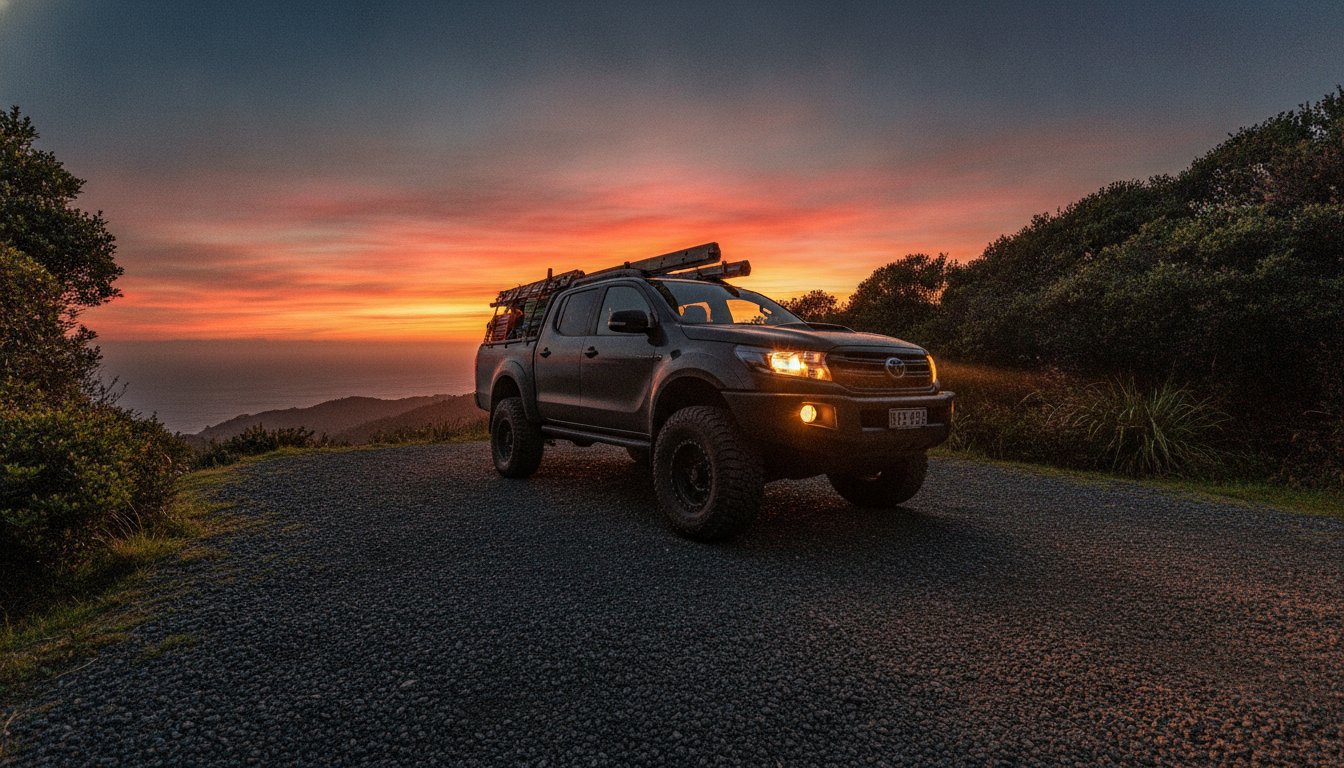
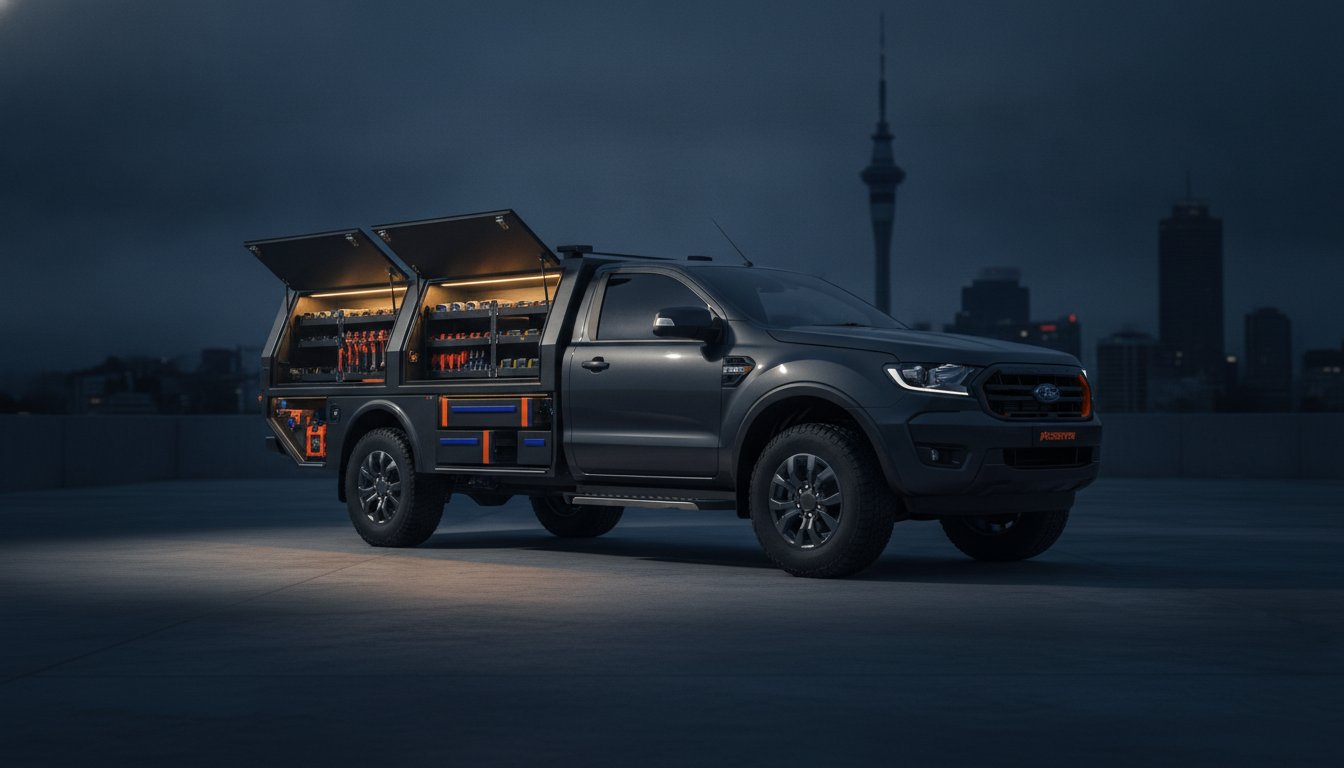
With over 45,000 new commercial vehicles registered in New Zealand over the last year, the Ford Ranger and Toyota Hilux continue to dominate our local worksites. However, a factory-standard ute is rarely equipped to handle the daily rigours of a busy trade without professional modification. When investing in work ute fitouts Auckland tradies often find that the difference between a cluttered tray and a streamlined mobile workshop comes down to precision engineering. Most professionals understand the frustration of searching for gear in a messy tray or the anxiety of seeing their rear suspension sag under a full load of tools and materials.
You deserve a vehicle that reflects your brand’s quality while maintaining total compliance with NZ transport regulations. This 2026 buying guide provides the technical expertise you need to manage GVM upgrades, LVV certification, and custom tray builds. We will explore how to maximise storage efficiency to stop wasting time on site and ensure your gear stays secure from theft. From heavy-duty suspension kits to integrated canopy systems, this is your comprehensive roadmap to building a more productive and professional trade operation.
Key Takeaways
- Learn how a professional vehicle setup serves as a mobile billboard to help you secure higher-value contracts across Auckland.
- Identify the most durable materials and drawer designs for work ute fitouts Auckland to ensure your storage system survives heavy daily use.
- Master the technical requirements of GVM compliance and learn why suspension upgrades are essential for legal payload management.
- Discover industry-specific layout strategies that prioritise tool security and quick access for sparkies, builders, and specialist contractors.
- Recognise the value of a comprehensive engineering approach that synchronises mechanical performance with structural vehicle modifications.
Why a Custom Work Ute Fitout is Critical for Auckland Tradies
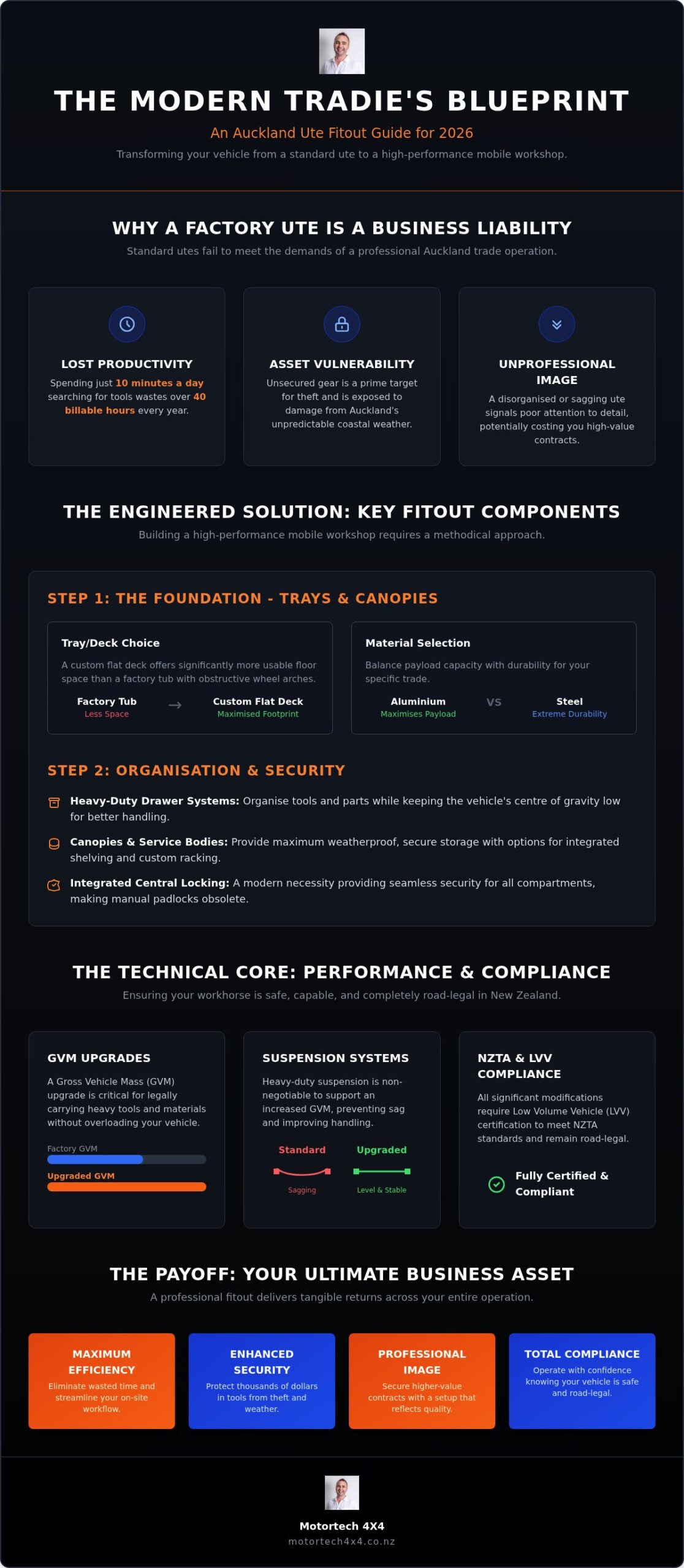
The modern work ute is no longer just a means of transport; it has evolved into a sophisticated mobile engineering hub. For those investing in work ute fitouts Auckland wide, the focus has shifted from simple storage to creating a high-performance asset that functions as both a workshop and a professional billboard. While the History of the Ute highlights its transition from a rural workhorse to an urban staple, the contemporary Auckland tradie requires a vehicle that manages the unique pressures of the local market. A standard factory tray is a blank canvas that often fails to meet the structural and organizational demands of a busy trade business.
Efficiency is the primary driver for a custom setup. If a builder or sparkie spends just ten minutes a day searching for misplaced tools, they lose over forty hours of billable time every year. A professional fitout eliminates this waste by ensuring every piece of equipment has a dedicated, secure home. This methodical approach doesn’t just save time; it reduces the mental fatigue associated with managing a cluttered workspace in high-pressure Auckland residential growth areas.
Protecting Your Assets from Theft and Weather
Security is a non-negotiable requirement in urban Auckland work zones. Integrated locking systems have rendered manual padlocks obsolete, providing a seamless layer of protection that connects directly to the vehicle’s central locking. When choosing between canopies and hardlids, the decision often rests on volume versus profile. A canopy provides maximum vertical space for large power tools, while a hardlid offers a lower centre of gravity and reinforced security for expensive gear. Weatherproofing is equally critical. Auckland’s sudden coastal showers can ruin sensitive electronic diagnostic tools in seconds. High-quality automotive seals and precision-engineered drainage channels are essential components of any professional build to keep your inventory dry year-round.
The Role of Professional Image in Business Growth
First impressions on-site carry significant weight when competing for high-value Auckland contracts. A vehicle that is overloaded, sagging, or disorganized sends a negative message about your attention to detail. Conversely, a ute with clean storage lines and a level stance projects an image of competence and reliability. This professional image acts as a silent salesman. It tells site managers and clients that you invest in quality equipment and maintain high standards in your own operations. Beyond the external perception, there’s a psychological benefit to the driver. Operating from an organized, high-spec vehicle reduces stress and allows you to focus entirely on the technical aspects of the job at hand.
Essential Components of a Premium Work Ute Setup
Building a high-performance mobile workshop requires a methodical selection of hardware that balances structural integrity with functional access. When engineering work ute fitouts Auckland professionals often start with the foundation: the choice between a custom tray and a standard tub. A flat deck tray offers significantly more usable floor space than a factory tub, allowing for wider drawer systems and unhindered access to the vehicle’s footprint. When selecting materials, aluminium is the preferred choice for those prioritising payload capacity, while steel remains the standard for extreme durability in heavy-duty civil environments. All such modifications must adhere to NZTA vehicle standards to ensure the vehicle remains road legal and safe under full load.
Internal storage systems are a core component of premium work ute fitouts Auckland tradies rely on for daily organisation. Heavy-duty drawer systems should feature “no-clog” runner designs to prevent failure in dusty construction environments. These systems allow for the organisation of heavy tools and small parts, keeping the centre of gravity low for better vehicle handling. For contractors requiring high-volume storage, a full service body provides a weather-sealed environment with integrated shelving and racking. This setup is the ultimate solution for trades that carry a vast inventory of components and diagnostic equipment.
Tray and Canopy Foundations
Maximising the vehicle’s footprint often involves installing a full-length aluminium canopy. These units provide a secure, weatherproof shell that can be tailored with internal shelving and custom racking. By choosing lightweight aluminium, you preserve more of your legal payload for tools and materials. If your work involves carrying long lengths of timber or ladders, integrated roof racks are essential. These should be engineered to distribute weight evenly across the canopy’s internal frame to prevent structural fatigue over time. You can explore a range of high-spec canopies and hardlids to find the right balance for your specific trade requirements.
Lighting and Power for On-Site Operations
Operational capability shouldn’t end when the sun goes down. Auckland’s short winter days make internal LED lighting a necessity for locating gear during early starts or late finishes. Beyond simple illumination, a modern fitout often requires a sophisticated 12V electrical system. A dual battery setup is critical for powering site fridges and tool chargers without risking a flat starter battery. For those involved in emergency civil works or night-time callouts, external work lights provide a safe, well-lit perimeter. These systems are typically integrated into the vehicle’s existing electronics, requiring precise installation to maintain reliability and safety.
The Technical Side: GVM Upgrades and Suspension
Executing high-quality work ute fitouts Auckland wide involves more than just bolting on storage boxes; it requires a deep understanding of vehicle dynamics and mechanical limits. Every kilogram added by a steel tray, aluminium canopy, or drawer system consumes your available payload. Standard factory suspension is typically engineered for a compromise between empty tub comfort and occasional loads. When subjected to the constant weight of a fully equipped mobile workshop, these factory components often fail. You’ll notice the rear end sagging, reduced steering precision, and increased braking distances. This isn’t just a performance issue; it’s a structural risk that affects the longevity of your vehicle’s chassis and drivetrain.
Staying Legal with Payload Compliance
In New Zealand, a light vehicle is defined by a Gross Vehicle Mass (GVM) threshold of 3500kg. Exceeding this limit reclassifies your ute as a heavy vehicle, which is a regulatory transition the NZTA rarely approves for suspension-based modifications. To stay legal, you must calculate your real-world payload by adding the weight of the fitout, tools, fuel, and all passengers. If this total exceeds the manufacturer’s original rating, professional GVM upgrades are the only solution. These modifications require a Low Volume Vehicle (LVV) certification. An approved certifier must inspect the work and fit an official LVV plate. Without this, your vehicle is technically unroadworthy, which can lead to insurance claim denials and Warrant of Fitness failures. It’s also vital to remember that a GVM upgrade does not increase your Gross Combination Mass; in fact, it reduces your remaining legal towing capacity.
ADAS Calibration: The Safety Step Most People Skip
Modern utes are packed with Advanced Driver Assistance Systems (ADAS) that rely on precision-aligned cameras and sensors. When you install a lift kit or add significant weight to the rear, the vehicle’s rake and height change. This shift misaligns the sensors responsible for Lane Keep Assist, Emergency Braking, and Adaptive Cruise Control. Operating a modified vehicle without professional ADAS calibration is a major safety oversight. Even a slight deviation in sensor angle can cause these systems to react incorrectly or fail during a critical moment on the road. Ensuring these safety technologies are recalibrated to match your new ride height is a mandatory part of any technical fitout. At Motortech 4X4, we treat this as a non-negotiable step to ensure your vehicle remains as safe as it was the day it left the showroom.
Trade-Specific Fitout Strategies for Auckland Industries
Every trade has unique mechanical and spatial requirements that a generic off-the-shelf solution cannot satisfy. When planning work ute fitouts Auckland wide, the most successful builds are those that categorise equipment based on frequency of use and weight distribution. A sparkie’s requirements for high-density small parts storage and cable reel access differ fundamentally from a builder’s need for structural timber racks and secure housing for heavy mitre saws. By tailoring the fitout to the specific industry, you transform a standard vehicle into a precision tool that enhances on-site productivity.
For civil and infrastructure contractors, the focus shifts toward high-visibility compliance and vehicle protection. These builds often incorporate heavy-duty bullbars, winches, and recovery gear to manage the demanding conditions of Auckland’s larger development sites. Conversely, a mobile mechanic requires a setup that integrates heavy machinery like air compressors and oil recovery systems. These high-volume components require careful placement to maintain vehicle balance and ensure the rear suspension isn’t permanently compressed on one side.
Optimising for Your Daily Workflow
A systematic approach to your layout prevents the common “messy tray” syndrome that plagues many trade vehicles. Follow these three steps to organise your mobile workshop:
- Step 1: Map out your workflow. Place your most frequently used tools at the rear or side openings for immediate access without climbing into the tray.
- Step 2: Segregate your zones. Create a “clean zone” for admin, PPE, and electronics, and a “dirty zone” for power tools, greasy parts, and hardware.
- Step 3: Plan for future growth. Leave a percentage of your storage footprint unallocated to accommodate new tool acquisitions or larger material loads as your business expands.
Performance Upgrades for Heavy Fleets
Adding a 500kg fitout and a full tool kit significantly alters your vehicle’s power-to-weight ratio. To regain lost performance and improve driveability under load, ECU remaps are a highly effective solution. This software calibration optimises torque delivery, ensuring your ute doesn’t struggle during motorway merges or steep Auckland climbs. Additionally, the constant strain of hauling a mobile workshop can lead to premature gearbox wear. A professional transmission flush is essential for protecting your drivetrain from heat-related degradation. For those working in dusty construction environments, installing a snorkel and breathers provides critical engine protection by sourcing cleaner air from a higher intake point. To ensure your vehicle is mechanically prepared for a heavy fitout, you can book a consultation for fleet fit-outs with our technical team.
Engineering Your Fleet with Motortech 4X4 Auckland
Choosing a partner for work ute fitouts Auckland isn’t just about finding someone to bolt on a canopy. It’s about finding a technical expert who understands how those modifications affect your vehicle’s safety and performance. At Motortech 4X4, we provide a comprehensive solution that integrates structural builds with mechanical upgrades. Whether you need a heavy-duty bullbar for site protection or a complex 12V electrical system for tool charging, our team manages the entire process from design to ADAS calibration. This “one-stop shop” approach means you don’t have to coordinate between multiple suppliers or risk conflicting modifications.
We pride ourselves on technical precision. Our Auckland centre is equipped to handle everything from GVM upgrades to specialised ECU remapping. We ensure your suspension is tuned to your specific tool load and your safety sensors are calibrated for your new ride height. Our team understands the specific site requirements of Auckland’s civil and residential construction sectors, ensuring every fitout meets local safety standards and NZTA regulations. We don’t just build storage; we engineer high-performance mobile workshops that are ready for the daily rigours of the New Zealand worksite.
Comprehensive Fleet Maintenance
Fleet vehicles are the backbone of any trade business. When a ute is off the road for emergency repairs, it’s not just the mechanical bill that hurts; it’s the lost billable hours and disrupted schedules. We offer proactive fleet servicing designed specifically for vehicles that carry constant heavy loads. This includes specialised 4×4 maintenance, transmission flushes to protect against heat stress, and thorough WOF inspections. Trade vehicles work harder than family SUVs and require a higher standard of diligence. Regular maintenance is a strategic investment in your business’s uptime and your team’s safety.
Ready to Customise Your Work Ute?
Every high-performance build starts with a professional assessment. Our experts will evaluate your current payload requirements and recommend the best combination of storage, suspension, and performance upgrades for your work ute fitouts Auckland. We’ll guide you through the GVM certification process to ensure your fleet remains 100% road legal and insurance compliant. Our consultation process ensures that your specific tool kit and daily workflow are at the centre of the design. Book your Auckland work ute consultation today!
Optimise Your Fleet for the Year Ahead
Engineering the perfect mobile workshop requires a meticulous balance of storage efficiency, mechanical performance, and legal compliance. As we have explored, high-quality work ute fitouts Auckland professionals rely on must address the structural realities of payload management. By synchronising heavy-duty tray builds with professional GVM upgrades and precise ADAS calibration, you ensure your vehicle remains safe, legal, and productive under the most demanding site conditions. A well-organised vehicle doesn’t just save time; it projects a professional image that helps secure high-value contracts.
Motortech 4X4 stands as Auckland’s leading 4×4 mechanical centre, providing the technical expertise needed to manage complex fleet modifications. As certified GVM upgrade specialists with on-site ADAS calibration capabilities, we provide a seamless one-stop solution for your business. Don’t settle for a generic setup that risks your safety or insurance status. Take the next step toward a more efficient and professional trade operation by consulting with experts who understand the mechanical impact of every modification.
Get a Professional Quote for Your Ute Fitout and transform your vehicle into a high-performance asset built for the long haul.
Frequently Asked Questions
Do I really need a GVM upgrade for a standard tradie fitout?
A GVM upgrade is necessary whenever the total weight of your fitout, equipment, and passengers exceeds the factory limits. For many work ute fitouts Auckland contractors choose, the weight of a steel tray and loaded canopy quickly reaches this threshold. Operating an overloaded vehicle is illegal and can void your insurance. We recommend a professional payload assessment to determine if a certified upgrade is required for your specific trade setup.
How long does a full custom ute fitout usually take in Auckland?
Most professional installations take between three and seven working days depending on the complexity of the build. A simple tray swap is relatively quick, but integrating custom electrical systems, canopies, and suspension upgrades requires more time for precision fitting and testing. We provide a clear timeline during the design phase to help you manage vehicle downtime and maintain your business operations with minimal disruption.
Will a heavy fitout void my vehicle manufacturer warranty?
Installing aftermarket accessories does not automatically void your entire vehicle warranty, but it can affect claims related to modified components. Specifically, if you overload a vehicle without a certified GVM upgrade, the manufacturer may deny claims related to the chassis, suspension, or drivetrain. Using a professional installer ensures that all modifications meet engineering standards and that the vehicle’s structural integrity remains compliant with New Zealand regulations.
Is it better to choose an aluminium or steel tray for a work ute?
Aluminium is generally the superior choice for preserving payload and resisting corrosion in Auckland’s coastal environment. It is significantly lighter than steel, allowing you to carry more tools while staying within legal weight limits. Steel is only recommended for extreme duty applications where the tray is subject to heavy impacts, such as in demolition or heavy civil works. For most trades, aluminium provides the best balance of performance and longevity.
What is ADAS calibration and why do I need it after a fitout?
ADAS calibration is the process of resetting your vehicle’s safety sensors, such as cameras and radar, after a height or weight change. When your ute’s rake is altered by a heavy fitout or lift kit, these sensors no longer point in the correct direction. This can cause emergency braking or lane keep assist systems to malfunction. We perform this calibration on-site to ensure your safety technology remains fully operational and accurate.
Can I customise my fitout for specific tools like drop saws or compressors?
Yes, customisation is a core part of professional work ute fitouts Auckland services. We can engineer specific mounting points, heavy duty slide-outs, and dedicated power supply systems for high-draw equipment like drop saws or air compressors. By planning your layout around your largest tools, we ensure that weight is distributed evenly across the chassis while maintaining easy access for your daily workflow on the worksite.
Do you provide fleet servicing for businesses with multiple utes?
We offer comprehensive fleet servicing and maintenance programs designed for businesses operating multiple trade vehicles. Trade utes work harder than standard vehicles and require more frequent inspections of the suspension, brakes, and drivetrain components. Our fleet services include WOF checks and pre-emptive maintenance to help you avoid expensive emergency downtime. This methodical approach ensures your entire team stays on the road and remains compliant with local transport standards.
What are the best security features to prevent tool theft from my tray?
Integrating your canopy or hardlid with the vehicle’s central locking is the most effective way to prevent tool theft. This removes the vulnerability of manual padlocks and ensures your gear is secured every time you lock the cab. Additionally, we recommend internal drawer locks and reinforced door skins to provide multiple layers of protection. High-quality security features are a critical investment for protecting your livelihood in urban Auckland work zones.