Did you know that a standard steel bullbar, winch, and canopy can strip away over 200kg of your ute’s legal carrying capacity before you even climb into the driver’s seat? Most NZ owners are surprised to find that once they add passengers and a full tank of diesel, they are already flirting with their legal weight limits. If you’ve ever felt your rig bottom out on a gravel track or wondered what is a GVM upgrade and do I need one, you aren’t alone. It’s a common point of confusion that carries serious risks for your safety and your insurance policy.
We understand the frustration of trying to balance a capable off-road build with strict Waka Kotahi regulations. This guide provides the definitive answers you need to master the technical and legal essentials of Gross Vehicle Mass. You’ll learn the difference between GVM and GCM, understand the critical 3,500kg certification threshold, and discover the exact process for securing a specialised upgrade in Auckland. By the end of this article, you’ll know exactly how to keep your rig performing at its peak while staying fully compliant on the road.
Key Takeaways
- Identify the “Payload Trap” where standard 4×4 accessories like bullbars and winches can leave you with as little as 600kg of real-world carrying capacity.
- Understand exactly what is a GVM upgrade and do I need one to protect your insurance coverage and maintain road legality when your rig is fully loaded.
- Master the technical requirements for NZTA compliance, including the mandatory Low Volume Vehicle (LVV) certification process and official plating.
- Learn why professional ADAS calibration is a non-negotiable safety step for modern utes following a heavy-duty suspension modification.
- Discover the professional consultation and installation process at our Auckland workshop to ensure your suspension kit is matched to your specific touring or trade requirements.
Understanding GVM: More Than Just a Number
Gross Vehicle Mass (GVM) represents the maximum weight your vehicle can legally carry while sitting on the road. It isn’t just a suggestion found in your owner’s manual; GVM is the legal limit set by the manufacturer for safety and structural integrity. When owners ask what is a GVM upgrade and do I need one, they are often surprised to find their rig is already flirting with this ceiling. Every accessory you bolt on, every litre of fuel you pump, and every passenger you carry eats into this allowance.
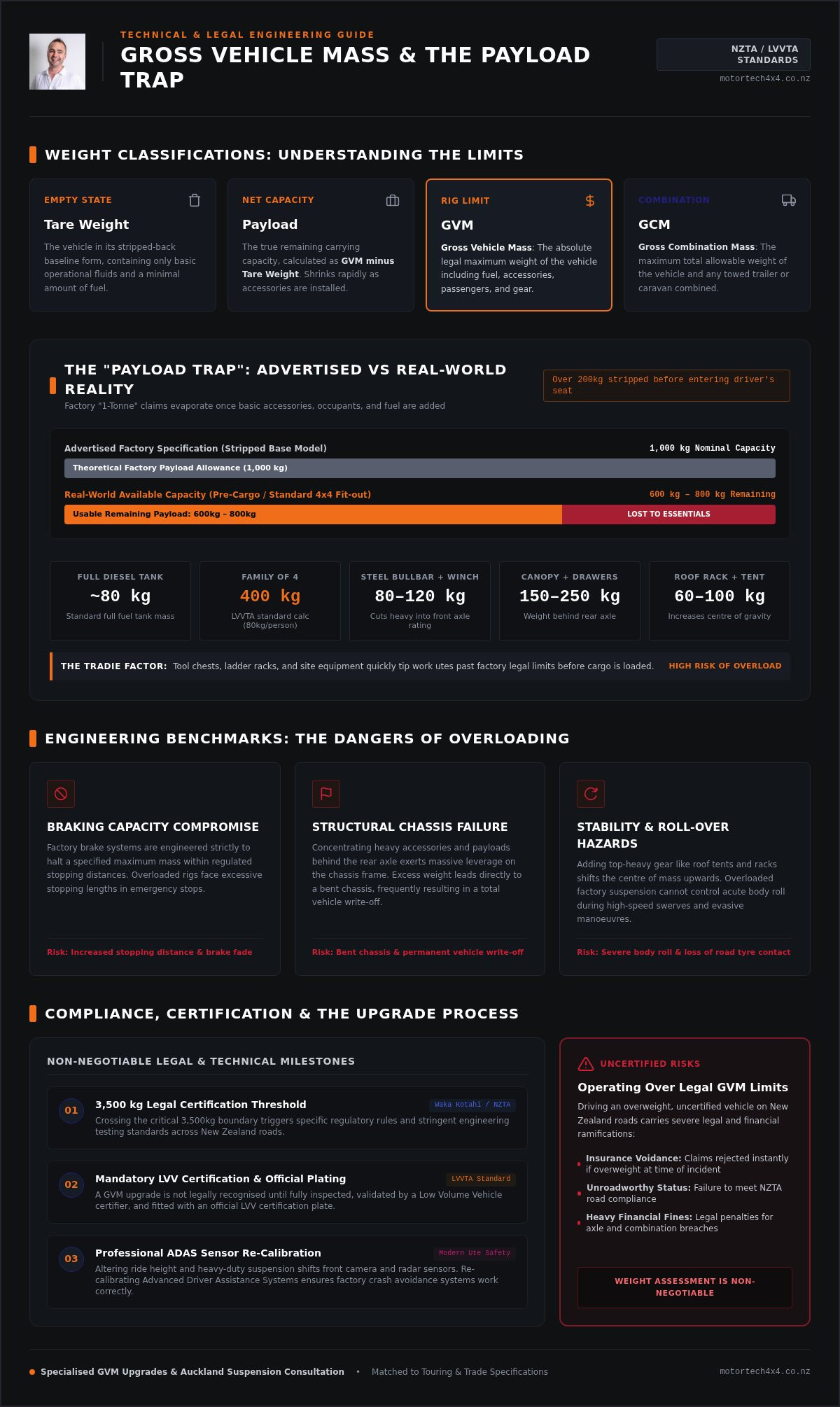
To understand your rig’s limits, you need to look at the total sum of its parts. GVM includes the weight of the vehicle itself (Tare weight), a full tank of fuel, all accessories like bullbars or winches, your passengers, and whatever payload you’ve thrown in the tray or canopy. If the total mass exceeds the factory rating, the vehicle is technically unroadworthy and unsafe.
The Difference Between GVM, GCM, and Tare Weight
Tare weight represents the vehicle in its empty state with only basic fluids and a small amount of fuel. Your payload is the remaining capacity: GVM minus Tare weight. This number is often smaller than most Auckland ute owners realise. When you hitch up a trailer or caravan, you must also consider the Gross Combination Mass (GCM). This is the total allowable weight of the vehicle and the trailer combined. Understanding gross vehicle mass ratings is vital because exceeding either GVM or GCM can lead to severe mechanical failure, voided insurance, or heavy fines.
Why Manufacturers Set These Limits
Manufacturers calculate these ratings based on critical engineering benchmarks. Braking capacity is a primary factor; a vehicle’s factory brakes are only designed to stop a specific mass within a safe distance. Overloading your rig compromises its ability to pull up in an emergency. Chassis strength is another major concern. We’ve seen cases across NZ where excessive weight, particularly behind the rear axle, leads to a bent chassis, which often results in a total vehicle write-off. Finally, stability and roll-over risks increase significantly when a rig becomes top-heavy. Maintaining these limits ensures the suspension can manage body roll and keep the tyres planted on the road during high-speed manoeuvres or sudden swerves.
The Payload Trap: Why Your Rig is Likely Overweight
Many dual-cab owners buy into the “one-tonne payload” marketing promoted by vehicle manufacturers. In reality, this figure is often a theoretical maximum based on a stripped-back base model with no accessories, no passengers, and minimal fuel. Once you begin customising your vehicle for work or weekend adventures, that generous allowance evaporates. For most modern utes, the real-world capacity drops to between 600kg and 800kg before you even load your gear. If you find yourself wondering what is a GVM upgrade and do I need one, the answer usually lies in the cumulative weight of your modifications.
Every addition to your rig has a cost beyond the price tag. Fuel alone adds roughly 80kg to your total mass. When you factor in a family of four, using the standard LVVTA calculation of 80kg per person, you’ve already accounted for 400kg of your payload. This leaves very little room for the heavy-duty gear required for Auckland’s rugged tracks or demanding worksites. High-quality additions like premium 4×4 bullbars Auckland drivers rely on provide essential protection, but they also represent a significant portion of your front axle’s legal limit.
The Weight of Common 4×4 Accessories
Accessories are the primary reason vehicles exceed their legal limits. It’s a game of kilograms that adds up faster than most owners anticipate. Consider these typical weights for a touring build:
- Steel Bullbar and Winch: Approximately 80kg to 120kg.
- Rear Canopy and Drawer Systems: Between 150kg and 250kg depending on materials.
- Roof Racks and Roof Top Tents: Roughly 60kg to 100kg.
When these components are fitted, the remaining payload for food, water, and recovery gear becomes dangerously slim. To ensure you stay within the LVVTA modification and certification guidelines, a professional weight assessment is the only way to know for sure where your rig stands.
The “Tradie Factor”: Tools and Equipment
For commercial users, the payload trap is even more precarious. A standard tool chest, ladder racks, and site equipment can instantly tip a work ute over its GVM. This isn’t just about the total weight; it’s about how that weight is distributed. Heavy tools positioned at the very rear of the tray can cause you to exceed individual rear axle limits while the vehicle’s total mass remains technically under the GVM. This uneven loading compromises steering and braking performance. We frequently manage fleet fit-outs Auckland wide to ensure trade vehicles remain compliant and safe for employees. If you’re unsure if your work rig is legal, a quick consultation with the team at Motortech 4X4 can help you identify your true starting point.
What is a GVM Upgrade? The Engineering Behind the Modification
A GVM upgrade is an engineered suspension solution designed to increase the legal carrying capacity of your vehicle. Unlike a basic aesthetic modification, this is a comprehensive structural enhancement. Many owners ask what is a GVM upgrade and do I need one when they notice their rig struggling under a heavy load, but it’s vital to understand that this is more than just a heavy-duty part swap. It involves a specific kit tested to ADR or LVVTA standards that legally adjusts the payload rating on the vehicle’s registry.
A common mistake is assuming a standard 2-inch lift kit serves the same purpose. It doesn’t. A standard lift kit merely alters ride height and clearance; it does not legally alter payload capacity. Using professional suspension kits in Auckland ensures that your rig remains stable and insurance-compliant, even when pushed to its new legal limits. These systems are designed to manage the increased mass without compromising the vehicle’s structural integrity.
More Than Just Springs: The Complete System
Engineering a higher payload requires a holistic approach to the vehicle’s chassis. While heavy-duty springs provide the literal support, they are only one part of the equation. Shock absorbers must be precisely matched to these higher spring rates to prevent a “pogo” effect or excessive bouncing on the motorway. High-quality kits also include upgraded bushes and shackles to manage the increased forces exerted on the suspension mounting points. This complete system improves the vehicle’s stance and prevents the chronic rear-end sag often seen in overloaded stock utes, ensuring the tyres maintain a consistent contact patch with the road.
The Importance of ADAS Calibration
Modern rigs are equipped with complex Electronic Stability Control and Advanced Driver Assistance Systems (ADAS). These systems, including Lane Keep Assist and Autonomous Emergency Braking, rely on cameras and radar sensors typically mounted in the grille or windscreen. When you install a GVM upgrade, the vehicle’s ride height and pitch change. This alters the sensor triangulation, which can lead to system errors or unexpected braking. Safety tech is load-dependent and must be adjusted for the new ride height to function correctly. At Motortech 4X4, we provide specialised ADAS calibration services in Auckland as part of the installation process. This ensures your safety systems aren’t “blinded” by the modification, keeping you and your passengers protected on the road.
Compliance and Legality: NZTA Standards and Insurance Risks
Operating a modified 4×4 on New Zealand roads requires strict adherence to Waka Kotahi (NZTA) regulations. If you’re asking what is a GVM upgrade and do I need one, the answer is often determined by your vehicle’s registration class. Most dual-cab utes in NZ fall under Class NA (Light Goods Vehicle), which has a maximum allowable GVM of 3,500kg. Any modification that increases this limit must be officially certified. Without this certification, your vehicle is technically unroadworthy. This means it will fail a Warrant of Fitness (WoF) inspection and could lead to significant legal complications if you’re involved in an accident.
The legal threshold is absolute. Even being slightly over your factory GVM without a certified upgrade makes the vehicle illegal to operate on public roads. This is a primary concern for Auckland drivers who use their rigs for both heavy trade work and weekend touring. A professional upgrade ensures your vehicle remains within the law while handling the specific weights you require.
The LVV Certification Process in NZ
Post-registration GVM modifications in New Zealand must go through an independent Low Volume Vehicle (LVV) certifier. This process is rigorous. The certifier doesn’t just look at the springs; they inspect axle ratings, tyre clearances, and the manufacturer’s Statement of Compliance for the kit. You cannot self-certify these changes. The process includes:
- Verification of ADR type-approval and engineering documents for the specific kit.
- Physical inspection of the installation to ensure all components meet LVVTA standards.
- Confirmation that the braking system and electronic stability controls remain effective at the higher mass.
Once approved, a certified alloy LVV plate is issued. This plate must be permanently attached to the vehicle structure within two months of the inspection. Driving without this physical plate attached renders the upgrade uncertified and the vehicle illegal to operate.
Insurance and Liability: Protecting Your Asset
Insurance companies are increasingly meticulous when assessing claims involving modified 4x4s. If your rig is involved in a collision and found to be even 1kg over its legal GVM, the insurer has grounds to decline a total-loss claim. They frequently cross-reference crash data with weighbridge slips or aftermarket accessory manifests to determine if the vehicle was roadworthy at the time of the incident. Operating an uncertified, overweight vehicle also shifts significant legal liability onto the driver.
For Auckland business owners, GVM compliance is a critical health and safety requirement. Under the Health and Safety at Work Act 2015 (HSWA), employers must ensure that work vehicles are safe and fit for purpose. Providing a crew with a vehicle that is habitually overloaded is a breach of these duties. To ensure your fleet or personal rig is fully compliant and protected, book a professional GVM assessment with Motortech 4X4 today.
Getting a GVM Upgrade in Auckland: The Motortech 4X4 Process
Determining exactly what is a GVM upgrade and do I need one begins with a factual assessment of your vehicle’s current state. At our Auckland workshop, we don’t rely on guesswork or generic estimates. We follow a methodical five-stage process that ensures every rig leaving our centre is structurally sound, legally compliant, and perfectly tuned for its specific application.
The Weigh-In: Starting with Facts
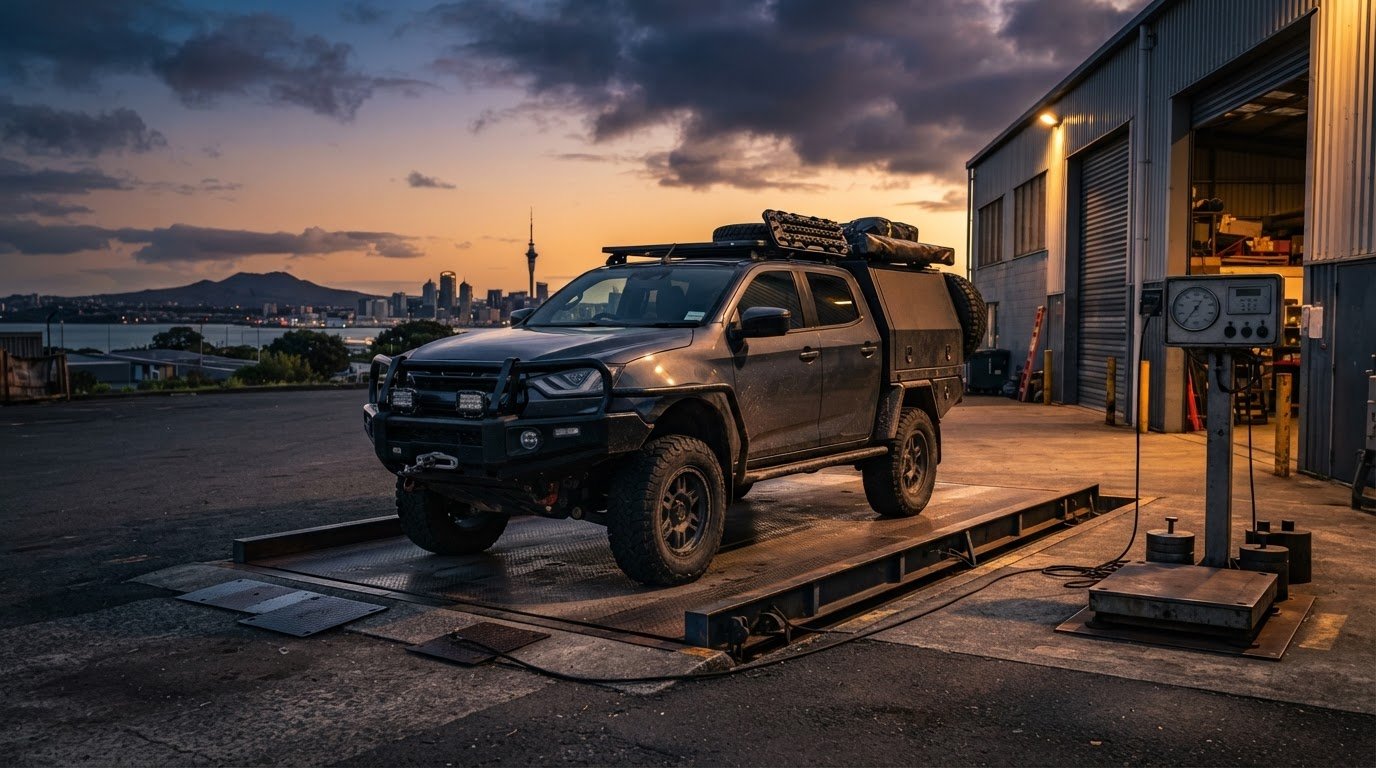
The consultation phase always starts at the weighbridge. We weigh each axle individually to identify the true starting point of your build. This data is critical because total mass is only half the story; we often find that accessories like heavy steel bars or rear-mounted spares push individual axle ratings over their limit while the total GVM remains technically legal. This assessment allows us to determine if you require a full GVM upgrade or if a more strategic packing strategy could solve your handling issues. By using real-world data, we provide a clear justification for your investment in safety and performance.
Once the weights are confirmed, we select a specialised kit matched to your use case. A trade ute carrying a constant 600kg of tools requires a significantly different spring rate and valving setup than a touring rig that only carries heavy loads during holiday expeditions. We ensure the hardware is fit for purpose, preventing the harsh unladen ride that often plagues poorly planned suspension modifications.
Why Choose Motortech 4X4 for Your Upgrade?
We operate as a genuine one-stop-shop for Auckland 4×4 enthusiasts and fleet managers. Our expertise extends beyond simple part fitting; we manage the entire ecosystem of your build. Whether you are installing roof racks NZ wide for a weekend getaway or preparing a commercial fleet for heavy site work, we ensure every component works in harmony with your upgraded GVM.
The final stages of our process are what set us apart as technical specialists. Following the professional installation of heavy-duty components, we perform a specialised ADAS calibration to ensure your lane-keep and braking sensors are aligned with the new ride height. We then coordinate with an independent NZTA-approved certifier to inspect the work and affix the mandatory LVV compliance plate. This meticulous approach guarantees that your rig isn’t just more capable, but is 100% legal and insurance-compliant for New Zealand roads.
Secure Your Rig’s Performance and Compliance
Understanding what is a GVM upgrade and do I need one is the first step toward building a safe and capable 4×4. As explored in this guide, the “payload trap” is a significant risk for both recreational tourers and commercial fleets across Auckland. Ensuring your vehicle remains within its legal engineering limits protects your insurance coverage and prevents catastrophic mechanical failure on the road. A certified upgrade isn’t just about carrying more; it’s about ensuring your suspension, brakes, and safety systems are engineered to handle the load.
Our specialised Auckland workshop provides the technical expertise required to manage this complex transition. From the initial weigh-in to official LVV certification support and full ADAS calibration capability, we provide a complete solution for your rig. We use only industry-leading components to ensure your suspension handles the increased mass without compromising ride quality or stability. Professional installation ensures your safety systems remain effective despite changes in ride height.
Don’t risk operating an overweight or uncertified vehicle. Book a GVM Consultation with the Auckland Experts at Motortech 4X4 today to secure your vehicle’s future. Your safety on New Zealand’s demanding roads is our priority, and we’re ready to help you build a rig that is truly fit for purpose.
Frequently Asked Questions
Is a GVM upgrade the same as a lift kit?
No, a standard lift kit merely alters ride height and ground clearance without changing the vehicle’s legal weight limits. While a GVM upgrade often includes a height increase, it is a comprehensive engineered solution tested to meet specific structural standards. It includes heavy-duty components designed to manage increased mass and requires official certification to legally adjust the payload rating on your vehicle’s registry.
Can I still get a WOF in Auckland with a GVM upgrade?
You can pass a Warrant of Fitness (WoF) in Auckland, but only if the modification is accompanied by a valid Low Volume Vehicle (LVV) certification plate. NZTA regulations require any modification to the suspension that increases payload to be inspected by an authorised certifier. If you have the physical alloy plate attached to your chassis, Auckland testing stations will treat the new GVM as the legal baseline for inspection.
Do I need a GVM upgrade if I only tow a small trailer?
It depends on your ute’s current setup. Even a small trailer exerts towball download mass, which counts directly toward your vehicle’s GVM and rear axle limit rather than the trailer’s weight. If your rig is already fitted with heavy accessories like bullbars or drawers, that extra downforce might push you over the limit. A professional weight assessment is the only way to confirm if your specific setup requires an upgrade.
How much extra payload does a typical GVM upgrade provide?
Most certified kits for popular dual-cab utes provide an additional 300kg to 600kg of usable payload. This typically brings a factory GVM of around 3,000kg up to the 3,450kg or 3,500kg threshold allowed for Class NA light vehicles. When asking what is a GVM upgrade and do I need one, consider that this extra capacity is often what makes a fully accessorised touring build legal for New Zealand roads.
Will a GVM upgrade make my 4×4 ride roughly when it is empty?
A poorly matched kit can result in a firmer ride when unladen, but professional installation minimises this effect. High-quality suspension systems use valving and spring rates designed to maintain composure across different load weights. At our Auckland service centre, we select specific kits based on whether your rig carries a constant heavy load, such as a trade setup, or fluctuates between empty and fully loaded for weekend camping trips.
Does a GVM upgrade increase my towing capacity (GCM)?
No, a GVM upgrade does not increase your Gross Combination Mass (GCM) or your manufacturer’s maximum tow rating. While you can carry more weight in the vehicle itself, the total allowable mass of the vehicle and trailer combined remains unchanged. Utilizing your full upgraded GVM often means you must reduce your trailer weight to ensure the total combination stays within the factory-mandated GCM limit to remain legal.
Can I install a GVM upgrade kit myself to save money?
While you could physically fit the parts, we strongly advise against DIY installation for GVM modifications. The certification process requires proof of professional fitment and involves mandatory ADAS calibration to ensure safety sensors are correctly aligned. An LVV certifier is unlikely to sign off on a kit without documented evidence of professional installation and sensor recalibration, both of which are essential for maintaining your vehicle’s insurance and road legality.
How do I know if my 4WD is currently over its legal GVM?
The most accurate method is to visit a public weighbridge or a specialised workshop for an individual axle weight assessment. You should weigh the vehicle in its “trip-ready” state, including a full tank of fuel, all accessories, and passengers. Common warning signs of being overweight include visible rear-end sag, increased braking distances, or the suspension frequently hitting the bump stops when driving over standard road undulations in Auckland.