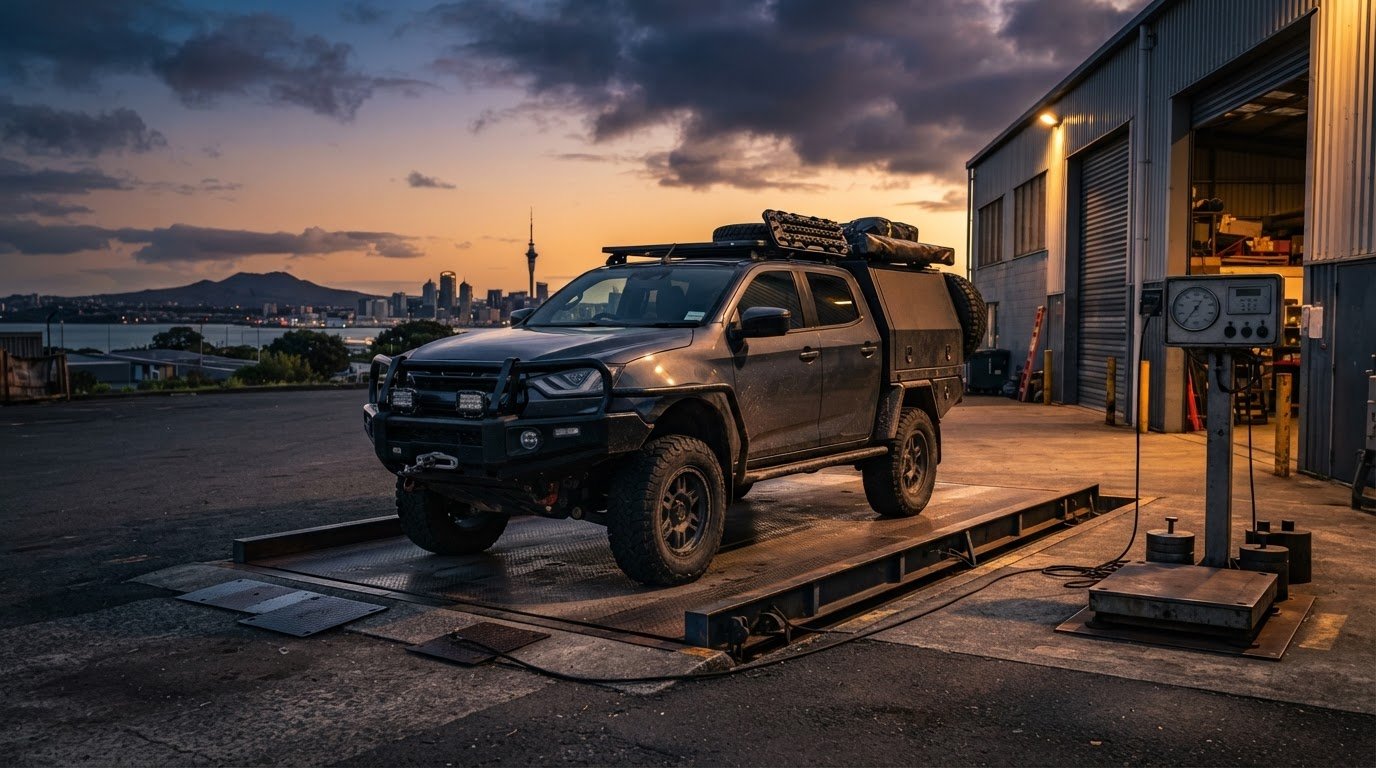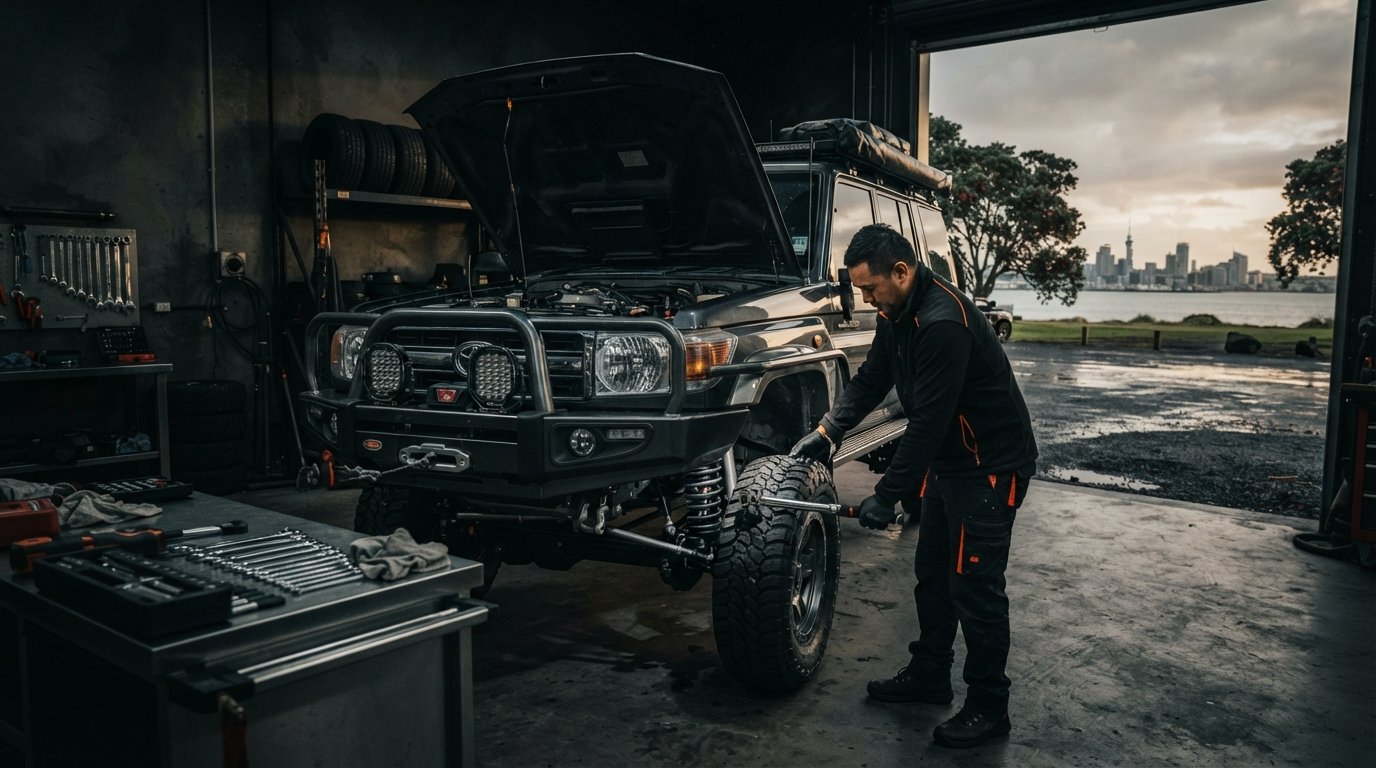
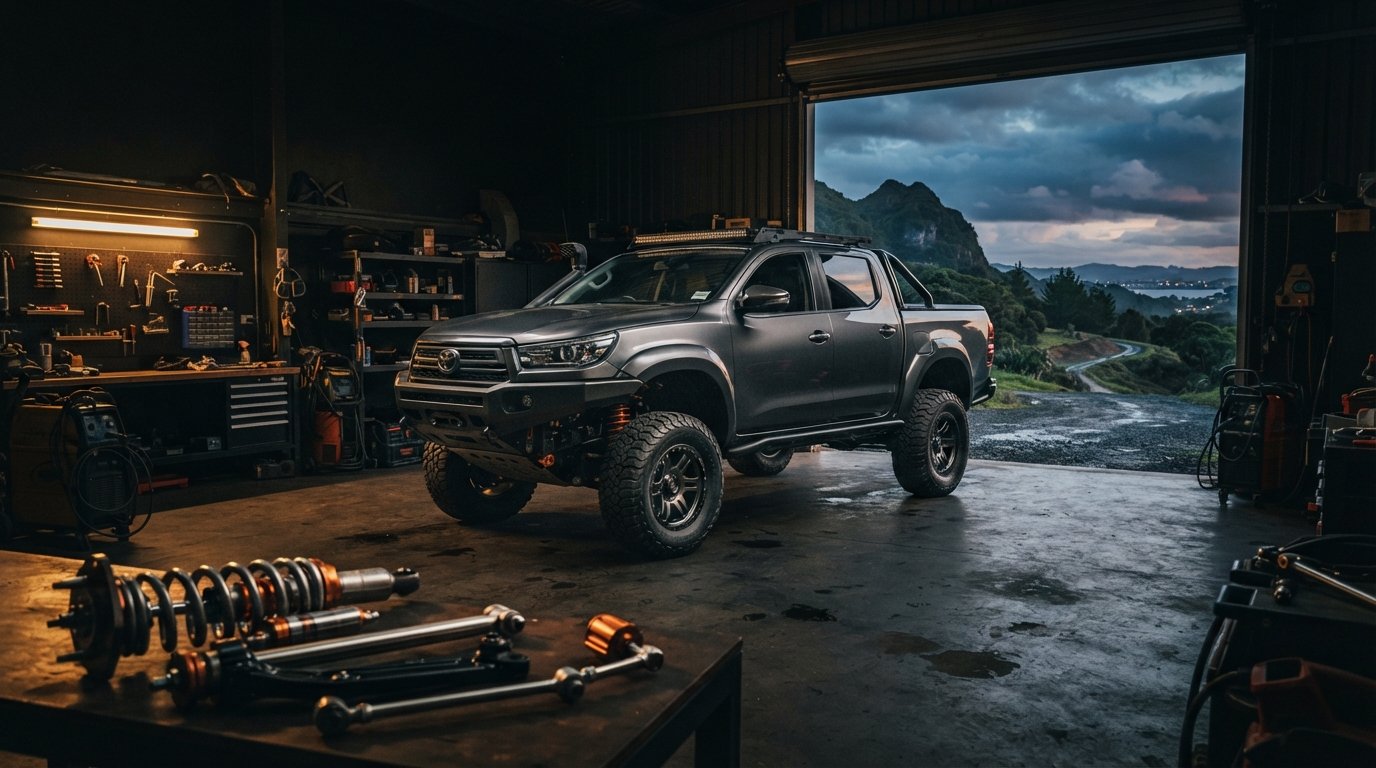
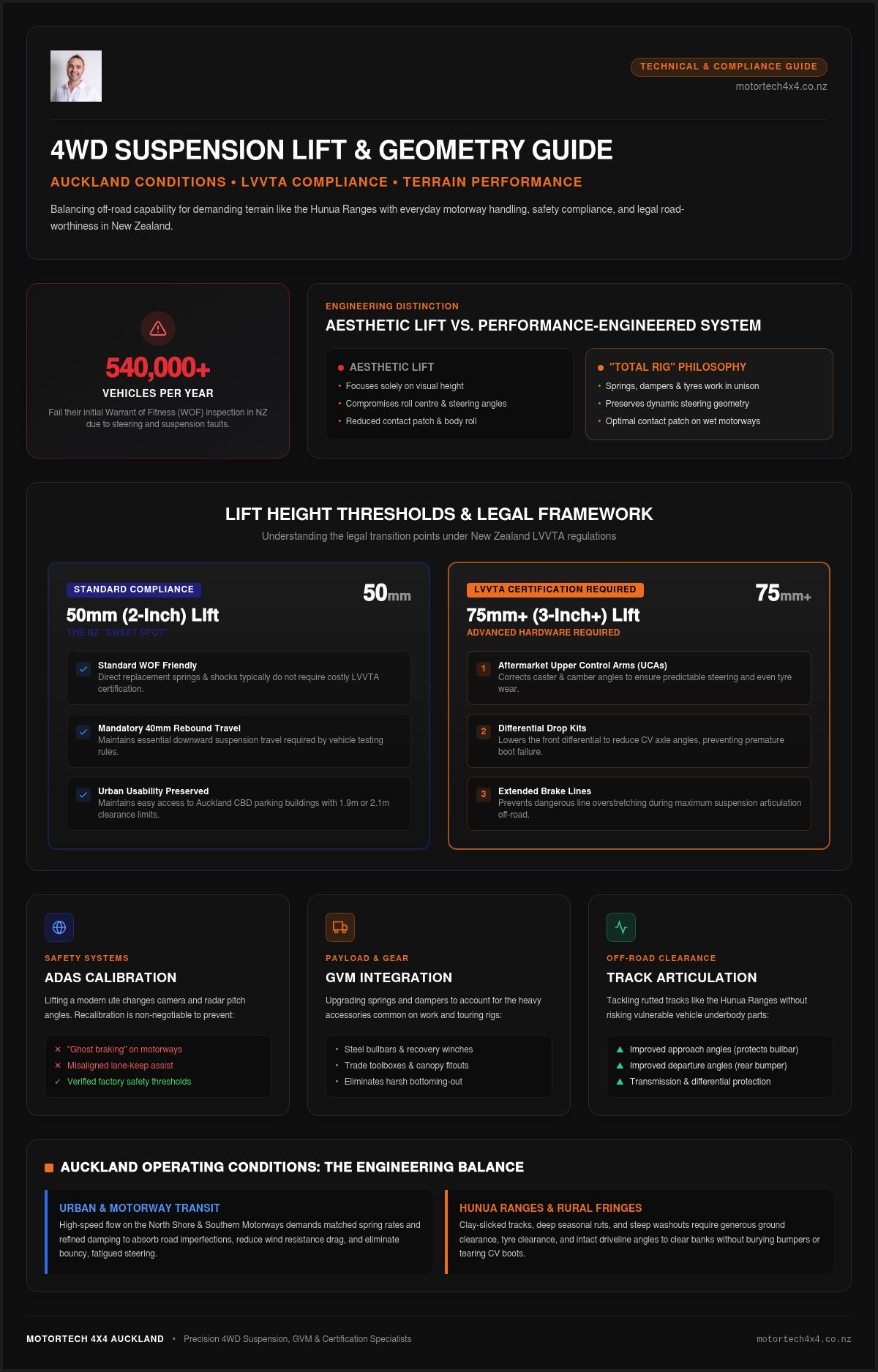
Did you know that over 540,000 vehicles fail their initial Warrant of Fitness inspection in New Zealand every year due to steering and suspension faults? It is a staggering figure that proves how easily a poorly planned suspension lift kit Auckland installation can turn a dream build into a legal nightmare. Most local 4WD owners want that aggressive stance and extra ground clearance for the Hunua Ranges, but nobody wants a rig that handles like a boat or triggers “ghost braking” on the Southern Motorway. You deserve a vehicle that looks the part and performs even better, without the constant worry of safety system malfunctions.
This guide will show you exactly how to choose a setup that delivers peak performance on the toughest tracks while staying 100% road legal. We will break down the 2026 LVVTA height thresholds, the critical importance of ADAS calibration, and why Motortech 4X4 focuses on precision-engineered systems. From boosting load-carrying capacity for your work gear to achieving a fully certified, professional finish, we cover everything you need to know to upgrade your rig with absolute confidence.
Key Takeaways
- Identify the specific LVVTA thresholds and the 50mm “sweet spot” that keep your vehicle compliant with New Zealand road rules.
- Discover how a tailored suspension lift kit Auckland experts install balances increased ground clearance with the daily comfort needed for city commuting.
- Learn why ADAS recalibration is a non-negotiable step for modern utes to ensure your emergency braking and lane-keep systems function correctly.
- Explore the critical link between suspension upgrades and Gross Vehicle Mass (GVM) to handle heavy accessories like winches and steel bullbars safely.
- Understand the difference between simple bolt-on parts and a precision-engineered system that protects your driveline and improves off-road capability.
Understanding Suspension Lift Kits for Auckland Conditions
Auckland’s geography presents a specific set of challenges for any 4WD owner. You might spend your morning navigating the high-speed urban flow of the North Shore motorways and your afternoon tackling the technical, clay-slicked tracks that define the region’s rural fringes. Selecting a suspension lift kit Auckland drivers can rely on requires a shift away from “one-size-fits-all” solutions. A generic kit might provide the look you want, but it often fails to account for the dynamic transition between tarmac stability and off-road articulation.
At Motortech 4X4, we differentiate between simple aesthetic lifts and performance-engineered suspension systems. An aesthetic lift focuses solely on height, often at the expense of the vehicle’s roll centre and steering geometry. In contrast, a performance system respects the suspension lift kit mechanics required to keep a vehicle planted. This “Total Rig” philosophy ensures that your springs, dampers, and tyres work in unison, maintaining a safe contact patch whether you are cornering on a wet motorway or climbing a steep fire track.
Why Ground Clearance Matters in the Hunua Ranges and Beyond
In areas like the Hunua Ranges, the tracks are notorious for deep ruts and sudden washouts caused by heavy seasonal rain. Without sufficient ground clearance, your vehicle’s underbody components, such as the transmission and differential, are highly vulnerable to impact damage. A well-fitted suspension lift kit Auckland experts have calibrated will improve your approach and departure angles significantly. This allows you to clear technical obstacles and steep banks without the risk of burying the bullbar or dragging the rear bumper through the mud.
Ride Quality: Balancing Off-Road Capability with City Comfort
There is a persistent myth that increasing ride height must result in a stiff or bouncy experience. This usually happens when spring rates are poorly matched to the vehicle’s weight. For the daily Auckland commute, you need a system that absorbs road imperfections rather than transmitting them into the cabin. By selecting high-quality dampers and springs tailored to your specific gear load, you can achieve a ride that feels more controlled and refined than the factory original. This balance is essential for long-distance touring where corrugated gravel roads would otherwise fatigue both the driver and the vehicle’s chassis.
Choosing the Right Lift Height: 2-Inch vs. 3-Inch and Beyond
Selecting the correct height for your suspension lift kit Auckland project involves more than just picking the most aggressive profile. While a taller rig offers undeniable presence, extreme height often compromises on-road stability and daily usability. For those navigating the Auckland CBD, vehicle height directly impacts your ability to enter parking buildings with 1.9m or 2.1m clearances. Additionally, a significant lift increases wind resistance, which can noticeably affect fuel economy during long hauls on the Northern Motorway.
The 50mm Lift: The Versatile All-Rounder
The 50mm (2-inch) lift is widely regarded as the “sweet spot” for New Zealand 4×4 enthusiasts. It offers a substantial increase in ground clearance, allowing for larger tyres, without necessitating a total overhaul of the vehicle’s driveline. One of the primary advantages is simplicity at Warrant of Fitness (WOF) time. Provided you use direct replacement springs and shocks that maintain the mandatory 40mm of rebound travel, a 50mm lift typically does not require expensive Low Volume Vehicle (LVV) certification. This makes it the most cost-effective and practical choice for a daily driver.
Going Higher: 75mm+ and the Need for Certification
Stepping up to a 75mm (3-inch) lift or higher moves your vehicle into a different category of mechanical and legal requirements. At these heights, factory suspension geometry is pushed beyond its design limits. To maintain safety and performance, you will likely need additional hardware, including:
- Aftermarket Upper Control Arms (UCAs): Essential for correcting caster and camber angles to ensure predictable steering and even tyre wear.
- Differential Drop Kits: These lower the front differential to reduce the angle of the CV axles, preventing premature boot failure.
- Extended Brake Lines: To ensure lines don’t overstretch during full suspension articulation off-road.
In New Zealand, any lift exceeding 50mm or any setup using strut spacers requires mandatory LVVTA certification. This process involves a rigorous inspection to ensure that advanced driver assistance systems, such as autonomous emergency braking, have been correctly recalibrated to account for the new ride height. Operating an uncertified vehicle at these heights can lead to failed insurance claims and road fines.
If you are planning a more complex build and want to ensure every component is compliant, the specialists at Motortech 4X4 can guide you through the selection and certification process from start to finish.
Performance vs. Payload: Integrating GVM Upgrades
Many 4WD owners in Auckland treat a suspension lift as a standalone modification. However, if you plan on adding a bullbar, a winch, or a rear canopy, your lift kit must be engineered to handle that specific weight. A standard suspension lift kit Auckland drivers install on a “stock” vehicle will quickly lose its height and performance once you bolt on heavy accessories. This leads to reduced ground clearance and compromised handling, as the springs are compressed beyond their intended operating range.
For tradies carrying heavy toolboxes or enthusiasts towing boats around the Hauraki Gulf, constant-load springs are essential. Without them, your vehicle will suffer from “bum sag,” where the rear sits lower than the front. This doesn’t just look unprofessional; it negatively affects your steering geometry, headlight aim, and braking efficiency. It is vital to match your spring rates to your actual daily operating weight rather than the vehicle’s unladen factory weight to ensure the suspension can actually do its job.
Staying Legal with GVM Upgrades in Auckland
Every vehicle has a legal Gross Vehicle Mass (GVM), which is the maximum it can weigh when fully loaded. Once you add bar work, a winch, and a full tank of fuel, many modern utes are dangerously close to their legal limit before you even add passengers or gear. A GVM upgrade allows you to legally carry more weight while maintaining the performance of your suspension. It is a critical consideration for staying compliant with NZ Transport Agency vehicle modification and LVV certification rules. You can learn more about these requirements in our GVM Upgrades Auckland guide.
The Impact of Bar Work on Front-End Suspension
Adding a steel bullbar and a winch can put an extra 80kg to 150kg directly over the front axle. If your suspension lift kit Auckland specialist hasn’t accounted for this, you’ll experience significant “nose-dive” during heavy braking. This shifts the vehicle’s weight forward aggressively, reducing rear-wheel traction and increasing stopping distances. Correctly calculated spring rates ensure your front end remains supported, preserving your approach angles and safety systems. For advice on selecting the right protection, check our guide on 4×4 Bullbars Auckland.
The Legal Side: WOF, LVVTA, and ADAS Calibration
New Zealand has some of the strictest vehicle modification laws in the world. When you install a suspension lift kit Auckland roads require you to be fully compliant with the Low Volume Vehicle Technical Association (LVVTA) standards. Failing to meet these requirements doesn’t just mean a rejected Warrant of Fitness (WOF); it can also lead to your insurance being voided in the event of an accident. Operating an uncertified vehicle on public roads is a risk that simply isn’t worth taking for any serious 4×4 owner.
LVVTA Certification: When Do You Need a Cert?
The common “50mm rule” is often misunderstood. While direct replacement springs and shocks that provide a 50mm lift usually pass a WOF without certification, certain components trigger an immediate requirement for an LVV plate. For example, any use of strut spacers or coil spacers has a zero-millimetre threshold allowance; they always require certification. Similarly, if your lift uses leaf spring blocks higher than 50mm, it is considered illegal. A professional installer ensures your setup maintains the mandatory 40mm of rebound (droop) wheel travel, which is a frequent cause of certification failure for DIY attempts. Professional fitting streamlines the process by ensuring geometry and clearances meet the inspector’s criteria from day one.
ADAS Calibration: The Missing Step in Most Lifts
Modern utes like the Next-Gen Ranger or Hilux N80 rely on Advanced Driver Assistance Systems (ADAS). These include forward-facing cameras and grille-mounted radars for emergency braking and lane-keep assist. When you fit a suspension lift kit Auckland workshops must recalibrate these sensors. A 50mm lift alters the focal horizon of these systems. Even a tiny 1-degree angular error creates a 2.6-metre offset at 150 metres, which can lead to “ghost braking” or the system failing to activate when it’s actually needed. This is a critical safety step that budget installers often overlook.
At Motortech 4×4, we provide specialised, on-site ADAS calibration for modified vehicles. We ensure your safety tech is perfectly aligned with your new ride height, giving you peace of mind on the motorway and the tracks. If you want to ensure your rig is both safe and legal, book your professional ADAS calibration and suspension fitting today.
Professional Lift Kit Installation at Motortech 4×4 Auckland
While many enthusiasts enjoy a bit of weekend wrenching, installing a suspension lift kit Auckland specialists have engineered is far more complex than just swapping springs. DIY attempts often lead to severe geometry issues that manifest as uneven tyre wear, “death wobble,” or unpredictable steering. A professional installation ensures that every component is fitted under the correct load and aligned to factory or modified specifications. It is about protecting your investment and ensuring the vehicle remains a pleasure to drive on both the motorway and the forest track.
Motortech 4×4 operates as a comprehensive service centre, moving beyond the simple “bolt-on” approach. Our process includes meticulous post-installation checks where every bolt is torqued to its correct setting and every safety system is verified. Because we handle everything from initial kit selection to ADAS calibration and WOF support, you don’t have to ferry your rig between different workshops. This unified approach guarantees that the mechanical modifications and electronic safety systems are perfectly synchronised, providing a seamless transition from the workshop to the road.
Expert Technicians and Specialised Equipment
Our Auckland workshop is equipped with specialised diagnostic and alignment tools specifically designed for modified 4x4s. A standard wheel alignment often isn’t enough once you’ve altered the ride height; you need technicians who understand how to adjust for the new centre of gravity and altered track width. For a deeper look at the components we use to achieve this balance, see our Suspension Systems Guide. We ensure your vehicle maintains optimal contact with the road, regardless of how much you’ve raised the chassis.
Booking Your Auckland Suspension Consultation
Every build starts with a detailed vehicle assessment. We don’t believe in one-size-fits-all solutions. During your initial consultation, we’ll discuss your typical payload, off-road goals, and budget to tailor a suspension lift kit Auckland package that works specifically for your rig. Whether you’re prepping for a Cape Reinga trek or need a reliable workhorse for the North Shore, we provide the technical expertise to get it right the first time. Contact the team at Motortech 4×4 today to start your vehicle transformation with the experts you can trust.
Prepare Your Rig for Auckland’s Toughest Tracks
Upgrading your vehicle is about more than just gaining height; it is about engineering a system that remains safe, stable, and compliant. We have explored why the 50mm lift is the versatile choice for most local drivers and how technical factors like ADAS calibration and GVM upgrades are non-negotiable for modern utes. By matching your spring rates to your actual payload, you ensure your vehicle handles as well on the Southern Motorway as it does on a clay-slicked forest track.
Choosing a suspension lift kit Auckland specialists recommend means you get a rig that is fully certified and built to last. As Auckland’s leading 4×4 modification specialists, Motortech 4×4 provides the technical precision required for complex builds. We are authorised installers for premium suspension brands and offer on-site ADAS calibration and GVM upgrade expertise to keep your vehicle 100% road legal.
Don’t leave your safety or your insurance to chance with a budget setup. Get a Professional Suspension Consultation at Motortech 4×4 and transform your vehicle into a high-performance machine. We look forward to helping you build the ultimate Auckland rig.
Frequently Asked Questions
Will a suspension lift kit void my new car warranty in NZ?
A suspension lift won’t automatically void your entire new car warranty in New Zealand, but it will affect claims related to the modified components and any parts that fail as a result of the change. For example, if a CV joint fails due to extreme angles from a lift, the manufacturer won’t cover it. It’s vital to check with your dealer, though most reputable brands are comfortable with professionally installed kits that meet legal standards.
How much does a professional suspension lift kit cost in Auckland?
The total investment for a suspension lift kit Auckland installation depends on your vehicle’s make, the brand of components chosen, and the complexity of the setup. High-performance bypass systems or remote reservoir shocks will naturally sit at a higher price point than standard nitrocharger kits. Beyond the physical parts, you should also account for professional fitting, a comprehensive wheel alignment, and any required ADAS recalibration to ensure the rig remains safe and legal.
Do I need an LVVTA certification for a 2-inch lift kit?
You generally don’t need Low Volume Vehicle Technical Association (LVVTA) certification for a 50mm lift if you use direct replacement springs and shocks that utilise original mounting points. However, certification becomes mandatory if you use strut spacers, coil spacers, or if the lift exceeds 50mm. To pass a Warrant of Fitness (WOF) without a cert, your vehicle must also maintain at least 40mm of rebound wheel travel and have adequate ground clearance under all structural components.
How long does it take to install a full suspension lift kit?
A professional installation typically takes between four and six hours, depending on the vehicle’s age and the complexity of the kit. Older vehicles with rusted or seized bolts can take longer to disassemble safely. At Motortech 4×4, we allow for a full day to ensure the mechanical fitment is perfect, the wheel alignment is precise, and the ADAS sensors are correctly recalibrated before the vehicle is returned to the customer for road use.
Will a lift kit make my ute harder to park in Auckland CBD?
Increasing your vehicle’s height can make certain Auckland CBD parking buildings inaccessible. Many older multi-story car parks have a maximum clearance of 1.9 metres, which a lifted ute with a roof rack might exceed. It’s important to measure your vehicle’s total height from the highest point, often the shark-fin antenna or roof rails, after the lift is installed. This ensures you don’t end up stuck or causing damage in tight urban spaces with low ceilings.
What is ADAS calibration and why is it needed after a lift?
Advanced Driver Assistance Systems (ADAS) use cameras and radar to manage safety features like autonomous emergency braking. When you install a suspension lift kit Auckland workshops must recalibrate these sensors because the change in ride height alters their focal point. If left unadjusted, the system might misinterpret the distance to other vehicles, leading to false alarms or a complete failure to engage in an emergency. It is a critical safety step for all modern 4WD vehicles.
Can I install a lift kit myself and get it certified later?
While you can technically perform a DIY installation, it often leads to complications during the certification process. LVVTA inspectors look for specific fitment standards, including correct torque settings and brake line clearances. If the geometry is slightly out, you might face expensive rework costs to get it up to standard. Professional installation ensures the job is done right the first time, saving you the stress and potential extra fees during your final vehicle compliance check.
How does a lift kit affect my vehicle’s towing capacity?
A standard suspension lift kit does not increase your vehicle’s legal towing capacity, as this is set by the manufacturer. However, a well-engineered kit with the correct spring rates can significantly improve stability and reduce “sag” when a heavy trailer is attached. If you find your vehicle is frequently reaching its weight limits, you should consider a certified GVM upgrade alongside your lift to ensure you remain legal and safe while hauling your boat or caravan.