If you’ve bolted on a bullbar, winch, and canopy, your 4×4 is likely illegal before you even pack the fridge. Most owners realise that modern utes have surprisingly low payloads, and the anxiety of a rejected insurance claim due to overloading is a heavy burden to carry. Calculating the GVM upgrade cost NZ owners face involves balancing premium hardware with mandatory engineering compliance. You want a vehicle that handles predictably under load without the constant worry of roadside fines or compromised braking performance.
This guide provides a transparent look at the real-world costs and legal requirements for GVM upgrades in New Zealand as of 2026. We’ll examine the technical components required for a professional fit-out and the specific LVVTA certification steps needed to keep your rig on the right side of the law. By reviewing the Land Transport Rule: Vehicle Dimensions and Mass 2016, you’ll gain a clear roadmap for your build. We’ll show you how to achieve a legally compliant vehicle with a higher payload and improved safety, ensuring your total investment delivers the performance your adventures demand.
Key Takeaways
- Understand the legal risks of overloading under the Land Transport Rule and why most factory utes require a GVM increase for touring.
- Identify how vehicle specifications and hardware choices, such as remote reservoir shocks, influence the total GVM upgrade cost NZ.
- Budget effectively by breaking down the investment into three essential pillars: high-performance hardware, professional labour, and mandatory LVVTA certification.
- Navigate the step-by-step LVVTA certification process in Auckland to ensure your rig is fitted with a valid certification plate.
- Learn the importance of integrated ADAS calibration and suspension tuning to maintain vehicle safety and handling performance under heavy loads.
What is a GVM Upgrade and Why Does Your Rig Need One?
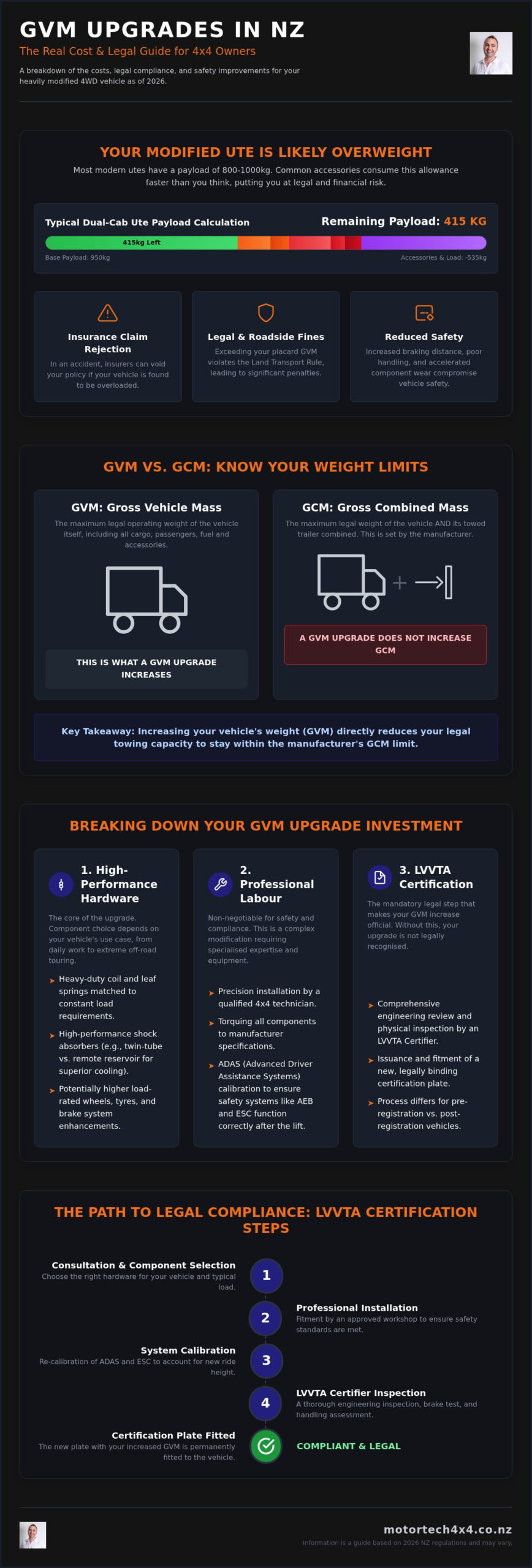
A Gross Vehicle Mass (GVM) is the maximum legal weight a vehicle can weigh when fully loaded. This figure includes the chassis, body, fuel, passengers, and every accessory bolted to the frame. Most modern dual-cab utes leave the showroom with a payload capacity between 800kg and 1000kg. While that sounds generous, it disappears faster than most owners realise. Once you install a steel bullbar, a winch, side steps, and a heavy-duty canopy, you’ve likely consumed half that allowance before adding a single passenger or a tool kit.
In New Zealand, the Land Transport Rule: Vehicle Dimensions and Mass 2016 dictates these limits. Driving a vehicle that exceeds its placard GVM is not just a safety risk; it’s a legal liability. If you’re involved in an accident while overloaded, your insurance provider has grounds to reject the claim entirely. A standard suspension lift kit focuses on ground clearance and aesthetics, but it does not legally increase your carrying capacity. A certified GVM upgrade is a comprehensively engineered solution. It includes specific spring rates and damping profiles, backed by an LVVTA certification plate to make the new limit legal. Understanding the GVM upgrade cost NZ owners encounter is the first step in ensuring your vehicle remains a compliant tool rather than a liability.
GVM vs. GCM: Understanding the Weight Limits
It’s a common misconception that increasing your GVM also increases your Gross Combined Mass (GCM). In almost all cases, the GCM remains a fixed constraint set by the manufacturer. This is the total allowable weight of the vehicle and trailer combined. If you upgrade your GVM to carry more gear in the tray, you must subtract that extra weight from your maximum towing capacity to stay within the legal GCM limit. We recommend weighing your rig at a public weighbridge after a tray and canopy fit-out to calculate your true real-world payload. This data is essential for planning a safe and legal setup.
The Safety and Handling Case for Upgrading
Overloaded vehicles suffer from increased braking distances, excessive body roll, and accelerated wear on drivetrain components like CV joints and wheel bearings. For business owners, ensuring a fleet is GVM-compliant is a critical WorkSafe responsibility under health and safety legislation. A professional upgrade improves stability under load and ensures the vehicle’s electronic stability control (ESC) and Autonomous Emergency Braking (AEB) systems function as intended. Professional installation often requires ADAS calibration to maintain these safety features after the ride height is altered, ensuring the vehicle remains predictable in emergency situations.
Key Factors That Determine Your GVM Upgrade Cost in NZ
The total GVM upgrade cost NZ drivers encounter is not a fixed figure. It fluctuates based on the specific engineering requirements of your vehicle and the performance level of the components selected. For instance, upgrading a Toyota Hilux involves different hardware configurations compared to a Ford Ranger or a LandCruiser 70 Series. Some vehicles require additional bracing or more complex component swaps to meet the stringent Compliance Requirements set by Waka Kotahi. Timing also plays a role. A pre-registration upgrade is often more streamlined as the new mass is recorded before the vehicle is first registered, whereas post-registration work requires a full LVVTA certification process.
Hardware Tiers: From Workhorse to Off-Road King
Your choice of suspension hardware is the primary driver of the physical component cost. Entry-level kits typically feature heavy-duty leaf springs and coil options designed to handle constant loads without sagging. However, if your rig spends significant time on corrugated tracks or carrying heavy tools daily, high-performance shock absorbers are essential. Standard twin-tube shocks are cost-effective but can suffer from heat fade under sustained stress. In contrast, remote reservoir shocks provide superior oil capacity and cooling, maintaining consistent damping performance. Beyond the suspension, some upgrades may necessitate higher load-rated wheels and tyres or even brake system enhancements to ensure the vehicle stops safely at its new maximum weight.
Labour and Workshop Requirements
Precision installation is non-negotiable for a legal upgrade. This process requires specialised 4×4 servicing expertise to ensure every component is torqued to specification and seated correctly. Modern vehicles equipped with Advanced Driver Assistance Systems (ADAS) add another layer of complexity. When you alter the ride height, the cameras and sensors responsible for lane-keep assist and emergency braking must be recalibrated to reflect the new geometry. A comprehensive fit-out includes a professional wheel alignment and a final safety check before the certifier inspects the work. For those looking to streamline this process, partnering with a specialist like Motortech 4X4 ensures all mechanical and calibration work is handled under one roof.
Budgeting for Your Upgrade: Components and Compliance Fees
Budgeting for a professional fit-out requires a holistic view of the three primary cost pillars. While many online retailers list kit prices in isolation, the true GVM upgrade cost NZ owners pay includes hardware, professional labour, and the mandatory engineering certification. Cheap kits often bypass the rigorous testing required for a Statement of Compliance. If a kit fails to meet LVVTA standards during the final inspection, the costs to rectify the setup can easily exceed the initial savings. It’s far more cost-effective to invest in a pre-engineered solution from the start.
Beyond the base kit, you must account for potential hidden expenses. A higher GVM often requires tyres with a higher load rating to match the new axle capacities. Additionally, fine-tuning the suspension geometry after the initial settling period is a standard part of a high-quality installation. Popular New Zealand utes like the Ford Ranger and Toyota Hilux often require different levels of labour intensity. This directly influences the final investment required for a compliant build, as some models involve more complex component swaps or chassis bracing.
Mandatory Certification and Engineering Fees
The certification process is the final hurdle to making your upgrade legal. As of August 2026, the LVVTA charges a fixed fee of $270 for the certification or re-certification paperwork. This is a fee the certifier pays to the association, and it’s separate from the certifier’s professional inspection time. Inspection costs vary based on the complexity of the vehicle’s modifications and the time required for a thorough safety audit. This process ensures your rig receives a permanent certification plate, which is essential for passing a Warrant of Fitness (WoF) and maintaining insurance coverage.
Long-Term Value and ROI for Fleet Owners
For commercial operators, a GVM upgrade is a strategic investment in fleet longevity. The GVM upgrade cost NZ businesses invest pays for itself through reduced downtime and lower maintenance requirements. Using fit-for-purpose suspension components reduces the frequency of component failures caused by constant overloading. It also protects the resale value of the vehicle. A fully certified rig is far more attractive to the second-hand market than an uncertified, overloaded ute. Most importantly, it mitigates the liability of a WorkSafe investigation or a rejected insurance claim, protecting your company’s bottom line.
Navigating the LVVTA Certification Process in Auckland
The journey from a workshop installation to a legal, plated vehicle is a methodical process. Once the mechanical work is complete, an authorised Low Volume Vehicle (LVV) certifier must conduct a physical audit. In the Auckland region, finding a certifier with specific experience in heavy-duty suspension and GVM increases is essential. They don’t just look at the springs; they inspect brake line clearances, steering geometry, and the integrity of all mounting points. Any discrepancy can lead to a failure, adding delay and frustration to your build. Selecting a pre-engineered kit significantly reduces this risk, as these systems are designed to meet specific safety criteria from the outset.
When factoring in the total GVM upgrade cost NZ owners pay, the final step is the fitment of the LVV plate. This permanent metal tag is riveted to the vehicle’s body, usually in the engine bay. It serves as the official record of the new GVM and any other modifications. This data is also uploaded to the vehicle’s permanent record in the NZTA system, ensuring that every future Warrant of Fitness (WoF) inspector can verify the vehicle’s legality instantly. If there is an error on a certification plate, the cost to recall the paperwork from off-site storage for correction is $80, so accuracy during the initial inspection is vital.
Compliance with NZTA Standards
NZTA oversees the safety of all modified vehicles on New Zealand roads through the Land Transport Rule. Their standards ensure that adding heavy-duty 4×4 accessories Auckland drivers rely on, such as bullbars, winches, or steel trays, doesn’t compromise the vehicle’s structural integrity. A WoF inspector will specifically look for the LVV plate if they notice a significant suspension lift or a change in carrying capacity. Without this plate, the vehicle is legally unroadworthy, which can lead to immediate fines and the voiding of your insurance policy.
Post-Upgrade Responsibilities
Securing the certification is not the end of the process. An upgraded GVM means your vehicle is consistently operating under higher stress levels. Regular 4×4 servicing is mandatory to ensure that heavy-duty bushes, dampers, and shackles remain in optimal condition. You must also notify your insurance provider of the new GVM rating. Most insurers require a copy of the certification paperwork to update your policy, ensuring you are fully covered when carrying a maximum load.
To ensure your vehicle meets all legal standards without the stress of certification failures, book a consultation with the specialists at Motortech 4X4.
Expert GVM Upgrades and Fleet Fit-Outs at Motortech 4X4
Auckland drivers face a unique set of challenges when preparing a vehicle for heavy-duty work or long-range touring. Motortech 4X4 provides the precision engineering required to transform a standard ute into a legal, high-performance asset. Managing the complexities of a professional build requires more than just a suspension swap. Our workshop handles the entire process, ensuring that every component works in harmony with the vehicle’s factory safety systems. When calculating the total GVM upgrade cost NZ businesses must weigh the initial investment against the long-term risk of non-compliance and mechanical failure.
Our comprehensive approach starts with hardware selection and extends to advanced electronic recalibration. We specialise in fleet fit-outs for Auckland businesses and tradies who need their vehicles to perform reliably under maximum load every day. This often involves integrating GVM solutions with heavy-duty 4×4 bullbars Auckland owners rely on for protection. By handling both the physical installation and the ADAS calibration in-house, we eliminate the need for multiple workshop visits and ensure the vehicle’s emergency braking and stability control systems remain fully functional.
The Motortech Difference: Authority and Reliability
Precision is the standard at Motortech 4X4. We operate a “one-stop” workshop in Auckland, capable of managing complex structural modifications and sophisticated electronic system recalibrations. Our technicians understand that a GVM upgrade is a safety-critical modification. We don’t cut corners on hardware or certification steps. This commitment to technical excellence ensures that every vehicle leaving our centre is compliant with NZTA standards and ready for the most demanding environments. We provide a steady, results-oriented service that prioritises customer safety and vehicle longevity above all else.
Get a Tailored Quote for Your Vehicle
Every vehicle has a different starting point and a different intended use. We provide vehicle-specific quotes rather than generic pricing because a Ford Ranger with a steel tray has different engineering requirements than a Toyota Hilux with a canopy and winch. We provide transparent breakdowns of the GVM upgrade cost NZ owners can expect for their specific vehicle configuration. This accuracy prevents unexpected costs during the certification phase and ensures your investment delivers the exact payload capacity you require. To start your journey toward a safer, more capable rig, Contact Motortech 4X4 today for a GVM upgrade consultation.
Secure Your Build with Professional GVM Certification
Achieving a legal and capable rig requires balancing high-performance hardware with the strict engineering standards of the LVVTA. The total GVM upgrade cost NZ owners encounter covers more than just parts; it includes the professional labour and mandatory certification fees required to keep your vehicle roadworthy and insured. Cutting corners with uncertified kits or DIY installs creates significant legal risk and compromises your vehicle’s safety systems during emergency manoeuvres.
Our Auckland-based modification team specialises in these technical transitions. We offer a comprehensive service that integrates heavy-duty suspension fit-outs with precise ADAS calibration, ensuring your electronic stability and braking systems are perfectly tuned to your new mass limits. Whether you’re managing a commercial fleet or preparing a personal touring rig, professional oversight is the only way to guarantee safety and compliance. Our expert fleet fit-out and modification team is ready to help you maximise your payload without sacrificing reliability.
Ready to upgrade your payload? Request a GVM Upgrade Quote from Motortech 4X4 today and ensure your next journey is fully legal and safe.
Frequently Asked Questions
How much does a GVM upgrade cost in NZ on average?
Total investment depends on the vehicle architecture and hardware selected. The GVM upgrade cost NZ owners pay covers the suspension kit, professional installation, and the mandatory LVVTA engineering fees. Factors like remote reservoir shocks or the need for chassis bracing on specific models will influence the final amount. We provide detailed, vehicle-specific quotes to ensure all compliance costs are transparent before work begins, preventing any budget overruns during the final certification phase.
Can I install a GVM upgrade kit myself to save money?
Attempting a DIY installation is not recommended because the certification process requires a Statement of Compliance from the manufacturer. Most reputable GVM kit providers only issue this documentation when the system is fitted by an authorised specialist. Incorrect installation can lead to certification failure, added inspection fees, and potential safety hazards. Professional fitment ensures that all components, including ADAS sensors, are correctly calibrated to meet stringent New Zealand safety standards.
Does a GVM upgrade increase my towing capacity?
A GVM upgrade increases your payload capacity but typically doesn’t change your Gross Combined Mass (GCM) or the manufacturer’s maximum towing rating. While you can carry more weight in the vehicle itself, you must ensure the total weight of the ute and trailer stays within the original GCM limit. If you use the full increased GVM, you may actually need to reduce your trailer weight to remain legally compliant on the road.
Is an LVVTA certification plate mandatory for a GVM upgrade?
An LVVTA certification plate is absolutely mandatory for any GVM increase in New Zealand. This metal plate is the only legal proof that your vehicle modifications meet the Land Transport Rule: Vehicle Dimensions and Mass 2016. Without this plate, your vehicle will fail its Warrant of Fitness (WoF) and your insurance policy could be voided. The plate provides a permanent record of the new mass limits for authorities and future owners.
How long does the GVM upgrade and certification process take?
The physical installation of the suspension hardware usually takes one to two days. However, the total timeline depends on the availability of an authorised LVV certifier and the processing time for the certification plate. After the inspection is complete, it can take several weeks for the official plate to be manufactured and dispatched. We manage this entire workflow to minimise vehicle downtime, which is especially critical for commercial fleet operators and tradies.
Will a GVM upgrade affect my vehicle warranty?
A GVM upgrade doesn’t void your entire vehicle warranty, but the manufacturer won’t cover the original suspension components or any failures directly attributed to the modification. Most premium GVM kits come with their own comprehensive warranty to cover the new springs and dampers. We recommend discussing the upgrade with your dealer if the vehicle is new, though certified upgrades are a standard industry practice for heavy-duty work vehicles.
Do I need to upgrade my tyres when I get a GVM upgrade?
You must ensure your tyres have a load rating that meets or exceeds the new axle capacities specified in the GVM upgrade. If your current tyres are rated for the factory mass but fall short of the upgraded limit, they must be replaced with higher-rated alternatives. The LVV certifier will check the load index on the sidewalls of all tyres as part of the mandatory safety audit to ensure the vehicle remains legal.
Can I get a GVM upgrade on a used vehicle?
Post-registration upgrades are common for used vehicles and follow a clear certification path. While brand new vehicles can sometimes be upgraded before their first registration, a used vehicle simply requires a full LVVTA inspection after the new components are fitted. This process is ideal for owners who have added heavy accessories like bullbars and canopies over time and now find their rig is pushing the legal factory weight limits.