A winch that isn’t integrated correctly with your vehicle’s safety sensors is a liability, not an asset. When you’re bogged in the soft sand at Muriwai or navigating the clay tracks at Woodhill, you need a recovery solution that works without compromising your truck’s integrity. Getting a professional Toyota Hilux winch installation Auckland requires more than just bolting a motor to a cradle; it demands a precise mechanical and electronic setup that respects modern engineering and local compliance.
We understand the concern that adding significant weight to the front end might cause sag or, worse, trigger a permanent fault light on your dash. It’s a valid worry, especially with the November 2026 WOF regulations requiring all Advanced Driver Assistance Systems (ADAS) to be fault-free for a pass. This professional guide explains how to secure your Hilux for New Zealand’s toughest tracks while protecting its sophisticated safety tech. We’ll examine the choice between hidden cradles and full bullbars, the necessity of post-install ADAS recalibration, and the high-amp wiring standards that prevent electrical fires and ensure your rig remains fully recovery-ready.
Key Takeaways
- Professional Toyota Hilux winch installation Auckland ensures your recovery gear is integrated with the chassis without compromising modern crumple zones or structural safety.
- Learn why the 1.5x Gross Vehicle Mass (GVM) rule is the essential standard for selecting a winch capacity that handles New Zealand’s heavy clay and sand tracks.
- Discover the mandatory role of ADAS calibration after fitment to ensure your autonomous braking and airbag timing remain fully compliant with November 2026 WOF standards.
- Understand the technical disassembly process required to mount a rated winch cradle securely while protecting the vehicle’s electrical system from high-amp loads.
- Find out how a “whole-vehicle” approach balances front-end weight to prevent suspension sag and maintain precise handling on the open road.
Why Professional Winch Installation is Vital for Auckland 4x4s
A 4×4 winch serves as a high-performance recovery system, specifically designed to integrate with the vehicle’s chassis to provide immense pulling power when traction fails. If you’re wondering what is a winch?, it’s essentially a mechanical device used to pull in or let out a cable, which, in a 4×4 context, becomes a lifeline on rugged North Island tracks. For modern utes like the N80 or N90 Hilux, a Toyota Hilux winch installation Auckland isn’t a simple bolt-on task. These vehicles feature sophisticated crumple zones engineered for occupant safety. A DIY fitment that ignores these structural zones can compromise the vehicle’s safety rating or even prevent airbag deployment in a collision.
Professional mounting ensures that the massive forces generated during a recovery are distributed evenly across the chassis. This prevent frame distortion and ensures the vehicle remains straight under load. For Auckland utes frequenting the heavy clay of the Hunua Ranges or the soft sands of Muriwai, meeting a high technical standard for fitment is a matter of both safety and vehicle longevity.
The High-Amp Electrical Challenge
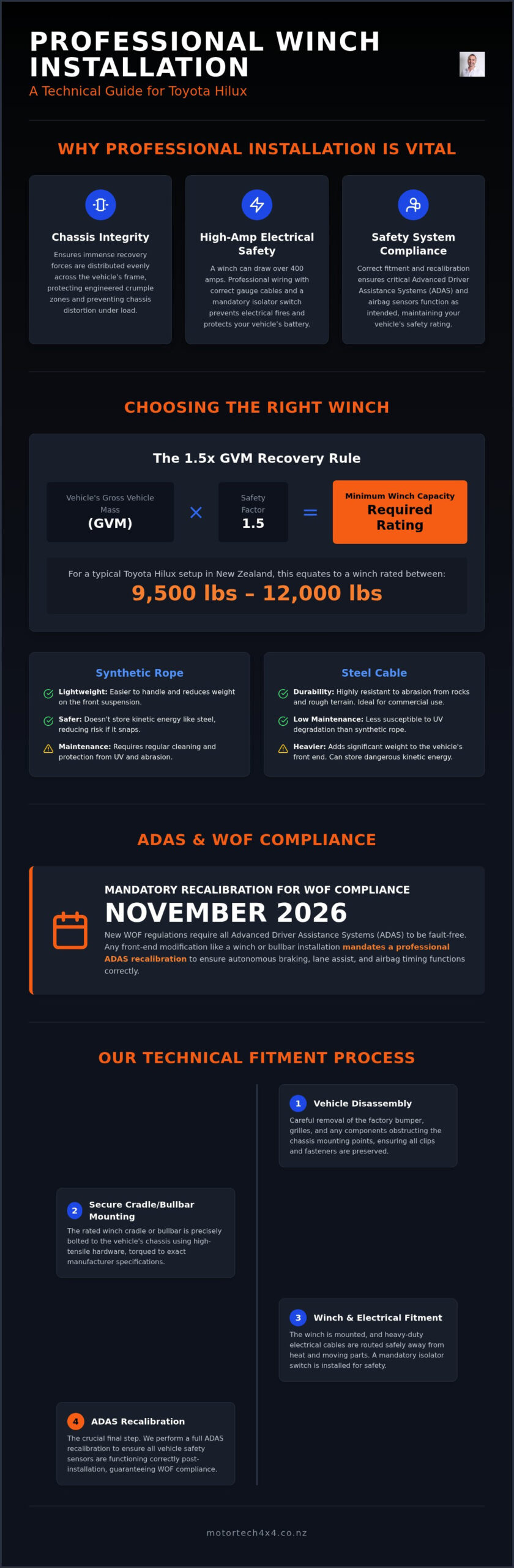
Modern winches pull over 400 amps during a heavy recovery. This massive current draw creates significant heat; without professional wiring and high-quality insulation, the risk of electrical fires is high. We install heavy-duty isolator switches as a mandatory safety measure to protect your battery health and ensure the system isn’t live when it’s not in use. Voltage drop is the reduction in electrical potential that occurs as current flows through the winch wiring, causing the motor to work harder and significantly shortening its operational lifespan. Using the correct gauge of cable and secure terminations is essential for reliability in Auckland’s salt-heavy coastal environments.
Chassis Integration and Mounting Cradles
Auckland owners typically choose between winch-rated bullbars or concealed winch cradles that sit behind the factory bumper. Both options require high-tensile bolts and specific torque settings to handle the kinetic energy of a recovery. If these components aren’t torqued to the manufacturer’s specifications, the mounting hardware can shear under load. Key considerations include:
- Winch-rated bullbars: These provide structural protection and a dedicated, reinforced mounting platform for the winch.
- Concealed cradles: These maintain the factory aesthetic while providing a rated, chassis-mounted recovery point.
- Alignment: The winch pull must align perfectly with the vehicle’s engineered recovery points to avoid twisting the chassis during an angled recovery.
Using a professional workshop ensures your Toyota Hilux winch installation Auckland meets the technical standards required for both off-road performance and Warrant of Fitness compliance.
Choosing the Right Winch for Your Hilux and NZ Terrain
Selecting a winch isn’t just about picking the highest number on the box. The industry standard for a safe recovery is the 1.5x Gross Vehicle Mass (GVM) rule. For a Toyota Hilux winch installation Auckland, this means calculating the total weight of your truck, including accessories, passengers, and cargo, to ensure the motor won’t stall when you’re truly bogged. Most Hilux setups in New Zealand require a winch rated between 9,500lb and 12,000lb to provide a sufficient safety margin.
Auckland drivers face diverse challenges that dictate specific technical requirements. Muriwai sand creates a suction effect on the tyres, requiring steady, low-heat pulls. In contrast, the deep, sticky clay of Woodhill Forest places massive peak loads on the gear. You need a winch with an IP67 or IP68 rating to survive the salt spray of the West Coast and the inevitable river crossings in the Kaimai Ranges. While most utes run 12V systems, heavy-duty fleet Hiluxes may occasionally require 24V configurations for high-cycle commercial applications, though 12V remains the standard for recreational rigs.
Synthetic Rope vs Steel Cable
Synthetic rope is the modern standard for recreational drivers because it’s lighter, safer if it snaps, and doesn’t store kinetic energy. However, Auckland’s high-UV index and salt-heavy air can degrade synthetic fibres over time. Regular rinsing and UV-protective sleeves are essential for longevity. Steel cable remains the preferred choice for heavy-duty commercial fleet vehicles due to its superior abrasion resistance against sharp rocks and debris found on remote work sites. If you aren’t sure which material suits your lifestyle, our technicians can help you choose the right winch setup during your consultation.
Winch Capacity and Motor Performance
A series wound motor is the only choice for New Zealand conditions. Unlike permanent magnet motors, they handle the heat of long, hard pulls in thick mud without losing torque. If you’re running a fully laden rig with a canopy and bar work, a 12,000lb unit provides the necessary headroom for self-recovery. An over-powered winch can strain a standard battery system by drawing more current than the alternator can replenish during a single recovery. All modifications must align with New Zealand compliance rules to ensure your vehicle remains road-legal and safe for the open road.
The Technical Fitment Process in Our Auckland Workshop
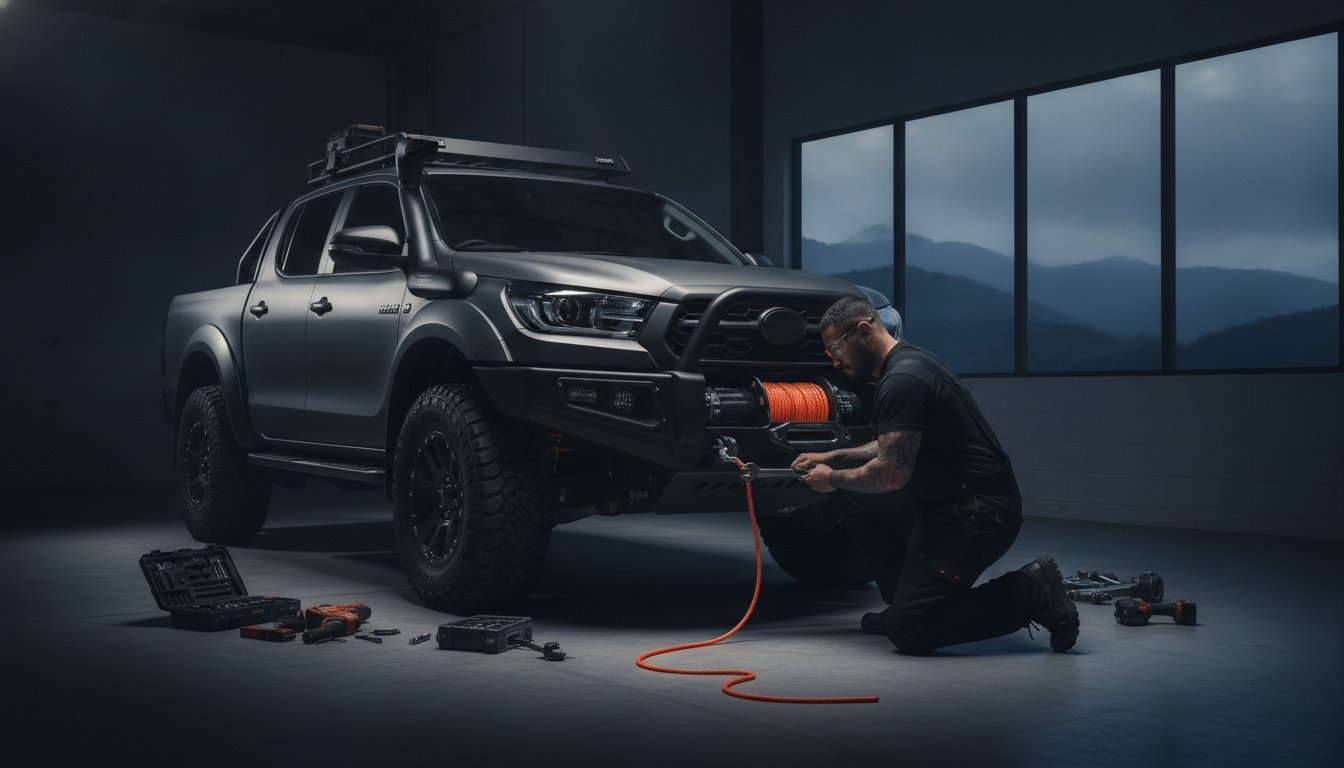
Our Toyota Hilux winch installation Auckland follows a methodical engineering workflow to ensure every component performs under peak stress. We begin with a precise disassembly of the front bumper and grille, taking care to isolate factory sensor looms and safety clips that DIY installers often damage. Once the front end is cleared, we secure the winch motor and gearbox within a structural, rated cradle. This cradle is the backbone of the system; it must be torqued to exact specifications to maintain chassis alignment during a heavy pull.
The electrical phase involves routing heavy-duty, loomed wiring away from heat sources and moving parts. We integrate high-amp fuses as a fail-safe against short circuits. Following the mount, we focus on fairlead alignment. We perform an initial rope tensioning sequence, which is critical to prevent the synthetic or steel line from binding or burying itself under load. Finally, we conduct comprehensive testing of both wired and wireless remote systems to confirm immediate response times before the vehicle leaves our workshop.
Optimising Approach Angles and Clearance
Professional fitting prioritises your ute’s off-road performance by ensuring the fairlead does not reduce the approach angle. We often “clock” the winch motor, rotating the housing so the clutch handle is easily accessible through the grille or bullbar. For a clean, protected finish, we mount the control box inside the engine bay. This keeps sensitive electronics away from mud and direct water ingress while maintaining a sleek exterior profile and protecting the unit from Auckland’s salt-heavy air.
Electrical Integration and Dual Battery Setups
Integrating a winch requires careful planning so the wiring does not interfere with other 4×4 accessories like light bars or UHF radios. For tradies using their winches on commercial work sites, a dual battery system is highly advantageous. It allows for multiple recoveries or heavy tool use without draining the primary cranking battery. We use specialised conduit and mounting brackets to protect every cable from the constant vibration and heat encountered on corrugated New Zealand gravel roads.
Safety Tech, ADAS Calibration, and NZ Compliance
A professional Toyota Hilux winch installation Auckland ensures your vehicle remains compliant with strict New Zealand safety standards. A common concern for owners is whether a winch affects airbag deployment timing. In a modern Hilux, airbags rely on decelerometers that measure impact force. As long as the winch is fitted within a Frontal Impact Compliant (FIC) cradle or bullbar, the structural integrity and safety triggers remain within factory specifications. However, the physical presence of the winch must meet LVVTA standards; this means no sharp protrusions and a minimum 3mm radius on all edges to ensure pedestrian safety.
Beyond the hardware, adding 40kg to 60kg of equipment to the front end creates a noticeable change in the vehicle’s rake. This front-end sag does more than just lower the nose. It misaligns your headlight beams, potentially blinding oncoming traffic, and shifts the braking bias during emergency stops. More critically, even a slight change in pitch requires ADAS calibration. Modern safety systems are calibrated to a specific vehicle height; if that height changes, the truck’s “eyes” are no longer looking where they should be.
Impact on Modern Safety Sensors
The radar and camera sensors in the 2026 Hilux are highly sensitive to changes in chassis geometry. If the front end sits lower after your Toyota Hilux winch installation Auckland, the Autonomous Emergency Braking (AEB) and Lane Keep Assist systems may malfunction or trigger false positives. This is why we often recommend upgrading suspension systems to manage the additional constant load. From 1 November 2026, an active ADAS warning light will result in an automatic WOF failure, making professional recalibration a non-negotiable step for any modified ute.
Winch Recovery Safety and Training
Fitting the gear is only half the job. Every recovery pull involves massive amounts of stored kinetic energy, which is why we emphasise the use of winch dampeners and rated recovery points. A rated bullbar provides the necessary structural platform to handle these loads safely. During our professional handover, we explain the clutch operation, remote syncing, and safe spooling techniques to ensure you’re confident when you’re out on the tracks. To ensure your rig is both recovery-ready and fully compliant, book your professional installation with our Auckland team today.
Why Auckland 4×4 Owners Choose Motortech 4X4 for Winch Fitting
Motortech 4X4 operates as a premier mechanical workshop where precision engineering meets rugged capability. Choosing us for your Toyota Hilux winch installation Auckland means your vehicle is handled by specialists who understand the critical intersection of physical hardware and electronic compliance. We don’t just bolt accessories to a frame; we follow a “whole-vehicle” philosophy. This methodology ensures that every modification, from the winch motor to the mounting hardware, is balanced against the truck’s weight distribution and safety systems. A rig that is front-heavy or poorly wired is a liability on the track.
We utilise industry-leading brands and high-tensile hardware specifically selected to withstand the corrosive, salt-heavy air of the Auckland coast. Every installation includes a comprehensive check of the front-end geometry to prevent long-term wear on your tyres and suspension components. Because we perform expert ADAS calibration in-house, your Hilux leaves our Auckland centre with its autonomous braking and lane-keep systems fully functional and WOF-compliant. This one-stop approach saves you from visiting multiple workshops to fix sensor faults after a mechanical upgrade.
Auckland Specialised Service
Our workshop is a convenient hub for Auckland tradies and weekend adventurers who require a fast, professional turnaround. We possess deep technical expertise across the entire Hilux range, including the established N80 and the latest 2026 N90 models. New Zealand’s conditions are unforgiving on recovery gear. Whether you’re dealing with the abrasive sands of Muriwai or the deep clay of Woodhill, our fitment standards focus on long-term durability. We protect every electrical connection and mechanical joint against the ingress of grit and moisture, ensuring your recovery gear works the first time, every time.
Ready for Your Next Recovery?
Selecting the correct winch requires a detailed analysis of your vehicle’s Gross Vehicle Mass (GVM) and intended use. We encourage a consultation to ensure your winch capacity matches your truck’s loaded weight, providing a sufficient safety margin for self-recovery. For commercial clients, we integrate these systems into comprehensive fleet fit-outs that prioritise safety and operational efficiency on remote work sites. Our team ensures that your rig is balanced, calibrated, and ready for the most demanding New Zealand tracks. Book your professional Toyota Hilux winch installation Auckland with the Motortech 4X4 team today to secure your vehicle’s performance and safety.
Secure Your Rig for the Toughest NZ Tracks
Professional fitment transforms a winch from a simple accessory into a reliable recovery system that preserves your vehicle’s factory safety standards. As we’ve explored, balancing front-end weight with the correct suspension and ensuring precise ADAS recalibration are non-negotiable steps for any modern ute. A high-quality Toyota Hilux winch installation Auckland provides the mechanical durability needed for Woodhill mud and the electronic precision required to pass a WOF without issue.
Motortech 4X4 is an Auckland owned and operated specialist 4×4 mechanical workshop dedicated to these high technical standards. Our on-site ADAS Calibration Centre and expert team ensure your Hilux is balanced, recovery-ready, and fully compliant with New Zealand regulations. Don’t leave your safety to chance with a DIY setup that might compromise your truck’s sophisticated radar and camera sensors.
Get a Professional Winch Installation Quote from Motortech 4X4 today. We look forward to helping you prepare your rig for your next adventure with absolute confidence.
Frequently Asked Questions
Do I need a new bullbar to install a winch on my Toyota Hilux?
You don’t necessarily need a full bullbar to fit a winch. While a winch-rated bullbar is a popular choice for added protection, we can install a concealed winch cradle that sits behind your factory bumper. This allows you to maintain the original look of your Hilux while providing a structural, chassis-mounted platform for recovery gear. Both options require professional fitment to ensure the mounting hardware handles the extreme stresses of a heavy pull.
Will installing a winch affect my vehicle’s warranty in New Zealand?
A professional Toyota Hilux winch installation Auckland won’t automatically void your entire vehicle warranty. Under New Zealand consumer law, a manufacturer can only deny a warranty claim if the modification directly caused the fault. Using a specialist workshop ensures the installation meets high technical standards, protecting your rights. We recommend checking with your dealer for specific fleet or extended warranty terms to ensure your truck remains fully covered post-modification.
Is synthetic rope better than steel cable for Auckland off-roading?
Synthetic rope is often better for recreational Auckland drivers because it’s lighter and safer if it breaks. It doesn’t store kinetic energy like steel cable, reducing the risk of injury during a failure. However, Auckland’s high-UV and salt-heavy air means synthetic fibres need regular rinsing and UV protection. Steel cable remains the preferred choice for commercial fleet vehicles that frequently encounter abrasive rocks or sharp debris on remote North Island work sites.
How much weight does a winch add to the front of my ute?
A winch typically adds between 30kg and 60kg to the front of your ute, depending on the model and whether you choose synthetic rope or steel cable. This additional weight sits forward of the front axle, which increases its impact on your vehicle’s rake. This extra load can lead to front-end sag, affecting your headlight aim and braking efficiency. Managing this weight often requires a specific suspension adjustment to maintain a level and safe ride.
What happens if my winch installation interferes with my parking sensors?
If your winch or bullbar blocks your parking sensors, they must be relocated and recalibrated to function correctly. Modern Hilux models use these sensors as part of a wider safety network. Our Auckland centre specialises in ADAS calibration to ensure that your parking sensors, radar, and cameras still provide accurate feedback after the physical modification. Professional relocation prevents constant error messages on your dash and ensures your automated safety systems remain reliable.
Do I need to upgrade my suspension after fitting a winch to my Hilux?
Yes, we highly recommend a front suspension upgrade after your Toyota Hilux winch installation Auckland. Adding a constant heavy load to the factory springs usually causes the front end to sit lower, which reduces your ground clearance and changes the vehicle’s handling characteristics. Upgrading to heavier-rated springs designed for the extra weight will restore your ride height, improve steering response, and ensure your truck handles safely on both Auckland motorways and rugged off-road tracks.
Can you install a hidden winch mount instead of a full bullbar?
We can certainly install a hidden winch mount if you prefer to keep your factory bumper. This involves fitting a rated steel cradle behind the bumper skin, providing a discreet but powerful recovery solution. It’s a great option for owners who want the security of a winch without the bulk or weight of a full steel bullbar. Our technicians ensure the cradle is securely integrated with the chassis to handle maximum recovery loads during a pull.
How often should I service my 4×4 winch to ensure it works when needed?
You should service your winch at least once every twelve months or after any significant water immersion. Auckland’s coastal environment is particularly harsh on mechanical components due to salt air corrosion. A standard service includes inspecting the electrical connections, cleaning the motor housing, and re-greasing the gearbox. We also recommend unspooling and re-tensioning your rope or cable every few months to check for any hidden damage or fraying before you head out on the tracks.