
Your diesel ute was built for the open road, but Auckland’s stop-start motorway traffic is effectively killing its engine. It’s frustrating to watch your dashboard light up with another DPF warning just as you’re trying to get across the Harbour Bridge. You likely bought a 4×4 for its legendary reliability and towing torque, not to have it constantly crippled by ‘limp mode’ or the threat of a NZ$8,000 filter replacement bill. If you’re searching for a DPF delete Auckland specialist, you’re looking for a permanent way to reclaim your vehicle’s performance and stop worrying about clogged filters during your weekend tours.
We understand that your vehicle needs to handle both the urban commute and the rugged New Zealand backcountry without compromise. This guide explains how to resolve persistent diesel particulate filter issues while optimising your ute for the local terrain. We’ll examine the technical realities of a DPF delete, the impact on engine longevity, and how professional ECU remapping can restore the responsiveness you need for towing boats or caravans. You’ll gain a clear understanding of the current NZTA regulations and discover the most reliable path to a high-performance, trouble-free diesel engine.
Key Takeaways
- Understand why Auckland’s stop-start motorway traffic is the primary cause of DPF clogging and frequent dashboard warning lights.
- Discover how a professional DPF delete Auckland service can unlock restricted torque and improve fuel efficiency for heavy towing.
- Learn why physical filter removal requires a specialised ECU remap to prevent software errors and ensure smooth engine operation.
- Compare the effectiveness of professional DPF cleaning against a permanent performance solution to protect your engine’s longevity.
- Identify how to prepare your 4×4 for remote North Island touring by eliminating the risk of ‘limp mode’ in isolated areas.
Understanding the DPF Dilemma for Auckland 4×4 Owners
Your diesel ute’s exhaust system relies on a Diesel Particulate Filter (DPF) to capture and store exhaust soot. While this component is essential for meeting modern emission standards, it wasn’t designed for the reality of Auckland traffic. The filter acts as a physical trap, but it requires specific heat conditions to burn off that trapped carbon. Choosing a DPF delete Auckland specialist is often the final step for owners who’ve grown tired of dashboard warnings and restricted performance.
In Auckland, we face a unique challenge. Short commutes from the North Shore to the CBD or crawling through Newmarket don’t allow the exhaust to reach the high temperatures needed for passive cleaning. When the engine stays cold, the soot load increases rapidly. Eventually, the vehicle triggers a warning light or, worse, drops into ‘limp mode’ to protect the engine from backpressure damage. Factory settings are calibrated for ideal laboratory conditions, not for a fully laden Hilux or Ranger tackling the Kaimai Ranges.
When you add the weight of a boat or a canopy, the engine works harder, producing more soot. If the DPF is already partially blocked from city driving, the resulting backpressure chokes the turbocharger. You’ll notice sluggish throttle response and a sharp increase in fuel consumption as the vehicle struggles to push exhaust gases through a restricted pipe. This creates a cycle where the engine burns more fuel, creates more soot, and further blocks the filter.
Passive vs. Active Regeneration
Passive regeneration occurs naturally during long, high-speed runs on the Southern Motorway. However, most modern utes rely on ‘active’ regeneration, where the Engine Control Unit (ECU) injects extra fuel to artificially raise exhaust temperatures. This cycle often starts just as you’re pulling into a driveway in Ponsonby or Grey Lynn. If you shut the engine off mid-cycle, the unburnt fuel can dilute your engine oil, causing long-term wear on internal components. Stop-start traffic effectively kills the regeneration cycle before it can finish.
The Cost of Constant DPF Maintenance
Owners often find themselves trapped in a cycle of expensive dealership visits. A forced regeneration performed by a technician is only a temporary fix for a deeper problem. While chemical cleaning services exist, they offer diminishing returns if the underlying driving pattern doesn’t change. This is why many owners seek a DPF delete Auckland solution; they want to eliminate the restriction entirely and restore the engine’s ability to breathe without constant electronic intervention. Repeated failures suggest that the factory system simply isn’t robust enough for heavy-duty Kiwi use.
DPF Delete vs. Professional Cleaning: Which is Right for You?
Deciding between a temporary fix and a permanent solution depends entirely on your vehicle’s condition and how you intend to use it. Professional cleaning is often the first port of call for many owners. This process uses chemical or thermal treatments to clear accumulated soot. It can be effective if the filter is simply “full” but structurally sound. However, if the internal ceramic core has melted or the soot has hardened into ash, cleaning becomes a waste of money. You’ll likely find yourself back in a workshop within a few months as the restriction returns.
A DPF delete Auckland service offers a definitive alternative. Instead of attempting to maintain a restricted exhaust, the internal filter element is removed. This eliminates the physical barrier, allowing your engine to breathe without the constant threat of a blockage. While a city-based tradie might opt for a clean to buy time, touring enthusiasts heading into remote parts of the North Island often prefer the total reliability that comes with removing the failure point entirely. Understanding how diesel particulate filters work helps in seeing why a physical restriction is such a significant hurdle for engine efficiency.
The Pros and Cons of a DPF Delete
- Reliability: You gain peace of mind by eliminating the primary cause of ‘limp mode’ and engine warning lights.
- Efficiency: Removing the filter reduces back-pressure. This allows the turbocharger to spool faster and reduces the workload on your engine, often leading to better fuel economy.
- Compliance: The main drawback involves navigating New Zealand’s evolving emissions regulations and Warrant of Fitness requirements.
Navigating NZ WOF and Legal Requirements
As of August 2026, NZTA regulations are clear. A vehicle first registered in New Zealand on or after 1 May 2010 will fail a Warrant of Fitness if the DPF has been removed or tampered with. However, current inspection protocols rely heavily on a visual check of the exhaust system. This is why many owners choose an emissions conversion. This specialised approach involves keeping the original factory canister intact while removing the internal restriction, maintaining a factory-standard appearance under the vehicle.
We prioritise technical excellence and honest communication. Every vehicle is different, and what works for a dedicated farm ute might not be the best choice for a late-model family SUV. Our team can help you assess the state of your exhaust system as part of our comprehensive 4×4 servicing, ensuring you make an informed decision that balances performance with your long-term goals.
Performance Gains: Torque, Towing, and Fuel Economy
Removing the physical restriction of a factory filter is like pulling a cork out of a bottle. In a standard diesel engine, the turbocharger has to work against significant back-pressure. This delay in exhaust flow slows down turbo spool, resulting in the laggy feeling many owners report. When you opt for a DPF delete Auckland solution, you’re effectively unlocking the engine’s ability to breathe. The immediate result is a more responsive throttle and a smoother power curve that makes daily driving through Auckland’s hilly suburbs far more effortless.
For North Island touring, torque is the most critical metric. Whether you’re climbing the Kaimai Ranges or overtaking on State Highway 1, you need consistent, predictable power. A restricted engine often feels breathless under sustained load because the ECU restricts fuel delivery to manage heat buildup in the filter. By removing this bottleneck, the engine maintains its peak torque for longer. This performance gain is most effective when integrated with specialised 4×4 servicing, ensuring all engine parameters are balanced for the new exhaust flow.
Fuel economy is another area where efficiency improves. A choked engine burns more diesel per kilometre simply because it has to work harder to overcome internal resistance. Additionally, the active regeneration cycles consume extra fuel just to burn off soot. Eliminating these cycles leads to a measurable drop in average consumption, especially for vehicles that carry heavy loads or run larger tyres. You’re no longer wasting diesel on a cleaning process that provides no actual drive power.
Towing Heavy Loads with Confidence
Hauling a three-tonne boat or a horse float puts immense strain on a diesel engine. High Exhaust Gas Temperatures (EGTs) are the enemy of longevity, and a blocked DPF only traps that heat closer to the turbo and cylinder head. A delete solution helps lower these temperatures, preventing the ECU from ‘derating’ or cutting power during long climbs. For total drivetrain health, we recommend pairing this upgrade with a transmission flush to ensure your gearbox can handle the improved torque delivery without overheating under load.
Compensating for Heavy 4×4 Accessories
Most modified utes in New Zealand carry significant extra weight. Adding 4×4 bullbars, winches, and steel bash plates increases the rolling mass and aerodynamic drag. When you combine this with larger all-terrain tyres, the factory power levels often feel inadequate. A DPF delete Auckland package helps regain that lost agility. It provides the extra grunt needed to turn larger rubber and ensures your modified rig feels as nimble as it did on the showroom floor, even when it’s fully kitted for a week in the bush.
The Technical Process: ECU Remapping and Hardware Mods
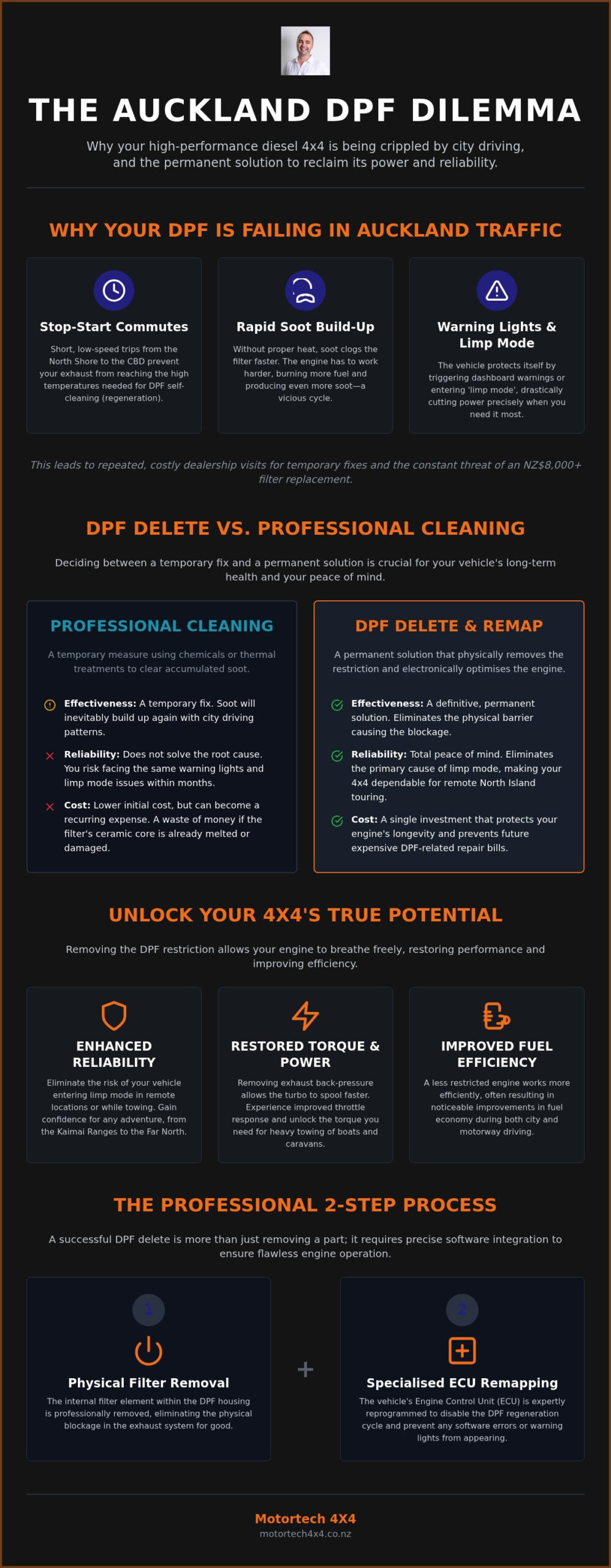
Executing a successful DPF delete Auckland project involves much more than just removing a physical component. Your vehicle’s Engine Control Unit (ECU) is programmed to monitor exhaust back-pressure and soot levels constantly. If you simply remove the filter without recalibrating the software, the computer will detect a fault and immediately trigger ‘limp mode’. This is why a physical modification must always be paired with a comprehensive software recalibration; experts such as StageX Performance OÜ highlight the importance of professional ECU modifications in ensuring the engine operates harmoniously without its factory restriction.
Off-the-shelf software files from Europe or North America often fail to account for New Zealand’s unique environment. While specialists might explore the sale of ECU tuning files and database subscriptions from Ecuremap to obtain professional base data, Auckland’s high humidity and specific cetane ratings require a tailored local approach. Our remapping process adjusts fuel maps to suit these conditions while maintaining factory safety limits, protecting your turbocharger and internal engine components from over-boosting or excessive heat. We prioritise a balanced tune that delivers power reliably rather than pushing the hardware to its absolute breaking point.
A DPF solution is often the catalyst for a broader performance build. Many owners choose to perform an EGR delete at the same time to prevent carbon buildup in the intake manifold. This ensures the entire breathing system is optimised. Upgrading your intake with a snorkel is another common addition, providing cleaner, cooler air when you’re off-road. When you combine these hardware changes with a Stage 1 remap, you transform the vehicle’s driveability. The engine becomes more efficient, more responsive, and better equipped for the demands of Kiwi touring. To get started on your vehicle’s transformation, book a consultation for a professional ECU remap and DPF solution with our technical team.
Why Motortech 4X4 is Auckland’s Choice for DPF Solutions
Choosing a provider for a DPF delete Auckland service requires more than just finding a technician with a laptop. At Motortech 4X4, we approach engine optimisation as one part of a total vehicle ecosystem. We aren’t generalist tuners; we are 4×4 specialists who understand the specific stresses placed on a diesel engine during heavy towing and remote touring. Our workshop provides local accountability and professional support that off-the-shelf software providers simply cannot match.
We take a holistic approach to every project. A performance-tuned engine delivers more torque, which often necessitates upgrades to other areas of the vehicle to maintain safety and control. This is why we integrate our DPF and ECU solutions with our expertise in suspension systems and GVM upgrades. Whether you’re driving a Toyota Hilux, Ford Ranger, Mitsubishi Triton, Isuzu D-Max, or Holden Colorado, we ensure the power delivery matches the mechanical capabilities of your chassis and drivetrain.
Your One-Stop Auckland 4×4 Centre
Planning a DPF solution as part of a complete vehicle fit-out saves time and ensures component compatibility. When the same team that installs your bullbar and winch also handles your engine tuning, you get a rig that functions as a cohesive unit. We don’t just focus on the exhaust flow; we also ensure that your vehicle’s safety technology remains accurate. If your modifications involve a lift or significant weight changes, we provide ADAS calibration to keep your emergency braking and lane-keep systems functioning correctly. It’s a level of diligence that general mechanical workshops often overlook.
Book Your Consultation in Auckland
Every 4×4 has a different history and a different purpose. We begin every project with a thorough assessment to determine the health of your diesel system and discuss your specific requirements. We provide honest, technical advice based on whether you’re a city-based tradie or a dedicated off-road enthusiast. Our goal is to provide a reliable, long-term solution that eliminates the frustration of limp mode and restores your confidence in your vehicle’s reliability. Don’t wait for the next warning light to appear on the Southern Motorway. Organise your DPF assessment with the Motortech 4X4 team today and take the first step toward a more efficient, capable 4×4.
Secure Your 4×4’s Reliability and Performance
Auckland’s unique driving conditions demand more from a diesel engine than standard factory calibrations can often provide. By addressing the physical and software restrictions of your exhaust system, you’re doing more than just clearing a dashboard light. You’re restoring the torque required for heavy towing and ensuring your ute remains dependable during remote North Island tours. A professional DPF delete Auckland service, when paired with a custom ECU remap, transforms a choked engine into a responsive and efficient powerplant.
Our specialist Auckland 4×4 mechanical workshop combines technical expertise in complex diesel emissions with a deep understanding of NZ touring requirements. We don’t just fix a single component; we optimise your entire vehicle for the way you actually drive. Whether you’re hauling a boat or navigating the backcountry, our custom solutions provide the accountability and precision your rig deserves. Take the first step toward a more capable vehicle and get a professional DPF and performance quote for your 4×4. It’s time to experience the true potential of your diesel engine without the constant threat of limp mode.
Frequently Asked Questions
Is a DPF delete legal for my 4×4 in Auckland?
Operating a vehicle on public roads without a functional DPF is generally illegal if it fails to meet New Zealand emissions standards. While performing the service is not illegal for a workshop, the legal responsibility for road compliance rests with the vehicle owner. Many owners choose this modification for off-road use or remote touring where reliability is paramount. You should always consider the specific use of your vehicle before proceeding.
Will my ute pass a WOF after a DPF delete?
Current NZTA regulations state that vehicles first registered on or after 1 May 2010 will fail a Warrant of Fitness if the DPF has been removed or tampered with. However, most inspections are currently visual checks of the exhaust system. This is why professional ‘stealth’ modifications, where the original canister remains intact, are popular. We provide honest advice on how these regulations might affect your specific vehicle during its next inspection.
How much fuel will I actually save with a DPF delete?
You can expect a measurable improvement in fuel economy because the engine no longer performs active regeneration cycles. These cycles inject extra diesel into the exhaust to burn off soot, which provides no drive power. Additionally, reducing exhaust backpressure allows the engine to operate more efficiently. While exact savings vary based on your driving style and load, many owners report a noticeable drop in litres per hundred kilometres during highway cruising.
Does a DPF delete make my 4×4 blow black smoke?
A professionally executed DPF delete Auckland service shouldn’t result in excessive black smoke. While the filter’s job is to trap soot, a high-quality ECU remap recalibrates the fuel-to-air ratios to ensure a clean, efficient burn. Excessive smoke is usually a sign of an ‘off-the-shelf’ tune or poor mechanical health. Our custom remapping process focuses on clean performance that maintains engine longevity without creating unsightly exhaust emissions.
Can a DPF delete be reversed if I want to sell the vehicle?
Yes, the process is reversible, though it requires both hardware and software changes. You’d need to install a functional DPF unit and have the ECU flashed back to its factory settings. Because a new replacement DPF is a significant investment, many owners keep their original components if they plan to sell the vehicle later. We can discuss the most practical way to manage this during your initial assessment at our Auckland workshop.
How long does the DPF delete and remapping process take?
Most professional DPF and remapping projects are completed within a single business day. This timeframe allows our technicians to perform a full diagnostic health check, carry out the physical modifications, and write the custom ECU software. Complex builds or vehicles requiring additional 4×4 servicing might take longer. We recommend booking in advance to ensure we can dedicate the necessary time to calibrate your vehicle’s software and hardware precisely.
Will a DPF delete void my manufacturer’s warranty?
Modifying your exhaust system or ECU software will almost certainly void the manufacturer’s warranty on those specific components. Most dealerships won’t cover engine or drivetrain issues if they can attribute the fault to an aftermarket modification. If your vehicle is still under a new-car warranty, you should weigh the performance benefits against the potential loss of factory coverage. We always recommend checking your specific warranty terms before making any permanent changes.
Do I need to do an EGR delete at the same time as the DPF?
While not strictly mandatory, performing an EGR delete alongside your DPF solution is highly recommended for total engine health. The EGR system recirculates soot-heavy exhaust gases back into the intake manifold, which causes carbon buildup over time. Addressing both systems simultaneously ensures your engine receives clean air and breathes freely. This combination is the most effective way to prevent future ‘limp mode’ issues and maximise the long-term reliability of your diesel engine.