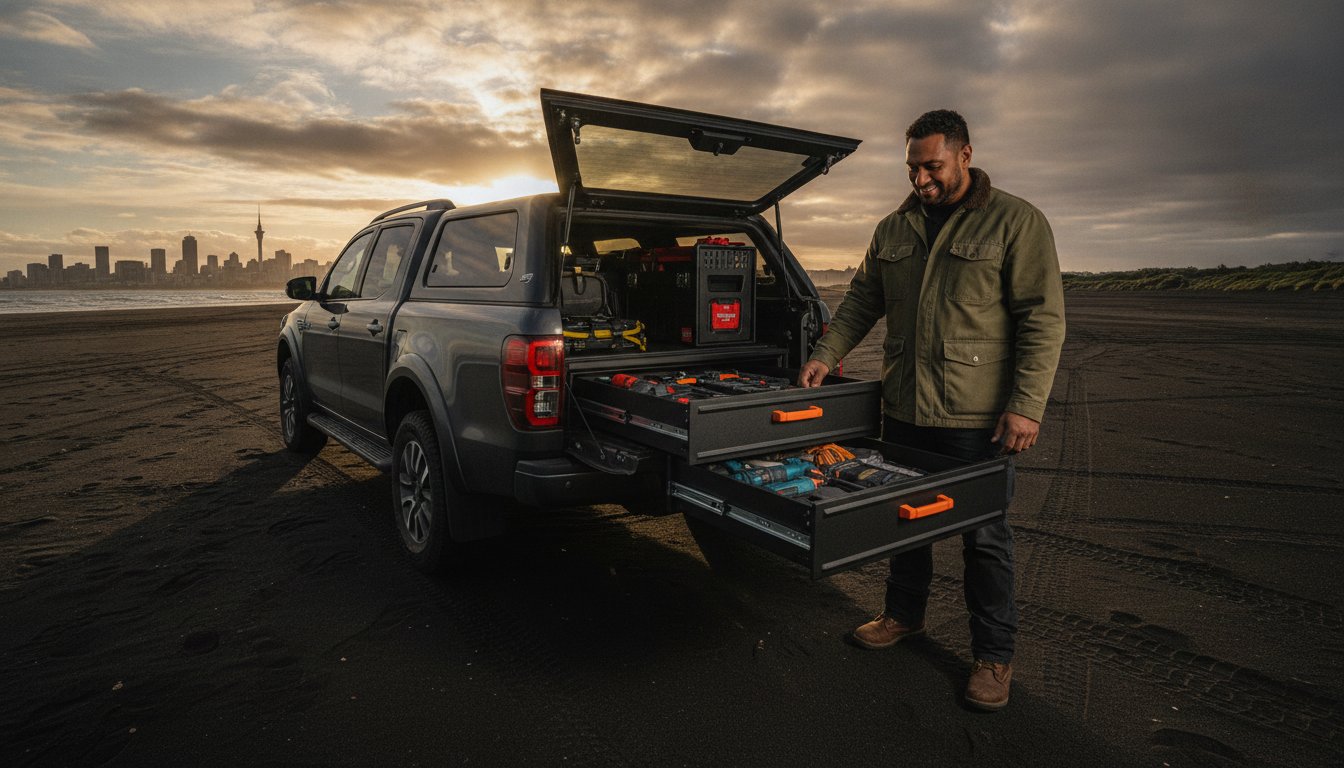

Could the very tyres you bought to conquer the North Island’s toughest tracks be the reason your vehicle’s safety systems fail when you need them most? It’s a common dilemma for local drivers who want an aggressive look but need to maintain motorway manners. Selecting the right 4×4 tyres Auckland involves more than just picking a tread pattern that looks tough in the car park; it requires a technical understanding of how larger rubber affects your GVM, your speedometer accuracy, and those crucial ADAS sensors.
We know you want a rig that handles the slickest NZ clay without the deafening drone of mud-terrains during the daily commute. You also need to stay on the right side of the law, especially with the 2026 WoF changes and increased $350 fines for non-compliant wheels. This specialist guide promises to help you find that perfect balance between off-road durability and urban safety. We’ll explore the engineering behind professional fitment, the necessity of ADAS recalibration, and how to ensure your suspension and tyres work as a single, high-performance unit.
Key Takeaways
- Identify the specific performance requirements for Auckland’s unique mix of stop-start motorway commuting and rugged weekend off-roading.
- Compare All-Terrain and Mud-Terrain tread patterns to determine which tyre type provides the best traction without sacrificing on-road comfort.
- Learn why fitting larger 4×4 tyres Auckland requires professional ADAS calibration and mechanical adjustments to maintain vehicle safety and compliance.
- Implement specialised maintenance strategies to combat the corrosive effects of salt air and road grime on your high-performance rubber.
- Understand the importance of a “complete build” approach that integrates your tyre selection with suspension upgrades and existing vehicle accessories.
Navigating the Auckland 4×4 Tyre Market: Performance Over Price
Selecting the right rubber for your vehicle is often the difference between a capable rig and a liability. While price-beat guarantees and budget retail offers are tempting, the “cheapest” tyre often results in a higher total cost of ownership. For a heavy Ford Ranger or Toyota Hilux, a low-cost tyre typically suffers from accelerated tread wear and poor heat dissipation. In the stop-start congestion of the Southern Motorway, these budget options can also lead to increased braking distances and a significant spike in cabin noise that makes daily commuting a chore.
Performance isn’t just about off-road traction; it’s about how the tyre interacts with your vehicle’s engineering. A high-quality set of 4×4 tyres Auckland drivers choose should enhance fuel economy through lower rolling resistance while maintaining a stiff enough sidewall to handle the weight of bullbars or winches. Understanding these technical requirements is something retailers like Partner Tires advocate for, as choosing a tyre based solely on a low upfront price potentially compromises safety during emergency manoeuvres on wet bitumen.
The Auckland 4×4 Lifestyle: City Commuter or Weekend Warrior?
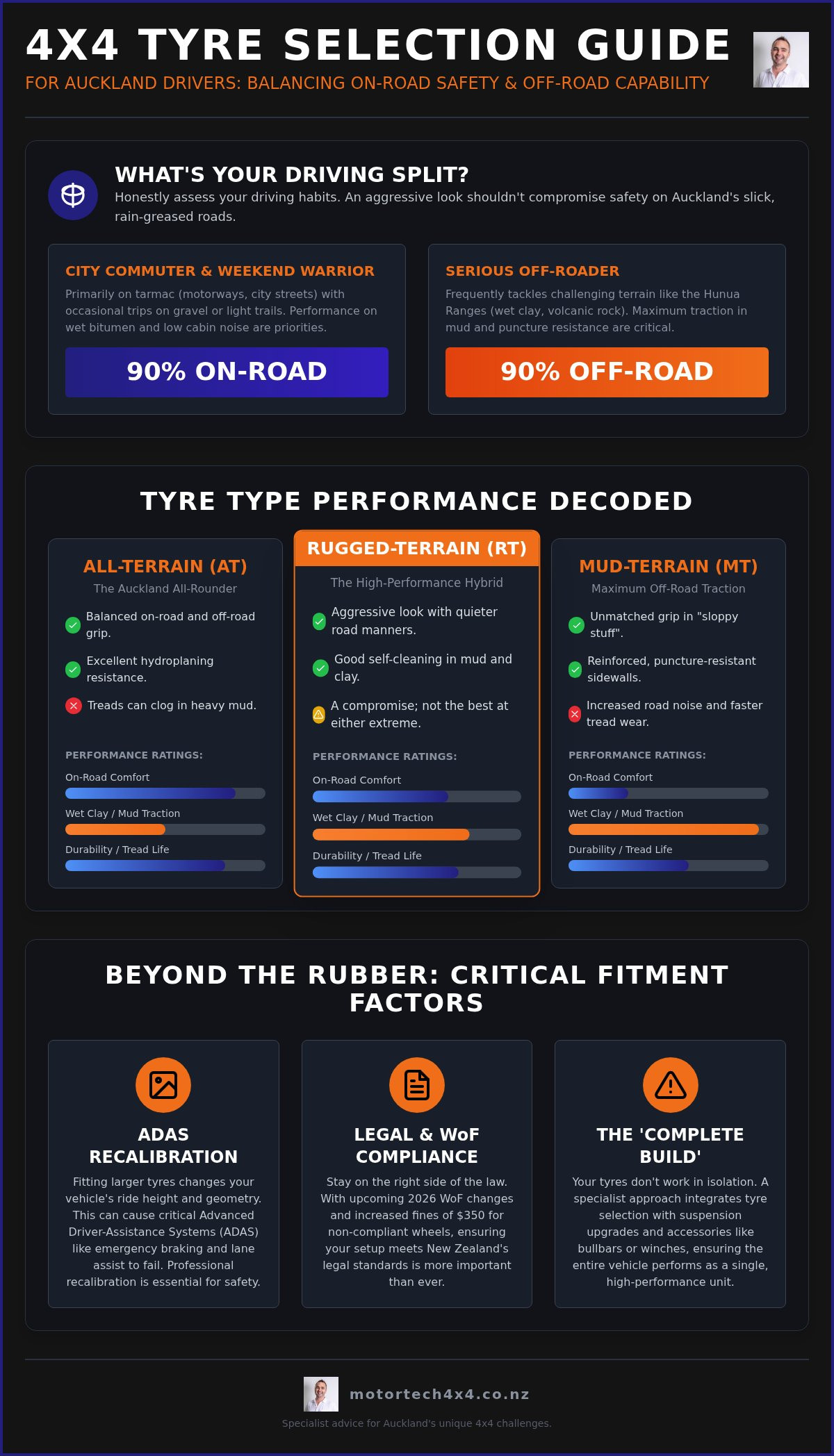
Be honest about your driving split before committing to a specific tread. If your vehicle spends 90% of its time on the tarmac and only 10% on gravel, an aggressive mud-terrain is a poor technical choice. This “aggressive look” shouldn’t come at the expense of safety on Auckland’s frequently slick, rain-greased roads. For tradies, the load rating is a non-negotiable factor. Your tyres must be rated to handle a full payload of tools and equipment without overheating or deforming, a detail often overlooked in basic retail environments.
New Zealand Terrain: Why Local Context Matters
New Zealand’s geography presents challenges that differ significantly from the dry, sandy tracks of the Australian outback. Our local trails, such as those in the Hunua Ranges, are often dominated by greasy wet clay and sharp volcanic rock. These conditions require a sophisticated understanding of off-road tyre types to ensure you don’t get bogged or suffer a sidewall puncture.
When you head out to Muriwai Beach, sidewall integrity becomes your primary concern. Airing down to increase your footprint is essential for sand driving, but a weak sidewall can easily unseat from the rim or suffer internal damage. A specialist 4×4 tyres Auckland workshop considers these local variables, ensuring your rubber is durable enough for the Hunuas while remaining refined enough for the drive back to the city.
All-Terrain vs. Mud-Terrain: Decoding Tread Patterns for NZ
The void ratio is the volume of space between the tread blocks, which directly dictates how effectively a tyre can self-clean and maintain grip on Auckland’s notorious clay-based tracks. Selecting the correct tread pattern is a technical decision that impacts everything from fuel consumption to stopping distances on the motorway. While many drivers prioritise an aggressive look, the mechanical reality of how these patterns interact with different surfaces should guide your purchase of 4×4 tyres Auckland.
All-Terrain Tyres: The Auckland All-Rounder
For the majority of dual-cab utes in the city, an All-Terrain (AT) pattern provides the most balanced performance. These tyres feature a tighter tread pattern that excels at hydroplaning resistance and high-speed braking on the Southern Motorway. When evaluating durability in local conditions, Maxxis tyres have become a staple for NZ enthusiasts due to their ability to withstand abrasive road chip while offering reliable off-road traction. However, ATs have a technical limit. On highly technical, rain-soaked tracks, the smaller voids can quickly fill with mud, effectively turning the tyre into a slick and reducing traction to near zero.
Mud-Terrain Tyres: For the Serious Off-Roader
Mud-Terrain (MT) tyres are engineered for maximum traction in the “sloppy stuff.” Their deep lugs and high void ratios are essential for winter excursions into the Hunua or Waitakere ranges. These tyres also feature reinforced sidewalls to defend against punctures from sharp NZ bush debris and volcanic rock. The trade-off is significant; MTs generate more road noise and tend to wear faster on hot bitumen. It’s also vital to ensure your setup meets New Zealand’s legal tyre requirements regarding tread depth and fitment standards to remain roadworthy.
The Rugged Terrain (RT) category has emerged as a high-performance hybrid solution. It combines the aggressive sidewall and self-cleaning ability of an MT with the quieter on-road manners of an AT. This is often the ideal solution for drivers who want an aggressive aesthetic without sacrificing civilised city driving. Selecting the right pattern requires a professional assessment of your vehicle’s weight and intended use. If you’re unsure which tread suits your rig, the team at Motortech 4X4 can provide a technical recommendation based on your specific 4×4 tyres Auckland requirements and driving habits.
Beyond the Rubber: Fitment, Lift Kits, and ADAS
Upgrading to larger 4×4 tyres Auckland enthusiasts often desire is rarely a simple bolt-on procedure. Increasing tyre diameter alters the vehicle’s final drive ratio, which directly impacts speedometer and odometer accuracy. If your speedometer reads 100km/h but you’re actually travelling at 107km/h due to oversized rubber, you risk both speeding fines and safety compromises. Guard clearance is another technical hurdle. Without a professional suspension lift, larger tyres will rub against the wheel arches or chassis rails during articulation, leading to premature wear and potential structural damage. Correcting these issues requires a mechanical understanding of offset and backspacing to ensure the wheel and tyre package clears all internal components.
ADAS Calibration: The Safety Step Most Shops Miss
To ensure your new setup provides both the clearance and the look you desire, you can find out more about custom truck wheels and off-road rims designed for New Zealand conditions.
Modern 4x4s rely on Advanced Driver-Assistance Systems (ADAS) to monitor the road through cameras and radar. When you change the ride height or tyre size, you effectively “blind” these sensors by shifting their calibrated perspective. A 5% change in tyre diameter alters the sensor’s pitch and field of view, potentially causing emergency braking or lane-keep assist to engage incorrectly. Professional ADAS calibration is mandatory after such modifications to ensure these safety systems remain functional and compliant. Many general retail shops ignore this step, leaving drivers with a vehicle that looks aggressive but possesses compromised safety electronics.
GVM Upgrades and Tyre Load Ratings
Legal compliance in New Zealand requires your tyres to match or exceed the vehicle’s Gross Vehicle Mass (GVM). If you’ve added heavy accessories like bullbars, winches, or a canopy, your rig may require a GVM upgrade to remain legal on the road. This upgrade must be supported by tyres with an appropriate load rating. A tyre that is physically large enough to fit your rim might not be engineered to carry the increased weight of a fully kitted fleet vehicle or a heavy-duty touring rig. Professional fitment is the only way to stay compliant with NZ transport regulations, ensuring your vehicle passes its WoF while maintaining its structural integrity.
Professional fitment involves more than just mounting rubber to a wheel. It requires a comprehensive “build” mentality where the suspension, GVM, and electronic safety systems are all synchronised. This meticulous attention to detail ensures your vehicle remains safe on the motorway and capable on the track. By integrating ADAS calibration with your tyre and suspension package, you protect both your investment and your passengers. Choosing a specialist for your 4×4 tyres Auckland ensures that every technical aspect of the fitment is addressed before you leave the workshop.
Maximising Your Investment: 4×4 Tyre Maintenance
High-performance rubber represents a significant capital investment for any vehicle owner. Neglecting the maintenance of 4×4 tyres Auckland drivers have fitted can lead to premature failure and a noisy, vibrating ride that ruins the driving experience. Unlike standard passenger tyres, the large tread blocks on off-road rubber are particularly susceptible to “scalloping” or “cupping” if the alignment is out by even a few millimetres. Auckland’s humid, salt-laden air also accelerates the degradation of rubber compounds and can contribute to the corrosion of wheel weights and valve stems. Regular cleaning and professional inspections are essential to prevent road grime from masking early signs of sidewall cracking or structural damage.
The Art of Airing Down: Pressure Guide for NZ Tracks
Adjusting tyre pressure is the most effective way to increase your vehicle’s footprint on soft or technical surfaces. For sand driving at Muriwai Beach, dropping pressures to 15-18 PSI allows the tyre to “float” rather than dig. On the rocky tracks of the Kaimais, a slightly higher pressure of 22-25 PSI is often preferred to provide better protection against sidewall pinches and sharp volcanic edges. Running pressures too low increases the risk of unseating the bead from the rim, which can leave you stranded in difficult terrain. It’s vital to use a reliable compressor to air back up to road-legal pressures before hitting the high-speed motorway back to the city.
Rotation and Alignment: Protecting Your Tread
A 5,000km rotation schedule is the gold standard for maintaining aggressive mud-terrain or rugged-terrain sets. This frequency prevents the leading edge of the tread blocks from wearing at a different rate than the trailing edge, which is the primary cause of excessive road drone. A precision wheel alignment is also critical after every major off-road excursion. Impacts with rocks or deep ruts can easily knock your toe or camber settings out of specification, leading to rapid tread loss on one side of the tyre. The Motortech 4X4 approach ensures your alignment accounts for your specific suspension geometry and weight distribution, rather than just relying on factory default settings.
Maintaining your 4×4 tyres Auckland requires a disciplined approach to both cleaning and mechanical checks. By staying on top of your rotation and alignment, you can extend the life of a premium tyre set by thousands of kilometres. Book your next 4×4 servicing and alignment at Motortech 4X4 to ensure your rig remains track-ready and safe for the daily commute.
Why Motortech 4X4 is Auckland’s Specialist Choice
High-volume retail chains often focus on turnover and generic fitments, but Motortech 4X4 operates with a mechanical precision that treats your vehicle as a complete system. Selecting 4×4 tyres Auckland drivers can rely on is only one part of a larger engineering puzzle. We don’t just mount rubber to a rim; we ensure that the choice of tyre complements your specific suspension kits, bullbars, and winches. This “build” mentality prevents common issues like poor handling or premature component wear that often follow basic retail fitments. Our workshop functions as a high-end mechanical centre where technical standards take precedence over retail margins.
Specialist Knowledge for Modern Rigs
Our team possesses deep technical expertise in modern platforms, including the Ford Ranger, Toyota Hilux, and LandCruiser. This knowledge is refined through extensive experience with fleet fit-outs, where durability and safety are non-negotiable standards. Whether you are kitting out a single vehicle for weekend touring or managing a commercial fleet, you benefit from the same high mechanical standards. We provide access to industry-leading brands such as Maxxis and Safari, ensuring your rubber is matched to the specific demands of NZ tracks. We understand how different tread patterns interact with the weight of a fully loaded ute, a factor that generalist shops frequently overlook.
The Motortech Service Guarantee
Every tyre fitment at our Auckland-based workshop includes a comprehensive vehicle health check. We evaluate your vehicle’s structural integrity and mechanical condition as part of the service. Unlike a standard tyre fitter, we offer on-site technical capabilities including ECU remaps and ADAS calibration. This ensures your vehicle remains safe and performs at its peak after any modification. Our status as an Auckland-owned and operated business means we drive the same Hunua clay and Muriwai sand that you do. This first-hand insight allows us to provide practical advice based on real-world local conditions rather than just reading from a product catalogue.
Choosing a specialist means your 4×4 tyres Auckland are fitted by professionals who understand the intersection of performance and legal compliance. We take responsibility for the entire vehicle setup, from GVM upgrades to electronic sensor alignment. This holistic approach is why we are the trusted partner for Auckland enthusiasts and commercial operators alike. Book your Auckland 4×4 service here to ensure your rig is engineered for the road ahead with the precision it deserves.
Engineering Your Rig for the Road Ahead
Selecting a new set of 4×4 tyres Auckland drivers can trust involves a technical assessment of your vehicle’s entire ecosystem. It isn’t just about the tread; it’s about how that rubber interacts with your suspension, your GVM limits, and your safety electronics. We’ve explored the importance of choosing a tread pattern that balances motorway refinement with track traction, alongside the mandatory requirement for ADAS calibration after any height modification. Precision maintenance, including 5,000km rotations and post-track alignments, remains the most effective way to protect your investment.
As Auckland’s leading 4×4 modification specialists, Motortech 4X4 provides the technical expertise required for modern Rangers, Hiluxes, and LandCruisers. Our workshop is equipped for full ADAS calibration and GVM upgrades, ensuring your vehicle remains compliant and safe regardless of the terrain. Whether you’re preparing for a coastal run or a technical bush track, our team is ready to provide a specialised solution tailored to your rig’s specific needs. Get a Professional Tyre Recommendation for Your Rig today and drive with the confidence that only expert engineering provides.
Frequently Asked Questions
What is the biggest tyre size I can fit on my 4×4 in NZ without a cert?
In New Zealand, you can generally increase your tyre’s overall diameter by up to 5% over the manufacturer’s original specification without requiring an LVV certification. This is provided the tyres do not contact any part of the vehicle’s body or suspension throughout the full range of travel. Speedometer accuracy must also remain within legal tolerances. We recommend a professional assessment to ensure your specific setup avoids legal complications or WoF failures.
How much louder are Mud-Terrain tyres on the Auckland motorway?
Mud-Terrain tyres are significantly louder than standard highway or All-Terrain patterns due to their high void ratio. On Auckland motorways, this manifests as a persistent rhythmic drone that increases with speed. Modern high-end designs have improved pitch sequencing to reduce this noise, but they remain less refined than AT options. If your daily commute involves heavy motorway use, the increased cabin noise is a technical trade-off for superior off-road traction in deep mud.
Do I really need an alignment after fitting new 4×4 tyres?
Yes, a professional wheel alignment is essential whenever you install new 4×4 tyres Auckland drivers choose for their rigs. Even minor misalignments cause rapid, uneven tread wear on expensive off-road rubber. Since 4×4 vehicles often have modified suspension, a standard retail alignment may not suffice. Our specialist approach ensures your vehicle’s geometry is perfectly synchronised with your specific tyre diameter and ride height, protecting your investment from premature degradation and handling issues.
Why are Maxxis tyres so popular for New Zealand 4x4s?
Maxxis tyres have gained a dominant market share in New Zealand because their rubber compounds and carcass designs are exceptionally suited to our local terrain. They provide a high level of puncture resistance against sharp volcanic rock while maintaining effective self-cleaning properties in wet clay. Their versatility across both the All-Terrain and Rugged-Terrain categories makes them a reliable choice for drivers who split their time between Auckland city commuting and remote North Island weekend tracks.
Will larger tyres void my vehicle manufacturer warranty?
Fitting larger tyres does not automatically void your entire vehicle warranty, but it can lead to the rejection of specific claims related to the drivetrain or suspension. Manufacturers may argue that the increased rotational mass and altered gearing placed undue stress on axles, bearings, or the transmission. It’s important to consult with a specialist to understand how modifications impact your specific warranty and to ensure all upgrades are engineered to professional standards that maintain vehicle integrity.
What tyre pressure should I use for driving on Muriwai Beach?
For the soft sand conditions found at Muriwai Beach, we typically recommend reducing your tyre pressures to between 15 and 18 PSI. This lower pressure increases the tyre’s contact patch, allowing your vehicle to float over the sand rather than digging in. You must remember to avoid sharp turns at these low pressures to prevent unseating the bead from the rim. Always use a compressor to return to road-legal pressures before driving back on the bitumen.
Can I fit 4×4 tyres to my standard factory wheels?
You can fit many All-Terrain and some Mud-Terrain tyres to factory wheels, provided the tyre width is compatible with the rim’s internal measurements. However, larger or wider 4×4 tyres Auckland enthusiasts prefer may require aftermarket wheels with a different offset to prevent rubbing on the upper control arms or chassis components. A professional fitment check is necessary to determine if your factory rims can safely support the load rating and dimensions of your chosen tyre.
How often should I rotate my All-Terrain tyres?
We recommend rotating All-Terrain tyres every 7,500 to 10,000 kilometres to ensure even tread wear across all four corners. Because 4x4s often carry uneven loads or have different steering geometries between the front and rear axles, regular rotation is critical for maximising tyre life. This practice helps prevent the development of specific wear patterns, such as cupping or scalloping, which can lead to increased road noise and reduced wet-weather performance over time.