What if the right diesel ECU remap is the one that suits your vehicle and workload, rather than the one with the biggest power claim? If you’re considering a diesel ECU remap in Auckland, you’ll want to understand what changes, how performance and fuel use may be affected, and what that could mean for reliability.
A remap adjusts the engine’s electronic calibration. The result depends on the vehicle’s condition, existing setup and how it’s driven. More power or torque isn’t proof of a better outcome, and fuel economy claims need to be considered against your real-world use. Emissions compliance, Warrant of Fitness requirements and warranty implications also deserve attention before booking.
This guide explains what a diesel remap can change, the trade-offs to consider and the vehicle details that matter in a discussion with a specialist. A considered approach starts with mechanical condition and intended use. Motortech 4X4 offers ECU remaps at its Glenfield workshop and services all makes and models.
Key Takeaways
- Understand how software calibration can alter engine behaviour, and why results vary between vehicles.
- Learn why ECU remapping and dyno tuning are related but not interchangeable terms.
- Weigh potential performance and economy goals against vehicle condition, emissions considerations and warranty implications.
- Before discussing a diesel ECU remap in Auckland, note how you use your vehicle, any modifications and known mechanical issues.
- Motortech 4X4 offers ECU remaps from its Glenfield, North Shore workshop and services all makes and models.
Diesel ECU remap Auckland: what changes when an engine is remapped?
A diesel ECU remap changes software settings in a vehicle’s engine control unit (ECU), the computer that helps manage engine operation. The calibration is the set of instructions the ECU uses to control how the engine responds. A remap revises those instructions; it doesn’t automatically change or upgrade the engine’s physical components.
That distinction matters when you’re considering a change in responsiveness, performance or day-to-day drivability. A remap doesn’t guarantee a particular result. Outcomes depend on the vehicle, its condition, existing setup and the calibration used. Two diesels with the same model badge may respond differently.
What does a diesel ECU control?
In everyday terms, the ECU is the engine’s electronic manager. It follows programmed settings to coordinate engine operation as driving conditions change. The broader role of an engine control unit includes processing information and managing engine functions.
Calibration describes how those instructions are arranged and adjusted. A remap changes software settings rather than replacing engine hardware. Technical discussions may refer to this as changing the ECU’s calibration or maps. You don’t need to know every term to have a useful conversation, but it helps to understand that software changes affect how the existing engine is managed.
Why do Auckland diesel owners consider a remap?
The reason often comes down to how the vehicle is used. A diesel used mainly for commuting has different demands from one set up for touring, carrying equipment or regular work. You might want to discuss how the vehicle responds in everyday conditions, or whether a revised calibration suits its intended workload.
Be specific about your goal. Describe your usual routes, loads, towing requirements and any changes already made to the vehicle. This keeps the conversation focused on suitability rather than headline claims. A quoted power or economy gain doesn’t establish what your vehicle will deliver, and figures from another vehicle don’t prove the result for yours.
In short: an ECU remap changes the engine control unit’s software calibration; a hardware upgrade physically changes or adds vehicle components. They’re different types of modification, even if owners consider them together as part of a performance plan.
When considering a diesel ECU remap Auckland service, start with the purpose rather than an assumed outcome. Is your priority everyday use, touring or a work-related need? A clear objective gives a specialist a practical basis to discuss your vehicle and the trade-offs without treating a remap as a one-size-fits-all upgrade.
How diesel ECU remapping works: calibration, testing and terminology
A remap isn’t simply a file labelled “more power” that suits every diesel. A considered approach starts by identifying the vehicle and its current setup, then clarifying what the owner wants from the calibration. The vehicle’s condition and existing modifications matter: software changes need to be considered in the context of the engine and supporting components, not in isolation.
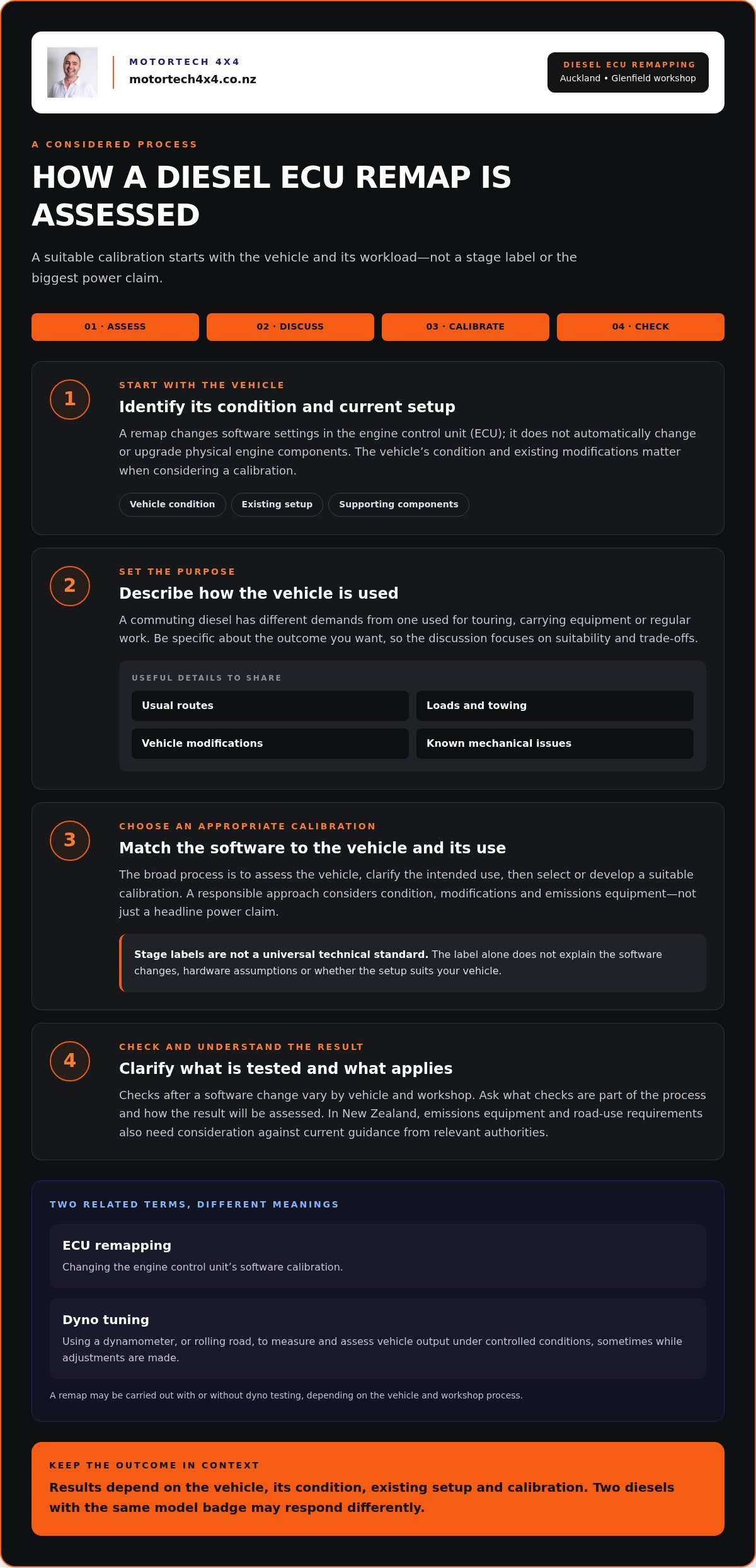
Broadly, the process involves assessing the vehicle, discussing its intended use, selecting or developing an appropriate calibration, and carrying out checks after the software change. The method varies with the vehicle and workshop. A useful discussion covers what is being changed, which checks are part of the process, and how the result will be assessed. In New Zealand, emissions equipment and road-use requirements also need to be considered against current guidance from relevant authorities.
A responsible calibration considers the vehicle’s condition, intended use, existing modifications and emissions equipment, rather than relying on a stage label or headline power claim.
What is the difference between ECU remapping and dyno tuning?
ECU remapping describes changing the engine control unit’s software calibration. Dyno tuning refers to using a dynamometer, or rolling road, to measure and assess vehicle output under controlled conditions, sometimes while adjustments are made. The terms are related, but they don’t mean the same thing. A remap may be carried out with or without dyno testing, depending on the vehicle and workshop process. Don’t assume dyno testing is part of every remap.
Testing and verification can take different forms. A workshop may use checks suited to the vehicle and the work being performed; equipment and procedures aren’t universal. For a diesel ECU remap Auckland enquiry, clarify how the calibration will be assessed without assuming a particular testing method or result.
What do Stage 1, Stage 2 and similar labels mean?
Stage labels are industry shorthand, not a universal technical standard. One tuner’s “Stage 1” may not describe precisely the same calibration as another’s. The label alone doesn’t tell you which software changes are included, what hardware is assumed or whether the setup suits your vehicle. Some stage descriptions refer to a vehicle with standard hardware; others may be associated with supporting modifications.
Look beyond the name. Discuss the calibration approach, any hardware assumptions and how these relate to your vehicle’s condition and use. A stage number cannot establish a specific power, torque or economy outcome, and it shouldn’t replace a clear explanation of the work involved.
If you’re weighing up a remap, describing your vehicle and intended use gives the conversation a practical starting point. Motortech 4X4 offers ECU remaps from its Glenfield workshop. You can discuss your vehicle with Motortech 4X4 as part of that decision.
Diesel ECU remap benefits and trade-offs: assess the claims carefully
A remap may change how a diesel performs, but advertised benefits aren’t a promise of what your vehicle will achieve. Manufacturer figures, tuner claims and results measured on another vehicle aren’t evidence of the outcome for yours. Its condition, modifications, load and driving pattern all affect what’s realistic.
Start with your objective, then weigh it against the conditions and questions below. This keeps a discussion about a diesel ECU remap Auckland focused on suitability rather than a headline claim.
| Potential objective | Relevant condition | Question to discuss |
|---|---|---|
| Change engine response or drivability | Vehicle condition, transmission behaviour and typical driving | What change is intended, and how will it be assessed? |
| Seek a performance change | Existing modifications, vehicle use and mechanical condition | What evidence applies to this vehicle and setup? |
| Reduce fuel use | Driving style, route, load and vehicle condition | Is economy the primary goal, and how would fuel use be compared fairly? |
| Suit the vehicle to work or touring | Regular loads, towing needs and operating conditions | How does the proposed calibration relate to that use? |
Can a diesel remap improve fuel economy?
Fuel use depends on more than calibration. Stop-start commuting, open-road cruising, hills, towing, cargo weight and driver behaviour can all affect consumption. Vehicle condition matters too. A result under one set of conditions may not carry over to another driver’s routine.
Treat economy as a possibility to discuss, not a guaranteed saving. If lower fuel use is your main aim, say so separately from any interest in performance. For a fair comparison, consider whether you can compare consumption before and after on similar routes, with similar loads and driving habits. Without like-for-like conditions, it’s difficult to attribute a change to the remap alone.
What reliability and compliance questions deserve attention?
Calibration choices should account for the vehicle’s mechanical condition, existing setup and intended use. A remap isn’t a repair and shouldn’t be expected to resolve an existing fault. If the vehicle has a known issue or warning light, mention it before considering software changes.
Also consider emissions equipment and New Zealand road-use requirements. Rules and inspection implications can depend on the vehicle and the work involved, so check current guidance from relevant New Zealand authorities, including Waka Kotahi NZ Transport Agency and, where applicable, the Low Volume Vehicle Technical Association. Don’t assume a calibration is compliant based solely on its description. Check warranty or insurance implications against the terms that apply to your vehicle.
A remap isn’t a universal fix. If a claim sounds broad, bring the conversation back to your vehicle, its condition and the outcome you want. That’s a more reliable basis for deciding whether the trade-offs make sense.
Before a diesel ECU remap: prepare your vehicle and questions
A useful remap discussion starts with accurate information, not assumptions about what the vehicle should gain. A clear account of its history and daily demands helps a specialist consider whether a calibration suits the vehicle and your priorities. Before enquiring about a diesel ECU remap Auckland service, gather the details below and note anything you’re unsure about.
Which vehicle details should you have ready?
Write down the vehicle’s make, model, year and engine details. If you don’t know the engine code or exact specification, share what you do know rather than guessing. Include available service history, current warning lights, known mechanical issues and previous engine or drivetrain work. A complete record supports an informed conversation, but it doesn’t replace an assessment of the vehicle.
- Describe its regular use. Note whether it’s mainly used for commuting, touring, work, towing or a mix. Explain typical routes and conditions, such as stop-start traffic, open-road travel or steep terrain.
- Be specific about loads. Mention passengers, tools, equipment, cargo or towing that are part of normal use. Occasional heavy loads may also be relevant if they shape your expectations.
- List existing modifications. Include changes to the engine, exhaust, intake, transmission or other components, and note when they were made if you know. Mention a modification even if you’re unsure whether it matters.
- Record known issues and servicing. Note warning lights, unusual behaviour, repairs and gaps in the service history. These details can help identify matters that need attention before discussing a calibration.
- Set a clear priority. Decide whether you’re seeking a change for everyday drivability, work use, touring or another reason. Keep fuel-economy expectations separate from your primary objective.
Think about the vehicle as a whole, too. If a remap is part of a wider touring or off-road plan, the Auckland 4×4 guide provides broader context on modifications, servicing and gear. If your build includes suspension changes, the suspension systems guide can help you consider that part of the setup separately from engine calibration.
Which questions help clarify whether remapping suits your use?
Ask how the vehicle’s condition and intended use inform the remap discussion, what changes are proposed and how the work will be assessed. Raise any current New Zealand road-use or emissions requirements that may apply, and check warranty and insurance implications against the terms relevant to you. Don’t assume one answer applies to every vehicle or policy.
Motortech 4X4’s mechanics, experienced with 4WDs, service all makes and models from its Glenfield, North Shore workshop. Bring your vehicle details, modification history and intended use to discuss an ECU remap with Motortech 4X4.
Diesel ECU remap Auckland: discuss your vehicle with Motortech 4X4
For Auckland diesel owners considering a remap, start with a vehicle-specific discussion rather than assuming every engine will deliver the same outcome. Motortech 4X4 offers ECU remaps at its workshop in Glenfield, on Auckland’s North Shore. Its mechanics are experienced with 4WDs and service all makes and models, bringing broader mechanical knowledge to the discussion.
What to expect when enquiring at Motortech 4X4
Give a clear picture of the vehicle and what you want it to do. Share its make, model, year and engine details, along with how you use it and any modifications or known issues. If you’re unsure about a detail, say so rather than guessing. Useful context keeps the discussion focused on your vehicle instead of a general promise.
Be direct about your priority. You might be interested in everyday drivability, regular work use or touring. Explain what matters most and what you hope to change. If fuel economy is part of the motivation, separate it from any performance goal so each can be discussed realistically. A remap is a calibration decision, not a guaranteed fix for mechanical concerns or a promise of a particular power, torque or fuel-use result.
The discussion should also account for the vehicle’s current condition and wider considerations. Raise known faults and ask how they affect suitability. If road use, emissions requirements, warranty or insurance are relevant to your decision, identify those questions and verify the guidance that applies to your vehicle and circumstances. Clear answers help you understand the decision before proceeding.
Auckland workshop support for your broader 4×4 needs
ECU remapping is distinct from servicing or a physical modification. Motortech 4X4 also provides 4×4 servicing and mechanical work, so the remap discussion takes place at a workshop that works across different makes and models. That broader mechanical context can help when considering a vehicle as a whole, while keeping software calibration separate from maintenance and hardware changes.
If your diesel is part of a larger touring or work build, explain how its other requirements fit into your plans. The remap can be discussed on its own merits alongside any related mechanical needs. This helps keep expectations practical, rather than treating an ECU change as a complete solution for every performance concern.
If you’re considering a diesel ECU remap Auckland service, bring your vehicle details and intended use to Motortech 4X4’s Glenfield workshop for a straightforward discussion. Discuss your vehicle with Motortech 4X4 and explore whether a remap suits your priorities.
Make your next step a vehicle-specific conversation
The next step isn’t choosing a tune by its label or headline claim. Decide what you want your diesel to do, then discuss whether a remap is a sensible fit for that vehicle and its condition. Keep expectations realistic, and allow for the possibility that a mechanical concern needs attention before the calibration is changed.
If you’re considering a diesel ECU remap Auckland service, Motortech 4X4 offers ECU remaps at its Glenfield workshop, and its mechanics service all makes and models. Take your vehicle details, history and intended use into the conversation. That gives the discussion a practical starting point without assuming a particular performance or fuel-economy result.
Discuss a diesel ECU remap for your vehicle with Motortech 4X4 and take the next step with a clearer understanding of your options.
Frequently Asked Questions
Is a diesel ECU remap legal in New Zealand?
A remap isn’t automatically illegal, but the changes must meet requirements that apply to the vehicle and its modifications. Under NZTA and LVVTA guidance, an increase of more than 20% in engine power or torque over the manufacturer’s original specification can require Low Volume Vehicle certification and a certification plate. Emissions equipment must also remain compliant. Check current requirements for your vehicle and proposed changes before proceeding.
Can a diesel ECU remap affect my vehicle warranty or insurance?
Yes, it may affect warranty cover or insurance, depending on the terms of your policy and the nature of the modification. A manufacturer may assess whether a fault relates to an engine calibration change, while an insurer may require disclosure of performance modifications. Don’t assume cover continues unchanged. Tell your insurer about the remap and review your policy wording; for warranty questions, check the terms that apply to your vehicle.
Can every diesel vehicle have an ECU remap?
No. Suitability depends on the vehicle’s ECU, engine setup, condition and existing faults. For example, a warning light or unresolved running issue may need attention before a calibration is considered. The vehicle’s age, modifications and intended workload also matter. An enquiry about a diesel ECU remap Auckland service is most useful when you can provide the make, model, year, engine details and known mechanical history.
Does a diesel remap require hardware changes?
Not always. Some calibrations are software changes to a vehicle with standard hardware, while other tuning approaches may rely on supporting modifications. The appropriate setup depends on the vehicle and intended calibration, so a stage label alone won’t tell you what parts are needed. Be clear about existing changes, such as intake or exhaust work, and establish whether the proposed calibration assumes hardware beyond the vehicle’s current configuration.
Can an ECU remap be reversed?
In some cases, the original ECU software can be restored, but reversibility depends on the vehicle and how the remap was carried out. Don’t assume returning to factory calibration removes every trace of a modification or resolves related warranty, insurance or compliance questions. Before work begins, ask how the original calibration is handled and what information about the change you should retain with the vehicle’s service records.
Will a diesel ECU remap affect my WOF?
It can, depending on the calibration and the vehicle’s resulting condition. A WOF inspection may be affected by non-compliant emissions equipment, excessive smoke or modifications that require certification. A remap that changes engine output beyond applicable thresholds may also have certification implications. A remap isn’t automatically a WOF failure, but don’t assume it passes by default. Check current NZTA inspection guidance for your vehicle and modification.