A clicking noise on a turn can point to an outer CV joint, while vibration under acceleration may relate to an inner joint or another driveline issue. If you’re considering CV joint replacement Auckland drivers should have the cause assessed before parts are replaced. Continuing to drive with a fault could allow damage to worsen.
It can be difficult to tell whether the problem is a worn joint, a damaged CV boot or another component. This guide explains common warning signs, what an assessment may involve and how findings can inform the repair decision, without asking you to diagnose the fault yourself.
You’ll also learn why a damaged boot may need attention before the joint, and when a complete assembly may be considered. Motortech 4X4 in Glenfield provides mechanical servicing for all makes and models, with specialist experience in 4WDs and genuine and high-quality OEM parts and consumables.
Key Takeaways
- Note when clicking, vibration or clunking occurs, but don’t rely on symptoms alone to identify the faulty component.
- A damaged CV boot, worn joint and complete drive shaft assembly can call for different repair approaches.
- Vehicle design and inspection findings help determine whether a boot, joint or assembly needs attention.
- For CV joint replacement Auckland drivers can arrange a mechanical assessment with Motortech 4X4 in Glenfield.
CV Joint Replacement Auckland: What the Joint Does and Warning Signs to Notice
A constant velocity (CV) joint transfers rotational power to the wheels while accommodating steering and suspension movement. Its design allows power to keep flowing as the wheel changes angle and position. The constant-velocity joint mechanics explain how it works through varying angles.
A noise or vibration alone can’t confirm that a CV joint is faulty. An assessment helps distinguish possible joint wear from other causes before repair work is decided.
Which symptoms can point to a CV joint problem?
Clicking, knocking or popping during a turn can be associated with a CV joint, particularly if the sound repeats as the wheel rotates. Vibration under acceleration may also warrant a drivetrain inspection. Neither symptom proves that the CV joint needs replacement. Other drivetrain, wheel or suspension components can produce similar signs.
Note the conditions in which the symptom occurs. Does the sound happen while turning, under acceleration or at a particular speed? Does it change with the vehicle’s movement? Share these details during assessment. They can help a mechanic understand when the symptom occurs and narrow down what needs inspection.
What does a CV boot protect?
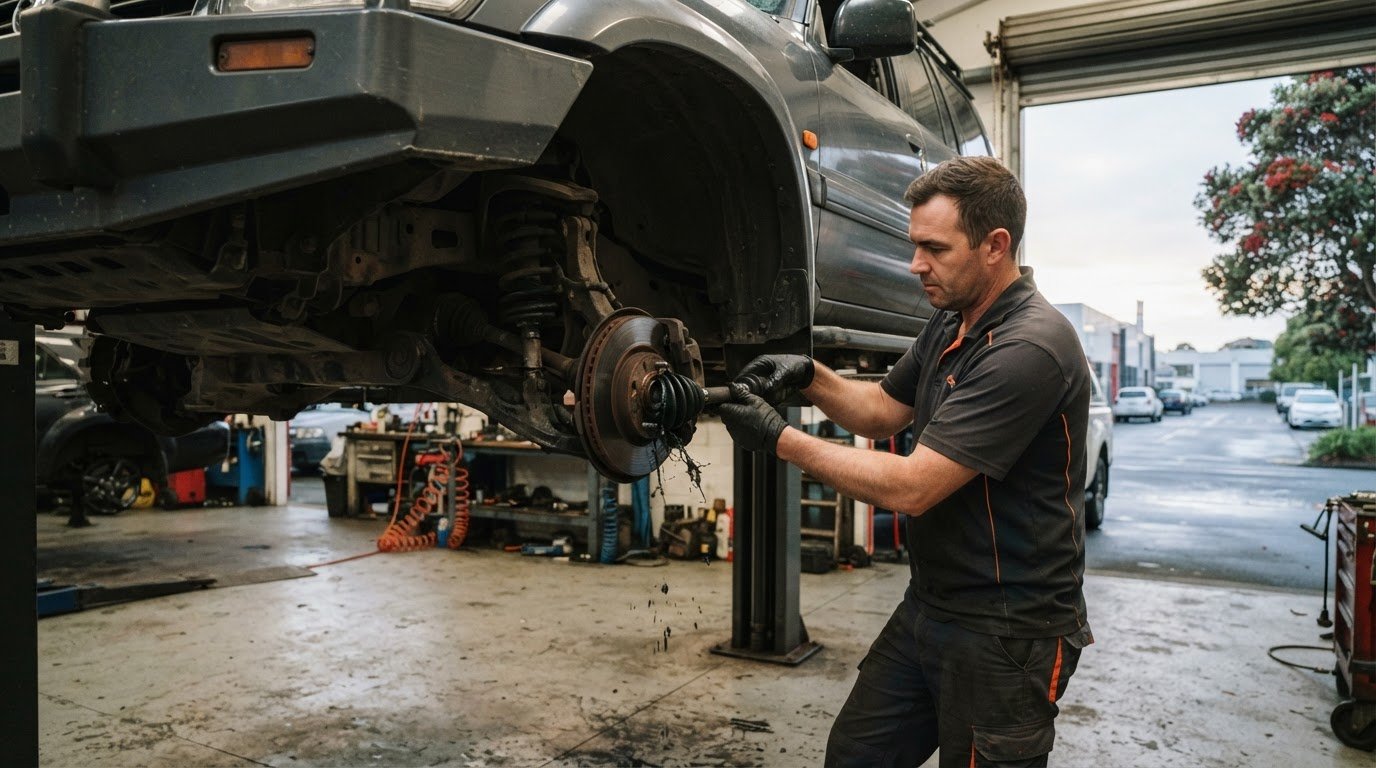
A CV boot is a flexible cover around the joint. It helps keep lubricating grease inside and road contaminants out. If the boot splits or its seal is compromised, grease may escape and dirt or moisture may reach the joint.
A damaged boot doesn’t automatically mean the joint needs replacement. If the joint is still in suitable condition, the repair may differ from what’s needed when internal wear or damage is found. The condition of both components needs to be assessed before the repair scope is determined. That distinction matters when arranging CV joint replacement in Auckland: the assessment should establish whether the boot, joint or both need attention.
CV Joint, Boot or Drive Shaft: What Needs Assessment Before Replacement?
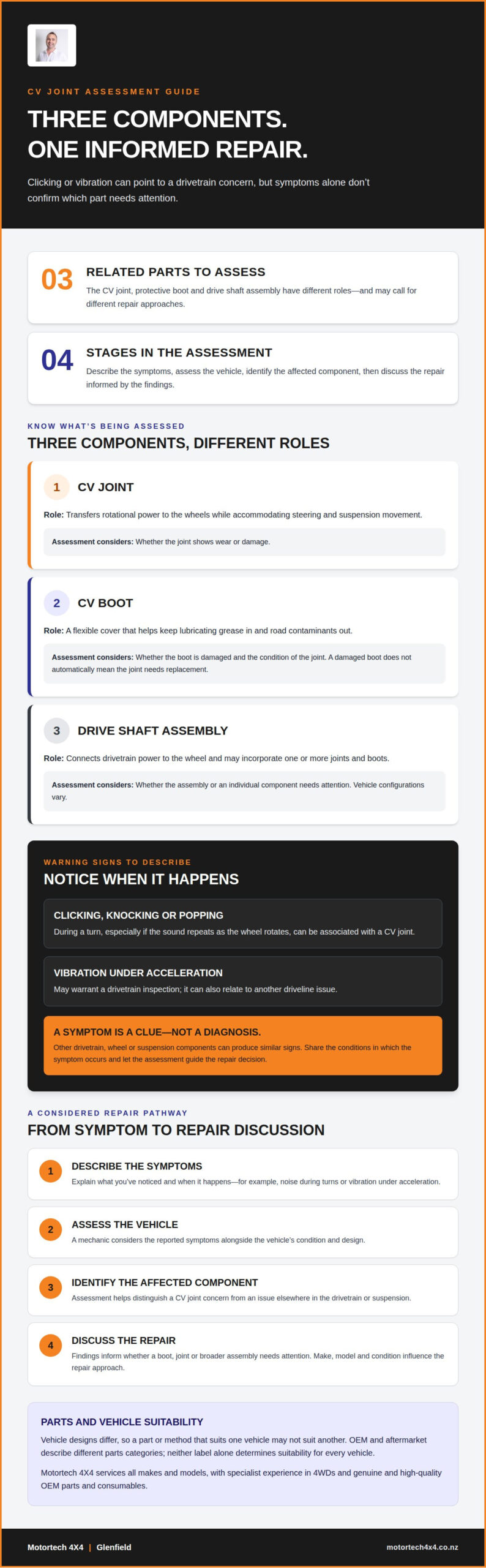
A noise or vibration doesn’t identify which part has failed. A CV joint, its protective boot and the drive shaft are related, but each has a different role and may call for a different repair. Vehicle design and inspection findings guide the decision, not symptoms alone.
How do a CV joint, boot and drive shaft differ?
| Component | Role | What assessment considers |
|---|---|---|
| CV joint | Moving power-transfer component that accommodates changes in wheel angle and position. | Whether the joint shows wear or damage. |
| CV boot | Protective cover that helps retain grease and keep contaminants out. | Whether the boot is damaged and the joint’s condition. |
| Drive shaft assembly | Connects drivetrain power to the wheel and may incorporate one or more joints and boots. | Whether the assembly or an individual component needs attention. |
Configurations vary between vehicles, so these terms don’t describe identical parts in every make and model. A damaged boot may be the main concern. A worn joint or broader assembly damage can change the repair scope.
Why does diagnosis matter before parts are selected?
Clicking or vibration can also come from other drivetrain or suspension components. An assessment considers the reported symptoms alongside the vehicle’s condition and design to identify the likely source before parts are selected. General information on symptoms of a failing CV joint can explain common signs, but it can’t establish what’s wrong with a particular vehicle.
OEM and aftermarket describe different parts categories; neither label alone determines suitability for every vehicle. Motortech 4X4 uses genuine and high-quality OEM car parts and consumables. Auckland drivers can arrange mechanical servicing at the Glenfield workshop through Motortech 4X4 mechanical servicing.
What to Expect During CV Joint Assessment and Replacement in Auckland
A clear description of the problem helps start the assessment, but you don’t need to identify the faulty part yourself. For CV joint replacement in Auckland, the repair decision should follow an assessment of the vehicle and the component’s condition.
What information should you share when booking?
Describe the sound or vibration in everyday terms, including when it occurs and whether the vehicle’s behaviour has changed. For example, mention if a noise happens during turns or vibration appears under acceleration. Share the vehicle’s make and model, along with relevant service history if you have it. These details give the workshop useful context without requiring you to diagnose the fault.
How does the workshop approach support a considered repair?
The process follows a clear sequence:
- Describe the symptoms: Explain what you’ve noticed and the conditions in which it happens.
- Assess the vehicle: A mechanic considers the reported symptoms and the vehicle’s condition.
- Identify the affected component: The assessment helps distinguish a CV joint concern from an issue elsewhere in the drivetrain or suspension.
- Discuss the repair: The findings inform whether a joint, boot or broader assembly needs attention.
Make, model and condition all influence the component and repair approach. Vehicle designs differ, so a part or method that suits one vehicle may not suit another. Motortech 4X4 services all makes and models, with experience in 4WDs, and uses genuine and high-quality OEM parts and consumables in its workshop.
For local context on servicing and four-wheel-drive vehicles, explore this Auckland 4×4 guide. To arrange an assessment, book mechanical servicing with Motortech 4X4 at its Glenfield workshop.
Arrange CV Joint Mechanical Service with Motortech 4X4 in Glenfield
If you suspect a CV joint fault, a local mechanical assessment is a practical step towards understanding what needs attention. Motortech 4X4 is based in Glenfield on Auckland’s North Shore and provides mechanical work for all makes and models, with experience servicing 4WDs.
Why Auckland drivers choose a local mechanical workshop
Describing when a noise or vibration occurs gives the mechanic useful context. An assessment can help identify whether the concern relates to a CV joint or another component, so the repair discussion is based on the vehicle’s condition rather than symptoms alone. Share what you’ve noticed, then use the assessment to understand the findings and repair approach.
If the sound seems related to the suspension as well as the drivetrain, the suspension systems guide offers broader context on suspension components and their role in vehicle performance.
Book a mechanical assessment in Glenfield
Motortech 4X4 provides mechanical servicing for all makes and models, alongside specialist 4WD servicing. Its fully equipped workshop uses genuine and high-quality OEM car parts and consumables. For Auckland drivers, the Glenfield workshop provides a local place to discuss a mechanical concern and have the vehicle assessed.
Have your vehicle’s make and model ready for the booking discussion. Describe the noise or vibration, when it occurs and any changes in how the vehicle behaves. Relevant service history can also provide useful context. You don’t need to identify the failed component before arranging an assessment.
Arrange a mechanical assessment at the Glenfield workshop with Motortech 4X4. Share your vehicle details and the symptoms you’ve noticed to help explain the concern.
Move Towards a Clear Repair Plan
An unexplained drivetrain noise can leave you weighing up whether to keep driving, seek advice or prepare for a repair. The next step doesn’t have to be a guess. An assessment can turn your observations into a clearer understanding of the issue and the options to consider.
For CV joint replacement in Auckland, a considered decision starts with the vehicle’s condition, not an assumption based on one symptom. Once the assessment is complete, discuss which component is affected and why the proposed repair suits its condition and vehicle design. That gives you a practical basis for deciding how to proceed without needing to interpret the mechanical fault yourself.
Bring your observations and vehicle details to the booking conversation, then let the assessment guide what happens next. Arrange mechanical service with Motortech 4X4 in Glenfield to discuss your concern.
Frequently Asked Questions
What are the signs of a failing CV joint?
Repeated clicking or popping during a turn, vibration under acceleration, or grease splashed around a wheel area can be warning signs. Note whether the sound changes with steering direction or vehicle speed, and whether vibration appears only while accelerating. These details help describe the issue, but can’t confirm the cause. Other drivetrain or suspension faults may produce similar symptoms, so a mechanical assessment is needed.
Can I keep driving with a clicking CV joint?
A clicking noise deserves prompt attention, but it doesn’t establish how serious the fault is or whether the CV joint is responsible. Avoid deliberately repeating the manoeuvre to test the noise. If the vehicle develops strong vibration, changes in handling or a worsening noise, pull over somewhere safe and arrange mechanical advice before continuing. An assessment can help clarify the concern and the appropriate next step.
How long does CV joint replacement take?
There isn’t one reliable timeframe for every vehicle. The work can depend on the vehicle’s make and model, access to the affected component, its condition and whether additional work is needed. For CV joint replacement in Auckland, a workshop can give a more useful time estimate after assessing the vehicle and identifying the repair scope. A generic online timeframe may not apply to your vehicle.
Is a CV joint the same as a drive shaft?
No. A CV joint allows power transfer while accommodating wheel movement; the drive shaft is the assembly that carries power between the drivetrain and wheel. A drive shaft may include CV joints and protective boots, but layouts differ between vehicles. A fault may involve one component rather than the complete assembly, so inspection helps identify what requires attention.
Can a damaged CV boot be repaired without replacing the CV joint?
Sometimes, a damaged boot can be replaced without replacing the joint, provided an assessment finds the joint remains serviceable. A split boot may have allowed grease to escape or contaminants to enter, so its appearance alone doesn’t show the joint’s internal condition. Both parts need to be assessed before the repair scope is determined. If the joint is worn or damaged, replacing the boot alone may not address the fault.