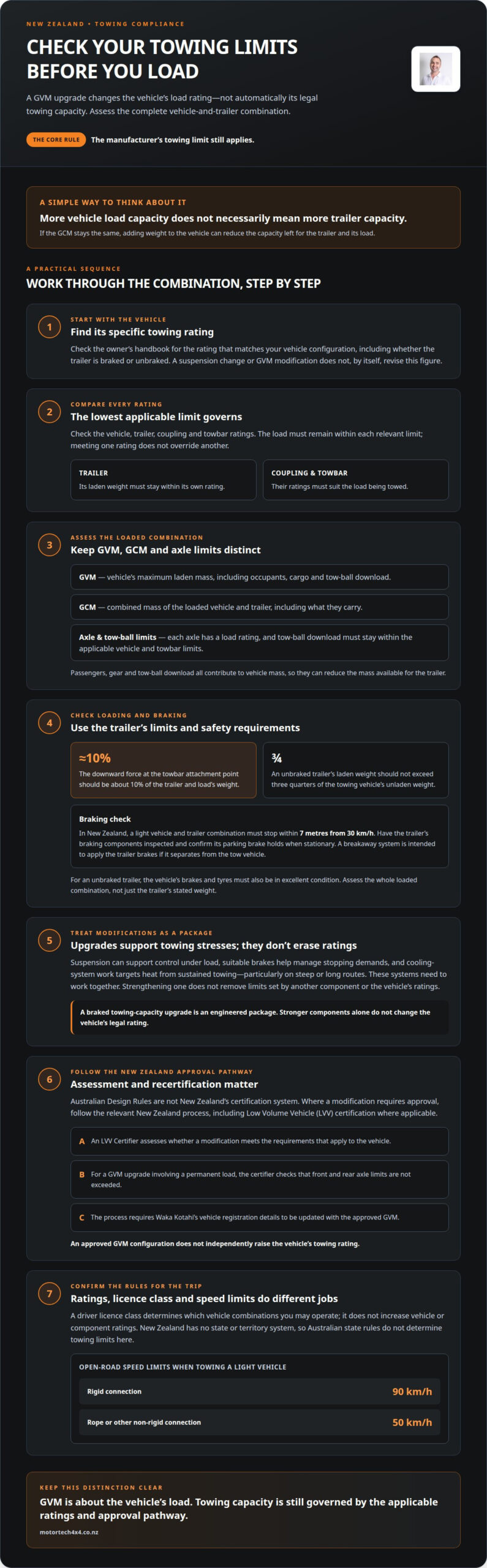
A GVM upgrade doesn’t, by itself, legally increase a vehicle’s towing capacity in New Zealand. The manufacturer’s towing limit still applies. To understand how to increase vehicle towing capacity legally, distinguish the vehicle’s GVM from its towing rating and Gross Combination Mass (GCM).
Stronger suspension or a higher GVM rating may seem to mean a vehicle can tow more, but these changes address different limits. If the GCM stays the same, a GVM upgrade can reduce the remaining capacity for the trailer and its load.
This guide explains the manufacturer’s limits, why a modification alone may not change the legal towing rating, and how engineering assessment and recertification fit into compliant vehicle modifications. It also explains when a GVM upgrade may help carry more in the vehicle, and why that is not the same as increasing towing capacity.
Key Takeaways
- Keep towing capacity, GVM and GCM distinct; a higher GVM rating alone doesn’t permit a heavier trailer.
- Suspension, brake and cooling-system upgrades can support towing, but modifications alone don’t change the vehicle’s legal towing limit.
- Understand how engineering assessment and recertification apply to the vehicle’s modifications and compliance pathway in New Zealand.
- Assess the loaded vehicle and trailer as a combination, because added vehicle weight can reduce the remaining capacity within the GCM.
Braked Towing Capacity (BTC) Upgrades: Do You Need One?
GVM includes the vehicle, everything inside it and tow-ball weight. GCM covers the loaded vehicle and trailer. Axle ratings and tow-ball download limits also apply, so meeting one rating doesn’t override another.
Effects of a braked-capacity upgrade
A braked towing-capacity upgrade is an engineered package intended to support a heavier braked trailer load by modifying relevant vehicle systems. Stronger components alone don’t change the vehicle’s legal rating. The modification must follow an applicable approval and recertification pathway before you can rely on a revised capacity. A GVM change addresses vehicle load, not necessarily trailer capacity.
Suspension, brake and cooling upgrades
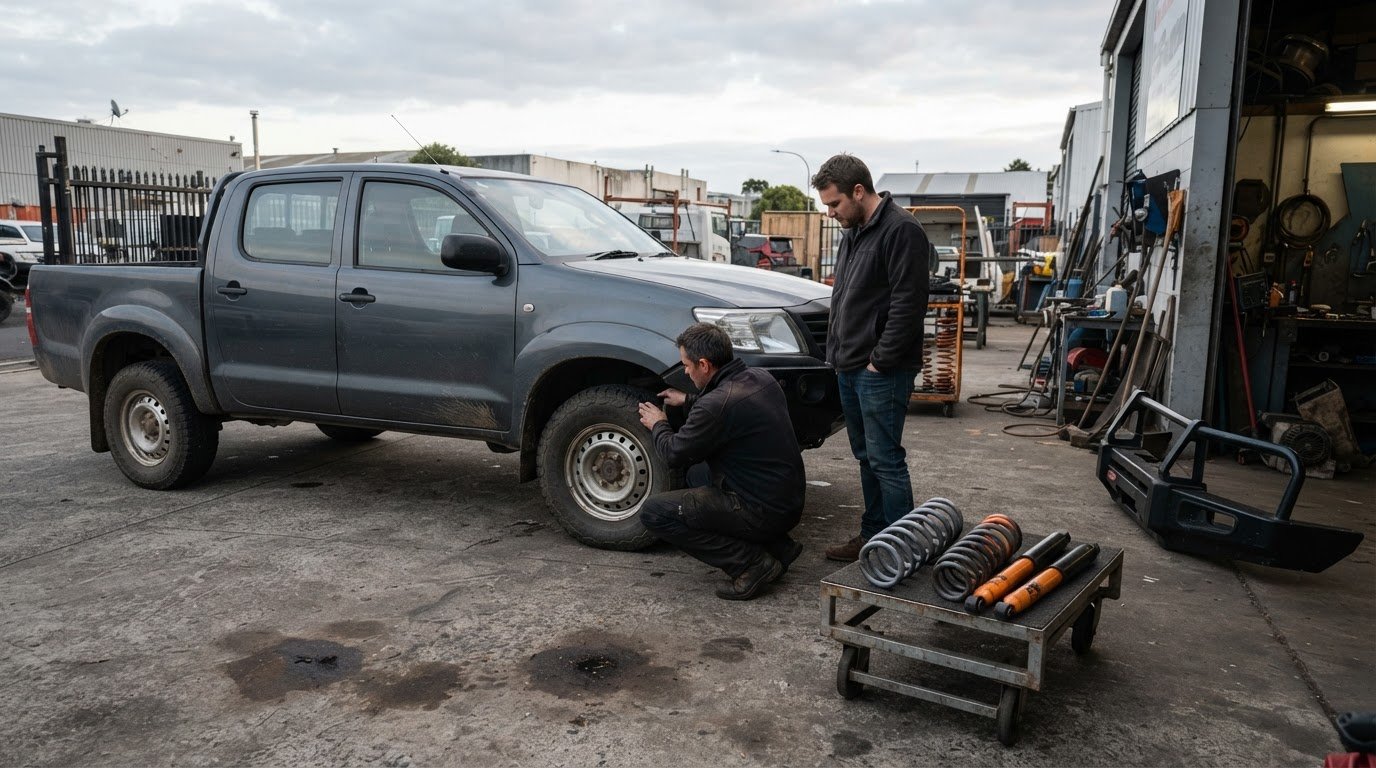
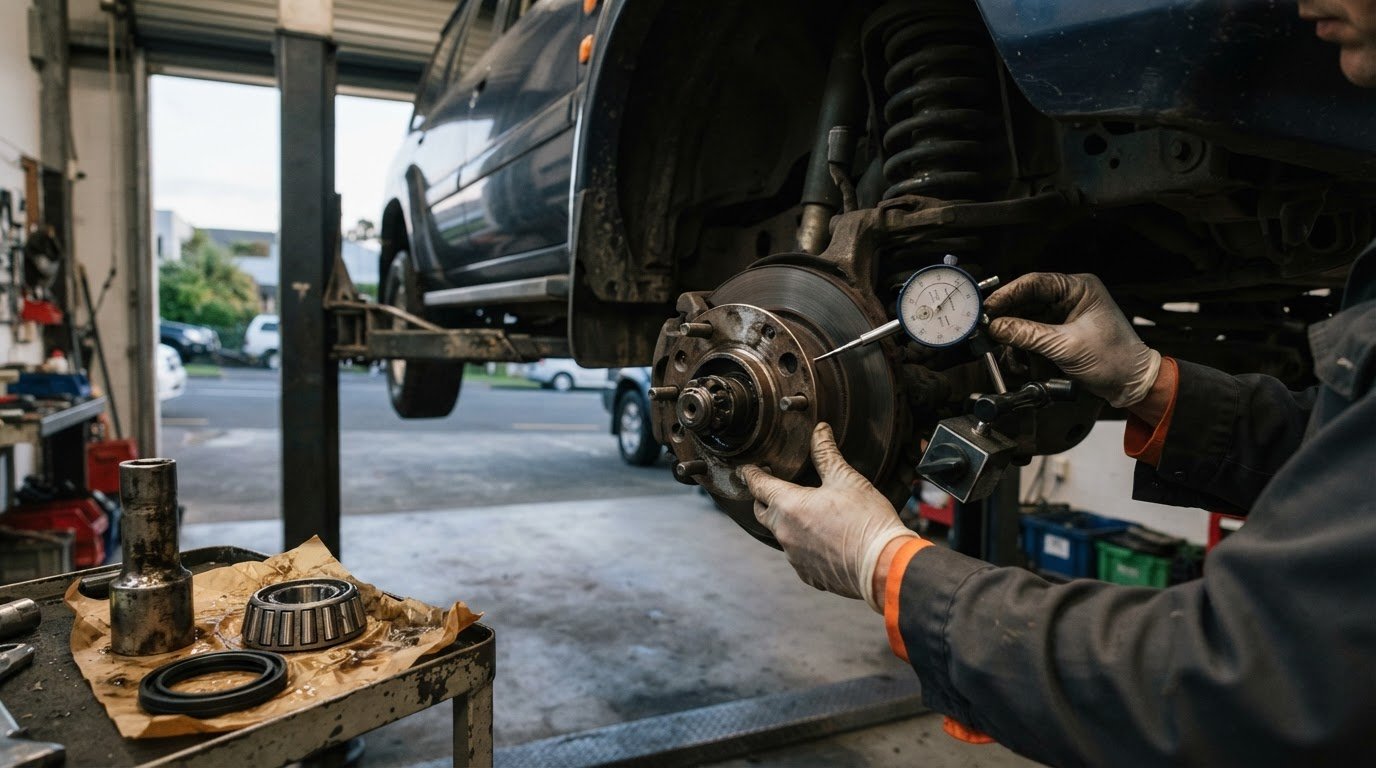
Suspension, brake and cooling-system changes address different towing stresses. Suspension upgrades can support control under load, suitable brakes help manage stopping demands, and cooling-system work targets heat from sustained towing, particularly on steep or long routes. These modifications need to work as a matched package: strengthening one system doesn’t remove limits set by another component or the vehicle’s ratings.
Trailer braking and weight distribution
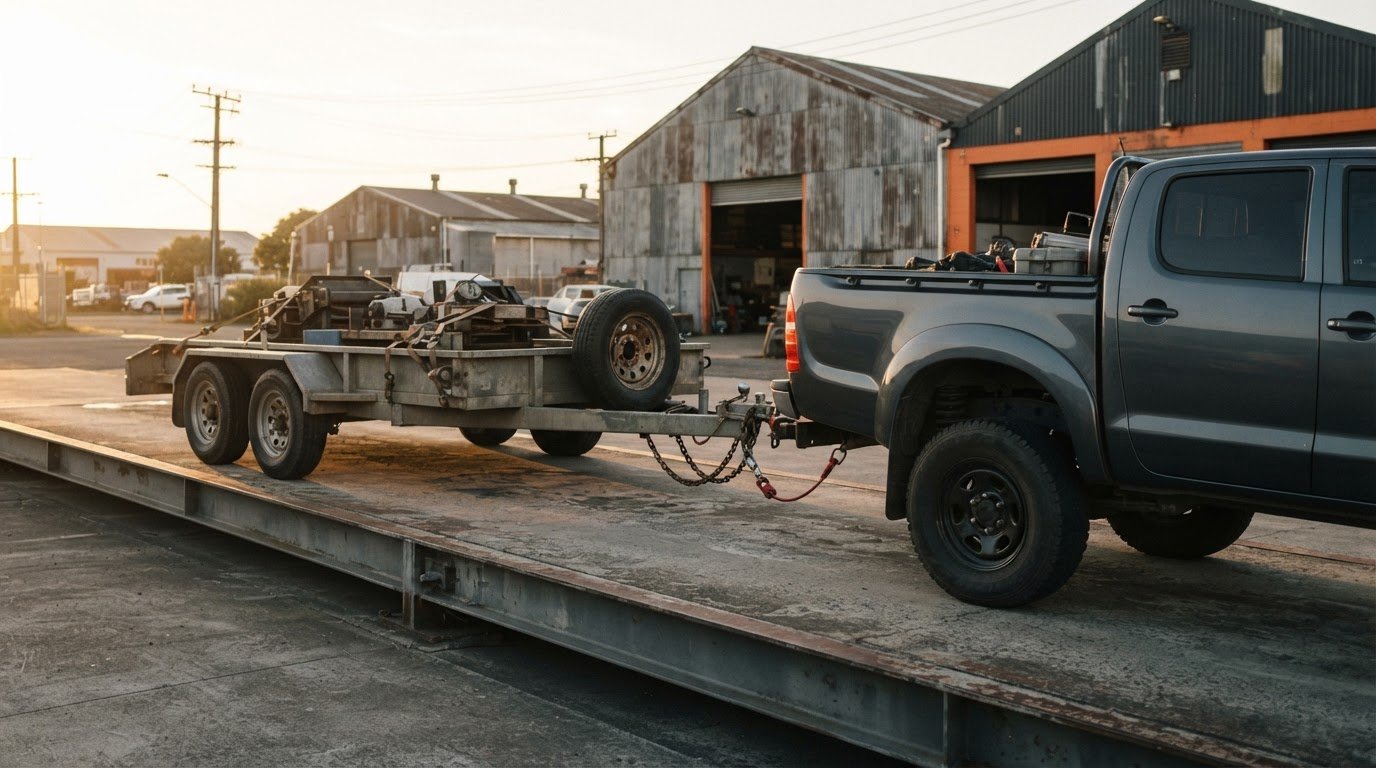
Trailer brakes contribute to stopping, while service brakes, parking brakes and breakaway brakes each have distinct roles. Before a trip, have the trailer’s braking components inspected and confirm its parking brake holds when stationary. A breakaway system is intended to apply the trailer brakes if it separates from the tow vehicle. In New Zealand, a light vehicle and trailer combination must stop within 7 metres from 30 km/h.
Weight distribution matters too. The downward force at the towbar attachment point should be about 10% of the trailer and load’s weight. Poor loading can affect handling and place uneven demands on the vehicle and trailer.
Vehicle mass and axle-load limits
GVM is the vehicle’s maximum laden mass, including occupants, cargo and tow-ball download. GCM is the combined mass of the loaded vehicle and trailer, including everything carried in or on them. Each axle has a load rating, and tow-ball download must stay within the applicable vehicle and towbar limits. Passengers or gear can therefore reduce the mass available for the trailer.
For an unbraked trailer, laden weight should not exceed three quarters of the towing vehicle’s unladen weight. The vehicle’s brakes and tyres must also be in excellent condition. Assess the complete loaded combination, not just the trailer’s stated weight.
Towing beyond the manufacturer’s limit
In New Zealand, the manufacturer’s towing rating is a key limit, alongside the ratings for the trailer, coupling and towbar. Exceeding any component’s rating can put extra stress on the combination and increase the risk of mechanical failure or loss of control.
Manufacturer-rated towing limits
The manufacturer-rated limit is the maximum trailer load specified for a vehicle configuration. Find the towing details in the owner’s handbook and use the rating for your specific vehicle, including whether the trailer is braked or unbraked. A suspension or GVM modification does not, by itself, revise that figure.
Gross Combination Mass (GCM) is the total mass of the loaded vehicle and trailer. Even if the trailer is within its own rating, the combined load must also stay within the vehicle’s applicable limits.
Legal towing capacity in New Zealand
In New Zealand, a vehicle’s legal towing capacity is constrained by the manufacturer’s rating and the relevant ratings for the trailer, coupling and towbar. The lowest applicable rating limits the load. A driver licence class determines which vehicle combinations the driver may operate, but it doesn’t increase the vehicle’s towing or component ratings.
For a light vehicle towing with a rigid connection, the open-road speed limit is 90 km/h. With a rope or another non-rigid connection, the maximum open-road speed is 50 km/h.
Trailer, coupling and towbar limits
Match the trailer, coupling and towbar ratings to the load. The hitch must have a towing-capacity rating suitable for that load, and the trailer’s laden weight must remain within its own limit. Tow-ball download also adds weight to the vehicle, so assess the loaded combination rather than the trailer alone.
For an unbraked trailer in New Zealand, laden weight should not exceed three quarters of the towing vehicle’s unladen weight. The vehicle’s brakes and tyres must also be in excellent condition.
State and territory towing rules
New Zealand has no state or territory system, so Australian state rules don’t determine towing limits here. Follow the vehicle and equipment ratings that apply to your combination. For example, check the manufacturer’s handbook and the trailer and towbar ratings before loading.
Towing above a vehicle’s rated capacity can cause dangerous failures or loss of control. The specific legal consequence depends on the breach. A licence class doesn’t make an overloaded combination compliant.
Australian Design Rules and authorised engineers
Australian Design Rules apply to Australian vehicles and approval pathways, not as New Zealand’s certification system. For vehicles registered in New Zealand, modifications requiring approval follow the relevant New Zealand certification process, including Low Volume Vehicle (LVV) certification where applicable.
New Zealand certification and engineering assessment
An LVV Certifier assesses whether a modification meets the requirements that apply to the vehicle. For a GVM upgrade involving a permanent load, the certifier checks that front and rear axle limits are not exceeded. The process also requires Waka Kotahi’s vehicle registration details to be updated with the approved GVM. These steps establish the modified vehicle’s approved configuration, but don’t independently raise its towing rating.
For a vehicle already registered in New Zealand, the GVM upgrade kit must be approved by an accepted overseas government agency and installed by a technician authorised by the kit manufacturer. Installation must follow the kit specifications.
Pre-registration labels and vehicle class
A GVM upgrade fitted before a new vehicle is registered may use an acceptable Second Stage of Manufacture (SSM) compliance label instead of LVV certification. The label must have a silver background and show the new GVM rating. A label marked ‘nonstandard’ doesn’t make the upgrade acceptable without LVV certification.
Vehicle class also sets a firm boundary. An NA-class light goods vehicle has a maximum allowable GVM of 3500 kgs. If its GVM is raised above 3500 kgs, it must be reclassified as a heavy vehicle and cannot use the LVV system for that change.
Certification records and configuration
The LVV Certifier must retain the overseas compliance documents and kit details in the certification file, including the vehicle VIN and kit part number. This record links the approved equipment to the specific vehicle and installation.
Changes outside the kit manufacturer’s specifications can invalidate an approved upgrade. Examples include changing tyre size or fitting an unapproved suspension modification. To preserve the approval, keep the vehicle aligned with its certified setup.
Legal towing-capacity increases and recertification
In New Zealand, a GVM upgrade alone doesn’t legally raise a vehicle’s towing capacity. Understanding how to increase vehicle towing capacity legally means separating a change in carrying capacity from approval to tow more.
Manufacturer and engineer approvals
A manufacturer-supported modification or engineering assessment can contribute to an approval pathway, but neither automatically changes the towing rating. A GVM upgrade doesn’t change Gross Combination Mass (GCM), so additional vehicle weight reduces the capacity remaining for the trailer.
Understanding how to increase vehicle towing capacity legally also means recognising certification’s limits. GCM upgrades lack a standardised test, and some specialists say they cannot be certified. An engineer’s involvement shouldn’t be treated as automatic authorisation to exceed the manufacturer’s towing limit.
Certification for towing-related modifications
For a GVM upgrade on a vehicle already registered in New Zealand, the kit must be approved by an accepted overseas government agency. A technician authorised by the kit manufacturer must install it, and the vehicle must receive Low Volume Vehicle (LVV) certification.
As part of the process, an LVV Certifier checks front and rear axle limits if a permanent load has been added. Waka Kotahi’s vehicle registration details must be updated with the approved GVM. The certification file also retains overseas compliance documents and kit details, including the vehicle VIN and kit part number.
Modification certification process and costs
Use an eligible kit, have an authorised technician install it to the manufacturer’s specifications, then complete LVV certification and update the vehicle registration details. Modifications outside the kit specifications, such as changing tyre size or fitting an unapproved suspension modification, can invalidate the upgrade.
Certification costs depend on the vehicle, kit, installation and assessment requirements, with the cost provided after a quote request. Keep the final vehicle configuration consistent with the certified setup so the approval reflects the modifications actually fitted.
Motortech 4X4: Vehicle lighting
Motortech 4X4 can help with vehicle upgrades that complement a towing setup, including vehicle lighting and suspension kits. These additions may support a broader vehicle setup, but they should not be treated as a substitute for checking applicable towing limits and certification requirements.
Consider vehicle lighting when you need to improve your vehicle’s lighting setup for towing conditions. Suspension kits may be relevant when planning a broader vehicle modification, but the vehicle’s ratings and certification requirements still apply. Bullbars and snorkels are also available as 4×4 accessories, each serving a different purpose from increasing towing capacity.
For a practical discussion about suitable vehicle upgrades, contact Motortech 4X4.
Plan your next vehicle upgrade
A towing setup is a whole-vehicle decision, not a single-part change. Before choosing a modification, define what the vehicle needs to carry and tow, then keep the approved configuration and its limits in view. This helps you assess how to increase vehicle towing capacity legally without confusing performance upgrades with a revised towing rating.
Motortech 4X4 offers Suspension Kits, Bullbars and Snorkels for vehicle modifications and accessories. These components serve different purposes, so selecting one should start with the needs of your vehicle rather than an assumption that it will raise towing capacity.
For a considered next step, discuss your towing setup with Motortech 4X4. A clear plan helps you move forward with your vehicle and its intended use in mind.
Frequently Asked Questions
Can You Legally Increase Your Towing Capacity?
Not through a GVM upgrade alone. In New Zealand, increasing a vehicle’s carrying capacity doesn’t automatically change its towing rating or Gross Combination Mass. A modification must follow the applicable approval and certification pathway, and the vehicle’s approved ratings still govern towing. If those ratings remain unchanged, upgraded suspension or brakes don’t give you permission to tow a heavier trailer.
How much can your vehicle tow safely?
Your safe towing load is limited by the lowest applicable rating for the vehicle, trailer, coupling and towbar, as well as the combination’s mass limits. In a fully packed touring vehicle, passengers, luggage and accessories all contribute to its loaded mass and affect the capacity remaining for the trailer. Include the trailer’s contents too, not just its empty weight, when assessing the complete setup.
Where can I find a vehicle’s braked and unbraked towing limits in NZ?
Start with the vehicle owner’s handbook, which gives the towing limits for that model and may distinguish between braked and unbraked trailers. Use the figures for your specific vehicle rather than assuming another model in the same range has the same limits. The trailer and towbar also have relevant ratings, so the handbook is only one part of the load assessment.
How do suspension, brakes, tyres, and cooling modifications affect legal towing capacity in New Zealand?
These modifications can support control, stopping, tyre performance or heat management under towing loads, but they don’t automatically revise the vehicle’s legal towing rating. Their effect depends on the approved modification and how the vehicle is configured. For example, a suspension change outside an approved GVM kit’s specifications can invalidate that upgrade. Treat component performance and legal capacity as separate questions.
What are the risks and penalties for towing above a vehicle’s rated capacity in NZ?
Towing above a vehicle’s rated capacity can cause dangerous mechanical failures or loss of control. The legal consequence depends on the specific breach. A driver licence class doesn’t make an overloaded combination compliant.