
Could a change to your vehicle’s software make overtaking or towing feel more confident without creating new reliability or compliance concerns? That’s the question behind the benefits of an ECU remap, and the answer depends on more than a headline power claim. Your engine’s condition, hardware and everyday workload all matter.
It’s reasonable to want stronger performance or improved drivability while being wary of exaggerated gains, extra fuel use or added strain on components. A remap adjusts the engine control unit’s calibration, with changes to areas such as fuelling, boost and ignition depending on the engine. Results vary, and a tune suited to one vehicle may not suit another.
This guide explains the practical changes a remap may deliver, the trade-offs to weigh up, and what to consider around reliability, fuel consumption, New Zealand compliance, insurance and warranty conditions. Vehicle health and intended use should shape any calibration. At Motortech 4X4’s Auckland workshop, ECU remapping sits alongside vehicle servicing and mechanical expertise, so an assessment can take your vehicle and its everyday use into account.
Key Takeaways
- The benefits of an ECU remap depend on your engine, vehicle condition and driving priorities, not just advertised performance claims.
- Understand how calibration changes can affect throttle response and power delivery, and why outcomes vary between vehicles.
- Weigh potential drivability gains against fuel use, mechanical considerations and New Zealand compliance requirements.
- Use your typical Auckland driving and touring plans to decide what you want a remap to achieve.
- A vehicle-specific assessment at Motortech 4X4 can help you discuss your vehicle’s condition, intended use and suitable calibration options.
What are the benefits of an ECU remap for everyday driving?
An ECU remap changes the calibration, or software settings, used by a vehicle’s engine control unit. The ECU processes information from sensors and manages systems such as fuel injection and ignition to control how the engine operates. The Engine Control Unit (ECU) is central to that process, but the effect of a remap depends on the engine and its existing setup.
In brief: An ECU remap adjusts engine-control software to change how the engine responds and delivers power. Results depend on the vehicle and aren’t guaranteed.
What changes when an ECU is remapped?
A remap revises selected calibration settings that guide engine operation under different conditions. Depending on the vehicle and its software, those settings may affect how quickly the engine responds to driver input and how it delivers power across the rev range. Changes need to account for the engine’s design and operating limits. A calibration that works for one model or engine variant isn’t automatically suitable for another.
Which everyday benefits might drivers notice?
Drivers may notice a change in throttle response. The engine might react more promptly, or its response may feel better matched to how the accelerator is used. Power delivery could also feel more progressive, with less need to adjust driving inputs to maintain momentum. These are possible outcomes, not standard results for every vehicle.
In Auckland traffic, a predictable response can make everyday acceleration feel more natural. On a hill or while towing, a change in how power arrives may affect how the vehicle holds speed or responds to the accelerator. The same applies to a loaded ute, although load, gearing, road gradient and engine condition all influence the experience. A remap won’t remove the physical demands of towing or carrying weight.
Fuel use is also affected by driving style and conditions. A calibration shouldn’t be treated as a promise of lower consumption. Frequent acceleration, heavy loads, stop-start traffic and road gradients can all shape real-world results, so don’t assume a claimed benefit will apply to every trip.
The practical benefits of an ECU remap are best judged against a clear goal, such as a response that better suits regular driving or loaded use. Consider what feels limiting now, then weigh that against the vehicle’s maintenance history and condition. A vehicle-specific assessment can help establish whether calibration is appropriate and set realistic expectations before any change is made.
How does an ECU remap create changes in engine performance?
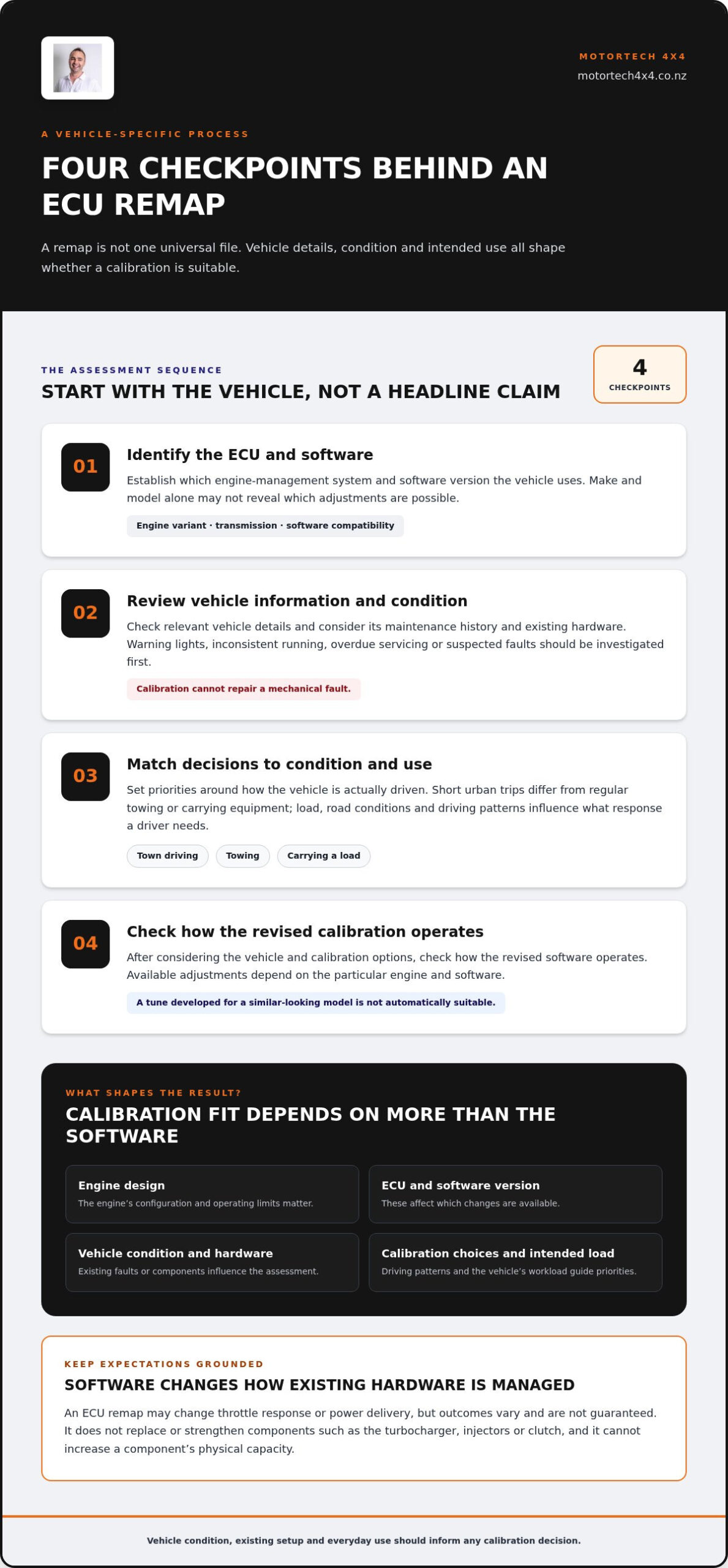
An ECU remap changes engine behaviour through a sequence of vehicle-specific decisions, not by applying one universal file to every car. Specialist tuning firms such as Dynogen Remapping Solutions structure this process around identifying the vehicle and its engine-management system, reviewing relevant vehicle information, deciding whether changes suit its condition and intended use, and checking how the revised calibration operates. Available adjustments depend on the particular engine and software.
The role of the engine control unit
The engine control unit receives information from sensors and uses programmed instructions to manage engine functions. Factory calibration is the original set of instructions for that vehicle’s configuration. Where the system allows, a tailored calibration may alter selected instructions to change how the engine responds. For example, an owner who regularly carries a load may have different priorities from someone who mainly drives an unladen car in town. This illustrates a possible calibration goal, not a promised result.
A technician needs to establish which ECU and software version the vehicle uses before considering changes. Make and model alone may not tell the whole story: engine variant, transmission, existing hardware and software compatibility can affect which adjustments are possible. Reading the vehicle’s information is an important starting point, rather than assuming a tune developed for a similar-looking model will suit.
Why vehicle condition and calibration quality matter
Calibration can’t repair a fault. Warning lights, inconsistent running, overdue servicing or a suspected mechanical issue should be investigated before performance changes are considered. An existing problem may affect how the vehicle behaves or make it harder to judge the effect of revised software. Motortech 4X4’s mechanical and servicing experience supports a practical focus on vehicle condition when assessing a remap.
Once the vehicle’s details and condition are understood, its intended use helps guide decisions. A car used mostly for short urban trips has a different duty cycle from a ute regularly towing or carrying equipment. Load, road conditions and driving patterns all influence what a driver needs from engine response. Calibration choices also depend on the engine’s design, the software’s available controls and the parameters that can be responsibly adjusted. Determining safe operating limits requires vehicle and calibration expertise, not guesswork.
Remap outcomes vary with engine design, ECU and software version, vehicle condition, existing hardware, calibration choices, intended load and real-world driving conditions. A post-adjustment check helps assess whether the calibration is operating as intended; the exact checks depend on the vehicle and tuning method. A remap doesn’t replace routine servicing, and maintenance remains necessary after software changes.
For broader context, automotive industry analysis of ECU remapping discusses market drivers such as performance optimisation and fuel efficiency. Those industry-level aims aren’t a guarantee of what an individual vehicle will achieve. Motortech 4X4 provides ECU remapping in Auckland, with assessment informed by the vehicle’s condition and intended use. Find out more about an Auckland ECU remap assessment.
ECU remap benefits versus trade-offs: what should drivers weigh?
A remap can change how an engine responds, but more performance isn’t automatically risk-free or right for every vehicle. Compare what you want to improve with what your vehicle’s condition, intended use and compliance obligations allow. Use the points below to set realistic expectations, not as a promise of a particular result.
| Potential benefit | Trade-off or consideration |
|---|---|
| Throttle response may feel better suited to everyday driving. | Response depends on the engine, calibration and vehicle condition; it may not feel the same in every driving situation. |
| Power delivery may better suit regular towing or carrying loads. | Extra demand can matter to components already affected by wear or maintenance issues. |
| A calibration may be designed around a particular driving priority. | There’s no universal tune, and a remap can’t make unsuitable hardware fit for a different workload. |
| Fuel use may change with calibration. | Driving style, traffic, terrain and load also affect consumption, so savings aren’t guaranteed. |
Can an ECU remap affect reliability or fuel use?
Reliability and fuel consumption depend on the vehicle’s condition, the calibration and how it’s driven. A well-maintained vehicle used within its normal workload presents a different picture from one with unresolved faults or frequent heavy towing. Additional performance doesn’t guarantee longer component life, and a remap can’t promise lower fuel consumption. If the driver uses the added response for harder acceleration, any potential efficiency benefit may be offset by that driving behaviour.
Set a practical goal before considering a change. If the vehicle is already running poorly, address its mechanical condition first rather than treating software as a repair. If it’s used for towing, include the usual load and routes in the assessment so it reflects the vehicle’s actual work. This helps keep expectations grounded without assuming every remap will cause mechanical damage.
What about warranty, insurance and compliance?
Warranty terms and insurance policies can differ. Before modifying a vehicle, understand how a remap may affect the manufacturer’s warranty and whether your insurer requires notification. Don’t assume the outcome is the same across vehicle brands, policies or individual circumstances. Review the relevant terms and keep records of the work.
New Zealand compliance also matters. A modification may have implications for WoF inspection and certification, depending on the vehicle and the changes made. Check current NZTA and Low Volume Vehicle (LVV) certification guidance for the requirements that apply to your specific remap. Emissions controls are a separate issue: changing an ECU calibration is not the same as removing or disabling emissions equipment. Tampering with emissions controls in a way that adversely affects emissions can create compliance problems, so an EGR or DPF delete shouldn’t be treated as a routine benefit of remapping.
The benefits of an ECU remap are most useful when weighed against the vehicle’s condition, real workload and obligations. A vehicle-specific assessment helps identify the relevant trade-offs before you decide whether a calibration change makes sense.
Is an ECU remap right for your vehicle and driving in Auckland?
The right decision starts with your vehicle, not a headline claim. Think about how it runs now, what you want to change and the work it regularly does. Auckland traffic, motorway commutes and trips on regional roads create different driving patterns, but none guarantees a particular result from a remap.
A practical suitability checklist before tuning
Work through these points before deciding whether calibration is worth exploring:
- Assess vehicle condition. Check that servicing is up to date and note any warning lights, unusual noises or unresolved faults. A remap isn’t a substitute for diagnosis or maintenance.
- Define your goal. Be specific about whether you’re seeking a change in throttle response, drivability or power delivery. A clear priority makes it easier to discuss realistic outcomes.
- Describe how you use the vehicle. Consider regular loads, towing, traffic and road types. For a 4×4, include equipment carried on board and whether towing is occasional or part of normal use. These details help describe the vehicle’s actual workload.
- Review your obligations. Before making a change, consider how it may affect your warranty and insurance, and establish which compliance requirements apply to your vehicle and proposed calibration. New Zealand certification and WoF considerations depend on the modification, so use current NZTA and Low Volume Vehicle (LVV) guidance for your situation.
This sequence keeps the decision grounded in practical use. A 4×4 driven around Auckland during the week and loaded for regional touring has a different pattern from one used mainly for short trips. The aim isn’t to assume that one use case needs a remap, but to identify whether a specific change would be useful in your day-to-day driving.
Vehicle modifications can also interact. Added accessories, a regular payload or towing equipment may affect how the vehicle is used, so consider the full setup rather than viewing engine calibration in isolation. The Auckland 4×4 modifications and servicing guide can help you consider related vehicle requirements alongside your intended use.
When a remap may not be the first step
If the engine has a warning light, runs inconsistently or has an unresolved maintenance issue, investigate that first. Changing calibration won’t fix a failing component, and a fault can make it difficult to judge whether any software adjustment is appropriate. Motortech 4X4’s Auckland workshop combines ECU remapping with vehicle servicing and mechanical work, supporting an assessment that considers vehicle condition as well as intended use.
Reconsider your expectations if your main reason for tuning is guaranteed fuel savings. Consumption depends on the vehicle, calibration, load, route and driving behaviour; a remap can’t promise lower fuel use. The benefits of an ECU remap are most relevant when they match a clear driving need and the vehicle is suitable for the change. Motortech 4X4 provides ECU remapping in Auckland, with vehicle-specific discussion of your intended use and priorities. Read about ECU remap assessments.
What to expect from an ECU remap assessment at Motortech 4X4
Once you’ve weighed the possible benefits and trade-offs, a vehicle-specific assessment is a practical next step. At Motortech 4X4’s Auckland workshop, ECU remapping is considered alongside mechanical knowledge and the vehicle’s condition. The aim is to understand whether calibration may suit your vehicle and its use, then discuss realistic possibilities without promising a particular gain.
Before an assessment, it helps to bring a clear picture of how you use the vehicle and what you’d like to change. Useful details include:
- Your vehicle’s make, model, engine and any relevant configuration details.
- Its servicing and maintenance history, plus any faults or warning lights you’ve noticed.
- Typical driving, including Auckland commuting, regional touring, regular loads or towing.
- Your main priority, such as response, drivability or power delivery.
- Any questions about compliance, insurance or warranty implications.
How vehicle-specific planning supports realistic outcomes
Calibration planning needs to account for the vehicle’s configuration and condition, as well as the owner’s priorities. A vehicle used mainly for local trips has a different pattern of use from one regularly carrying equipment or towing. Sharing those details helps frame the discussion around relevant possibilities and limitations, rather than applying assumptions based on another vehicle.
Clear expectations matter. An assessment can help establish whether a proposed change aligns with the vehicle and its intended use; it can’t guarantee a particular result or correct a mechanical issue. Motortech 4X4 offers vehicle servicing as well as ECU remaps, bringing practical mechanical context to the discussion about suitability.
Take the next step with an Auckland specialist
Before proceeding, bring the decision back to four points: Is the vehicle in suitable condition? What work does it regularly do? What change do you hope to notice? Have you considered relevant compliance, insurance and warranty requirements? Resolve any uncertainty before deciding whether a remap is appropriate.
This measured approach keeps the focus on your vehicle, rather than headline claims. The benefits of an ECU remap are most meaningful when the calibration discussion reflects the engine, condition and real-world use. Motortech 4X4 is an Auckland workshop offering ECU remaps and vehicle servicing, so you can explore the service with those factors in view.
Explore ECU remap services with Motortech 4X4 to discuss whether a remap could suit your vehicle and driving needs.
Make your next step a considered one
The useful question isn’t whether a remap sounds appealing in theory, but whether it fits the way you rely on your vehicle. Before taking the next step, note what you’d like to feel change in the driver’s seat and what you need the vehicle to keep doing reliably. That gives an assessment a practical starting point and keeps the discussion centred on your priorities, rather than assumptions about what a calibration should deliver.
The benefits of an ECU remap are most relevant when they align with your vehicle’s condition, everyday use and realistic expectations. If you’re ready to explore that fit, take a closer look at ECU remapping with Motortech 4X4. A clear conversation about your vehicle and goals can help you decide on a sensible way forward.
Frequently Asked Questions
Can an ECU remap be reversed to the factory settings?
Often, the original calibration can be restored if the factory software was retained and the vehicle’s ECU allows it. Reversibility depends on the vehicle, software and remapping method, so don’t assume every change can be undone in the same way. Before proceeding, establish whether the original file is available and what restoration involves. Returning software to factory settings also doesn’t necessarily reverse any separate physical modifications.
Does an ECU remap affect car insurance in New Zealand?
It may affect your cover, depending on your policy and insurer. Before a remap, read your policy’s modification and disclosure requirements and tell your insurer about the proposed change. Ask for confirmation of any effect on cover in writing, then keep the response with your vehicle records. Requirements can differ between insurers, so don’t assume that a remap is automatically covered or automatically excluded.
Can a remap affect a vehicle’s WoF?
It can, if the modification requires certification or affects compliance. Current New Zealand guidance states that remapping a turbocharged or supercharged engine to alter boost, fuelling or ignition timing requires LVV certification; a naturally aspirated engine requires certification if power rises by more than 20% over the manufacturer’s specification. Check current NZTA and LVVTA requirements for your vehicle, and ensure emissions equipment remains compliant.
Will an ECU remap work on a vehicle with existing engine faults?
A remap isn’t a repair, so an existing fault should be diagnosed before calibration is considered. For example, if an engine warning light appears or the vehicle hesitates under acceleration, record when it happens and have the cause assessed. Changing software while a fault is present may complicate diagnosis and make the vehicle’s response harder to evaluate. Addressing the underlying issue first gives any later assessment a sounder starting point.
Can an ECU remap improve fuel economy?
It may change fuel consumption, but lower use isn’t guaranteed. A driver who frequently accelerates hard, makes short trips or carries extra weight may see a different result from someone driving steadily on open roads. To judge economy fairly, compare similar routes and loads and record fuel use over several fill-ups before and after the change. The benefits of an ECU remap depend on the vehicle and how it’s used.
Does every turbo-diesel vehicle respond to an ECU remap in the same way?
No. Two turbo-diesel vehicles can differ in engine variant, ECU software, transmission, hardware and condition, even if their badges and model years look similar. For instance, a vehicle with different accessories or a history of heavy use may need a different suitability assessment from a lightly used example. An Auckland workshop assessment should consider the individual vehicle rather than treating a tune for one model as a template for all.
Can an ECU remap affect towing performance?
It may change how the engine delivers power under load, which could affect the driver’s experience while towing. The outcome depends on the vehicle’s condition, transmission, trailer weight, terrain and calibration. A remap doesn’t increase the vehicle’s rated towing capacity or make an overloaded combination safe. Before towing, stay within the vehicle and trailer limits, and consider how often you tow and the typical load when discussing whether calibration suits your use.