A DPF delete may seem like a straightforward answer to repeated warning lights or failed regeneration, but in New Zealand, road-use compliance can outweigh the perceived mechanical benefits. If you’re weighing the DPF delete pros and cons NZ drivers need to consider, start here: removing or tampering with emissions-control equipment is prohibited under the Land Transport Rule: Vehicle Exhaust Emissions 2007, and a modified vehicle may fail its Warrant of Fitness (WoF).
It’s understandable to look for a lasting fix when DPF faults keep returning. But claims about performance, fuel use and reliability need to be weighed against emissions, WoF and possible insurance implications. Before deciding, check what’s happening with your specific vehicle and compare diagnosis, professional cleaning or replacement with removal. An Auckland-based specialist such as Motortech 4X4 can discuss vehicle-specific mechanical considerations, but road-use approval should be confirmed separately. The aim is to identify a suitable next step, not choose a quick fix that creates a bigger problem.
Key Takeaways
- Understand what a DPF does and what removal or disabling changes. Don’t rely on performance claims that may not apply to your vehicle.
- Use the DPF delete pros and cons NZ comparison to weigh possible mechanical effects against emissions, inspection and ownership considerations.
- Compare diagnosis, cleaning, repair and replacement with deletion. The right option depends on the fault and the filter’s condition.
- Before considering road use, check current NZTA guidance and the requirements for your specific vehicle and modification.
- Record warning messages, driving conditions and recent repairs to help inform a proper assessment.
DPF Delete in NZ: What It Changes and Why Owners Consider It
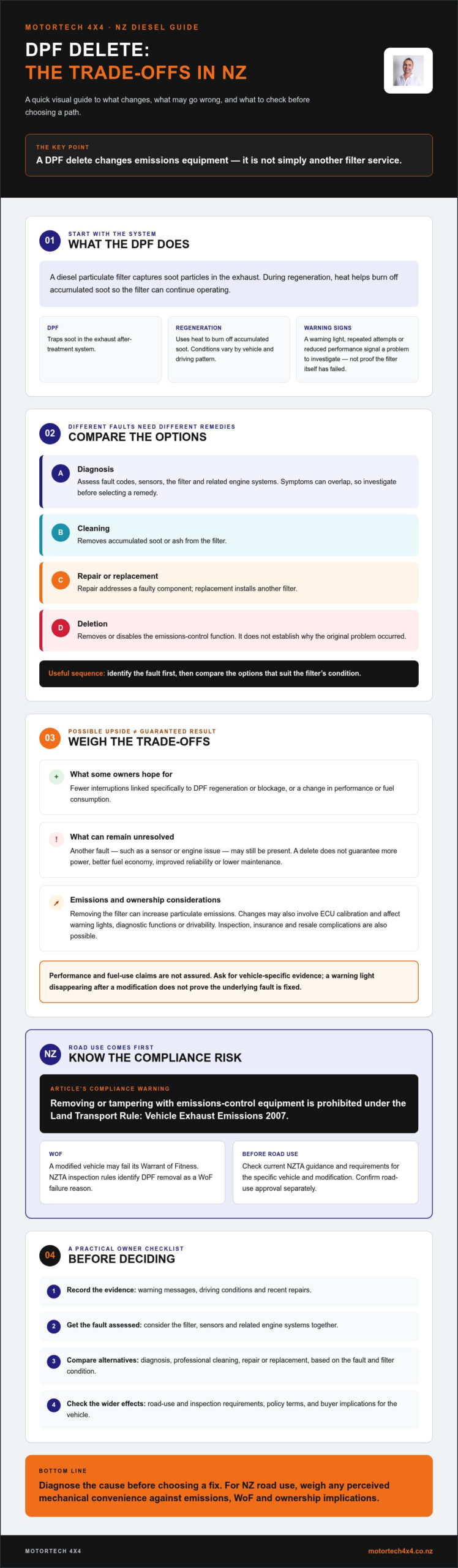
A diesel particulate filter (DPF) is part of a diesel vehicle’s exhaust after-treatment system. It captures soot particles before they leave the exhaust, helping to reduce particulate emissions. The Diesel Particulate Filter (DPF) overview explains common filter designs and regeneration. A DPF delete means removing or disabling this emissions-control equipment. It changes the vehicle’s emissions system, not just a service item.
Cleaning removes accumulated soot or ash from a filter; repair addresses a faulty component; replacement installs another filter; deletion removes or disables the emissions-control function. These options address different conditions, so diagnosis should come before choosing a remedy.
What does a diesel particulate filter do?
The filter traps soot as exhaust passes through it. During regeneration, heat helps burn off accumulated soot so the filter can continue operating. Regeneration is a normal part of DPF operation, although the conditions needed for it vary by vehicle and driving pattern.
A warning light, repeated regeneration attempts or reduced engine performance signals a problem to investigate, not proof that the filter itself has failed. Sensors monitor the system, while the EGR system manages exhaust gas recirculation. Neither is the DPF. A sensor fault, another engine issue or a blockage may produce overlapping symptoms, so fault codes and vehicle condition need to be assessed together.
Why do some diesel owners consider a DPF delete?
Recurring faults, interrupted regeneration and uncertainty about repair options can make removal seem like a simpler way to avoid further DPF-related trouble. Owners may also encounter claims of improved response, performance or fuel use. These outcomes aren’t guaranteed. They depend on the vehicle, its condition and the changes made, and shouldn’t be confused with measured results for that specific vehicle.
For anyone weighing the DPF delete pros and cons NZ owners face, convenience is only one consideration. A delete changes emissions performance and can raise road-use, inspection and ownership questions. Check the requirements for the specific vehicle and modification before considering it for road use. A professional assessment can help establish whether the fault lies with the filter, its sensors or another part of the system, and which alternatives are worth comparing.
DPF Delete Pros and Cons NZ: Mechanical, Emissions and Ownership Trade-offs
A delete can look attractive if DPF warnings, interrupted regeneration or repeated repair decisions are disrupting vehicle use. Removing the filter may avoid DPF-related interruptions, but it won’t identify or fix another cause, such as a sensor or engine fault. Nor does it guarantee more power, better fuel economy, improved reliability or lower maintenance. Those outcomes depend on the vehicle and need to be assessed against its condition and use.
There’s an important trade-off: the DPF captures soot, so removing or disabling it can increase particulate emissions. Changes to the emissions system may also require ECU calibration and affect warning lights, diagnostic functions or drivability. A warning light disappearing after a modification doesn’t prove the underlying fault has been resolved.
| Potential benefit | Limitation or risk | What to verify |
|---|---|---|
| Fewer interruptions linked specifically to DPF regeneration or blockage. | Other faults may remain, and a delete doesn’t establish why the original problem occurred. | Ask for a diagnosis of fault codes, sensors and related engine systems before comparing options. |
| Some owners expect a change in performance or fuel consumption. | Gains aren’t assured. Results depend on the vehicle, so don’t assume general claims will apply. | Request vehicle-specific evidence and clarify what changes to calibration and diagnostics are involved. |
| May seem to simplify ownership for someone frustrated by recurring DPF concerns. | Higher particulate emissions and possible inspection, insurance or resale complications can outweigh perceived convenience. | Check policy terms and disclose modifications where required. Confirm buyer and inspection implications for the vehicle. |
Compliance deserves particular attention. NZTA’s Warrant of Fitness inspection rules identify DPF removal as a WoF failure reason for vehicles within the applicable requirements. Check current guidance for the vehicle’s registration and modification rather than assuming an inspection outcome. A WoF result also shouldn’t be treated as confirmation that every road-use or insurance question has been settled.
Before deciding, compare the expected mechanical outcome with the emissions, calibration and ownership implications. Motortech 4X4, an Auckland-based vehicle service centre with DPF and EGR experience, can discuss vehicle-specific mechanical considerations without promising road-use approval. Explore DPF and EGR delete considerations alongside a professional assessment.
DPF Delete vs Cleaning, Repair or Replacement: Compare the Alternatives
Diagnose the fault before choosing a DPF remedy. Identify the problem, assess the filter and check for contributing engine issues before deciding whether cleaning, repair, replacement or deletion is relevant. A blocked filter can be the result of another problem, not the root cause. Clearing or removing the filter without investigating why it became blocked may leave the underlying fault unresolved.
When diagnosis or professional cleaning may be considered
Start with the evidence. A technician can assess fault codes, sensor readings and the filter’s condition, then consider whether symptoms point to restricted flow, a sensor issue or another engine-system fault. Driving pattern and recent repairs can also help build the picture. For example, repeated short trips may affect regeneration, but that alone doesn’t confirm the cause of a warning light.
Professional cleaning may be an option if the filter’s condition makes it suitable. It isn’t a guaranteed fix for every failure, and it won’t repair a damaged filter or resolve a separate engine fault. Ask whether the assessment found a contributing issue that also needs attention, and how the result will be checked afterwards.
When repair or replacement may be more suitable
If testing identifies a failed sensor or another faulty component, repairing that part may address the cause more directly than cleaning the DPF. A damaged or otherwise unsuitable filter may need replacement. Full-service specialists such as On Top Diesel & Automotive emphasise comprehensive diesel diagnostics to isolate underlying engine faults before replacing expensive exhaust components. Ask the technician to explain the confirmed fault, why the proposed work fits the findings and which checks will be carried out afterwards.
Deletion is different from these options: it removes or disables emissions-control equipment rather than restoring its function. It doesn’t, by itself, establish or fix why the DPF fault occurred. If road use is relevant, check the vehicle-specific requirements and current NZTA guidance, including the official NZTA DPF removal regulations, before making a decision.
There’s no single remedy for every vehicle. The appropriate comparison depends on the diagnosis, filter condition, vehicle use and confirmed cause. For broader maintenance context, see this guide to specialist 4×4 servicing and maintenance. A professional assessment can help owners weigh the mechanical options in the wider context of the DPF delete pros and cons NZ drivers need to consider, without assuming that a delete is suitable for road use.
DPF Deletes and NZ Road-Use Compliance: What to Verify First
Don’t assume a DPF modification is suitable for road use because the vehicle runs normally or has passed one inspection. Requirements can depend on the vehicle and the change made, so check current rules before deciding. When considering the DPF delete pros and cons NZ, separate mechanical considerations from compliance. A technician can explain the vehicle’s systems, but inspection decisions and insurance terms need to be confirmed with the relevant authorities and provider.
Questions to ask about NZTA requirements and WoF
As at September 2026, NZTA’s Vehicle Inspection Requirements Manual says a vehicle first registered in New Zealand on or after 1 May 2010 will fail a WoF if its DPF has been removed or tampered with. The relevant NZTA exhaust emissions and inspection guidance sets out the inspection requirements. Check the current version and how it applies to the specific vehicle. Don’t treat a visual check or a single test result as blanket approval for road use.
Before any work, ask an authorised WoF inspector:
- Which current emissions and inspection requirements apply to this vehicle and proposed change?
- How would missing, altered or disabled equipment affect its WoF inspection?
- Are there separate certification or registration conditions to confirm?
Record the date and source of any regulatory advice, then verify it against current NZTA guidance. Vehicle class, import history and certification status may affect which requirements apply.
Road use, off-road use and vehicle-specific checks
A stated off-road or motorsport intention shouldn’t be assumed to create an exemption for a vehicle that is also driven on public roads. Confirm how the vehicle will be used and which requirements apply to that use. While dedicated off-highway platforms and heavy equipment can look to specialist suppliers such as Diesel Freak for aftermarket diesel components, any vehicle operating on public roads must strictly satisfy emissions standards. Check with your insurer whether the proposed modification must be disclosed and whether it affects cover. Certification, registration conditions and inspection requirements may need separate confirmation.
Confirm compliance before modifying emissions equipment, not afterwards. Motortech 4X4 can discuss vehicle-specific mechanical considerations, but can’t promise road-use approval. For an informed discussion about your vehicle’s DPF or EGR considerations, contact Motortech 4X4.
How to Decide: A Practical DPF Fault Checklist for NZ Owners
A structured check helps you avoid authorising work based on a warning light alone. Before weighing the DPF delete pros and cons NZ drivers need to consider, establish what’s causing the fault, confirm the requirements for your vehicle and compare remedies against the diagnosis.
A five-step decision process before authorising work
- Record the symptoms. Note warning messages, when they appear, how the vehicle was being driven and any changes in performance. Include recent servicing or repairs. Don’t assume the DPF itself is the root cause.
- Request a professional diagnosis. Ask which fault codes and test results support the finding, and whether sensors or other engine systems may be involved.
- Check road-use requirements. Confirm which current emissions, WoF and other vehicle requirements apply to your vehicle and any proposed modification. Verify this with authoritative guidance and an authorised inspector before work begins.
- Compare suitable options. Ask whether cleaning, component repair or filter replacement fits the diagnosed condition. If deletion is raised, clarify its mechanical implications and separately verify whether it’s appropriate for your intended use.
- Decide with the findings in writing. Request a clear summary of the fault, recommended work, expected checks afterwards and any compliance questions you still need to confirm.
What to discuss with an Auckland workshop
Be clear about the vehicle’s use, symptoms and repair history. Ask what the diagnostic assessment covers, what evidence identifies the fault and how the proposed work addresses its cause. If the explanation is unclear, ask for clarification before approving the work.
Keep mechanical advice and compliance confirmation separate. Ask how the proposal affects emissions equipment and which inspection questions you should put to an authorised WoF inspector. Check with your insurer whether you need to disclose a modification or whether it affects your cover. A vehicle operating normally, or passing one check, doesn’t settle every road-use or insurance question.
Motortech 4X4 is an Auckland-based vehicle service centre with experience in mechanical servicing and EGR and DPF deletes. The team can discuss vehicle-specific mechanical considerations, but that discussion isn’t a promise of road-use approval. Once you’ve recorded the symptoms and gathered your questions, discuss your vehicle with the Motortech 4X4 team.
Make Your Next DPF Decision With Confidence
The key to weighing the DPF delete pros and cons NZ owners face is to separate a confirmed mechanical fault from assumptions about what removal might improve. Warning lights or regeneration issues call for diagnosis first. Cleaning, repair or replacement may be more appropriate, depending on the filter’s condition and the cause of the problem.
Before authorising any emissions-system change, check current NZTA and WoF requirements for your specific vehicle, and confirm insurance questions directly with your provider. A vehicle running normally or passing one inspection doesn’t settle every road-use consideration.
Motortech 4X4 is an Auckland-based specialist workshop offering mechanical servicing, ECU remaps, and EGR and DPF delete expertise. The team can discuss vehicle-specific mechanical considerations without promising road-use approval. Discuss your vehicle and DPF concerns with Motortech 4X4 to clarify your next step.
Frequently Asked Questions
Is a DPF delete legal in New Zealand?
There isn’t a safe blanket answer without checking the vehicle and proposed modification against current requirements. Before changing emissions equipment, review applicable NZTA guidance and inspection rules, and ask an authorised WoF inspector how they apply to your vehicle. A qualified workshop can discuss mechanical considerations, but confirm compliance advice against current authoritative sources. Registration history, vehicle conditions and intended use may also affect what you need to verify.
Can a vehicle with a DPF delete pass a WoF in NZ?
A WoF outcome depends on the applicable inspection requirements and the vehicle’s condition, so don’t rely on a general promise that a modified vehicle will pass. Missing or disabled emissions equipment may raise compliance concerns. Ask an authorised WoF inspector about your exact vehicle before making changes, and check current guidance. A previous WoF result doesn’t guarantee the outcome of a later inspection or settle every road-use requirement.
What are the main pros of a DPF delete?
Some owners expect fewer DPF-related interruptions or changes to maintenance and performance, but these outcomes aren’t guaranteed. Results depend on the vehicle, its calibration and the fault behind the symptoms. A delete may seem convenient, but it can increase particulate emissions and create compliance or ownership questions. Get the fault diagnosed and compare suitable repair options before treating removal as a solution. These are central considerations in the DPF delete pros and cons NZ discussion.
What are the disadvantages of removing a DPF?
Removing or disabling a DPF can increase particulate emissions and may lead to road-use, inspection, insurance, resale or diagnostic concerns. The specific implications depend on the vehicle and current New Zealand requirements, so verify them rather than assuming a universal outcome. A delete may also leave the original cause of repeated blockage unresolved, particularly if a sensor or another engine-system fault is involved. Diagnosis should inform any decision.
Can a DPF delete improve power or fuel economy?
It may change how a vehicle performs, but a power increase or fuel saving isn’t guaranteed. Results vary with the vehicle, calibration and the fault that prompted the change. A blocked or malfunctioning system may affect performance, but removing equipment doesn’t establish the cause. Ask for evidence specific to your vehicle, and weigh any claimed improvement against emissions effects and verified road-use requirements before deciding.
Should I clean, repair or replace a DPF instead of deleting it?
The right option depends on diagnosis, filter condition and the confirmed cause of the fault. Professional cleaning may suit some filters, while damaged components or a related engine issue may need a different repair. Cleaning or replacement without finding the root cause can leave the problem unresolved. Ask the technician to explain the evidence, proposed options, post-work checks and any compliance considerations before authorising repairs.
Will a DPF delete stop warning lights and regeneration problems?
There’s no guaranteed outcome without assessing the vehicle and its calibration. Warning lights or repeated regeneration issues may involve the DPF, but sensors or other engine faults can also contribute. Record the messages, driving conditions and recent repairs, then ask a workshop to check the fault codes and explain its findings. Before approving any remedy, clarify how it affects emissions controls and which road-use requirements you need to verify.