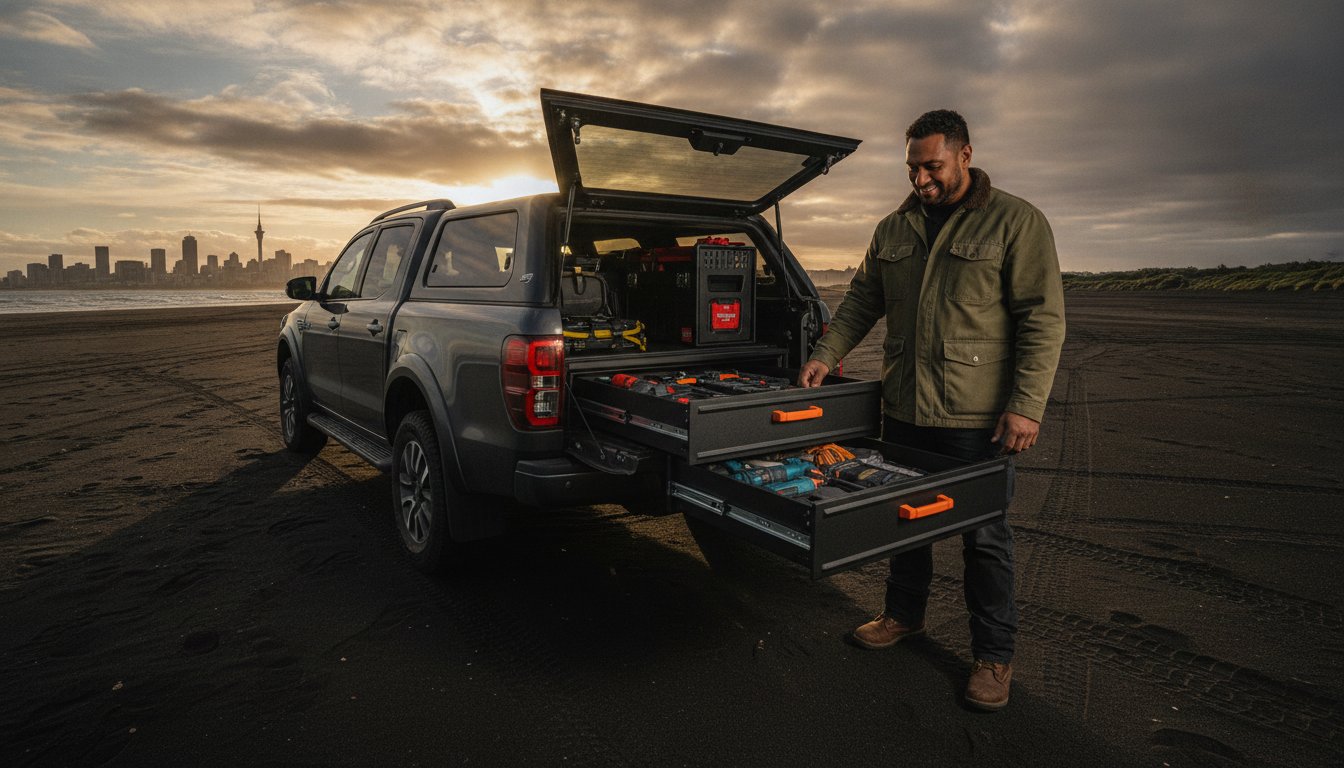

You’re merging onto the Southern Motorway when the dash lights up and your ute loses all power; it’s limp mode again. For many 4×4 owners, the constant battle with clogged filters and eye-watering dealership quotes makes a professional DPF delete Auckland service feel like a necessity rather than an upgrade. It’s frustrating to own a high-performance vehicle that’s constantly crippled by stop-start urban traffic and restrictive emissions hardware. You bought your rig for reliability and adventure, not to be stuck in a workshop every time the automatic regeneration cycle fails.
We understand that you want a permanent solution that restores your engine’s original throttle response and fuel economy. This article explores how specialised DPF solutions can return your vehicle to peak performance while helping you manage the technical and legal landscape in New Zealand. We’ll look at the vital role of ECU remapping, the reality of WOF compliance for vehicles registered after May 2010, and why a precise, hardware-and-software approach is the only way to ensure long-term reliability on and off the road.
Key Takeaways
- Learn why Auckland’s stop-start commutes are the primary cause of DPF blockages and how to identify the early warning signs of a failing system.
- Understand why a professional DPF delete Auckland service must include precise ECU remapping to prevent error codes and ensure your engine runs correctly without the filter.
- Compare the long-term reliability and cost-effectiveness of DPF removal versus temporary cleaning or expensive OEM replacements.
- Navigate the current NZTA regulations and WOF requirements for diesel vehicles, including the specific rules for vehicles registered after May 2010.
- Discover how integrating performance modifications with specialised 4×4 servicing provides a total solution for your rig’s longevity and performance.
Understanding the DPF: Why It Fails in Auckland Conditions
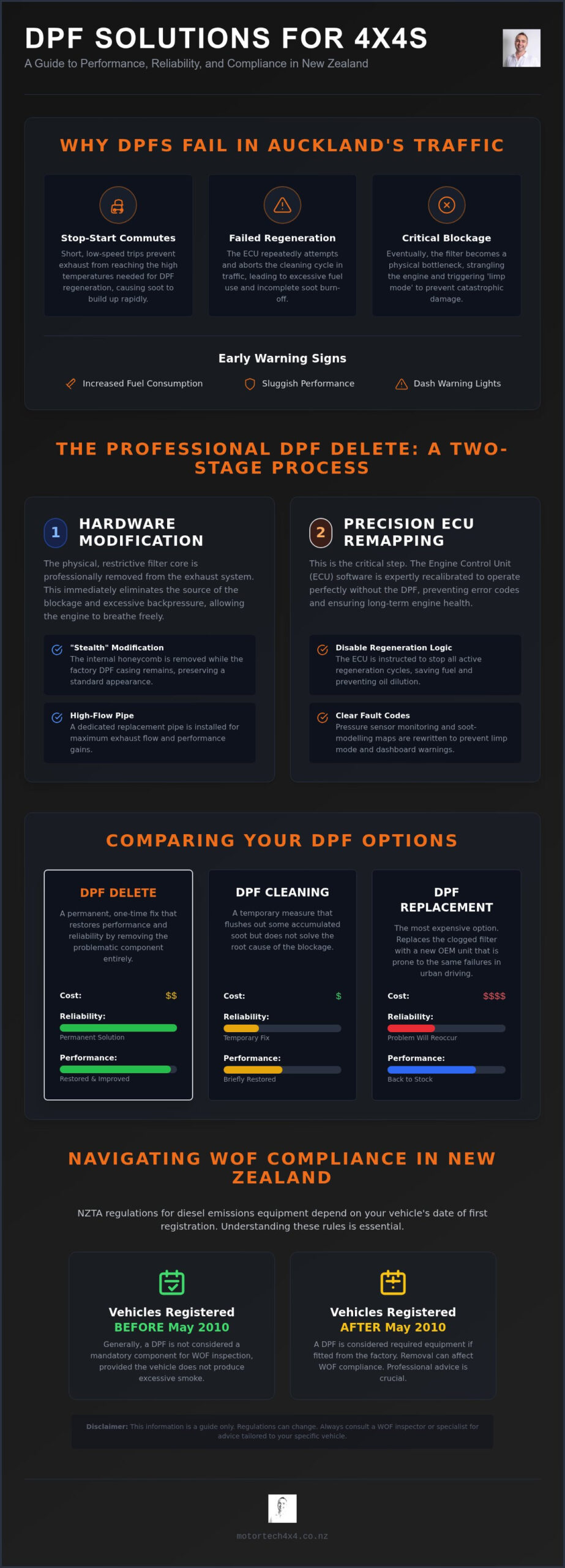
A Diesel Particulate Filter (DPF) is a critical component designed to capture and store exhaust soot. While it’s effective at reducing tailpipe emissions, it’s essentially a high-maintenance trap that requires specific conditions to clean itself. Most modern diesel utes and 4x4s rely on a process called regeneration, where the trapped soot is burnt off into a fine ash. When this cycle is interrupted or fails to trigger, the filter becomes a physical bottleneck for your engine.
The Science of Soot Accumulation
Diesel combustion naturally produces particulates that the filter’s ceramic core must trap. During passive regeneration, the exhaust heat generated from steady highway speeds is usually enough to burn these off. However, when the vehicle is used for shorter trips, the Engine Control Unit (ECU) initiates an active regeneration cycle. This involves injecting extra diesel into the exhaust stream to artificially raise temperatures to roughly 600 degrees Celsius. DPF restriction occurs when accumulated particulate matter narrows the exhaust passage, significantly increasing backpressure and forcing the engine to work harder to expel waste gases. This backpressure doesn’t just reduce power; it places immense thermal strain on your turbocharger seals and can lead to oil dilution as unburnt fuel slips past the piston rings.
Why Auckland Drivers Struggle Most
Auckland’s geography and infrastructure create a perfect storm for DPF failure. Crawling along SH1 or SH16 during peak hour means your exhaust gas temperature never reaches the threshold required for a successful burn-off. If you’re constantly stopping and starting, the ECU frequently aborts the regeneration cycle. This leads to a rapid build-up of soot that eventually bypasses the cleaning phase and enters a critical state. Many owners consider a DPF delete Auckland service once they realise that an “Italian tune-up” or a quick blast down the motorway won’t clear a severely impacted core. Once the soot levels reach a certain percentage, the vehicle enters limp mode to prevent permanent engine damage.
You’ll notice the symptoms long before the vehicle stops completely. Fuel consumption spikes as the car tries and fails to complete active cycles. You might feel a sluggish throttle response or notice a distinct lack of punch when overtaking. Ignoring these warning lights often leads to expensive dealership quotes for a full replacement unit. A professional DPF delete Auckland solution addresses these mechanical bottlenecks at the source, preventing the long-term wear that a blocked filter causes to your engine’s vital components.
The DPF Delete Process: Hardware and ECU Remapping
A successful DPF delete Auckland project requires a dual-stage approach that addresses both the physical exhaust restriction and the vehicle’s electronic logic. Simply unbolting a component is not enough. The engine’s brain must be taught to operate without the data it usually receives from the exhaust sensors. This process transforms a vehicle prone to breakdowns into a reliable tool for both work and weekend adventures. It’s a surgical procedure that requires precision to ensure the engine remains protected while performance is unlocked.
Physical Hardware Modifications
The physical side of the process involves removing the restrictive ceramic core. Many owners opt for a “stealth” modification, where the internal honeycomb is removed while the original outer casing remains intact. This preserves a factory appearance in the engine bay and maintains a standard look. Alternatively, a dedicated high-flow replacement pipe can be installed to maximise flow. This hardware must still accommodate the factory Exhaust Gas Temperature (EGT) and pressure sensors. Even when these sensors are electronically disabled, they often remain in place to maintain the structural integrity of the exhaust system and provide a clean finish.
Precision ECU Software Calibration
Software is where most DIY or “budget” attempts fail. The Engine Control Unit is programmed to constantly monitor the pressure difference across the filter. If the hardware is removed without a corresponding ECU remap, the computer will detect a fault and immediately trigger limp mode. Professional calibration involves rewriting the soot-modelling maps and disabling the regeneration logic entirely. While these systems were originally implemented to reduce the health and environmental impacts of fine particulates, a failed system in an urban environment like Auckland creates its own set of mechanical risks. Professional, locally-developed maps ensure that air-to-fuel ratios remain within safe limits, protecting your engine while delivering the performance gains you expect.
This performance synergy is the real benefit of a professional DPF delete Auckland service. You aren’t just fixing a fault; you’re unlocking the latent potential of your engine. By removing the restrictive hardware and recalibrating the software, we provide a permanent fix that dealerships simply cannot offer. With the physical blockage gone, the turbocharger can spool faster and the engine can breathe without fighting backpressure. If you’re ready to improve your vehicle’s reliability, consult our specialist workshop to discuss the best path forward for your specific make and model.
DPF Delete vs. Cleaning vs. Replacement: A Comparison
When the DPF warning light appears, most owners are faced with three distinct paths. You can attempt a professional clean, pay for a full factory replacement, or opt for a permanent delete. Each option carries different implications for your wallet and your vehicle’s long-term reliability. In the context of Auckland driving, where stop-start traffic is unavoidable, the decision usually comes down to whether you want a temporary patch or a final solution to limp mode anxiety.
- DPF Cleaning: A lower upfront cost but often fails to address deep-seated ash accumulation.
- OEM Replacement: Guaranteed compatibility but comes with a prohibitive price tag and the risk of future blockages.
- DPF Delete: A one-off investment that removes the hardware bottleneck entirely and improves engine efficiency.
The Myth of Permanent DPF Cleaning
Professional DPF cleaning services in Auckland typically start between $395 and $450 plus GST for passenger vehicles and utes. While these services can restore flow levels to approximately 98% of original equipment manufacturer (OEM) standards, they are often a “revolving door” solution. Chemical flushes and ultrasonic tanks are effective at removing soot, but they struggle with hardened ash, which is the non-combustible byproduct of oil and fuel additives. If your driving habits remain the same, a cleaned filter can easily block again within months. When you factor in the repeated labour costs of removing and refitting the filter, multiple cleans quickly become more expensive than a single DPF delete Auckland service.
Evaluating OEM Replacement Costs
For many 4×4 owners, the quote for a new DPF unit is a genuine shock. Genuine filters for popular New Zealand models like the Toyota Hilux, Ford Ranger, or Mitsubishi Triton frequently cost upwards of $5,000. For heavy commercial vehicles, this figure can climb as high as $10,000. While some aftermarket filters exist, they often lack the precious metal coatings required for efficient regeneration, leading to premature failure and more sensor errors. Choosing a DPF delete Auckland provides a superior return on investment by eliminating future maintenance costs and potential engine damage, whereas a factory replacement merely restarts a countdown to the next failure. By removing the core, you eliminate the risk of a $5,000 bill returning in another 100,000 kilometres.
Ultimately, a delete is the only option that provides a permanent fix for the mechanical strain caused by exhaust backpressure. While cleaning and replacement satisfy the vehicle’s original emissions design, they do not account for the harsh reality of Auckland’s motorway crawling. A professional delete ensures your 4×4 remains a dependable tool, regardless of how much time you spend idling in traffic.
Legalities and WOF Compliance in New Zealand
Understanding the NZTA regulatory framework is essential before committing to any exhaust modification. In New Zealand, the responsibility for a vehicle’s compliance rests entirely with the owner, even if a workshop performs the labour. While the primary goal of a DPF delete Auckland service is to restore reliability and performance, you must navigate the specific rules that govern Warrant of Fitness (WOF) inspections. These regulations are designed to ensure that vehicles remain safe and don’t produce excessive visible smoke, which is a key metric during the inspection process.
WOF Inspection Standards for Diesel Vehicles
The current NZTA stance is clear: any vehicle first registered in New Zealand on or after May 1, 2010, will fail a WOF if the DPF has been removed or tampered with. The only exception to this rule is if the owner provides written evidence from an entry certifier that the vehicle has passed a prescribed metered emissions test without the filter. During a standard Auckland WOF, inspectors perform a visual check to confirm the factory emissions equipment is present. This is why “stealth” modifications, where the internal core is removed while the exterior casing remains intact, are a common choice for those seeking to maintain a factory appearance. Beyond the visual check, your 4×4 must pass a smoke opacity test. A professional delete paired with a high-quality ECU remap ensures the engine burns fuel cleanly, preventing the heavy black smoke that triggers an immediate failure.
Responsible Modifications for Auckland 4×4 Enthusiasts
A high-performance rig is more than just an unrestricted exhaust. We advocate for a holistic approach to vehicle builds where every modification is documented and compliant. If you are upgrading your engine’s output, it’s vital to ensure your suspension kits and braking systems are rated for the increased performance. Many DPF delete Auckland projects are part of larger builds that include GVM upgrades and specialised fleet fit-outs. In these cases, maintaining structural integrity is paramount. Professional installation ensures that all exhaust sensors are correctly housed and that no structural components are compromised during the process. Furthermore, if your vehicle features advanced safety tech, we ensure that ADAS calibration is maintained so your lane-keep and emergency braking systems continue to function as intended.
Balancing off-road capability with street legality requires technical expertise and an honest understanding of New Zealand law. Whether you’re building a dedicated track machine or a daily-driven ute, the quality of the workmanship determines your long-term success. If you’re unsure how these regulations apply to your specific vehicle, enquire about our compliance-focused modifications to ensure your 4×4 stays on the road and out of trouble.
Professional DPF Solutions at Motortech 4X4 Auckland
Motortech 4X4 stands as a specialised service centre dedicated to the mechanical and electronic integrity of your vehicle. While many workshops offer generic repairs, our facility focuses on the intricate intersection of hardware modifications and software calibration. A DPF delete Auckland project is never a standalone task for us. It’s a technical restoration that requires a deep understanding of how your engine interacts with modern emissions systems. Whether you’re managing a commercial fleet or preparing a personal touring rig, we provide the precision required to ensure long-term reliability on any terrain.
Expertise You Can Trust
Our team brings over 20 years of collective experience to every project. We don’t just unbolt parts; we diagnose the root cause of your vehicle’s issues. Before any hardware is touched, we perform a comprehensive diagnostic check to ensure that the DPF blockage isn’t a symptom of a larger mechanical fault, such as a leaking injector or a faulty turbocharger. We treat every vehicle that enters our workshop like our own touring rig. This meticulous attention to detail is why we’re the preferred choice for complex diesel modifications in the region. Whether you’re managing a large commercial fleet fit-out or preparing a custom touring build for a cross-country trek, we understand that your vehicle is a vital investment. Our goal is to protect that investment through superior workmanship and technical precision.
The Motortech 4X4 Difference
Choosing us means accessing a true one-stop-shop for all your off-road and performance needs. We seamlessly integrate specialised solutions with our standard 4×4 servicing, ensuring your vehicle’s maintenance schedule remains on track. Our capability extends far beyond engine tuning. We can equip your vehicle with premium bullbars and snorkels, suspension upgrades, and GVM kits. This holistic approach ensures that your rig’s performance upgrades are matched by its structural protection and handling capabilities. We value transparent communication, providing you with a clear breakdown of the costs and technical requirements before work begins.
Reliability is the cornerstone of every build we undertake. By combining high-quality physical components with precision-developed software, we eliminate the persistent threat of limp mode and sensor failure. A professional DPF delete Auckland service is an investment in your vehicle’s future. Ready to restore your rig’s reliability? Contact Motortech 4X4 for a professional DPF consultation today and experience the difference that specialist expertise makes to your vehicle’s performance.
Restore Your Rig’s Reliability and Performance
Navigating Auckland’s motorways shouldn’t be a constant battle with limp mode and warning lights. We’ve explored how urban driving conditions accelerate filter failure and why a professional DPF delete Auckland service provides the only permanent solution for a clogged core. By combining physical hardware removal with specialised ECU remapping, you can unlock better fuel economy and throttle response while protecting your engine from excessive backpressure. It’s about transforming your 4×4 from a high-maintenance liability into a dependable tool for work and adventure.
As expert Auckland-based 4×4 specialists, we offer a comprehensive approach that covers everything from complex software calibration to full vehicle servicing and fit-outs. We ensure that every modification is handled with technical precision, respecting the balance between performance gains and long-term mechanical safety. Don’t let restrictive emissions hardware compromise your vehicle’s longevity or your peace of mind. Book Your DPF Consultation with Motortech 4X4 Today and get your ute back to peak operating condition. We look forward to helping you build a more reliable rig.
Frequently Asked Questions
Is a DPF delete legal in New Zealand for on-road use?
Legality depends on your vehicle’s registration date and its intended application. Under current NZTA regulations, any vehicle first registered in New Zealand on or after May 1, 2010, must have its factory emissions equipment intact to pass a Warrant of Fitness. While many owners perform these modifications for off-road builds or dedicated track rigs, the legal responsibility for on-road compliance rests with the vehicle owner. It’s essential to understand these rules before modifying a daily-driven ute.
Will my 4×4 fail its WOF if I get a DPF delete?
A vehicle registered after May 2010 will fail its inspection if the DPF is identified as removed or tampered with. Inspectors perform a visual check of the exhaust system to confirm factory components are present. If you’ve opted for a stealth modification where the internal core is removed but the original casing remains, the vehicle may pass the visual check. However, it must still meet smoke opacity standards during the metered emissions test to be successful.
What are the main performance benefits of removing the DPF?
Removing the restrictive ceramic core significantly reduces exhaust backpressure, which allows the turbocharger to spool much faster. This results in sharper throttle response and a noticeable increase in low-end torque for towing or off-road driving. You’ll also see improved fuel economy because the engine no longer performs fuel-heavy active regeneration cycles. By eliminating the hardware bottleneck, you remove the primary cause of limp mode and permanent DPF-related breakdowns that plague many modern diesel engines.
Do I need to remap my ECU after a DPF delete?
Yes, an ECU remap is a mandatory part of any professional DPF delete Auckland project. The engine’s computer is programmed to monitor pressure sensors and temperature probes within the exhaust system. If the hardware is removed without software recalibration, the ECU will immediately detect a fault and trigger limp mode. Professional remapping disables the regeneration logic and soot modelling maps, ensuring the engine runs correctly without searching for missing sensor data or triggering dashboard warning lights.
How much does a DPF delete cost in Auckland?
Costs for a specialized DPF delete vary based on your vehicle’s make, model, and the complexity of the software calibration required. A complete solution involves both mechanical labour for the hardware modification and technical time for the custom ECU remapping. While prices fluctuate depending on whether you choose a stealth core removal or a full high-flow replacement pipe, the investment is typically lower than the cost of a single genuine OEM filter replacement, which can exceed five thousand dollars.
Can a blocked DPF cause permanent engine damage?
Yes, a severely restricted filter creates excessive backpressure that can lead to catastrophic engine failure over time. High exhaust temperatures can damage turbocharger seals and bearings. Additionally, when the ECU repeatedly fails to complete active regeneration cycles, unburnt diesel can leak past the piston rings into the oil sump. This oil dilution reduces the lubricating properties of your engine oil, potentially leading to premature wear of internal components like the crankshaft and camshaft bearings.
What is the difference between a DPF delete and a DPF bypass?
A DPF delete usually refers to the complete removal of the internal filter core or the entire unit from the exhaust stream. A bypass often involves installing a straight-through pipe in place of the factory filter assembly. Both methods achieve the same goal of removing the physical exhaust restriction. A delete using the original casing is often called a stealth modification to maintain a factory appearance. Both options require professional software remapping to prevent the vehicle from entering a fault state.
Will a DPF delete stop my car from blowing black smoke?
A professional DPF delete Auckland service paired with a high-quality ECU remap results in a clean-running engine. While a blocked filter causes poor combustion and sluggishness, a poorly executed delete with a low-quality tune can actually increase smoke output. We focus on precision calibration to ensure the air-to-fuel ratio is perfectly optimised. This prevents the heavy black soot often associated with modified diesels, ensuring your rig remains efficient and doesn’t draw unwanted attention during heavy acceleration or towing.