What is worse than waking up in a remote North Island campsite only to find your main battery dead and your fridge warm because of an unreliable power setup? You have likely felt that nagging doubt while deep in the bush, wondering if a DIY wiring job can actually handle the punishment of rugged NZ tracks or if you have chosen the wrong battery chemistry for your specific needs. It is a common frustration for 4WD owners who want the freedom of off-grid travel without the constant anxiety of a flat start battery or the risk of an electrical fault.
We understand that a professional dual battery system installation Auckland is more than just adding a second tray; it is about creating a vehicle-integrated power plant that protects your sensitive factory electronics. This guide will help you master your off-grid power requirements by detailing how to select and install a system that delivers genuine “set and forget” reliability. We will compare the performance of Lithium versus AGM, explain the necessity of precise DC-DC charging, and preview the steps required for a neat, workshop-standard fit-out that keeps your gear running for days on end.
Key Takeaways
- Learn how to isolate your secondary power circuit to ensure your engine’s starting battery is always preserved for ignition.
- Understand why modern smart alternators require a dedicated DC-DC charger to achieve a 100% battery charge in late-model utes.
- Compare the space-saving benefits of permanent, built-in installations against the versatility of portable power stations for your canopy or tray.
- Identify why a professional dual battery system installation Auckland is critical for maintaining your vehicle warranty and ensuring compatibility with factory ADAS safety systems.
- Master the calculation of your daily Amp-hour requirements to choose the most efficient battery chemistry for your specific off-grid touring duration.
What is a Dual Battery System and Why Does Your 4×4 Need One?
A dual battery system is an isolated secondary power circuit specifically engineered to run your 12V accessories without compromising your vehicle’s ability to start. For many Auckland weekenders, the standard factory battery setup is barely sufficient for daily commuting, let alone supporting a weekend of off-grid camping. When you opt for a professional dual battery system installation Auckland, you’re essentially installing an insurance policy against a dead engine. By separating your auxiliary loads from your starting battery, you ensure that engine ignition remains the primary priority of your main battery, while your fridge and lights run off a dedicated second source.
Relying on a single battery for 4×4 touring creates a significant point of failure. Modern utes and SUVs are packed with complex computer systems that continue to draw power even when the vehicle is parked. Adding a portable fridge, high-output camp lights, or a small inverter to this existing load quickly exceeds what a standard lead-acid battery can handle. Without an isolated secondary system, you risk being stranded in remote locations like the Waitakere Ranges or along the North Island’s rugged coastlines. It’s a gamble that most experienced off-roaders simply aren’t willing to take.
The Difference Between Starting and Deep Cycle Batteries
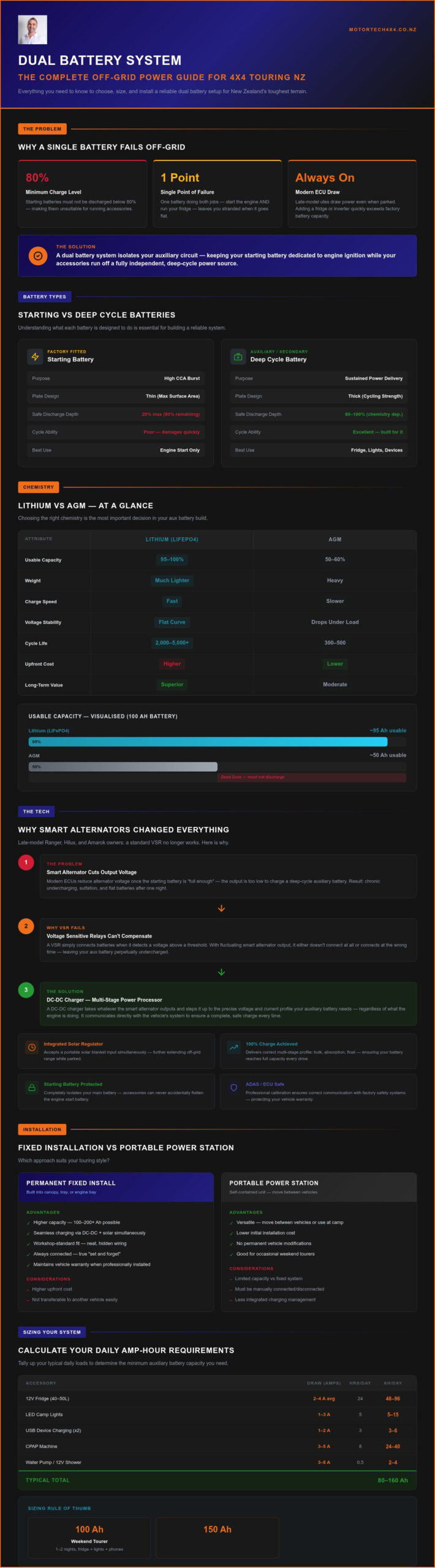
Your vehicle’s factory battery is a starting battery, built to deliver a massive burst of energy to turn the engine over. It uses thin lead plates to maximise surface area for high Cold Cranking Amps (CCA), but it isn’t designed to be discharged below about 80 per cent of its capacity. Deep cycle batteries are the opposite. They feature thicker plates designed for sustained energy delivery over long periods. While they lack the punch to start a large diesel engine, they can be repeatedly discharged and recharged without internal damage. This cycling ability makes them the only logical choice for powering auxiliary gear during multi-day stays.
Managing Modern Power Demands in the Bush
The shift in camping technology has fundamentally changed 12V requirements. A few years ago, a basic torch and a bag of ice were enough. Now, 4×4 enthusiasts expect to run high-efficiency 12V fridges, charge multiple devices, and even use CPAP machines or induction cooktops in the bush. Standard lead-acid batteries often fall short because they suffer from significant voltage drop under load and have a heavy weight-to-capacity ratio. To maintain a reliable, set and forget system, your setup must account for these increased demands with modern chemistry and smart management to ensure your beer stays cold and your vehicle stays mobile.
Understanding the Tech: DC-DC Chargers, Smart Alternators, and Battery Chemistry
Modern vehicle electronics have moved far beyond the simple electrical systems of the past. If you own a late-model Ranger, Hilux, or Amarok, a standard Voltage Sensitive Relay (VSR) is no longer a viable solution for your power needs. A professional dual battery system installation Auckland now requires a sophisticated DC-DC charger to bridge the gap between your vehicle’s alternator and your auxiliary battery. These chargers act as a multi-stage power processor, ensuring your secondary battery receives the correct voltage and current profile regardless of what the engine is doing.
DC-DC chargers also offer the benefit of integrated solar regulators. This allows you to plug in a portable solar blanket while parked, further extending your off-grid capability. Without this tech, your auxiliary battery remains at the mercy of the vehicle’s ECU, which prioritises fuel savings over your fridge’s power supply. This integration is a standard part of a high-quality dual battery system installation Auckland, providing a total power solution that handles both alternator and solar inputs seamlessly.
Why Smart Alternators Changed the Game
Engineers now use smart alternators to reduce engine load and improve fuel efficiency. The vehicle’s ECU monitors the starting battery and, once it is “full enough,” reduces the alternator’s output voltage to a level that is too low to charge a deep-cycle auxiliary battery. This leads to chronic undercharging, which causes sulfation in AGM batteries or prevents Lithium systems from ever reaching their full capacity. Professional calibration ensures that your charging system communicates correctly with the vehicle’s smart alternator, preventing “flat battery” scenarios after only one night at camp.
Lithium vs AGM: Which is Right for Your NZ Rig?
Choosing the right battery chemistry is a balance of weight, cost, and location. Lithium (LiFePO4) has become the preferred choice for many Auckland tourers because it offers a significantly higher energy density. You can typically use 90 to 100 per cent of its capacity compared to only 50 per cent for an AGM battery. Lithium is also roughly one-third the weight, which is a critical factor when managing your vehicle’s GVM limits after adding bullbars and winches.
However, AGM remains a robust and cost-effective option for specific setups. It is particularly well-suited for under-bonnet installations where high engine bay temperatures would damage sensitive Lithium cells. If you’re unsure which chemistry suits your touring style, the team at Motortech 4X4 can provide a technical consultation to match a battery to your specific power draw and mounting requirements.
Fixed Dual Battery Installations vs Portable Power Stations
Choosing between a permanent vehicle-integrated setup and a portable power station is a critical decision for any touring build. While “all-in-one” boxes have gained popularity for their plug-and-play simplicity, they often fall short in high-vibration off-road environments. A professional dual battery system installation Auckland ensures that every connection is hard-wired, eliminating the reliability issues associated with standard cigarette lighter plugs that frequently vibrate loose on corrugated tracks. For those planning a comprehensive vehicle build, our Auckland 4×4 Guide provides deeper insights into how power systems fit into your total modification strategy.
Space efficiency remains a major advantage of the fixed approach. A built-in system is typically tucked away behind a rear seat, under the bonnet, or integrated into a custom canopy wall. This leaves your tray floor clear for bulky camping gear and recovery equipment. Portable stations are inherently bulky and take up valuable real estate. They must also be secured with heavy-duty straps to prevent them from becoming dangerous projectiles in the event of a sudden stop or a crash on a steep descent.
The Case for a Fixed Professional Installation
A fixed dual battery system installation Auckland offers the ultimate “set and forget” experience. Your auxiliary battery charges automatically whenever the engine is running, requiring no manual intervention. These systems are designed to integrate seamlessly with external solar panels and rear Anderson plugs for towing. This creates a robust power grid that survives the harshest North Island conditions. The aesthetics are also superior, with all cabling hidden behind factory panels for a clean, professional finish that adds value to your vehicle.
When a Portable Power Station Might Suffice
Portable units offer flexibility for those who only camp occasionally or need to move their power source between multiple vehicles. They can be useful for very casual campers who don’t require high-current outputs for winching or induction cooking. However, the downsides are significant for serious tourers. Charging speeds are often much slower than a dedicated DC-DC setup, and you’re limited by the internal components of the box. If a single component fails inside a portable unit, the entire system is often out of commission until it can be sent away for repair.
Planning Your Power Grid: Capacity, Mounting, and Accessory Integration
Effective power management starts long before the first wire is crimped. A successful dual battery system installation Auckland requires a meticulous audit of your energy needs to ensure you don’t undersize your storage or charge capacity. This process involves more than just picking a battery; it requires designing a circuit that accounts for voltage drop, heat dissipation, and the specific draw of your essential camping gear. Without a structured plan, even the most expensive components can fail to deliver the off-grid freedom you expect.
Calculating Your Daily Power Budget
To determine your required capacity, multiply the hourly draw of each accessory by its expected run time. A typical 12V fridge might consume 1.5 to 2.0 Amp-hours (Ah) per hour depending on the ambient temperature. If you’re running camp lights for three hours and charging multiple smartphones, your daily total might reach 40 to 50 Ah. When using AGM chemistry, you’ll need at least 100 Ah of capacity to stay within the 50 per cent discharge limit. Lithium allows for a smaller, lighter footprint while providing 80 to 90 per cent usable energy. Always plan for at least two days of redundancy to account for the unpredictable New Zealand weather.
Mounting Locations and Weight Distribution
The physical placement of your battery impacts both vehicle performance and component longevity. Under-bonnet mounting is a traditional space-saver, but extreme engine heat can significantly shorten a battery’s lifespan, even when using protective heat shields. Behind-the-seat installations in dual-cab utes offer a protected environment but require specialised slimline batteries to fit the narrow cavity. For many serious tourers, a canopy fit-out is the gold standard. It allows for a centralised power hub with easy access to chargers and fuses while keeping heavy components low and centred to maintain stable handling on rugged tracks.
Beyond mounting, the quality of your cabling defines the reliability of your system. We use heavy-gauge, multi-strand copper wire to eliminate voltage drop, ensuring your DC-DC charger receives the full signal from the alternator. Integrating solar inputs via a dedicated Anderson plug allows you to maintain your power grid indefinitely when parked up at a remote beach. If you’re ready to upgrade your rig with a system that handles the punishment of the bush, you can book your professional installation with our specialist team today.
Professional Dual Battery Installation at Motortech 4X4 Auckland
Choosing a professional dual battery system installation Auckland is the only way to ensure your vehicle modifications remain compliant with insurance requirements and manufacturer warranties. Modern vehicle electrical systems are incredibly sensitive. A single poorly grounded wire or an incorrect fuse rating can trigger fault codes in the engine ECU or disable critical safety features. At Motortech 4X4, we treat your vehicle’s electrical grid with the same precision as a mechanical engine rebuild, ensuring every component is integrated safely and effectively.
Our commitment to industrial-grade wiring sets us apart from generic accessory fitters. We utilise high-temperature corrugated conduit, marine-grade heat-shrink connectors, and custom-fabricated mounting brackets that withstand the constant vibration of off-road use. This methodical approach prevents the “birds nest” of wiring often seen in DIY projects, which is a leading cause of electrical fires and intermittent power loss. Every system we install undergoes rigorous electrical load testing before it leaves our workshop, guaranteeing it can handle the combined draw of your fridge, winches, and high-output lighting.
Custom Solutions for Tradies and Tourers
We recognise that a weekend tourer has vastly different power requirements than a commercial fleet vehicle. For tradies, we specialise in high-output systems designed for constant tool charging and site power. For the serious overlander, we design bespoke canopy power boards that centralise your chargers, inverters, and switch panels into one organised hub. Crucially, our technicians ensure that these modifications do not interfere with factory ADAS calibration or engine management systems. This technical diligence is why we are the preferred choice for comprehensive fleet fit-outs and high-end 4×4 builds in the region.
Book Your Auckland Dual Battery Consultation
Getting your power system right starts with a technical consultation at our Auckland workshop. During this visit, we assess your vehicle type and your specific accessory list to design a solution that fits your budget and touring goals. Whether you are planning a quick trip to the Coromandel or a multi-month expedition across the South Island, we provide the expertise to keep your gear running. We recommend bringing your vehicle and a list of your most power-hungry devices so we can accurately calculate your required battery capacity and charging rates.
Ready to master your off-grid power requirements? Contact the team at Motortech 4X4 today to discuss your project. Our specialists are standing by to help you build a reliable, set and forget power system that handles the most rugged New Zealand tracks with ease.
Power Your Next Off-Grid Expedition
Mastering your vehicle’s electrical system is the difference between a successful remote tour and an expensive recovery. By integrating a dedicated DC-DC charger and selecting the correct battery chemistry for your specific load requirements, you gain the freedom to run high-performance accessories without risking a dead engine. Whether you choose the lightweight efficiency of Lithium or the heat-resistant durability of AGM, the success of your setup relies on precise calibration and industrial-grade wiring standards.
A high-quality dual battery system installation Auckland ensures that your modifications are compatible with modern smart alternators and sensitive factory safety systems. Our specialised service centre provides the expertise required for complex electrical integration, protecting your vehicle warranty while delivering a neat, reliable power hub. Beyond power systems, we offer a total solution for 4×4 enthusiasts, including suspension upgrades, bullbars, and comprehensive maintenance services.
Don’t leave your off-grid reliability to chance. Book your professional dual battery installation at Motortech 4X4 to ensure your rig is ready for the most demanding New Zealand tracks. We look forward to helping you build a power system that lets you focus on the adventure ahead.
Frequently Asked Questions
Can I install a dual battery system myself in my modern 4WD?
You can attempt a DIY fit-out, but modern 4x4s feature complex CAN bus wiring and smart alternators that are easily damaged by incorrect grounding. A professional dual battery system installation Auckland ensures that all electrical modifications are safe and compatible with your vehicle’s factory engine management system. This technical approach prevents the risk of electrical fires and ensures that sensitive safety features like ADAS remain fully functional after the upgrade is complete.
How long does a professional dual battery installation take in Auckland?
A standard installation typically requires a full working day at our Auckland workshop. This timeframe allows our technicians to complete the mechanical mounting, precision wiring, and comprehensive electrical load testing. If your build involves complex canopy power boards or integration with multiple accessories like winches and lighting, the process may extend into a second day. We prioritise quality and safety over speed to ensure every connection meets our industrial-grade workshop standards.
Do I really need a DC-DC charger for my Hilux or Ranger?
Yes, a DC-DC charger is essential for late-model Hilux and Ranger vehicles equipped with smart alternators. These alternators reduce output voltage to save fuel, which prevents an auxiliary battery from ever reaching a full state of charge. A DC-DC charger acts as a voltage booster, providing the specific multi-stage charge profile required to maintain battery health. Without it, your secondary battery will suffer from chronic undercharging and a significantly shortened lifespan.
Which is better for a 4×4 dual battery: AGM or Lithium?
Lithium is superior for weight-sensitive builds and deep discharge requirements, while AGM remains the better choice for under-bonnet mounting due to its high heat tolerance. Lithium (LiFePO4) allows you to use nearly 100 per cent of its capacity, whereas AGM should only be discharged to 50 per cent. If your goal is a lightweight, long-range touring setup, Lithium is the logical choice. For basic setups in high-heat environments, AGM provides a robust and cost-effective solution.
Will a dual battery system void my vehicle’s factory warranty?
A professionally installed system will not void your factory warranty, provided the work is performed to industry standards using compliant components. We ensure that our dual battery system installation Auckland does not splice into critical factory looms or interfere with engine management electronics. By using dedicated fuses and isolated circuits, we protect the integrity of your vehicle’s original electrical grid. Always choose a specialist workshop that understands the specific technical requirements of your vehicle make and model.
Can I charge my dual battery system using solar panels while camping?
Yes, most modern dual battery setups are designed to integrate seamlessly with portable solar blankets or fixed roof panels. High-quality DC-DC chargers often feature a built-in Maximum Power Point Tracking (MPPT) regulator. This allows the system to prioritise solar energy when you are parked, keeping your fridge running indefinitely without idling the engine. We typically install a dedicated Anderson plug to make connecting your solar panels a simple plug-and-play operation at camp.
What happens if my secondary battery goes flat?
If your auxiliary battery goes flat, the isolation circuit ensures that your primary starting battery remains fully charged and untouched. You will still be able to start your engine and drive home safely. Once the engine is running, the DC-DC charger will automatically begin the recovery process, directing alternator power to the flat secondary battery until it is replenished. This fail-safe design is the primary reason for installing a dedicated dual-circuit power system in your 4WD.
How much maintenance does a dual battery system require?
Modern dual battery systems are largely “set and forget” and require very little ongoing maintenance. We recommend a quick visual inspection of the battery terminals every six months to check for any signs of vibration-induced loosening or corrosion. If you frequently drive on corrugated tracks or through salt water, ensure the mounting brackets remain secure and the casing is free of debris. Most sealed AGM and Lithium batteries require no internal fluid checks or venting maintenance.