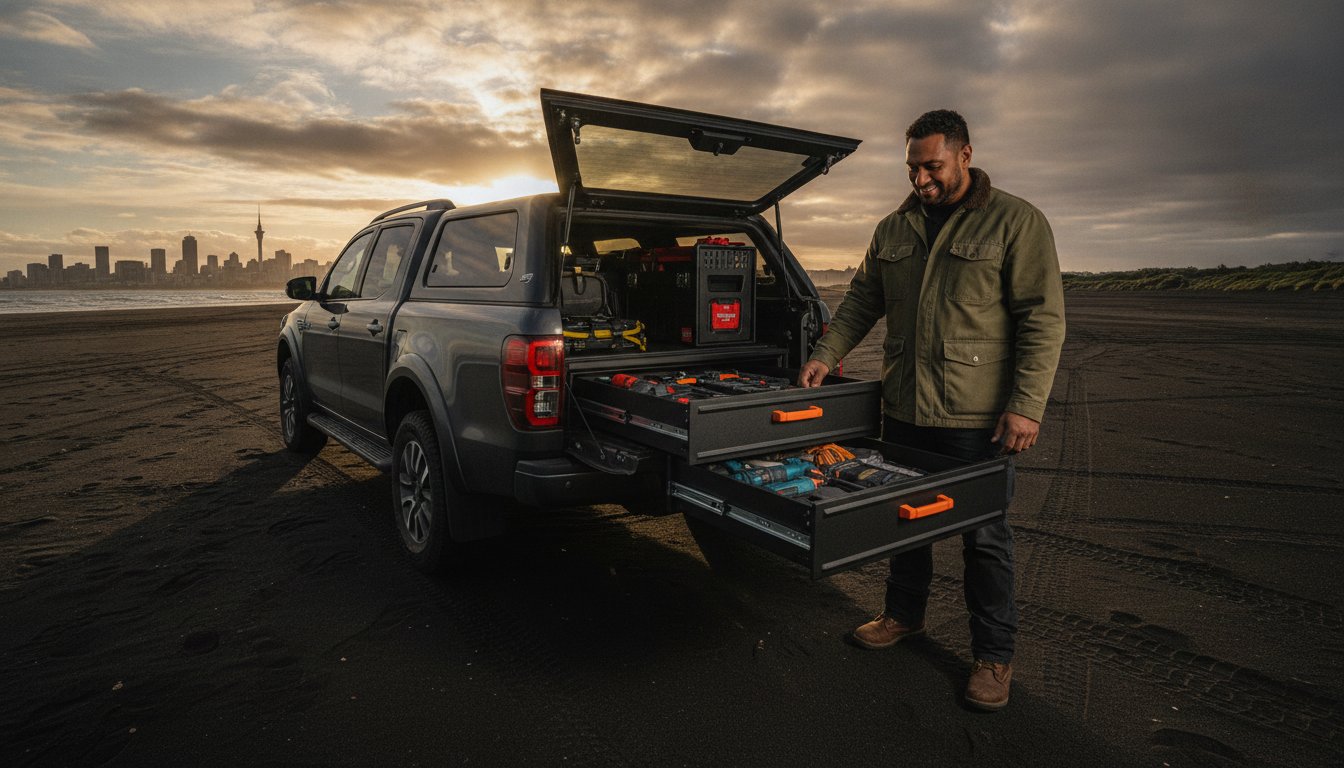

Is your Auckland weekend getaway one roadside weigh station away from a voided insurance policy? You’ve likely felt that unsettling sag in the rear suspension once the canopy, fridge, and recovery gear are finally loaded. It’s a common frustration for 4WD owners who realise that even a modern ute can reach its legal weight limit before the family is even in the cabin. If you’re searching for GVM upgrades Auckland wide, you already know that simply adding stiffer springs isn’t enough to stay on the right side of the law.
You need a solution that balances mechanical performance with strict New Zealand compliance. This guide helps you master the technical and legal requirements of GVM upgrades so your rig remains safe, certified, and ready for heavy-duty tasks. We will examine the Low Volume Vehicle (LVV) certification process, why the 3500kg threshold is a critical boundary for light vehicles, and how a professional engineering approach ensures your insurance remains valid when you hit the road. By understanding these requirements, you can improve vehicle handling and gain total peace of mind for your next adventure.
Key Takeaways
- Understand the ‘payload trap’ and how common accessories like bullbars and winches quickly exhaust your vehicle’s factory weight limits.
- Learn why professional GVM upgrades Auckland specialists focus on a total-vehicle engineering approach rather than just fitting stiffer rear springs.
- Navigate the Low Volume Vehicle (LVV) certification pathway to ensure your modifications are legally recognised and your insurance remains valid.
- Discover the critical role of ADAS calibration in modern suspension upgrades to maintain the integrity of your vehicle’s electronic safety systems.
- Compare the handling and safety performance of an engineered GVM solution against standard lift kits when your rig is fully laden.
What is a GVM Upgrade and Why Does Your Auckland Rig Need One?
Every vehicle has a defined limit. In technical terms, this is known as the Gross Vehicle Mass (GVM). This figure represents the maximum legal weight your vehicle can weigh when fully loaded. It includes the chassis itself, fluids, passengers, and every piece of aftermarket gear you have bolted on. For many local 4WD owners, GVM upgrades Auckland are the only way to carry necessary equipment safely while remaining compliant with New Zealand law.
Modern dual-cab utes often boast impressive payload figures on paper, usually around the one-tonne mark. However, this is the ‘Payload Trap’. That figure is calculated for a bare vehicle. Once you add a steel bullbar, a winch, a canopy, and a roof rack, you have already consumed a massive portion of that capacity. Add a family of four and a fridge full of supplies, and you are likely over the limit before you have even left the driveway. Exceeding this limit leads to catastrophic component failure, including snapped axles or cracked chassis rails.
Auckland drivers face unique challenges that make weight management critical. Consider the strain of stop-start traffic on the Southern Motorway or pulling a heavy trailer up the Bombay Hills. An overloaded vehicle suffers from increased braking distances and unpredictable handling. In these high-pressure environments, exceeding your GVM isn’t just a technicality; it’s a significant safety risk. The extra weight places immense stress on the braking system, leading to dangerous brake fade during long descents or emergency stops.
The Difference Between Payload and Towing Capacity
It’s a common mistake to confuse payload with towing capacity. While your vehicle might be rated to tow 3,500kg, its Gross Combined Mass (GCM) dictates the total weight of the vehicle and trailer together. Crucially, the tow-ball download weight counts towards your GVM. This is the vertical pressure the trailer puts on the hitch. It often catches boat owners off-guard, as a large trailer can easily add 200kg or more directly to the rear axle, instantly pushing a standard suspension setup past its legal limit.
Legal Implications for NZ Drivers and Insurance
Operating an overloaded vehicle in New Zealand carries heavy consequences. The NZ Transport Agency (NZTA) sets strict weight limits to protect road infrastructure and public safety. If you’re involved in an accident and your vehicle is found to be over its legal GVM, your insurance company may deny your claim entirely. You also risk being issued a non-operation notice during roadside inspections. This effectively grounds your rig until the weight is reduced or the vehicle is professionally certified with GVM upgrades Auckland wide.
The Engineering Behind a Certified GVM Upgrade Kit
A common misconception among 4WD owners is that a GVM upgrade simply involves fitting stiffer springs to the rear of the ute. In reality, a certified kit is a comprehensive engineered solution designed to maintain vehicle stability under extreme stress. When you increase the legal carrying capacity, every component in the suspension and drivetrain must be reassessed to ensure it meets NZ Transport Agency vehicle mass limits. It isn’t just about height. It’s about control.
Heavy-duty shock absorbers play a critical role in these kits. As mass increases, so does the kinetic energy the vehicle generates while moving. Standard dampers often struggle to dissipate the heat generated by this extra energy, leading to shock fade and a dangerous loss of handling. Upgraded shocks in a GVM kit are valved specifically to manage these higher loads. They ensure the tyres stay in contact with the road surface, even on the corrugated tracks common in rural New Zealand.
Engineering for higher payloads also requires attention to lateral forces. When cornering with a full load, the vehicle’s centre of gravity is higher, placing immense pressure on bushings and shackles. High-quality kits replace factory rubber bushings with durable polyurethane or reinforced components. For specific vehicle models undergoing high-stage GVM upgrades Auckland, chassis reinforcement may also be required. This prevents the frame from flexing or cracking under the increased weight of heavy canopies and towing gear.
Specialised Suspension Components
Suspension kits in GVM upgrades are tailored to how you use the vehicle. Progressive rate springs offer a smoother ride when unladen but stiffen as more weight is added. Constant load leaf springs are better suited for fleet vehicles that carry heavy tools 100% of the time. High-performance dampers are also essential to prevent brake dive. This occurs when the front of the ute dips aggressively under heavy braking, which can unbalance the vehicle. In rugged NZ conditions, greaseable shackles are a necessity, allowing for easy maintenance and ensuring long-term durability against mud and salt spray.
Braking Systems and Heat Dissipation
Increased mass directly impacts stopping distances. A vehicle carrying an extra 500kg requires significantly more force to come to a complete halt. To maintain safety, many GVM-certified kits include high-performance brake pads and braided brake lines. Braided lines don’t expand under pressure like standard rubber hoses, providing a firmer and more consistent pedal feel. Ensuring your vehicle can stop safely is a non-negotiable part of any professional GVM upgrade. Heat management is also vital during steep Auckland descents, such as coming off the Waitakere Ranges, where standard brakes can quickly overheat and fail.
Comparing Standard Suspension vs. Certified GVM Upgrades
Many owners assume that a two-inch lift kit is the same as a GVM upgrade. This is a mistake that can lead to both mechanical failure and legal trouble. While an aesthetic lift kit focuses on ground clearance and fitting larger wheels, it does not change the legal weight capacity of the vehicle. In contrast, GVM upgrades Auckland are engineered solutions that address the physics of a fully laden vehicle. These kits are developed with specific spring rates and damping curves to ensure the vehicle remains stable when carrying its maximum permissible mass. Crucially, only a certified upgrade comes with the required engineering documentation to update your vehicle’s records legally.
Factory suspension is designed as a compromise. It needs to be soft enough for a comfortable unladen commute but firm enough to carry a moderate load. When you push a factory setup to its limit with heavy accessories like steel canopies or long-range tanks, the ride quality suffers significantly. The vehicle will often “bottom out” on small bumps, and you may notice your leaf springs starting to invert. GVM-rated components are built for durability under constant stress. They use superior materials and larger bores to dissipate heat, ensuring they outlast factory-spec parts that would otherwise fail prematurely under heavy-duty use.
Handling and Stability Under Load
A vehicle at its weight limit behaves differently on winding NZ roads. Standard suspension often results in excessive body roll and “sway” when navigating corners, which can be unnerving for the driver. Certified GVM kits are designed to maintain correct suspension geometry even at maximum payload. This ensures the tyres maintain an optimal contact patch with the road. Predictable handling is vital for safety, particularly during emergency manoeuvres in heavy Auckland traffic. A rig that doesn’t wallow or dive under pressure gives the driver far more control during a split-second decision.
Cost vs. Long-Term Value
The initial investment in a certified GVM kit is higher than a basic suspension lift. However, the long-term value is clear. You avoid the cost of replacing blown factory shocks or sagging leaf springs every few years. Additionally, a certified GVM upgrade increases the resale value of a trade vehicle. Buyers in the second-hand market look for rigs that are already legal and “fit for purpose”. Most importantly, you gain peace of mind. Knowing your vehicle is fully compliant with insurance requirements and road safety standards is an invaluable asset for any professional or enthusiast.
The Legal Process: LVV Certification and Compliance in NZ
Increasing a vehicle’s weight limit requires more than just high-performance hardware. In New Zealand, any modification that alters the Gross Vehicle Mass of a registered light vehicle must undergo a formal Low Volume Vehicle (LVV) certification. This process is governed by the Low Volume Vehicle Technical Association (LVVTA), which works alongside Waka Kotahi to ensure all road-going modifications meet stringent safety standards. For those seeking GVM upgrades Auckland, understanding this pathway is the only way to guarantee your vehicle remains legal on public roads.
The process begins with the installation of an approved kit by an authorised technician. Once fitted, the vehicle must be inspected by an independent LVV certifier. If the modification passes, the certifier issues a Statement of Compliance. This document is a critical piece of evidence that should be kept in the vehicle at all times. Finally, a physical LVV Electronic Data Plate (LVV EDP) is attached to the vehicle’s pillar or engine bay. This plate, which transitioned to a digital format in February 2021, allows authorities and WOF inspectors to verify the vehicle’s modified mass limits instantly. Following the guidance in LVVTA Information Sheet #02-2022 is essential for ensuring your setup meets current 2026 standards.
The Role of the LVV Certifier
An LVV certifier acts as a neutral third party to validate the quality of the installation. They don’t just look at the springs; they perform comprehensive checks on brake performance and suspension clearance under load. They ensure that the modifications haven’t compromised the vehicle’s stability or safety systems. Unauthorised weight increases are a common reason for WOF failure in New Zealand. If your rig lacks the necessary certification plate, it’s technically unroadworthy, which can lead to fines or the immediate grounding of your vehicle during a roadside inspection.
Pre-Registration vs. Post-Registration Upgrades
There is a distinct difference between upgrading a brand-new vehicle and one that is already registered. If a kit is fitted before the vehicle’s first registration, it’s often treated as a ‘Second Stage of Manufacture’. This simplifies the paperwork as the new GVM is recorded at the time of registration without requiring the full LVV process. However, post-registration upgrades are extremely common and fully achievable for used vehicles. While they require the formal LVV certification pathway, working with a specialist ensures the transition is seamless. If you need assistance navigating these technical and legal requirements, you can consult with our team about GVM upgrades Auckland to ensure your rig is fully compliant.
Why Motortech 4X4 is Auckland’s Choice for GVM Solutions
Choosing the right partner for GVM upgrades Auckland is a decision that impacts the safety, legality, and longevity of your vehicle. Motortech 4X4 functions as a specialised “one-stop shop” where mechanical expertise meets precision engineering. We understand that a suspension modification is only one part of a larger technical puzzle. Our Auckland facility is equipped to manage every stage of the process, ensuring that your rig leaves our workshop fully certified and fit for its intended purpose.
Our commitment to technical excellence is reflected in our methodical approach to vehicle modification. We don’t believe in “near enough” when it comes to weight limits and structural integrity. By maintaining a high-performance workshop environment, we provide the level of precision required for complex mechanical engineering. This diligence is why local enthusiasts and commercial operators trust us to handle their most demanding heavy-duty tasks with absolute confidence.
Precision ADAS Calibration Post-Upgrade
Modern 4WDs are equipped with sophisticated Advanced Driver Assistance Systems (ADAS). These systems use cameras and radar to manage functions like adaptive cruise control and lane-departure warnings. When a GVM upgrade alters the vehicle’s height or rake, it changes the sensor’s orientation relative to the road. This can lead to system errors or dangerous miscalculations in emergency situations. Motortech 4X4 includes ADAS Calibration as a fundamental part of our service suite. We use specialised equipment to re-align these sensors, ensuring your electronic safety features remain accurate and reliable after your suspension has been modified. A GVM upgrade is technically incomplete without verifying the integrity of these electronic systems.
Comprehensive Fleet and Trade Solutions
Auckland tradies often face the most demanding payload requirements, regularly carrying heavy loads of tools, materials, and site equipment. We specialise in complete fleet fit-outs that take the guesswork out of compliance. From selecting the correct GVM kit to managing the final LVV certification, our team handles the technical and administrative burden. This ensures your trade vehicles are not only capable of carrying the load but are also fully protected by insurance. We invite you to book a consultation at our Auckland service centre for a professional payload assessment to determine the best engineering solution for your specific needs.
Secure Your Load and Your Legal Standing
Mastering your vehicle’s weight capacity is about more than just avoiding a sagging rear end. It is a critical intersection of mechanical engineering, road safety, and legal compliance. By moving beyond basic suspension lifts and investing in certified GVM upgrades Auckland, you ensure your rig handles predictably under its heaviest loads while keeping your insurance policy intact. A professional approach means every component, from heavy-duty dampers to the digital LVV certification plate, works in unison to protect your investment.
Motortech 4X4 provides the technical precision your vehicle deserves. As an authorised installer for industry-leading GVM brands, we manage the entire process from fitment to final inspection. Our service includes professional LVV certification management and the vital in-house ADAS calibration required to keep modern electronic safety systems accurate. Don’t leave your compliance to chance or settle for incomplete solutions that overlook sensor alignment. Book your Auckland GVM assessment and stay legal on the road today. Your vehicle will be ready for the toughest tasks with the peace of mind that only expert engineering can provide.
Frequently Asked Questions
Is a GVM upgrade the same as a lift kit?
No, a GVM upgrade is fundamentally different from a standard suspension lift. While a lift kit focuses on increasing ground clearance and aesthetic appeal, it doesn’t change your vehicle’s legal weight capacity. A GVM upgrade is a certified engineering solution that increases the legal payload, allowing you to carry more weight while remaining compliant with New Zealand road laws.
Will a GVM upgrade make my 4WD ride roughly when it’s empty?
Ride quality depends on the specific spring rates chosen for your setup. Constant load springs are designed for vehicles that always carry heavy gear and can feel stiff when the ute is empty. However, using progressive rate springs often maintains a comfortable ride during the daily commute while providing the necessary support when the vehicle is fully laden for a weekend trip.
How much extra payload can I actually gain with a GVM upgrade?
Most certified kits provide a payload increase of approximately 10% over the original factory GVM. Depending on your specific vehicle make and model, some high-performance kits can achieve a payload increase of over 700kg. This extra capacity is often the difference between being dangerously overloaded and being fully legal with a canopy and bullbar fitted.
Do I need to notify my insurance company after a GVM upgrade?
Yes, you must inform your insurer about any GVM upgrades Auckland specialists perform on your vehicle. Because this is a material modification that changes the vehicle’s legal operating limits, failure to disclose it could void your policy. Providing your insurer with the Low Volume Vehicle (LVV) certification ensures your rig is covered at its new, higher mass limit.
Can any mechanic install a GVM upgrade kit in Auckland?
No, the installation must be performed by a technician authorised by the specific kit manufacturer to be eligible for LVV certification. The certifier requires proof that the components were fitted according to the manufacturer’s strict engineering standards. Using an unauthorised workshop will likely result in a failed certification and a vehicle that cannot legally be driven on public roads.
How long does the GVM upgrade and certification process take?
The entire process typically takes several business days to complete. While the physical installation of the suspension and braking components usually takes one day, the subsequent LVV inspection and the processing of the electronic data plate through the LVVTA add extra time. We recommend planning for your vehicle to be in the workshop for at least three to five days.
What happens if I get caught driving an overloaded vehicle in NZ?
Driving an overloaded vehicle can lead to heavy fines and the issuance of a non-operation notice, which effectively grounds your vehicle until the weight is reduced. Authorities are increasingly conducting roadside weighing, especially during peak holiday periods. Beyond the legal penalties, an overloaded vehicle is unsafe and places you at significant risk of having an insurance claim denied after an accident.
Does a GVM upgrade increase my towing capacity (GCM)?
No, a GVM upgrade does not increase your Gross Combined Mass (GCM). It increases the maximum legal weight of the vehicle itself, but the total weight of the vehicle and trailer combined remains the same as the factory rating. In fact, as you increase the weight of your vehicle to its new GVM, you actually reduce the remaining weight available for towing to stay within the GCM limit.