Does your 4×4 handle like a dream on the Southern Motorway but feel dangerously unstable the moment you hitch up the boat or hit a corrugated secondary road? It’s a common frustration for many owners who find their vehicles bouncing excessively or wearing through expensive tyres far too quickly. You want the peace of mind that your rig is both capable off-road and fully compliant with New Zealand’s strict WOF and LVVTA standards for modified vehicles.
Securing a comprehensive 4×4 suspension check in Auckland is about more than just comfort; it’s the technical foundation of your vehicle’s safety. This guide provides the clarity you need to evaluate your vehicle’s health. You’ll learn how to spot the subtle signs of component fatigue, understand exactly what a professional inspection involves, and discover how proper GVM management and ADAS calibration keep you legal. We will break down the essential requirements for your suspension system so you can head out on your next adventure with total confidence in your vehicle’s performance and reliability.
Key Takeaways
- Understand how Auckland’s diverse terrain, from the Southern Motorway to Waitakere tracks, places unique stress on your vehicle’s suspension components.
- Learn to identify critical warning signs of wear, such as uneven tyre cupping or excessive nose-diving during braking on urban streets.
- Discover why a professional 4×4 suspension check in Auckland is essential for evaluating shock absorber efficiency and steering link integrity.
- Evaluate the benefits of upgrading to heavy-duty suspension kits versus simple repairs to improve load-handling and off-road performance.
- Gain insights into the technical requirements for GVM upgrades and ADAS calibration to ensure your modified rig stays legal and safe.
Why a 4×4 Suspension Check in Auckland is Critical for Your Safety
Auckland driving conditions are notoriously diverse. Your vehicle might spend the morning cruising at 100km/h on the Southern Motorway and the afternoon navigating the steep, greasy tracks of the Waitakere Ranges. This transition from high-speed bitumen to rugged off-road terrain places immense stress on your vehicle suspension system. Unlike a standard passenger car, a 4×4 suspension is a sophisticated network of heavy-duty springs, shock absorbers, and bushes engineered to handle variable loads and extreme articulation.
Safety risks escalate quickly when these components fatigue. A 4WD naturally has a high centre of gravity; if the damping is compromised, the vehicle becomes prone to excessive body roll and instability. Understanding the balance between load-carrying capacity for work and articulation for weekend adventures is vital for any dual-cab ute owner. Booking a professional 4×4 suspension check in Auckland ensures your rig remains stable regardless of the surface beneath your tyres.
The Role of Suspension in Vehicle Control
Shock absorbers do more than provide a smooth ride. Their primary job is to keep your tyres in constant contact with the road surface. If your shocks are worn, your tyres will bounce, significantly reducing the effectiveness of your braking system. This loss of contact is particularly dangerous during emergency manoeuvres on wet Auckland roads where precision steering is required to avoid an accident. Dampening is the technical process of controlling the energy stored in a spring to prevent the vehicle from continuing to bounce or “rebound” after hitting a pothole or a track rut.
4X4 Specific Challenges: Bullbars, Winches, and Payloads
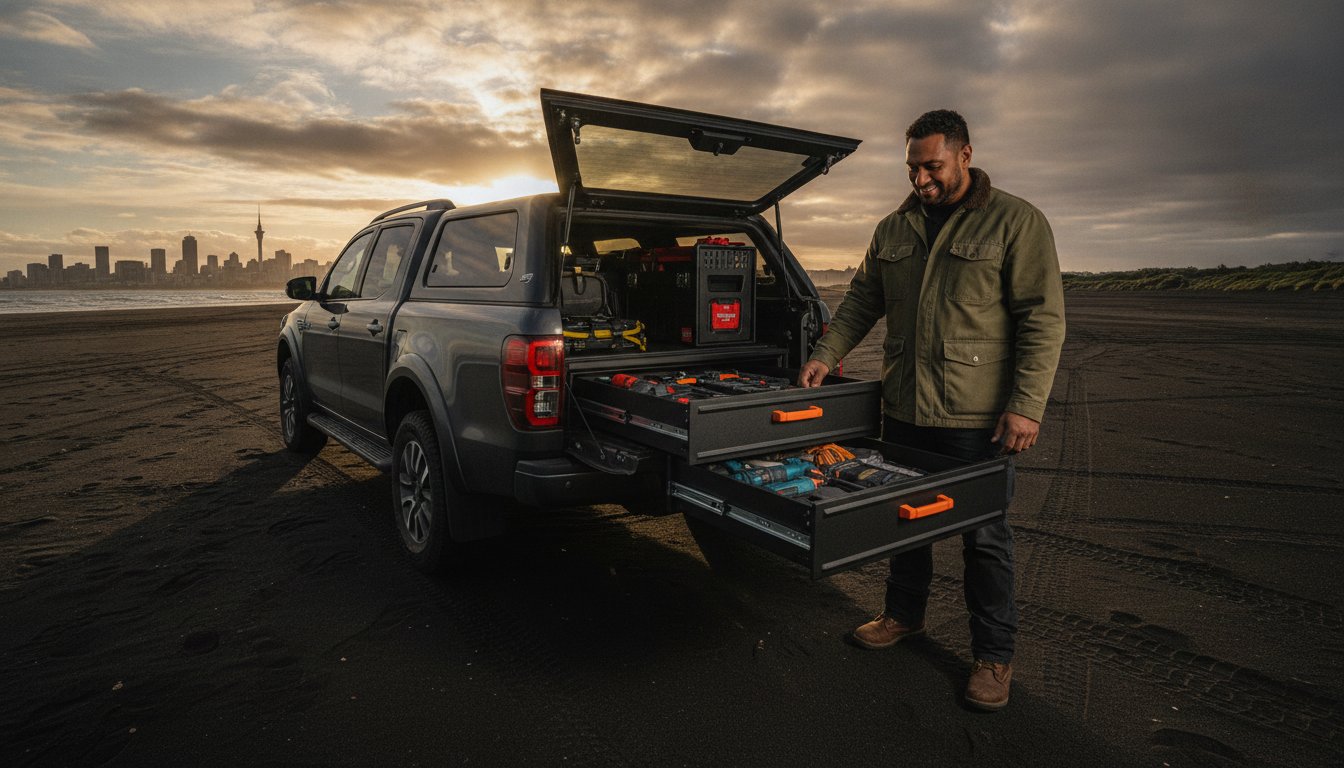
Modern 4x4s are often fitted with heavy front-end accessories that a standard suspension system isn’t designed to support indefinitely. Steel bullbars and high-capacity winches add significant static weight, which accelerates shock absorber wear and can cause the front end to sag. On the other side of the vehicle, constant heavy payloads or towing trailers will eventually flatten rear leaf springs and perish the rubber bushes.
A standard “car” suspension check often fails to account for these specific stress points. General workshops may overlook the nuances of a lifted setup or the unique wear patterns caused by heavy off-road use. This is why a specialized 4×4 suspension check in Auckland is non-negotiable for owners who demand reliability. Specialist technicians understand how to inspect the structural integrity of heavy-duty components under the specific weights of a fully kitted-out rig.
Common Warning Signs Your 4WD Suspension Needs Professional Attention
Detecting suspension failure early prevents costly damage to other drivetrain components and ensures your vehicle remains safe. One of the most obvious indicators is the “nose-dive” effect; if the front of your rig dips excessively toward the bitumen when you apply the brakes at a set of traffic lights, your front shock absorbers are likely fatigued. Similarly, when navigating roundabouts in suburbs like Ponsonby or Henderson, excessive leaning or “body roll” indicates that your springs and shocks are no longer providing adequate lateral support. Maintaining your suspension in a safe and proper operating condition is a legal obligation for every road user.
Uneven tyre wear is another classic symptom that often goes unnoticed until it’s too late. Look for “cupping” or scalloped dips around the edge of the tread. This pattern occurs when a failed damper allows the tyre to bounce down the road rather than maintaining a smooth, constant contact patch. If you notice these symptoms, booking a 4×4 servicing appointment at Motortech 4X4 is the most efficient way to prevent further tyre damage and restore handling precision. A professional 4×4 suspension check in Auckland will identify whether these issues stem from internal valve failure or external bush degradation.
Audible clues also provide significant insight into your vehicle’s health. Listen for persistent knocking or squeaking sounds when traversing uneven ground or driveway kerbs. These noises often suggest that the rubber bushes in your control arms or leaf spring shackles have perished, allowing metal-on-metal contact. Physical signs, such as oil leaking from the shock absorber bodies, are definitive proof of seal failure and require immediate technical attention to avoid total damping loss.
Handling Issues and the “Spongy” Ride
A well-tuned 4×4 should feel planted and responsive, even when navigating the loose metal of a rural Auckland backroad. If your vehicle continues to bounce several times after hitting a speed bump or a pothole, the dampers are no longer controlling the spring’s energy. This “spongy” ride quality isn’t just uncomfortable; it severely limits your ability to hold a consistent line on gravel tracks, as the tyres spend less time in firm contact with the surface.
Visual Inspection: What You Can Spot at Home
You don’t need a hoist to identify some major suspension red flags. Inspect your shock absorbers for “wet” patches or accumulated grime, which indicates that hydraulic fluid is escaping past the seals. Check the rubber bushes in your control arms for visible cracks or chunks of missing material. Finally, observe your vehicle on level ground; if it sits noticeably lower on one side, you likely have sagging springs that can no longer support the vehicle’s static weight.
The Inspection Process: What Happens During a Professional 4×4 Check?
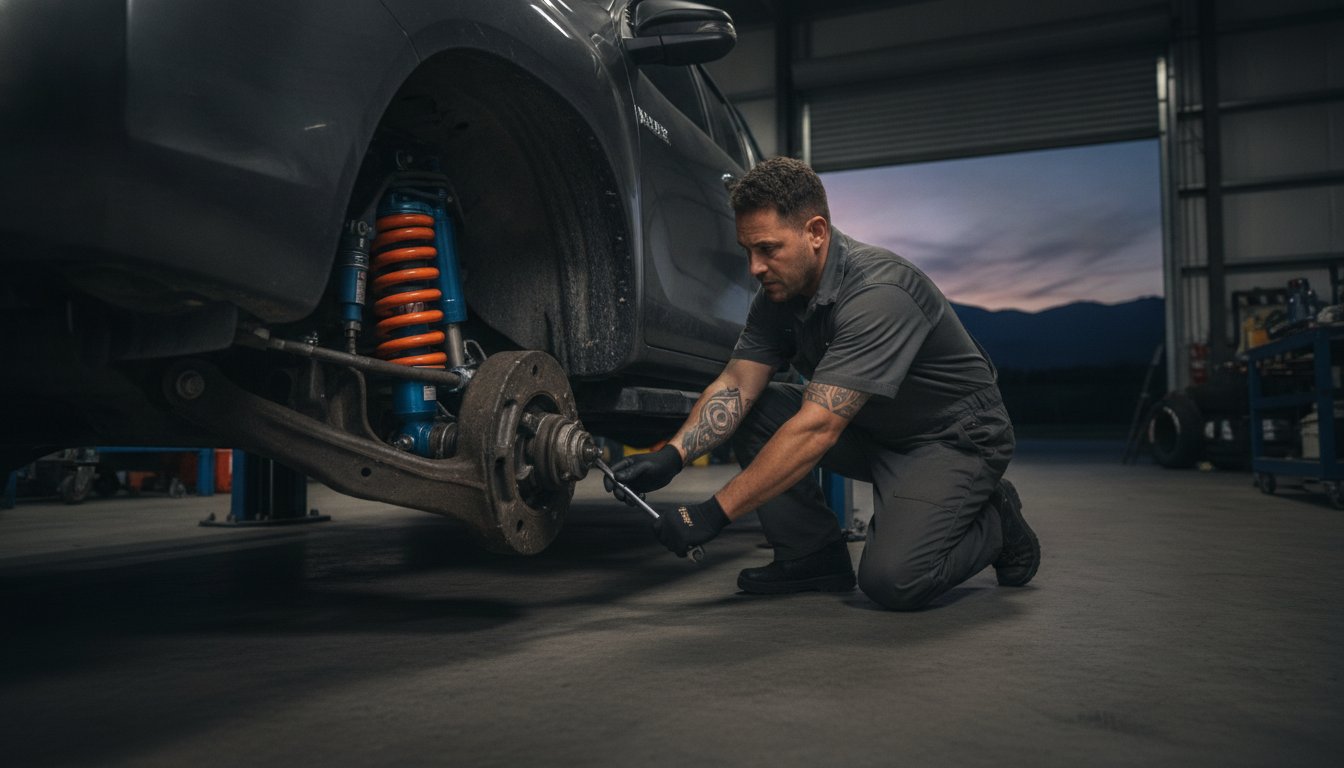
A professional 4×4 suspension check in Auckland is a methodical, technical procedure that goes far beyond a cursory glance under the wheel arches. It begins with a comprehensive multi-point inspection of all steering and suspension links. Technicians examine ball joints, tie rod ends, and control arm bushes for any signs of play, cracking, or fatigue. These components are the critical pivot points of your vehicle; even minor wear here can lead to significant steering wander and compromised safety on the motorway.
Specialised diagnostic tools are employed to measure shock absorber efficiency with precision. Unlike a simple “bounce test,” these tools provide objective data on how well your dampers are controlling spring oscillation. This technical data is then paired with a professional wheel alignment. Correct alignment is essential to ensure that your vehicle tracks straight and that your tyres wear evenly across the entire tread surface. To conclude the process, a technician who specialises in 4×4 dynamics conducts a thorough test drive. This step is vital because an experienced driver can identify subtle handling nuances, such as driveline vibrations or specific rebound characteristics, that a stationary diagnostic might miss.
Beyond the Mechanical: ADAS Calibration
Modern 4x4s are equipped with Advanced Driver Assistance Systems (ADAS) that rely on precise sensor data to function correctly. When you modify your suspension, or even when significant wear causes the vehicle to sag, the ride height and pitch change. This shift can misalign front-facing cameras and radar sensors, directly affecting the accuracy of Lane Keep Assist and Autonomous Emergency Braking. Ensuring your vehicle undergoes ADAS calibration after any suspension work is a critical safety step that many general workshops overlook. It ensures your electronic safety net is looking exactly where it needs to be.
GVM and Payload Assessment
Operating a 4×4 near its legal Gross Vehicle Mass (GVM) limit places extreme stress on factory suspension components. During an inspection, technicians evaluate whether your current setup is legally and mechanically adequate for your typical loaded weight. If you frequently carry heavy tools, camping gear, or tow a large caravan, your standard suspension may be insufficient and potentially illegal. A comprehensive check serves as the essential first step toward a GVM upgrade. This process ensures your rig remains compliant with New Zealand road regulations while maintaining peak performance and stability under heavy loads.
Upgrading vs. Repairing: Choosing the Right Path for Your Rig
When a professional 4×4 suspension check in Auckland reveals worn components, you face a critical decision: perform a standard repair or invest in a comprehensive system upgrade. A repair typically involves replacing a single failed part, such as a leaking shock or a perished bush, to restore the vehicle to its factory baseline. While this is a cost-effective solution for a stock vehicle used primarily for urban commuting, it often fails to address the underlying causes of premature wear in modified rigs. If your vehicle is kitted out with heavy accessories or regularly carries a load, standard replacement parts will likely fatigue just as quickly as the originals.
Investing in a heavy-duty setup makes significant financial sense if you plan to keep the vehicle for several years. High-performance suspension kits are engineered as a cohesive package where springs and shocks are valved to work in harmony under specific weight profiles. For off-road enthusiasts, a lift kit provides essential ground clearance and improves approach and departure angles, allowing you to navigate technical tracks without damaging the chassis. The challenge lies in achieving this capability without sacrificing on-road manners. A superior upgrade ensures the vehicle feels firm and planted on the Southern Motorway, rather than harsh or jittery over every expansion joint.
Tailoring Suspension to Your Lifestyle
Every rig has a unique weight distribution that dictates its suspension requirements. A vehicle fitted with a heavy steel bullbar and winch requires a significantly higher front spring rate than a stock vehicle to prevent front-end sag and maintain correct steering geometry. Similarly, you must choose between comfort-biased leaf springs for daily driving or load-biased options if you frequently carry heavy tools or tow a caravan. Shock absorber valving dictates the speed at which fluid moves through the piston, directly controlling how the vehicle reacts to high-speed corrugations versus low-speed body roll.
WOF Compliance and Legal Requirements
New Zealand has strict regulations regarding vehicle modifications to ensure road safety. According to NZTA guidelines, most suspension lifts exceeding 50mm require a Low Volume Vehicle Technical Association (LVVTA) certification to remain road-legal. A professional 4×4 suspension check in Auckland ensures that any fitted suspension kit complies with these safety standards, preventing expensive failures or rejections during your next Warrant of Fitness inspection. Using reputable, high-quality brands is the most reliable way to ensure long-term compliance and mechanical durability. If you’re unsure which path is right for your vehicle, the team at Motortech 4X4 can provide a professional assessment. Book your suspension consultation today to discuss the best setup for your specific needs.
Why Motortech 4X4 is Auckland’s Specialist Choice for Suspension
Motortech 4X4 operates with a level of specialisation that general automotive workshops simply cannot match. We provide a true one-stop solution for the modern adventurer and commercial fleet owner alike. Our services extend beyond simple repairs to include high-end modifications such as GVM upgrades and the installation of heavy-duty suspension kits. When you book a 4×4 suspension check in Auckland with us, you are gaining the expertise of technicians who actually drive and test these vehicles in rugged New Zealand conditions. This hands-on knowledge ensures we identify potential failures before they leave you stranded on a remote track.
Our integrated approach means we view your vehicle as a complete package. If you are visiting our workshop for ECU remaps to boost towing power or undergoing fleet fit-outs for a new set of work utes, we verify that your suspension is capable of handling the increased demands. We use only reputable, industry-leading brands that meet our strict professional fitting standards. This diligence ensures that every accessory, from bullbars to winches, is supported by a chassis that remains stable, predictable, and safe under all conditions.
The Motortech Difference: Precision and Authority
We maintain a relentless focus on technical excellence and customer safety. Our Auckland workshop is equipped to manage everything from a basic safety inspection to a complex, full overland build designed for long-distance touring. We understand the critical intersection of high-performance upgrades and legal compliance, ensuring your vehicle remains WOF-legal while performing at its peak. Our team takes pride in being a master of the craft, providing a level of precision that guarantees your rig is ready for the harshest environments New Zealand has to offer.
Next Steps: Booking Your Suspension Check
Booking your service at our Auckland centre is an efficient and professional process. To get the most out of your appointment, it is helpful to provide our team with information regarding your typical payload or specific towing requirements. This data allows our technicians to evaluate your current setup with absolute precision and tailor their recommendations to your specific lifestyle. Don’t wait for a component failure to disrupt your plans. Contact the team at Motortech 4X4 to organise your suspension check today.
Secure Your Next Adventure with a Professional Inspection
Maintaining your vehicle’s suspension is the most effective way to ensure safety and performance across Auckland’s varied road network. Whether you are navigating urban roundabouts or technical off-road tracks, your rig depends on a precisely tuned system of shocks and springs. By identifying early warning signs like uneven tyre wear or excessive body roll, you protect your investment and ensure your vehicle remains fully compliant with NZTA regulations.
As Auckland-based 4×4 modification experts, Motortech 4X4 provides the specialised technical oversight required for modern dual-cab utes and SUVs. We are authorised dealers for industry-leading suspension brands and specialists in complex GVM upgrades and ADAS calibration. Every 4×4 suspension check Auckland owners book with us is conducted by technicians who understand the specific stresses of New Zealand terrain. This professional diligence guarantees that your vehicle handles predictably when fully loaded or towing.
Don’t leave your safety to chance before your next weekend getaway. Book your 4×4 suspension check at our Auckland service centre today to ensure your vehicle is kitted for peak performance. We look forward to helping you get the most out of your rig.
Frequently Asked Questions
How often should I have my 4×4 suspension checked in Auckland?
You should aim for a professional 4×4 suspension check in Auckland every 10,000 kilometres or after any significant off-road excursion. Regular inspections are vital because Auckland’s combination of high-speed motorways and corrugated secondary roads places unique stresses on bushes and dampers. Catching minor fatigue early prevents more expensive failures in your steering rack or drivetrain components.
Will a suspension lift kit affect my car’s warranty?
Installing a suspension lift kit typically only affects the warranty on the modified components and any parts directly impacted by the change. Your vehicle’s statutory warranty remains valid for unrelated mechanical or electronic systems. It’s essential to use high-quality kits and professional installers to ensure that any modifications meet the manufacturer’s engineering standards and legal requirements.
Can I fail a WOF because of my shock absorbers?
Yes, you can fail a Warrant of Fitness (WOF) if your shock absorbers show signs of leaking fluid or significant damping loss. NZTA inspectors also check for perished rubber bushes, cracked leaf springs, and excessive play in ball joints. A pre-WOF 4×4 suspension check in Auckland helps identify these issues so you can address them before the official inspection takes place.
What is the difference between a standard shock and a heavy-duty 4×4 shock?
Heavy-duty 4×4 shocks feature larger internal bores and higher oil capacities designed to dissipate heat more effectively than standard units. Standard shocks are engineered for unladen passenger comfort; heavy-duty versions are valved specifically to manage the weight of bullbars, winches, and heavy payloads. This extra durability prevents “shock fade” during prolonged off-road use or when navigating steep Auckland terrain.
Do I need to recalibrate my cameras (ADAS) after a suspension check or repair?
Recalibrating your Advanced Driver Assistance Systems (ADAS) is necessary whenever a repair or upgrade alters your vehicle’s ride height or pitch. Even a minor change in rake can cause front-facing cameras and radar sensors to miscalculate distances for emergency braking. Professional recalibration ensures these electronic safety systems continue to operate within the manufacturer’s original specifications after any suspension work.
How much does a typical 4×4 suspension inspection cost?
The cost of a 4×4 suspension inspection depends on the depth of the diagnostic process and the specific equipment used. While a basic visual check is often included in standard vehicle servicing, a comprehensive 4×4-specific assessment involves measuring shock efficiency and inspecting all steering links. You should contact a specialist workshop to discuss a detailed assessment tailored to your vehicle’s modifications.
Can worn suspension cause my 4×4 to use more fuel?
Worn suspension can indirectly increase fuel consumption by causing poor wheel alignment and increased rolling resistance. When springs sag or bushes perish, the tyres may no longer sit flat on the road, forcing the engine to work harder to maintain speed. Restoring your suspension geometry through a professional check often leads to smoother handling and improved fuel efficiency over long distances.
Is it necessary to replace springs and shocks at the same time?
Replacing springs and shocks at the same time is highly recommended to ensure the entire system remains balanced and performs as intended. Because the labour required to access these components is often the same, installing them together is more cost-effective. New shocks paired with old, sagging springs will wear out prematurely as they struggle to control the incorrect spring rate.