
That heavy caravan might be within your ute’s rated towing capacity, but if your headlights are pointing at the birds and your steering feels light, your vehicle is effectively a safety hazard on New Zealand roads. It’s a common frustration for many Kiwi drivers who find that factory springs simply aren’t up to the task of a full load. You likely expected your 4×4 to handle the weight with ease; however, the reality of rear-end sag often leads to poor braking response and a “squat” that compromises your steering control.
Investing in a professional towing suspension upgrade NZ ensures your vehicle remains level under pressure while staying fully compliant with local regulations. You’ll learn how to eliminate sag and improve handling without compromising your daily ride quality or risking your insurance coverage. This guide provides a clear technical breakdown of GVM upgrades and airbag kits, the necessity of LVVTA certification, and why ADAS calibration is now a mandatory consideration for Warrant of Fitness inspections as of November 2026. We’ll help you build a safe, legal, and high-performing towing setup that is fit for purpose.
Key Takeaways
- Identify the mechanical causes of vehicle “squat” and how it negatively affects steering geometry and headlight aim.
- Evaluate the differences between adjustable airbags and constant-load springs to achieve a level ride height under varying loads.
- Determine the legal requirements for a towing suspension upgrade NZ, including the critical distinction between GVM and GCM ratings.
- Realise the importance of ADAS calibration and precise wheel alignments for maintaining vehicle safety standards and WOF compliance.
Why Factory Suspension Fails for Heavy Towing in NZ
Manufacturers design modern dual-cab utes and SUVs to appeal to the widest possible audience. This typically results in factory suspension tuned for “unloaded” comfort, providing a plush ride for the daily school run or motorway commute. While this feels great on the showroom floor, these soft springs lack the rate required to support heavy vertical loads on the tow ball. When you hitch up a three-tonne caravan or a tandem-axle boat trailer, the rear of the vehicle compresses significantly. This physical shift is known as “suspension sag” or “squat”, and it does more than just ruin your vehicle’s stance.
This rearward weight transfer creates a “floating front end” sensation. Because the nose of the vehicle pivots upward, the front tyres lose the firm contact patch necessary for precise steering. You’ll likely find yourself constantly correcting the wheel to maintain a straight line. More dangerously, this attitude severely reduces braking efficiency. Since the front brakes perform the majority of the stopping work, a nose-high position prevents them from biting effectively. In an emergency braking situation on a wet New Zealand highway, this can lead to dangerously increased stopping distances. Implementing a professional towing suspension upgrade NZ is the most effective way to restore this lost balance and safety.
The Auckland Dual-Purpose Challenge
Auckland drivers face a specific set of demands that factory components struggle to meet. You might spend your week navigating tight suburban streets or the Southern Motorway, only to head to a rugged west coast boat ramp or a Coromandel campsite on the weekend. This dual-purpose lifestyle places immense strain on stock dampers. Added weight from essential accessories like bullbars, winches, and canopies further depletes your available payload. Over time, New Zealand’s notoriously corrugated backroads accelerate shock absorber fade, leading to a bouncy, uncontrolled ride. Exceeding your vehicle’s Gross Vehicle Mass (GVM) with these additions is a common issue that factory suspension simply isn’t built to handle.
Signs Your Rig Needs a Suspension Upgrade
Identifying the limits of your current setup is vital for road safety and vehicle longevity. Seeking a towing suspension upgrade NZ becomes a priority when you notice any of the following symptoms while hitched:
- Excessive Body Roll: The vehicle feels top-heavy and leans precariously when cornering or changing lanes.
- Headlight Misalignment: Your low beams are illuminating the trees or dazzling oncoming drivers instead of lighting the road.
- Frequent Bottoming Out: The suspension hits the bump stops when driving over minor undulations or speed humps.
- Unpredictable Handling: A general feeling of instability or “snaking” from the trailer at open-road speeds.
A towing suspension system is a specialised combination of high-rated springs and heavy-duty dampers designed to maintain vehicle level, stability, and steering control while operating under significant loads.
Airbags vs. Heavy-Duty Springs: Choosing Your Setup
Selecting the right hardware for a towing suspension upgrade NZ depends largely on your vehicle’s duty cycle. Owners who use their utes as both a family runabout and a heavy-duty tow rig often face a compromise between a comfortable unladen ride and the support needed for a three-tonne load. Understanding the mechanical differences between adjustable helper airbags and constant-load springs is essential for achieving a balanced result that complies with NZTA vehicle mass regulations. While both systems aim to eliminate sag, they achieve this through very different mechanical means.
Airbag Helper Kits: Adjustability on the Fly
Airbag helper kits are designed to work in conjunction with your existing leaf or coil springs. These heavy-duty rubber bellows sit between the axle and the chassis, allowing you to adjust the internal pressure based on the current load. This versatility is their primary advantage. If you are towing a heavy caravan one day and driving empty the next, you can simply vent the air to return to a factory-like ride quality. They are particularly effective for levelling a rig that carries uneven weight distributions, such as a slide-on camper or a heavy tool chest on one side of the tray. However, reliability depends on professional plumbing and high-quality pressure management systems. Poorly installed lines or cheap fittings can lead to slow leaks, which compromise safety during long-haul trips across the North Island. When installed correctly by a specialist, they provide an excellent adjustable solution for varying payloads.
Heavy-Duty Springs: The Constant Load Solution
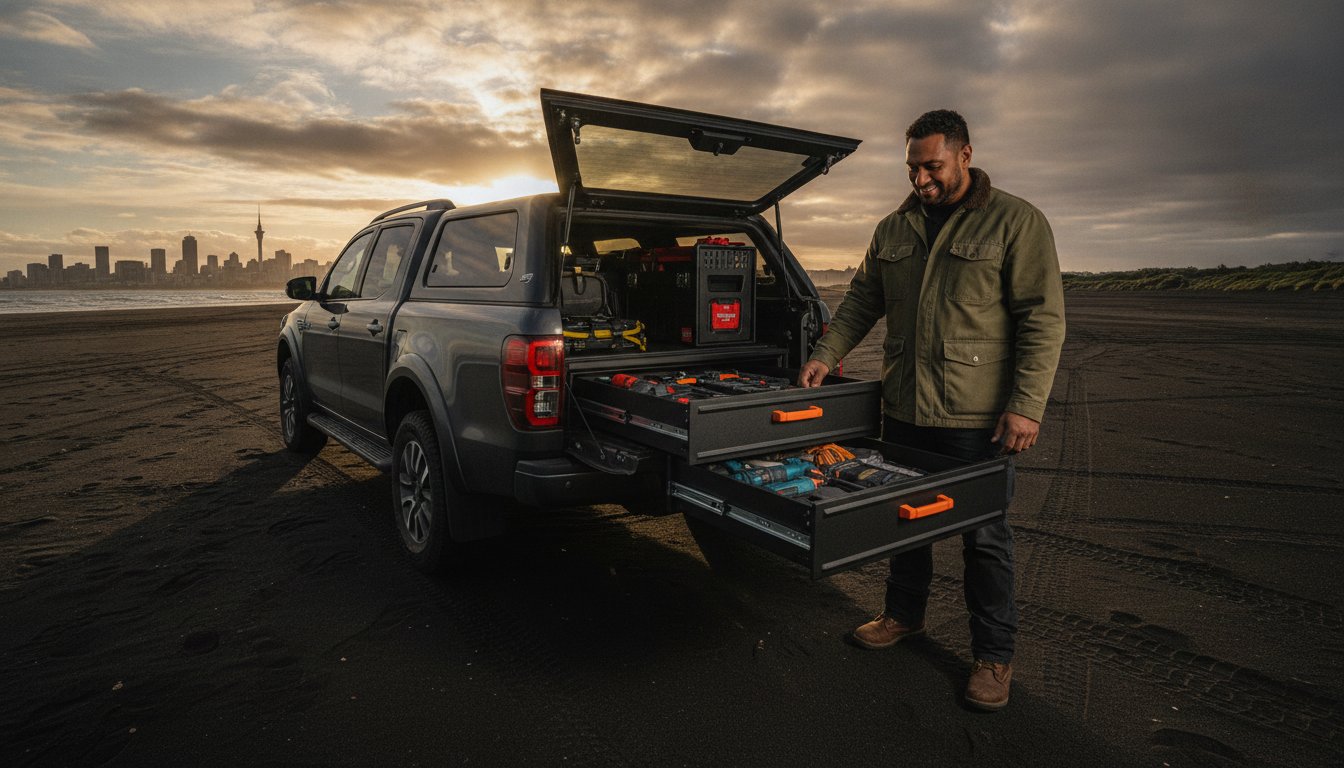
For vehicles that carry a permanent load, such as those fitted with steel bullbars, winches, and internal drawer systems, upgraded springs are often the superior choice. This is a “set and forget” solution. You can choose between traditional multi-leaf packs, which offer high capacity and durability, or modern parabolic springs. Parabolic springs use fewer leaves and a specific taper to provide a more supple ride without sacrificing load-carrying ability. The critical factor is matching the spring rate to your vehicle’s constant weight. Pairing these heavier springs with high-performance shock absorbers is mandatory. Without the correct damping control, the stiffer springs will cause the vehicle to bounce uncontrollably after hitting a bump. A comprehensive suspension kit ensures that the springs and dampers work in unison to maintain tyre contact and stability. This approach offers a high cost-to-performance ratio for dedicated touring vehicles that rarely travel light. If you are unsure which rate suits your specific build, consulting with a professional for a weight assessment is the best way to ensure your towing suspension upgrade NZ delivers the desired handling improvements.
GVM Upgrades: Staying Legal and Safe with Heavy Payloads
Many vehicle owners assume that installing a heavy-duty towing suspension upgrade NZ automatically increases their vehicle’s carrying capacity. This is a common misconception that can lead to serious legal and mechanical consequences. To stay compliant, you must understand the difference between Gross Vehicle Mass (GVM) and Gross Combination Mass (GCM). GVM is the maximum allowable weight of your vehicle when fully loaded, including passengers, fuel, and accessories. GCM is the total weight of the vehicle and the trailer combined. While a standard suspension kit improves how the vehicle handles weight, it does not legally change the figures printed on your manufacturer’s door placard.
For trade fleets and long-distance touring rigs, a formal GVM upgrade is often essential. These upgrades are specifically engineered and tested to increase the legal payload of your vehicle. This process is vital for protecting your insurance coverage. In the event of an accident, if your vehicle is found to be over its factory GVM, your insurer may decline the claim. Additionally, using certified components helps maintain your factory warranty by ensuring that the modifications meet stringent engineering standards. It provides a level of protection that a basic “lift kit” simply cannot offer.
When is a GVM Upgrade Necessary?
Determining your real-world weight requires more than just a guess. You must account for the weight of every passenger, a full tank of fuel, bullbars, winches, and the tow-ball mass of your trailer. It’s surprisingly easy to exceed factory limits once you add a caravan or a heavy toolbox to the tray. Exceeding these limits in New Zealand carries significant legal risks, including fines and the potential for your vehicle to be ordered off the road. A GVM upgrade is a certified engineering modification, not just a spring change. It ensures that your chassis, brakes, and suspension are all capable of managing the increased mass safely and predictably.
The Certification Process in New Zealand
In New Zealand, any significant modification to a vehicle’s load-carrying capacity must be overseen by the Low Volume Vehicle Technical Association (LVVTA). Even if you purchase an “off-the-shelf” GVM kit from a reputable manufacturer, it still requires professional installation by an authorised technician and a formal sign-off from an LVV certifier. This process involves a thorough inspection to ensure the vehicle remains safe for road use. Once approved, a modification plate is fixed to the vehicle. This plate is your proof of compliance for future Warrant of Fitness (WOF) inspections and confirms that your towing suspension upgrade NZ meets all local safety standards.
Critical Technicalities: ADAS Calibration and Alignment
Modern vehicle safety is no longer purely mechanical. While older utes only required a simple spanner to adjust, a contemporary towing suspension upgrade NZ involves complex interactions with on-board electronics. Any change to the static ride height immediately alters your wheel alignment settings. Specifically, your caster and toe angles will shift, which can lead to “darting” on the motorway or rapid tyre scrubbing. A professional alignment is the only way to restore factory handling characteristics and ensure your steering wheel remains centred after a heavy-duty kit installation.
Beyond the hardware, your Advanced Driver Assistance Systems (ADAS) are highly sensitive to pitch and height changes. Radar sensors in the front grille and cameras behind the windscreen are calibrated to a specific height from the tarmac. If your new suspension alters this by even a small margin, the system’s “vision” is compromised. This misalignment often manifests as “ghost braking”, where the Autonomous Emergency Braking (AEB) triggers for no apparent reason on the motorway, or Lane Keep Assist becomes erratic. For owners of the latest Hilux, Ranger, and Triton models, these systems are integral to the vehicle’s safety rating and must be handled with precision.
Why “Near Enough” Isn’t Good Enough for Safety
Precision is vital when dealing with Lane Keep Assist and AEB. If your sensors are tilted even a fraction of a degree due to a rear-end lift, the vehicle may fail to “see” a hazard in time or react to a non-existent threat. Ensuring your safety tech correctly interprets the road surface is a non-negotiable part of the upgrade process. Motortech 4×4 provides a specialised ADAS calibration service in Auckland to ensure your vehicle’s electronic brain is perfectly synced with its new physical height.
WOF Compliance for Lifted and Upgraded Tows
New Zealand’s regulatory landscape is becoming increasingly strict regarding vehicle modifications. A common reason for WOF failure after a DIY suspension install is the neglect of basic safety clearances. Inspectors will check for excessive brake line tension at full suspension droop and any signs of steering bind. Furthermore, the Land Transport Rule: Vehicle Standards Compliance Amendment 2026 introduces a significant change. As of November 1, 2026, WOF and COF inspections will officially include checks for ADAS features. Any modification affecting safety systems requires professional recalibration to remain road-legal. Failing to address this can result in a failed inspection and potential insurance complications. Professional installation ensures all components are fitted within legal tolerances, protecting your vehicle’s certification and your safety on the road.
Professional Towing Upgrades at Motortech 4×4 Auckland
Motortech 4X4 operates as a comprehensive technical hub for owners seeking a reliable towing suspension upgrade NZ. Our Auckland-based facility provides a “one-stop shop” service that covers every stage of the modification process. This begins with a detailed weight assessment to determine your vehicle’s specific requirements and concludes with precise ADAS calibration. By managing the entire project in-house, we ensure that every mechanical component and electronic system functions in perfect harmony. Our team possesses deep expertise in industry-leading suspension brands, selecting hardware specifically engineered to withstand the unique challenges of New Zealand’s terrain. This professional approach ensures your vehicle or commercial fleet remains on the road, performing with the reliability expected of a high-end mechanical workshop.
Customising Your Rig for the Kiwi Road
A successful towing setup requires more than just heavy-duty springs. We consult with you to match spring rates precisely to your permanent load and the vertical mass of your caravan or boat. This level of customisation is essential for vehicles navigating the steep gradients and winding turns of the Auckland-to-Northland trek. We understand the difference between a rig used for North Shore motorway commuting and one destined for rugged west coast boat ramps. Beyond suspension, we consider the holistic health of your vehicle. For instance, integrating a transmission flush into your service schedule is a vital preventative measure for vehicles frequently hauling heavy loads. This ensures your drivetrain remains cool and protected during long summer hauls to the coast or through demanding backroad terrain. Our goal is to provide a total solution that enhances both protection and performance.
Book Your Towing Consultation
Navigating the legalities of GVM upgrades can be a complex task for vehicle owners. Motortech 4X4 simplifies this by managing the entire certification and engineering process on your behalf. We coordinate with authorised certifiers to ensure your vehicle receives its modification plate without unnecessary delays. Every installation undergoes rigorous post-install testing to verify that braking, steering, and electronic safety systems meet our high standards for performance and compliance. We take the technical responsibility off your shoulders, providing a finished product that is fully road-legal and safe. Whether you manage a commercial fleet requiring heavy-duty fit-outs or a private touring rig built for adventure, our Auckland centre is equipped to handle the most complex tasks with precision and diligence. We value technical excellence and customer safety above all else.
Get a Professional Towing Suspension Quote from Motortech 4X4 and ensure your vehicle is fit for the road ahead.
Secure Your Towing Setup for the Long Haul
Achieving a safe and stable tow rig requires a holistic approach that goes beyond simply stiffening the rear end. By addressing the mechanical limits of factory components through a certified towing suspension upgrade NZ, you restore steering precision and braking efficiency. It’s essential to remember that hardware changes must be supported by professional ADAS calibration and precise wheel alignments to maintain safety standards and legal compliance. These steps are vital for passing your WOF and protecting your vehicle’s longevity.
Whether you’re managing a commercial fleet or preparing for a family caravan tour, staying within your vehicle’s legal GVM ensures your insurance remains valid and your rig is fit for purpose. Motortech 4×4 is a specialised 4×4 mechanical workshop and Auckland ADAS calibration specialist dedicated to providing these comprehensive solutions. As professional GVM upgrade providers, we handle the technical complexities so you can focus on the road ahead. You don’t have to compromise on safety or performance when you have the right technical partner.
Upgrade Your Towing Performance at Motortech 4×4 Auckland
Safe travels on your next Kiwi adventure.
Frequently Asked Questions
Will a suspension upgrade void my new vehicle warranty in NZ?
A suspension upgrade does not void your entire new vehicle warranty, but it may affect claims related specifically to the suspension and associated components. Under New Zealand consumer law, a manufacturer generally cannot refuse a warranty claim unless they can demonstrate that the aftermarket modification directly caused the mechanical failure. Many high-quality kits are designed to work within factory tolerances to ensure the vehicle’s driveline integrity remains intact.
How much does an LVVTA certification cost for a towing upgrade in Auckland?
LVVTA certification costs vary depending on the complexity of the modification and the individual certifier’s inspection fees. This cost is a separate professional fee from the hardware and installation of your towing suspension upgrade NZ. Because GVM increases require formal engineering sign-off, you must account for both the inspection time and the physical modification plate that is fixed to your chassis upon approval.
Do I need a GVM upgrade if I only tow a small boat?
You likely won’t require a GVM upgrade for a small boat if your vehicle’s total weight remains well within the manufacturer’s plated limits. However, if your ute is already fitted with heavy accessories like steel bullbars, winches, and canopies, even a modest tow-ball mass can push you over the legal limit. It’s best to perform a full weight assessment to see how much payload capacity you have remaining after passengers and fuel.
Can I install helper airbags myself?
Professional installation is strongly recommended for helper airbags to ensure the plumbing and pressure management systems are reliable. Improperly installed lines can lead to slow leaks or catastrophic failure while under load, which puts your safety at risk on the motorway. Furthermore, if the airbags are part of a certified GVM upgrade, they must be fitted by an authorised technician to satisfy New Zealand’s legal certification requirements.
What is the maximum legal lift height for a towing rig in NZ?
New Zealand regulations generally allow a suspension lift of up to 50mm before requiring formal LVVTA certification, provided the kit meets certain safety standards. For a dedicated towing vehicle, the priority should be load-carrying capacity and maintaining a level ride height rather than achieving maximum clearance. Excessive lift can raise the vehicle’s centre of gravity, which often leads to decreased stability and unpredictable handling when hitched to a trailer.
How does a suspension upgrade affect my vehicle’s fuel economy?
A suspension upgrade can influence fuel economy by altering the vehicle’s weight and aerodynamic profile. If the upgrade corrects a severe rear-end sag, it can actually improve airflow while towing, which may slightly offset the weight of heavier springs or airbags. Conversely, a significant increase in ride height increases wind resistance, which typically results in higher fuel consumption during open-road driving.
Why does my ute feel stiff when it is not loaded?
Your ute feels stiff because heavy-duty springs are engineered with a higher spring rate to support significant weight. When the tray is empty and there is no trailer attached, the springs don’t compress enough to absorb road shocks, leading to a firmer and sometimes bouncy ride. This is why many Kiwi drivers opt for adjustable components like airbags, which allow you to soften the ride when the vehicle is unladen.
What is the difference between GVM and GCM for towing?
GVM is the maximum legal weight of the vehicle alone when fully loaded, whereas GCM is the maximum allowable weight of the entire combination, including the vehicle and the trailer. While a towing suspension upgrade NZ can be used to legally increase your GVM through certification, the GCM is a fixed limit set by the manufacturer. This limit is based on the vehicle’s engine performance, cooling capacity, and braking strength.