A winch is only as good as its installation. Get it wrong, and what should be your most reliable piece of recovery gear becomes a serious liability on the trail. If you’re exploring winch installation in Auckland and feeling overwhelmed by the options, the technical specifications, and the question of who to actually trust with the job, you’re not alone.
Most 4×4 owners know they need a winch. What trips them up is everything that comes after that decision: the pulling capacity, the mounting requirements, the electrical load on the vehicle, and whether the installer actually understands how all of those factors work together. These aren’t minor details. They’re the difference between a winch that performs when you need it most and one that fails under load.
This guide cuts through the confusion. You’ll come away with a clear understanding of the winch types and specifications that suit different 4×4 builds, what a professional installation actually involves, and what to look for in a trusted local specialist. From selecting the right unit to ensuring your setup is safe, compliant, and ready for New Zealand’s demanding terrain, here’s everything you need to know.
Key Takeaways
- Learn the technical differences between electric and hydraulic systems to select the right winch for your vehicle’s specific recovery requirements.
- Understand the critical steps involved in professional winch installation Auckland wide, covering everything from structural mounting to precise electrical integration.
- Identify what to look for in a local specialist to ensure your recovery gear is installed according to high safety and performance standards.
- Discover essential maintenance routines that prevent common mechanical failures and extend the service life of your winch.
- Recognise the importance of professional calibration and testing to ensure your winch performs reliably in demanding New Zealand conditions.
Understanding Winches: Types and Features
A winch is more than just a piece of hardware bolted to the front of your vehicle; it is a critical safety component that can mean the difference between a successful recovery and a dangerous situation. For drivers heading into the rugged terrain surrounding the city, professional winch installation Auckland wide is a standard upgrade for any serious touring or off-road build. These devices provide the mechanical advantage necessary to move heavy loads, allowing for self-recovery or the assistance of other vehicles in difficult conditions.
What is a Winch and How Does It Work?
The mechanics of a winch involve a high-torque motor that drives a rotating drum through a gear reduction system. This assembly allows a relatively small motor to generate thousands of kilograms of pulling force. Electric winches are the most popular choice for 4×4 enthusiasts because they are easy to integrate into a standard 12V electrical system. They provide immediate power and can often function even if the vehicle’s engine has stalled, provided the battery remains healthy.
Safety features are paramount in modern winch design. High-quality units include automatic load-holding brakes to prevent the line from slipping when the motor is stopped. Reputable brands focus on weather-sealed solenoids and motors to protect internal components from the elements. When you invest in professional winch installation Auckland services, you are ensuring that these complex mechanical and electrical systems are correctly aligned and secured to handle maximum load capacities without failure.
Choosing the Right Winch for Your Vehicle
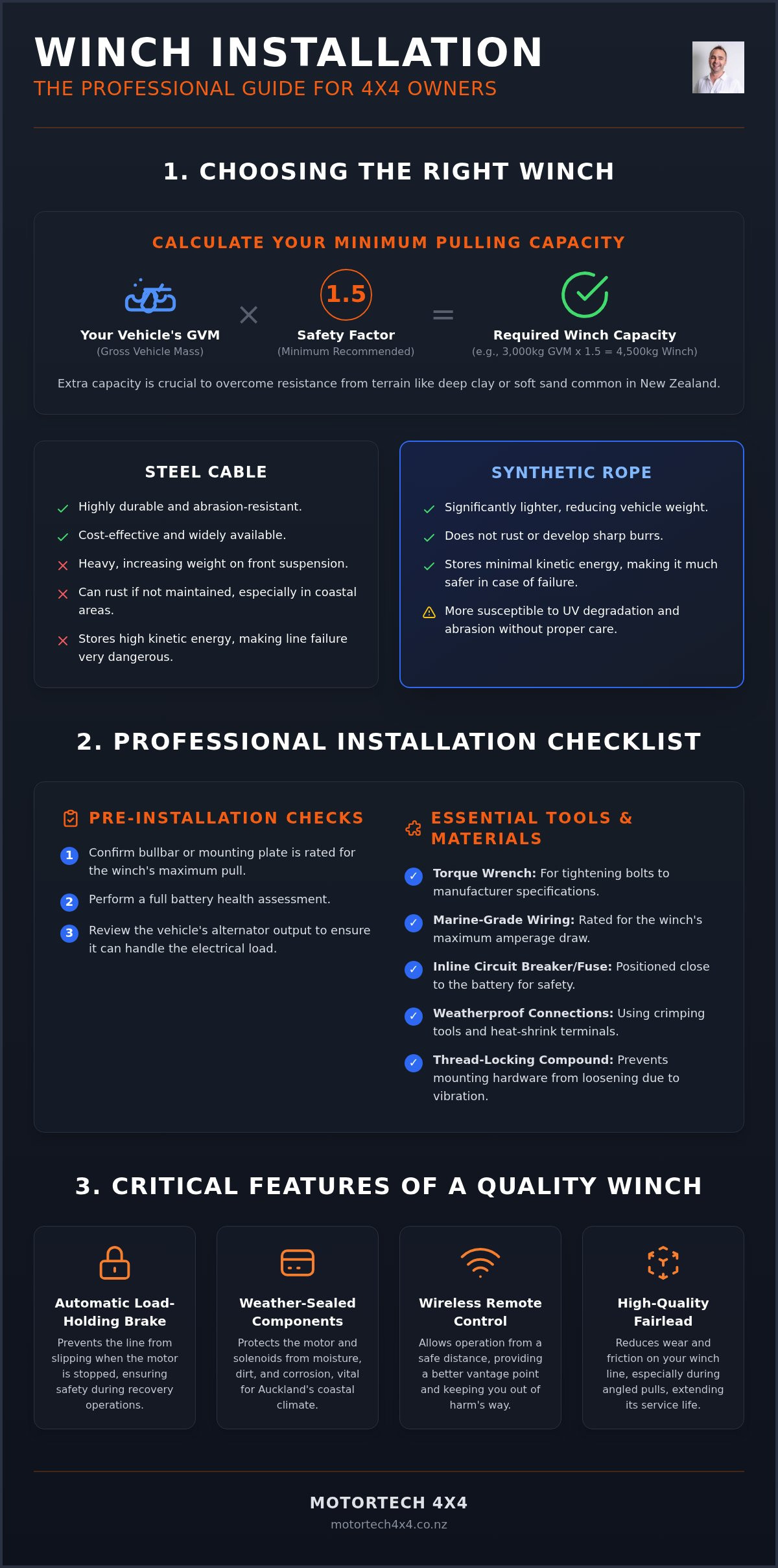
Selecting the appropriate winch is a technical process that starts with your vehicle’s Gross Vehicle Mass (GVM). You should aim for a pulling capacity that is at least 1.5 times the weight of your vehicle when it is fully loaded with fuel, passengers, and gear. In the Auckland region, where you might encounter deep clay in the Waitakere ranges or soft sand on the west coast, the extra pulling power is essential to overcome the suction and resistance of the terrain.
Environment plays a significant role in your choice of components. Auckland’s coastal air and high humidity levels mean that corrosion resistance is a top priority. Many local owners opt for synthetic ropes over traditional steel cables. While steel is durable and cost-effective, synthetic rope is significantly lighter, does not rust, and stores less kinetic energy, making it much safer in the event of a line failure. Additionally, consider features like wireless remote controls, which allow you to operate the winch from a safe distance, and high-quality fairleads that reduce wear on your winch line during angled pulls.
Winch Installation Process: A Step-by-Step Guide
Understanding what a professional installation actually involves puts you in a far stronger position as a vehicle owner. Whether you’re overseeing the work or simply want to know what’s happening to your 4×4, a clear picture of the process helps you ask the right questions and verify the job has been done correctly. Proper winch installation Auckland wide follows a structured sequence that covers mechanical mounting, electrical integration, and functional testing before the vehicle leaves the workshop.
Preparation and Tools Needed
Before any hardware is touched, a competent technician will assess your vehicle’s front-end structure to confirm the mounting plate or bullbar is rated to handle the winch’s maximum rated line pull. Mounting a high-capacity winch to an undersized or incompatible mounting point creates a structural failure risk under load. Pre-installation checks should also include a battery health assessment and a review of your vehicle’s alternator output, since a winch drawing significant amperage under sustained load will stress an already marginal electrical system.
Essential tools and materials for a professional installation include:
- Torque wrench for mounting bolts tightened to manufacturer specifications
- Crimping tools and heat-shrink terminals for secure, weatherproof electrical connections
- Marine-grade wiring rated for the winch’s maximum amperage draw
- Inline circuit breaker or fuse positioned close to the battery
- Dielectric grease for protecting all electrical terminals from moisture ingress
- Thread-locking compound applied to mounting hardware to prevent vibration-induced loosening
Installation Steps
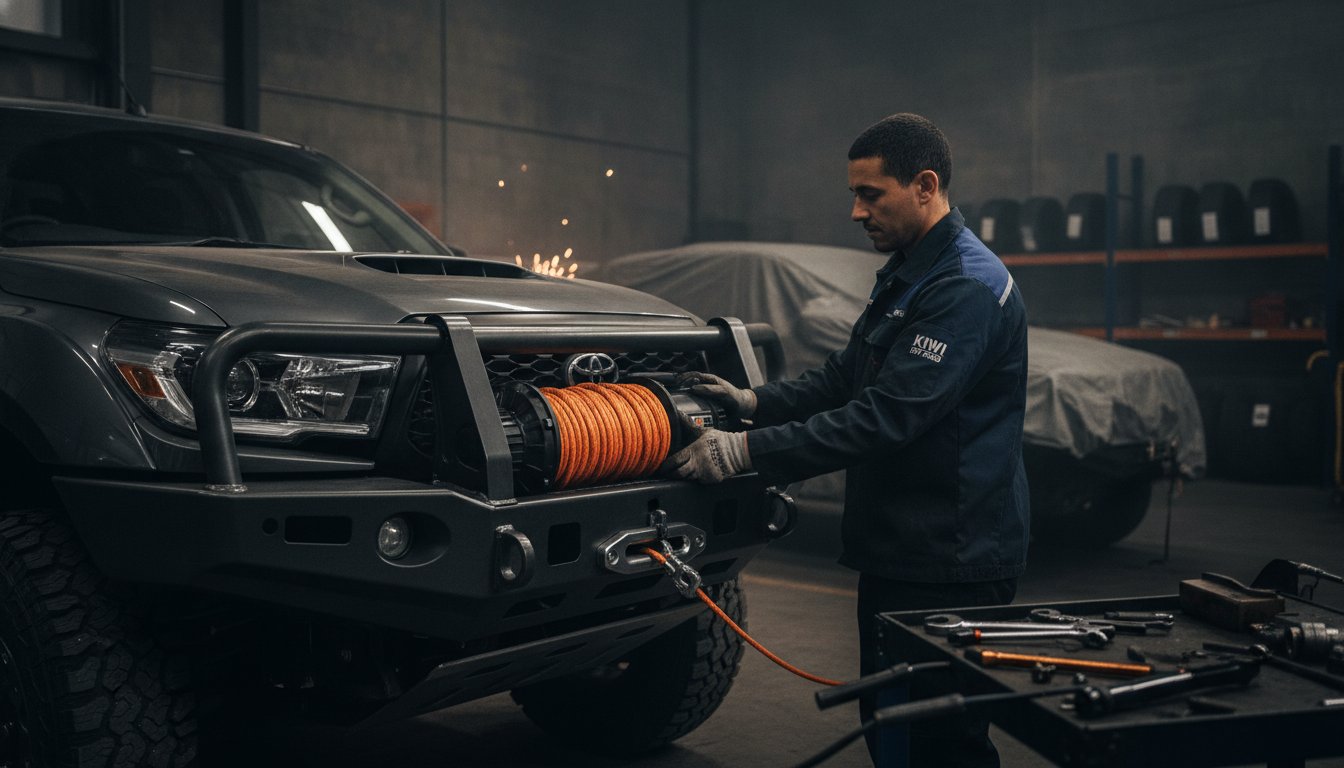
Mounting comes first. The winch is aligned to the mounting plate and secured with grade-rated hardware, ensuring the drum sits level so the rope or cable spools evenly under load. Uneven spooling accelerates wear and can cause dangerous line piling on one side of the drum.
Electrical wiring follows a deliberate sequence. The heavy-gauge power cables are run from the battery to the solenoid pack, keeping positive and negative leads separated and protected with split loom conduit wherever they pass through the engine bay. Every connection point is crimped, not twisted, and sealed with heat-shrink tubing. The control cable connecting the solenoid to the winch motor is routed away from heat sources and moving components.
Once wiring is complete, functional testing is non-negotiable. The winch is operated through its full range, both in and out, under a controlled load to verify smooth engagement, correct brake holding, and proper remote operation. Any abnormal noise, hesitation, or voltage drop under load signals a problem that needs to be resolved before the vehicle is returned to the owner.
Skipping or rushing any of these stages is where DIY installations most commonly go wrong. If you’d prefer the confidence of a verified, load-tested result, speak to the team at Motortech 4X4 about their professional installation service.
Finding a Professional Winch Installer in Auckland
Knowing what a quality installation involves is only half the equation. The other half is finding someone you can trust to actually deliver it. Auckland has no shortage of workshops offering 4×4 modifications, but not all of them bring the same depth of experience to winch installation specifically. The difference between a competent general mechanic and a dedicated 4×4 specialist becomes very apparent when something goes wrong under load on a remote trail.
Start your search by focusing on businesses that specialise in 4×4 modifications rather than general automotive workshops that offer it as a secondary service. Specialists work with these systems daily, which means they’re across the vehicle-specific fitment challenges, the electrical load requirements, and the structural compatibility issues that a generalist might overlook. Customer reviews and testimonials are a reliable signal here. Look for consistent feedback about technical knowledge, not just general customer service.
Local 4×4 clubs are one of the most underutilised resources for finding quality installers. Members who regularly use their vehicles in demanding conditions have a vested interest in recommending workshops that actually perform. A recommendation from someone who’s put their recovery gear through real-world use carries far more weight than an online listing.
Before committing to any installer, ask directly about warranties on both parts and labour, and clarify what their process looks like if a fault develops post-installation. A workshop confident in their workmanship won’t hesitate to answer those questions clearly.
What to Look for in a Winch Installer
Experience with vehicle-specific fitment is non-negotiable. Different platforms, whether a Toyota Land Cruiser, Ford Ranger, or Mitsubishi Triton, have different front-end structures, electrical architectures, and bullbar compatibility requirements. An installer who understands those distinctions will approach each job differently rather than applying a one-size-fits-all method. Ask whether they offer services beyond installation, such as suspension work, electrical upgrades, or bullbar fitting, as this broader capability often reflects a deeper understanding of how these systems interact on a built vehicle.
The Benefits of Professional Installation
Professional winch installation Auckland wide delivers something a DIY approach simply can’t guarantee: accountability. A qualified technician takes responsibility for structural integrity, electrical safety, and load-tested performance before the vehicle leaves the workshop. That accountability translates directly into reliability when you’re in a recovery situation kilometres from help.
There’s also a long-term maintenance dimension. A specialist who installed your system understands its configuration and can identify developing issues quickly during a service. Motortech 4×4 brings certified technicians and years of dedicated 4×4 modification experience to every installation, making them a dependable choice for Auckland owners who want the job done properly from the outset.
Common Issues and Maintenance for Winches
A winch is a high-performance mechanical tool, not a “set and forget” accessory. Because these units often sit unused for long periods between adventures, they are susceptible to environmental degradation and internal seized components. Ensuring your gear remains operational requires a proactive approach to maintenance, especially given the demanding coastal and muddy conditions found around the Auckland region.
Understanding Winch Failures
Most winch failures are rooted in electrical degradation. Auckland’s high humidity and salt-laden air accelerate corrosion on battery terminals, ground points, and solenoid connections. If you hear a rapid clicking sound when engaging the remote, it is often a sign of a failing solenoid or a poor electrical ground rather than a motor fault. Overheating is another common killer, usually caused by pulling heavy loads for too long without allowing the motor to cool, which can melt internal brush holders or damage the armature.
You should monitor your equipment for specific warning signs. Slow operation under light loads, unusual grinding noises from the gearbox, or visible fraying on a synthetic rope are clear indicators that the unit needs attention. While many electrical issues can be repaired by replacing a solenoid or cleaning terminals, internal gear damage or a burnt-out motor often makes replacement more cost-effective than a complex rebuild. When you invest in professional winch installation Auckland specialists provide, they can often diagnose these issues during your regular vehicle servicing.
Routine Maintenance Tips
Prevention is significantly more affordable than a mid-recovery failure. After a trip to places like Muriwai or the South Head sand dunes, you must wash your winch rope. Sand and grit act like sandpaper on synthetic fibres, wearing the rope from the inside out. Power the rope out fully, wash it in clean water, and allow it to dry before respooling. Steel cables require a light coating of oil to prevent rust, though they should be checked for “kinks” or broken strands that can compromise their structural integrity.
Mechanical exercise is equally important. Run your winch in and out for a few minutes once a month to circulate the internal grease and keep the motor brushes clean. Always respool the rope under tension; a loose spool can cause the line to “bind” or bury itself under the layers when you eventually put it under load, which can crush the drum or snap the rope. Check all mounting bolts and electrical leads for tightness, as the vibrations from New Zealand’s corrugated backroads can loosen even the most secure fittings.
If your recovery gear has been submerged in deep mud or salt water, it requires a professional inspection to ensure moisture hasn’t bypassed the seals. To keep your equipment in peak condition, book a winch health check with Motortech 4×4 and ensure your self-recovery system is ready when you need it most.
Why Choose Motortech 4X4 for Your Winch Installation?
Selecting a workshop for winch installation in Auckland requires a partner who understands the mechanical and electrical complexities of modern 4×4 platforms. Motortech 4X4 operates as a specialised mechanical facility, moving beyond simple accessory fitting to provide comprehensive engineering solutions. Our certified technicians bring years of experience in 4×4 modifications, ensuring that every winch is integrated seamlessly with the vehicle’s structural and electronic systems.
The Auckland environment presents unique challenges for recovery gear. Corrosive salt air and demanding off-road tracks require a higher standard of workmanship than a standard retail fitment. We focus on technical excellence, using marine-grade components and precise calibration to ensure your recovery gear meets safety standards. This methodical approach identifies potential issues, such as electrical load mismatches or mounting plate incompatibilities, before they become failures in the field.
Our commitment to being a one-stop solution means we don’t just bolt on a product and send you on your way. We offer a total package that includes professional advice on winch selection, expert installation, and ongoing maintenance support. This diligence ensures that your vehicle remains compliant with local regulations while performing at its peak in the rugged New Zealand landscape.
Customer Testimonials and Success Stories
Our reputation is built on delivering reliable, high-performance outcomes for touring and off-road enthusiasts. Customers consistently report a high level of confidence in their recovery systems after our team has handled the installation and load testing. We’ve successfully managed complex vehicle modifications for a wide range of 4×4 platforms, prioritising safety and structural integrity in every project. These results-oriented solutions are why local owners trust us as their definitive source of technical expertise.
Contact Motortech 4X4
If you’re ready to upgrade your vehicle’s recovery capability, speak with a specialist who understands the technical requirements of winch installation Auckland wide. We offer professional consultations to help you select the right winch and mounting solution for your specific GVM and intended use. Visit our Auckland workshop or contact us for a detailed quote on your next project. Our team is available to discuss comprehensive service packages, ensuring your 4×4 remains capable, safe, and ready for any recovery situation.
Ready for the Recovery? Secure Your Setup Today
Equipping your vehicle with a high-performance winch is a significant step toward total off-road independence. This upgrade requires a precise understanding of electrical loads, structural ratings, and the specific demands of the New Zealand environment. Selecting the right pulling capacity and maintaining your gear regularly are the foundations of a reliable recovery system that won’t fail when you need it most.
When you’re ready to ensure your vehicle is prepared for the unexpected, professional winch installation Auckland services provide the necessary peace of mind. Motortech 4X4 combines local expertise in 4×4 modifications with professional technicians who bring extensive experience to every project. Our commitment to quality and customer satisfaction ensures your equipment is installed to the highest technical standards, allowing for safe and effective operation in any terrain.
Contact Motortech 4X4 for expert winch installation services in Auckland! Don’t leave your safety to chance on your next adventure. Get your setup right the first time and explore the backcountry with total confidence.
Frequently Asked Questions
What is the average cost of winch installation in Auckland?
Costs vary significantly based on vehicle type, existing bullbar compatibility, and specific electrical requirements. A complex fit-out requiring custom mounting or extensive wiring integration will naturally differ from a standard installation on a pre-drilled bar. It’s best to request a vehicle-specific quote to ensure an accurate assessment of the labour and components required for your particular setup.
How long does it take to install a winch on a 4×4?
A standard installation typically takes between three to six hours depending on the vehicle’s front-end configuration and electrical architecture. If the bullbar is already winch-compatible and the battery access is straightforward, the process is efficient. However, installations requiring bumper trimming, custom mounting plates, or complex dual-battery wiring will extend the timeframe required for a professional result.
Can I install a winch myself or should I hire a professional?
While DIY installation is possible for those with advanced mechanical and electrical skills, professional installation is recommended to ensure structural integrity and safety. Professionals use load-rated hardware and verified electrical connections that prevent failures under extreme tension. For a guaranteed result, many owners opt for professional winch installation Auckland wide to maintain vehicle compliance and operational reliability.
What types of winches are best for off-roading?
Electric winches are the industry standard for most off-roading applications due to their ease of use and integration with 12V systems. For heavy-duty or industrial use, hydraulic winches offer superior duty cycles but require complex plumbing into the power steering system. Most Auckland enthusiasts find high-torque electric winches with synthetic rope provide the best balance of performance and safety.
How do I maintain my winch for optimal performance?
Regular maintenance involves cleaning the rope after use, checking electrical terminals for corrosion, and cycling the motor monthly to circulate internal grease. Synthetic ropes should be washed in fresh water to remove abrasive grit, while steel cables require light lubrication to prevent rust. Ensuring the mounting bolts remain torqued to specification is also vital for long-term structural safety.
What should I look for when choosing a winch installer?
Prioritise installers with specific experience in 4×4 modifications and vehicle-specific fitment rather than general automotive workshops. Look for a facility that employs certified technicians and offers comprehensive load testing after the installation is complete. A reputable installer will be able to explain the electrical load requirements and confirm that your mounting solution is rated for the winch’s pulling capacity.
Are there any warranties or guarantees on winch installations?
Warranties generally cover both the hardware unit itself and the labour associated with the installation. Hardware warranties are provided by the manufacturer, while reputable specialised workshops offer a guarantee on their workmanship. It is important to clarify these terms before work begins to ensure you have support if any electrical or mechanical issues arise after the installation is complete.