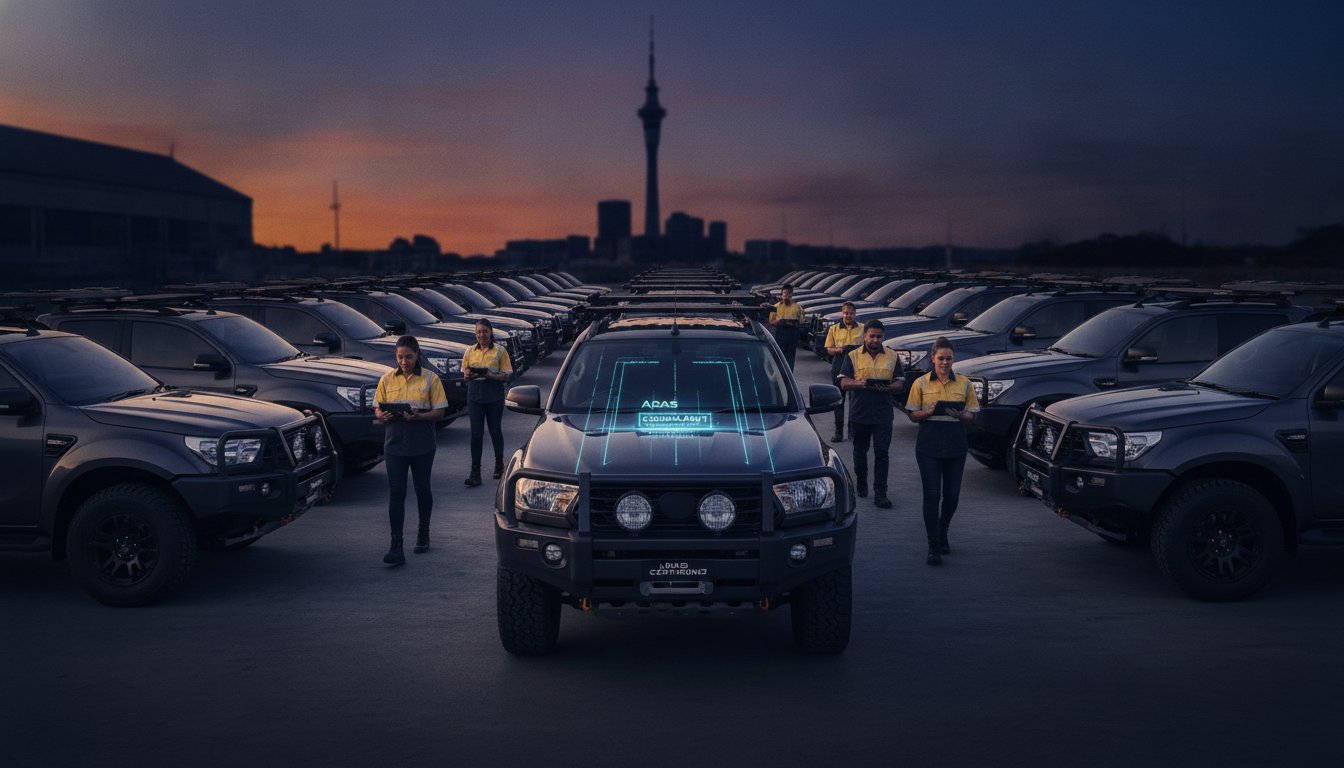
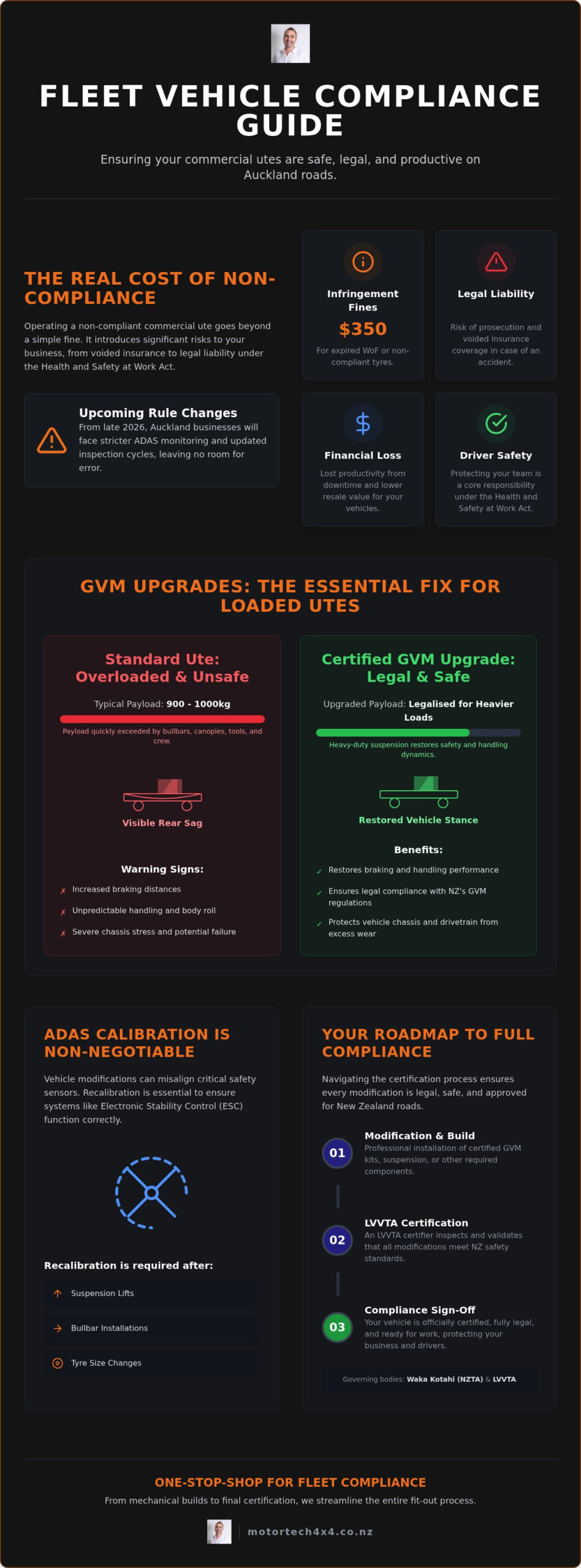
Operating a commercial ute with an expired Warrant of Fitness or non-compliant tyres now carries a $350 infringement fee, but the real cost of a compliance failure is measured in lost productivity and legal liability. As of late 2026, Auckland businesses face stricter ADAS monitoring and updated inspection cycles that leave no room for error. We understand that keeping your vehicles on the road while managing heavy payloads is a constant balancing act. If you’re worried about failing a COF due to overloading or feel confused by the latest LVVTA requirements, you aren’t alone. Securing the right fleet vehicle compliance upgrades Auckland wide is no longer just about ticking a box; it’s about protecting your drivers and your bottom line.
This guide ensures your commercial fleet remains legal, safe, and productive through expert GVM solutions and technical upgrades. We will explain how the 1 November 2026 rule changes affect your ADAS calibration and why proper weight management is the key to vehicle longevity. You’ll gain a clear roadmap for navigating the certification process, ensuring your modified utes meet every New Zealand standard without the usual stress or delays.
Key Takeaways
- Identify how to align your commercial fleet with Health and Safety at Work Act obligations through precise mechanical modifications and safety standards.
- Mitigate the risks of chassis stress and increased braking distances by implementing certified GVM upgrades for heavily loaded trade utes.
- Maintain the integrity of electronic safety systems by ensuring ADAS calibration is performed following any suspension lifts or bullbar installations.
- Navigate the roadmap for fleet vehicle compliance upgrades Auckland to ensure all vehicle modifications are legal, safe, and fully certified for local roads.
- Streamline the fit-out process with a comprehensive “one-stop-shop” service that handles everything from mechanical builds to final compliance sign-off.
Understanding Fleet Vehicle Compliance Upgrades in Auckland
Fleet vehicle compliance upgrades Auckland businesses invest in are more than mere mechanical modifications; they are essential safety and legal requirements for any modern trade operation. These upgrades involve altering a vehicle’s factory specifications, such as its GVM or suspension, to ensure it can safely handle the specific demands of commercial use. Because trade utes are often loaded with heavy tools, equipment, and materials, the standard factory settings rarely suffice for long term safety or legal adherence. Fleet compliance is the intersection of mechanical integrity, legal certification, and driver safety.
Prioritising these upgrades is a core responsibility under the Health and Safety at Work Act. Auckland companies must ensure that the equipment provided to staff, including the company ute, is fit for purpose and does not pose an undue risk. A standard Warrant of Fitness (WOF) checks basic roadworthiness, but it does not account for significant modifications or consistent overloading. If you install a heavy duty canopy or a GVM kit, a standard WOF is no longer sufficient. You require a Low Volume Vehicle (LVV) certification to prove the vehicle remains safe despite these changes, ensuring your fleet stays on the road without legal interruption.
The Legal Framework: NZTA and LVVTA
Waka Kotahi (NZTA) sets the overarching standards for all vehicles on New Zealand roads. However, the Low Volume Vehicle Technical Association (LVVTA) manages the specific certification of modified vehicles. A modification triggers the need for an LVVTA certifier whenever it affects the structural integrity or safety systems of the ute. Common modifications requiring this sign-off include:
- Suspension lifts that exceed factory geometry limits.
- GVM upgrades designed to increase carrying capacity.
- Bullbar installations that may affect airbag deployment or sensor fields.
These physical changes often interact with Electronic Stability Control (ESC) and other safety software. This means every modification must be validated to ensure the electronic safety nets still function as intended under load.
Benefits of Proactive Compliance for Your Business
Staying ahead of compliance requirements reduces corporate liability. If an accident occurs and the vehicle is found to be overweight or modified without the correct certification, insurance coverage is often voided. This leaves the business owner personally liable for damages and potential prosecution. Proactive upgrades also protect your investment. A ute with a certified GVM upgrade and a documented service history maintains a much higher resale value than a non-compliant equivalent. By avoiding failed inspections and the associated $350 fines for non-compliant components, you minimise downtime and keep your team productive on the job site.
GVM Upgrades: The Essential Compliance Move for Loaded Utes
Gross Vehicle Mass (GVM) isn’t just a technical specification; it’s a hard legal limit that many Auckland tradies unknowingly exceed every day. Most modern 4×4 utes arrive with a payload capacity of around 900kg to 1000kg. While that sounds substantial, it disappears quickly once you factor in a steel bullbar, a winch, a canopy, and a full tank of diesel. By the time a crew of two and their heavy toolboxes are on board, the vehicle is often operating outside its engineered safety window. This isn’t just hard on the gear; it’s a direct breach of NZ’s official GVM regulations, which can lead to failed inspections and liability issues.
Driving an overweight ute creates a cascade of safety risks. Braking distances increase significantly because factory rotors and pads weren’t designed to dissipate the heat generated by an over-limit load. Handling becomes unpredictable, especially in emergency swerves, as the centre of gravity shifts and the suspension fails to control body roll. Over time, this leads to severe chassis stress and potential structural failure. For businesses seeking fleet vehicle compliance upgrades Auckland wide, the goal is to legalise the load while restoring the vehicle’s dynamic safety. Look for warning signs like a visible sag in the rear, vague steering, or the suspension bottoming out on standard worksite tracks.
How GVM Upgrades Work
A certified GVM upgrade involves replacing the factory-standard suspension with heavy-duty components engineered for constant, high-capacity loads. It’s not enough to simply add a leaf to the spring pack. A professional kit includes matched springs, shock absorbers, and reinforced bushes that work in unison to manage the extra weight. Once the mechanical work is complete, an independent certifier must sign off on the installation. This process ensures the modification meets LVVTA standards and allows for the vehicle’s legal rating to be officially updated on its registration, keeping your fleet fully compliant.
Top Vehicles for GVM Upgrades in NZ
The Toyota Hilux and Ford Ranger are the primary candidates for these upgrades due to their ubiquity in the New Zealand trade sector. These platforms are highly adaptable, allowing for custom service bodies or heavy-duty flat decks that would otherwise push a standard ute over its limit. Tailoring the suspension to your specific trade needs, whether you’re carrying a constant 600kg of plumbing gear or a varying load of construction materials, is vital for both compliance and comfort. If you’re currently planning a new build, checking out Hilux accessories in NZ is a great way to ensure your fit-out remains within legal boundaries from day one.
ADAS Calibration: Maintaining Safety Standards After Modifications
Modern commercial utes are essentially computers on wheels, packed with sophisticated sensors that monitor the road in real time. Advanced Driver Assistance Systems (ADAS) rely on cameras and radar to manage everything from emergency braking to lane positioning. When you install a suspension lift or a heavy duty bullbar, you’re physically moving the position and angle of these digital eyes. A camera mounted behind the windscreen that used to look 100 metres ahead might now be pointed at the bitumen 80 metres away. This is why fleet vehicle compliance upgrades Auckland businesses trust must include professional recalibration to ensure these safety nets function as intended.
Misaligned sensors are more than just a nuisance; they’re a liability. If your radar is off by even a fraction of a degree, your autonomous emergency braking (AEB) might fire late or, worse, trigger a false positive in heavy Auckland traffic. From 1 November 2026, New Zealand’s vehicle inspection rules will change to include a mandatory check for ADAS warning indicators during WoF and CoF inspections. If your sensors aren’t calibrated after a fit-out, your vehicle will fail its inspection. Motortech 4X4 provides specialised, onsite ADAS calibration to keep your fleet legal and your drivers protected.
Common ADAS Features Impacted by Upgrades
Modification projects rarely happen in a vacuum, and each change affects the vehicle’s electronic ecosystem differently. The Low Volume Vehicle Technical Association (LVVTA) provides the standards we follow to ensure these systems remain reliable. Key features that require attention include:
- Adaptive Cruise Control (ACC): Front facing radar sensors often need repositioning and recalibration after bullbar installation to maintain correct following distances.
- Lane Departure Warning (LDW): Camera based systems are highly sensitive to changes in ride height and pitch caused by suspension kits.
- Electronic Stability Control (ESC): Changes in tyre size or GVM can alter the data the ESC system uses to prevent skids, requiring a system reset to maintain accuracy.
The Calibration Process
Standard wheel alignments don’t suffice for modern fleet safety. While an alignment ensures your tyres wear evenly and the ute tracks straight, it does nothing to correct the digital field of view for your radar and cameras. Our process involves both static calibration, using specialised targets in a controlled workshop environment, and dynamic calibration on the road. This dual approach ensures the vehicle’s “brain” is perfectly synced with its new physical geometry. By addressing these technical requirements during the fit-out, you ensure your fleet meets the 2026 safety tech standards before the vehicle even leaves the workshop.
The Roadmap to a Fully Compliant Fleet Fit-Out
Achieving a fully legal commercial build requires a methodical approach that starts long before the first bolt is turned. For businesses coordinating fleet vehicle compliance upgrades Auckland based, the process must be structured to ensure every modification is documented and certified. A haphazard fit-out leads to delays, failed inspections, and potential liability. By following a clear roadmap, you ensure your vehicles remain productive and protected from day one. This process moves beyond the inspection day, focusing on the engineering and planning phases that competitors often overlook.
The first step is a comprehensive consultation and load assessment. We calculate the anticipated operational weight by assessing the tools, equipment, and accessories that will be permanently fitted. Understanding the “wet weight” versus the factory GVM allows us to determine exactly which GVM upgrades are necessary to keep the vehicle legal. Following this, we move to the selection of certified components. We only use suspension kits, GVM kits, and bullbars with proven engineering data that meet New Zealand standards.
Professional installation is where mechanical integrity is established. Our qualified technicians handle the heavy lifting in our Auckland workshop, ensuring every component is fitted to manufacturer and NZTA requirements. Once the physical build is complete, we perform ADAS calibration and final mechanical testing. This ensures the electronic safety systems are perfectly synced with the new physical geometry. The final step is facilitating the LVVTA certification. We coordinate with local certifiers to inspect the build, ensuring the LVV plate is issued and the vehicle’s rego is updated correctly.
Choosing the Right Accessories for Compliance
Selecting accessories like bullbars requires more than just looking for rugged protection. It is critical to choose bars that are fully airbag compatible and winch-ready to maintain the vehicle’s original safety ratings. Similarly, high-quality vehicle lighting is essential for commercial night operations, providing the visibility needed for safe roadside or off-road work. If you’re looking for the best in frontal protection, you can explore our ARB bullbar selection and other accessories designed specifically for New Zealand’s demanding conditions.
Managing the Paperwork and Rego
Compliance doesn’t end when the vehicle leaves the hoist. You must ensure your vehicle’s Certificate of Fitness (COF) or Warrant of Fitness (WOF) reflects its new rating and modifications. Keeping detailed records of all upgrades is a requirement for insurance validity and health and safety audits. By working with an Auckland-based workshop that manages the entire process from build to sign-off, you can significantly speed up the certification timeline and avoid the common pitfalls of self-managed fit-outs. For a seamless transition to a legal fleet, contact us to organise your Auckland fleet fit-out today.
Why Auckland Businesses Trust Motortech 4X4 for Fleet Upgrades
Motortech 4X4 operates as a specialised technical hub for Auckland businesses that require more than standard mechanical repairs. Our workshop is built on a foundation of engineering precision and rugged 4×4 expertise. We understand the specific demands of local trade environments, from the muddy tracks of the Waitakere Ranges to the high traffic corridors of the Auckland motorway network. By providing a comprehensive “one-stop-shop” service, we eliminate the need for fleet managers to coordinate between multiple vendors. We handle every stage of the process, from the initial mechanical build and component installation to the final ADAS calibration and compliance sign-off.
Our authoritative knowledge in GVM management and high-performance 4×4 systems ensures that your rigs are not only legal but also built for maximum reliability. We prioritise driver safety and vehicle longevity, ensuring that every modification enhances rather than compromises the ute’s structural integrity. This professional approach to fleet vehicle compliance upgrades Auckland wide is designed to keep your crew safe and your business protected from the legal risks of non-compliance. We position ourselves as a dependable partner, delivering the technical excellence required to keep your commercial fleet operational in a demanding regulatory environment.
Our Specialist Fleet Services
We provide custom fleet fit-outs tailored to the unique requirements of the construction, forestry, and utility sectors. Whether your utes require heavy-duty suspension for constant tool loads or specialised lighting for roadside safety, we deliver a solution that meets your specific industry standards. Beyond the initial build, our team offers ongoing fleet servicing to ensure your vehicles maintain their compliance and performance throughout their working life. For businesses looking to optimise their fleet’s output, we also provide professional ECU remaps. These calibrations improve fuel efficiency and increase towing capability, providing a tangible return on investment for your commercial vehicles.
Get Your Auckland Fleet Compliance Sorted Today
Managing compliance proactively is the only way to avoid the significant costs of downtime. Waiting for a vehicle to fail its WOF or COF due to an overweight chassis or misaligned ADAS sensors is the most expensive way to handle your fleet’s legal obligations. A failed inspection leads to immediate operational delays and the potential for $350 infringement fees under the 2026 regulations. Booking a consultation at our Auckland service centre allows us to audit your current fleet and identify any risks before they become a problem. Our team will guide you through the necessary upgrades and certification steps to ensure your business remains fully compliant. Organise your fleet compliance audit with Motortech 4X4 today to secure your fleet’s future.
Securing Your Fleet’s Future on Auckland Roads
The 2026 regulatory landscape leaves no room for guesswork regarding vehicle weight limits and electronic safety systems. Ensuring your commercial utes are equipped with certified GVM upgrades and precise ADAS calibration is the only way to avoid increasing infringement fees and operational downtime. By prioritising these technical standards now, you protect your drivers and maintain the long term value of your business assets. Compliance is a proactive strategy that keeps your team moving without the threat of failed inspections or legal liability.
Managing fleet vehicle compliance upgrades Auckland wide doesn’t have to be a fragmented or stressful process. As an Auckland-owned and operated specialist workshop, we provide the specific expertise needed to navigate the intersection of mechanical performance and legal certification. With specialist ADAS calibration equipment onsite and expert GVM upgrade installers, we handle the entire build from the initial load assessment to the final LVVTA sign-off. Book your fleet compliance upgrade at Motortech 4X4 Auckland today to ensure your rigs remain fully legal and road ready. We look forward to helping your business stay productive and safe on every job site.
Frequently Asked Questions
What fleet vehicle modifications require an LVVTA certificate in Auckland?
Any modification that alters the suspension geometry, increases the load rating, or changes the structural integrity of the chassis requires an LVVTA certificate. This includes GVM upgrades and suspension lifts that exceed factory tolerances. Ensuring these fleet vehicle compliance upgrades Auckland wide are correctly certified prevents legal issues during future Certificate of Fitness inspections and ensures the vehicle remains roadworthy under New Zealand law.
How much does a GVM upgrade typically cost for a commercial ute?
The cost of a GVM upgrade depends entirely on the vehicle model and the specific suspension components required to manage your operational loads. Because every trade fit-out is unique, we recommend a consultation to assess your payload requirements and the weight of your permanent accessories. This ensures you receive an accurate estimate for a certified solution that meets your business needs without over-engineering the build.
Do I really need ADAS calibration after a 2-inch lift kit?
Yes, recalibrating your Advanced Driver Assistance Systems (ADAS) is critical after any suspension lift. Even a 2-inch lift changes the pitch and height of the front-facing radar and cameras, which can lead to autonomous braking errors or lane-keep failures. With the 1 November 2026 rule changes, any ADAS warning light on your dash will result in an immediate WoF or CoF failure during your next inspection.
Can I carry out my own fleet compliance upgrades?
While basic accessories can be self-installed, fleet compliance upgrades require professional engineering data and independent certification to be legal. Attempting these modifications without the correct technical documentation often leads to failed inspections and wasted workshop time. Using a specialist workshop ensures all components are matched and the build is ready for the LVVTA certifier’s final sign-off without the risk of rejection.
How long does the certification process take for a modified fleet vehicle?
The timeframe for certification typically involves a few days for the mechanical build followed by the certifier’s inspection and the processing of the LVVTA plate. Wait times for independent certifiers in Auckland can vary based on current demand, so it’s best to plan your fit-out in advance. We manage this schedule to ensure your rigs spend as little time off the road as possible during the certification phase.
Will compliance upgrades affect my vehicle manufacturer’s warranty?
A professionally installed compliance upgrade generally only affects the warranty of the specific components being replaced. While the vehicle manufacturer won’t cover the aftermarket suspension or GVM kit, the rest of your factory warranty should remain intact. Choosing high-quality, certified parts and having them fitted by specialists is the best way to maintain the reliability and safety standards of your commercial ute.
What happens if my fleet vehicle is found to be over its GVM rating?
Operating a vehicle over its GVM rating voids your insurance coverage and exposes the business to significant liability under the Health and Safety at Work Act. From late 2026, operating a non-compliant vehicle also carries increased infringement fees of $350. Beyond the fines, the mechanical stress on the chassis and brakes poses a genuine safety risk to your drivers and other road users.
Does Motortech 4X4 handle the certification paperwork for us?
Yes, we provide a comprehensive service that includes facilitating the necessary LVVTA certification and updating your vehicle’s registration details. We handle the technical documentation and coordinate with independent certifiers on your behalf. This approach ensures your fleet vehicle compliance upgrades Auckland are completed efficiently, allowing your crew to get back to work with the confidence that their vehicle is fully legal and safe.