Your Ford Ranger might be New Zealand’s favourite ute, but it’s likely illegal the moment you add a canopy, a bullbar, and a full tray of gear. Most owners don’t realise that even a standard weekend load can push a stock suspension past its legal Gross Vehicle Mass (GVM), leading to dangerous handling and that tell-tale “bum sag.” Securing a Ford Ranger GVM upgrade NZ wide is no longer just about performance; it’s a critical step for anyone who needs their vehicle to remain insurance-compliant and safe under heavy loads.
We understand the frustration of a vehicle that feels unsettled on the road or the constant worry that an overweight fine is just one roadside inspection away. This guide provides the technical clarity you need to master the complexities of legal GVM modifications. You’ll learn how to achieve a fully certified 3500kg GVM rating while ensuring your ADAS systems remain perfectly calibrated. We’ll walk through the mandatory LVVTA certification process, essential heavy-duty suspension components, and the path to total fleet compliance so you can drive with absolute peace of mind.
Key Takeaways
- Learn why factory payload limits are easily exceeded by common accessories and how to recognise the signs of an overloaded vehicle.
- Understand the engineering requirements for a Ford Ranger GVM upgrade NZ to ensure your ute handles heavy loads safely without compromising structural integrity.
- Navigate the NZTA compliance pathway, including the mandatory LVVTA certification and the importance of using ADR-compliant components.
- Discover why ADAS calibration is essential after a GVM increase to keep your vehicle’s safety technology functioning correctly.
- Compare the specific upgrade requirements for different models, from the PX series through to the wider-track Next-Gen Ranger.
Understanding GVM Upgrades for Your Ford Ranger in NZ
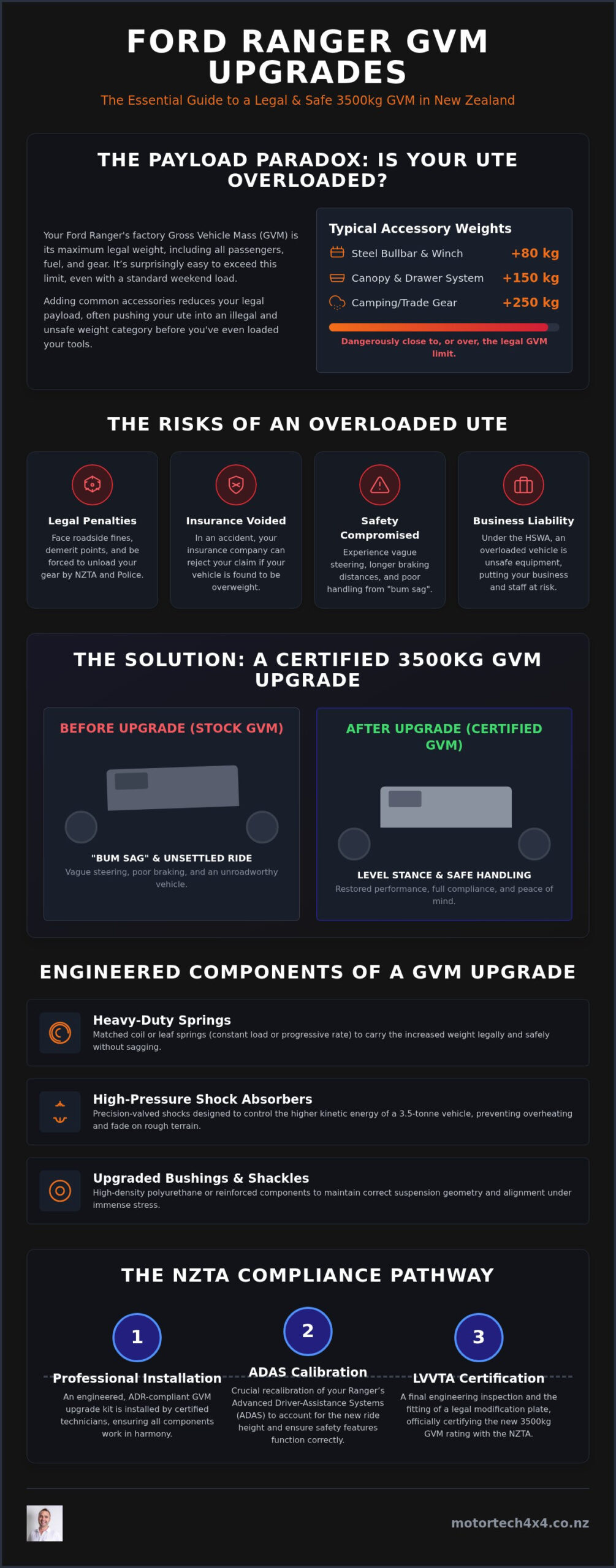
The Gross Vehicle Mass (GVM) represents the maximum legal weight of your vehicle when fully loaded. This figure includes the chassis, body, fuel, passengers, and every accessory bolted to the frame. While the Ford Ranger is a powerhouse, its factory GVM limit is surprisingly easy to exceed. Most owners face what we call the “Payload Paradox” where adding essential off-road protection actually strips away their legal carrying capacity. A steel bullbar and winch alone can add 80kg to the front axle, while a canopy and drawer system can easily add 150kg to the rear. Before you’ve even loaded your tools or camping gear, you’re already nearing the limit.
It’s vital to distinguish between GVM and Gross Combined Mass (GCM). GVM is the limit for the vehicle itself; GCM is the total weight of the ute and whatever it’s towing. A Ford Ranger GVM upgrade NZ wide focuses on increasing the vehicle’s internal carrying capacity. Don’t assume that fitting heavy-duty springs solves the problem. While stiffer springs might level the ride, they don’t legally change your vehicle’s rating in New Zealand. Without an engineering certification and a physical modification plate, your Ranger remains legally bound to its original factory limits regardless of the hardware you’ve installed.
The Legal Risks of Being Overweight on NZ Roads
NZTA and Police Commercial Vehicle Safety Teams (CVST) use portable weigh scales to check axle loads during roadside inspections. If you’re over your GVM, you face immediate fines and may be forced to unload gear on the side of the road before continuing. More importantly, insurance companies often reject claims if an accident occurs in an overloaded vehicle, as it’s technically unroadworthy. For business owners, the Health and Safety at Work Act (HSWA) adds another layer of responsibility. You’re legally required to provide safe equipment for staff. An overloaded Ranger is a significant liability that puts your team and your business at risk.
Signs Your Ranger Needs a GVM Increase
You don’t always need a scale to know you’re at the limit. Excessive rear-end sag is the most obvious indicator, often leaving the nose of the ute pointing skyward. This shifts weight off the front wheels, leading to vague steering and increased braking distances. You might also notice the suspension “bottoming out” over Auckland’s undulating backroads or when entering construction sites. If your Ranger feels unsettled or takes longer to stop when loaded, your factory suspension is likely overwhelmed. It’s time to consider a professional Ford Ranger GVM upgrade NZ solution to restore safety and performance.
The Engineering Behind a Certified GVM Increase
Engineering a legal Ford Ranger GVM upgrade NZ requires a holistic approach to vehicle dynamics rather than a simple parts swap. When you increase the rated mass of a ute, you’re fundamentally altering its structural and kinetic limits. This process begins with a matched set of heavy-duty coil or leaf springs paired with high-pressure shock absorbers. Unlike standard components, these shocks feature specific valving designed to control the increased kinetic energy of a 3.5-tonne vehicle. Without this precise damping, an upgraded Ranger would suffer from uncontrolled oscillations, making it dangerous on uneven surfaces. Following NZTA vehicle modification rules ensures that these hardware changes are not just physically capable, but legally recognised.
Structural integrity is maintained through upgraded bushings and shackles. High-load environments put immense stress on factory rubber components, leading to premature failure and alignment drift. Using high-density polyurethane or reinforced rubber bushings ensures the suspension geometry remains consistent under pressure. We also pay close attention to the centre of gravity. A GVM upgrade often involves a slight increase in ride height, which can affect lateral stability. To counter this, the engineering must ensure the vehicle’s braking performance and electronic stability control remain within safe operating parameters for the new weight rating.
Suspension Components: Beyond Just ‘Stiffer Springs’
Precision valving in shock absorbers is what separates a professional kit from a generic setup. Off-the-shelf shocks often overheat and “fade” when dampening a fully loaded tray over corrugated roads. We select springs based on your specific use case. Constant load springs are ideal for tradies with heavy permanent fit-outs, while progressive rate springs offer more comfort when the tray is empty. Crucially, we must maintain correct driveline angles. Lifting a Ranger changes the geometry of the driveshaft, which can cause vibrations or accelerated wear if the differential and gearbox angles aren’t kept within factory tolerances.
ADAS Calibration: The Forgotten Step in GVM Upgrades
Modern Rangers are packed with Advanced Driver Assistance Systems (ADAS). These cameras and radar sensors are calibrated to the vehicle’s factory height and rake. When you install a Ford Ranger GVM upgrade NZ kit, you change the vehicle’s “posture.” This tilt can cause the Autonomous Emergency Braking (AEB) and Lane Keep Assist to misread the road ahead. Motortech 4X4 provides in-house ADAS calibration to ensure these safety systems are reset to your new ride height. This is a legal and safety requirement that many general workshops overlook. For a truly complete solution, it is best to choose specialist suspension kits that include both mechanical installation and electronic recalibration.
NZTA Compliance: Navigating LVVTA Certification and WOFs
Achieving a legal Ford Ranger GVM upgrade NZ requires more than just high-end hardware; it is a formal re-engineering process overseen by the Low Volume Vehicle Technical Association (LVVTA). To ensure your vehicle remains road-legal and insurance-compliant, you must follow a structured compliance pathway. This begins with selecting a kit that meets Australian Design Rules (ADR) or equivalent local standards. Once the mechanical installation is completed by a qualified technician, an independent LVVTA certifier must inspect the vehicle. They verify that the suspension, braking, and steering components work harmoniously under the new weight rating. After a successful inspection, a permanent silver LVVTA data plate is affixed to your firewall, and the vehicle’s records are updated with the NZTA to reflect the increased GVM.
The LVVTA Certification Process Explained
An LVVTA certifier acts as a third-party auditor of the modification. During the inspection, they check for adequate tyre-to-body clearance, correct fastener torque markings, and the presence of all required kit components. A common reason for certification failure is insufficient tyre load ratings. If your tyres aren’t rated to carry the new axle loads, the upgrade cannot be signed off. While the certification process involves a fixed fee of NZ$270.00 for the Electronic Data Plate, the real value lies in the legal protection it provides. This “silver plate” is your proof that the vehicle meets the Land Transport Rule: Vehicle Dimensions and Mass 2016, protecting you from liability in the event of a heavy-load accident.
WOF vs. COF: How GVM Affects Your Inspection Type
In New Zealand, the 3500kg GVM mark is a critical regulatory threshold. Vehicles with a GVM of 3500kg or less fall into the light vehicle category, requiring a standard Warrant of Fitness (WOF). If a Ford Ranger GVM upgrade NZ pushes the vehicle’s rating above 3500kg, it moves into the heavy vehicle category, necessitating a Certificate of Fitness (COF) every six months. Most Ranger owners aim for the “sweet spot” of exactly 3500kg. This allows for a significant payload increase while keeping the vehicle within the more convenient and cost-effective WOF inspection cycle. When you present your Ranger for its next WOF, the inspector will check the LVVTA plate to confirm the modifications are legal, ensuring a seamless pass despite the heavy-duty suspension.
Comparing Ranger GVM Kits: From PX Series to Next-Gen
The Ford Ranger has undergone significant architectural changes since the PX1 debuted in 2011. Engineering a Ford Ranger GVM upgrade NZ for a 2012 model is vastly different from working on the latest Next-Gen platform. While the earlier PX series relied on traditional mechanical setups, the 2022+ models feature a 50mm wider track and outboard-mounted rear dampers. This wider stance provides better stability from the factory, but it also means that GVM kits must be specifically engineered for the increased leverage on the suspension arms. Most certified kits aim to lift the factory GVM from approximately 3230kg to a robust 3500kg, providing that critical extra payload for accessories and gear.
Selecting the right kit depends on your vehicle’s “empty” weight. “Constant Load” kits are designed for tradie utes that always carry 300kg to 600kg of tools, drawers, and a canopy. If you fit these to a touring vehicle that is empty half the time, the ride will be harsh and “pogo” over bumps. “Touring” kits offer a more compliant ride for those who only reach max GVM when hitching up a caravan for a weekend trip. Matching the spring rate to your actual daily load is the only way to ensure the vehicle remains comfortable and safe.
Next-Gen Ranger GVM Challenges
The Next-Gen Ranger introduces sophisticated electronic systems that complicate suspension modifications. The V6 Diesel engine is significantly heavier than the 2.0L Biturbo, requiring specific front spring rates to maintain the correct ride height and rake. Features like the electronic “E-shifter” and electronic brake boosters change how the vehicle responds to weight shifts during heavy braking. We must also account for the electronic power steering and lane-keep assist systems, which are sensitive to changes in steering geometry. Ensuring these systems remain within their operational window is a core part of the engineering sign-off for modern GVM increases.
PX1, PX2, and PX3: Maximising the Older Platforms
For owners of the PX1, PX2, or PX3 models, a Ford Ranger GVM upgrade NZ is often an opportunity to refresh a high-kilometre workhorse. We frequently find worn leaf-spring bushings and sagging factory coils that have been hammered by years of service. A comprehensive GVM kit replaces these tired components, significantly improving handling and steering precision. These kits are fully compatible with existing accessories like snorkels, bullbars, and winches, provided the total weight remains within the new certified limits. If you are ready to restore your ute’s capability, you can enquire about GVM upgrades to determine the best kit for your specific Ranger model.
Professional GVM Installations at Motortech 4X4 Auckland
Auckland drivers require more than just a retail shop for their suspension needs; they need a partner that understands the intersection of mechanical engineering and New Zealand’s strict compliance laws. Motortech 4X4 has established itself as the definitive source for precision 4×4 engineering in the region. We take a “one-stop” approach to every Ford Ranger GVM upgrade NZ project, handling the entire lifecycle of the modification under one roof. This includes the heavy-duty mechanical installation, the technical ADAS calibration, and the final coordination with an independent LVVTA certifier. By managing every stage internally, we ensure that your vehicle’s safety systems and structural upgrades work in perfect unison.
Efficiency is central to our service model. We understand that for many of our customers, a ute is a primary tool of trade, and downtime represents a loss of income. We organise the certification process alongside the physical installation to ensure your Ranger isn’t sitting idle. Our technicians are experts in New Zealand’s rugged conditions, selecting components that can withstand everything from Northland’s clay tracks to the heavy-duty demands of Auckland’s construction sites. This local expertise ensures your upgrade is fit for purpose, not just on paper, but on the road.
Auckland Fleet Fit-Outs and Support
Commercial organisations and trade fleets face unique challenges regarding vehicle weight and workplace safety. We provide customised GVM solutions for large-scale fleet fit-outs, ensuring every vehicle in your company remains legal and insurance-compliant. Beyond the initial upgrade, we offer ongoing fleet servicing and maintenance to monitor the performance of your modified suspension. Whether your team is navigating the soft sands of Muriwai for utility work or hauling heavy gear through the Hunua Ranges, our engineering ensures your Rangers handle the terrain with stability and precision.
Booking Your Ranger GVM Consultation
The first step in any successful Ford Ranger GVM upgrade NZ is a comprehensive pre-install weigh-in. We don’t guess your requirements. By weighing your vehicle in its current state, we can determine the exact payload increase needed to accommodate your specific accessories, from steel bullbars to heavy-duty hardlids. This data-driven approach allows us to provide a tailored quote that reflects your actual usage patterns and load requirements. Contact Motortech 4X4 today for a professional GVM upgrade consultation and ensure your Ranger is legally prepared for the heavy lifting ahead.
Secure Your Payload and Legal Compliance Today
Ensuring your ute is legally rated for the work you do is the only way to protect your business, your insurance, and your safety on the road. A certified Ford Ranger GVM upgrade NZ provides the structural reinforcement and engineering sign-off required to handle heavy loads without compromising vehicle dynamics. By choosing a professional installation, you guarantee that every component, from heavy-duty springs to calibrated safety sensors, works exactly as intended under pressure.
At Motortech 4X4, we combine specialised 4×4 workshop expertise with comprehensive fleet fit-out experience to deliver a complete compliance solution. Our on-site ADAS calibration ensures your vehicle’s safety technology remains precise after its height increase, while our team handles the complexities of the LVVTA certification process for you. Don’t let an overloaded tray compromise your safety or void your policy. Book your Ford Ranger GVM Upgrade at Motortech 4X4 Auckland and drive with the confidence that your vehicle is engineered for the task. We’re ready to help you get the most out of your Ranger.
Frequently Asked Questions
Will a GVM upgrade void my Ford Ranger’s factory warranty?
A GVM upgrade does not void your entire vehicle warranty, but it replaces the factory suspension warranty with the aftermarket manufacturer’s coverage. Ford won’t cover failures caused by the modification or the increased loads placed on the chassis. However, the engine, transmission, and drivetrain warranties remain intact unless a fault is directly attributed to the upgrade. It’s best to discuss this with your dealer if you have specific service agreements in place.
Does a GVM upgrade increase the amount I can legally tow?
No, a GVM upgrade only increases the vehicle’s internal carrying capacity; it doesn’t raise the Gross Combined Mass (GCM) or the legal towing limit. Your Ranger’s maximum braked towing capacity remains at 3500kg. While the upgrade improves stability and reduces rear sag while towing, you must still ensure the total weight of the ute and trailer stays within the original factory GCM limit to remain legal on New Zealand roads.
How much does a GVM upgrade typically cost in New Zealand?
Total costs involve the hardware kit, professional installation, and mandatory certification fees. The LVVTA Electronic Data Plate fee is fixed at NZ$270.00. Beyond this, you’ll need to account for the suspension kit, labour for mechanical fitment and ADAS calibration, and the independent certifier’s inspection time. Because requirements vary between PX models and Next-Gen Rangers, we recommend a tailored consultation to determine the exact hardware requirements for your specific setup.
Can I install a GVM kit myself and get it certified later?
While you can physically bolt on the parts, an LVVTA certifier requires proof of professional installation to sign off on a GVM increase. Most reputable GVM kits must be fitted by an authorised technician to ensure the engineering standards are met. Self-installation often leads to certification failure if torque markings or specific component orientations aren’t perfect, resulting in higher costs to rectify the work before the silver plate can be issued.
What is the difference between a pre-registration and post-registration GVM upgrade?
Pre-registration upgrades are performed before the vehicle is first registered, often under a Second Stage Manufacture approval. Post-registration upgrades, which are more common for existing owners, require an individual engineering inspection and LVVTA certification. Both methods result in a legal weight increase, but post-registration involves a physical inspection of your specific vehicle by an independent certifier to ensure compliance with the Land Transport Rule: Vehicle Dimensions and Mass 2016.
How long does the GVM upgrade and certification process take?
Most installations take one full day, including the mechanical fitment and ADAS calibration. The certification process adds another layer, as we must coordinate with an independent LVVTA certifier for the final inspection. While the physical work is fast, the administration for the new data plate can take a few days. We manage this timeline at our Auckland workshop to minimise your vehicle’s downtime and ensure the process is as efficient as possible.
Do I need to upgrade my tyres when I get a GVM upgrade?
You must ensure your tyres have a load index sufficient for the new axle ratings. If your current tyres are rated lower than the upgraded GVM requires, an LVVTA certifier won’t sign off on the modification. This is a common oversight during a Ford Ranger GVM upgrade NZ project. We check your tyre specifications during the initial consultation to confirm they meet the legal requirements for your new 3500kg rating.
Is an LVVTA certificate mandatory for all suspension lifts in NZ?
An LVVTA certificate is mandatory if the lift exceeds 50mm or if you are changing the vehicle’s GVM rating. While a minor levelling kit might not always require certification, any modification that legally increases your carrying capacity must have a silver plate. Without this certification, your vehicle is technically unroadworthy, which can lead to failed WOF inspections and rejected insurance claims in the event of an accident.