Would you trust a $15,000 engine rebuild to a $2 tube of silicone and a shaky drill hand? Most Auckland drivers understand that a snorkel is essential for tackling the Waitakere tracks or crossing deep fords, but the fear of a botched job is real. You have likely worried about a technician drilling into your guard only to leave behind raw metal that invites rust or, worse, interferes with your new ute’s ADAS safety sensors. Getting a professional 4×4 snorkel installation Auckland wide is about more than just height; it’s about precision engineering and watertight integrity.
We agree that your vehicle deserves better than a “near enough is good enough” approach when it comes to structural modifications. This guide explains why expert fitting is a non-negotiable requirement for New Zealand’s harsh coastal and off-road environments. You’ll discover how to choose the right gear to protect your engine and maintain your peace of mind for long-distance touring. We will also look at the technical differences between polyethylene and stainless steel options, the latest LVVTA compliance standards for 2026, and how to ensure your modification doesn’t void your factory warranty.
Key Takeaways
- Understand how elevating your air intake protects your engine from Auckland’s salt-heavy coastal air and abrasive beach sand.
- Compare the technical performance of UV-stable polyethylene snorkels against the custom aesthetics of stainless steel alternatives.
- Learn why a professional 4×4 snorkel installation Auckland service is vital for ensuring watertight seals and long-term rust prevention.
- Discover the importance of ADAS calibration to ensure your vehicle’s safety systems remain fully functional after structural modifications.
- Identify the benefits of choosing a specialised mechanical workshop for a “one-stop” fitment and technical check-up.
Why Your 4WD Needs a Snorkel in Auckland Conditions
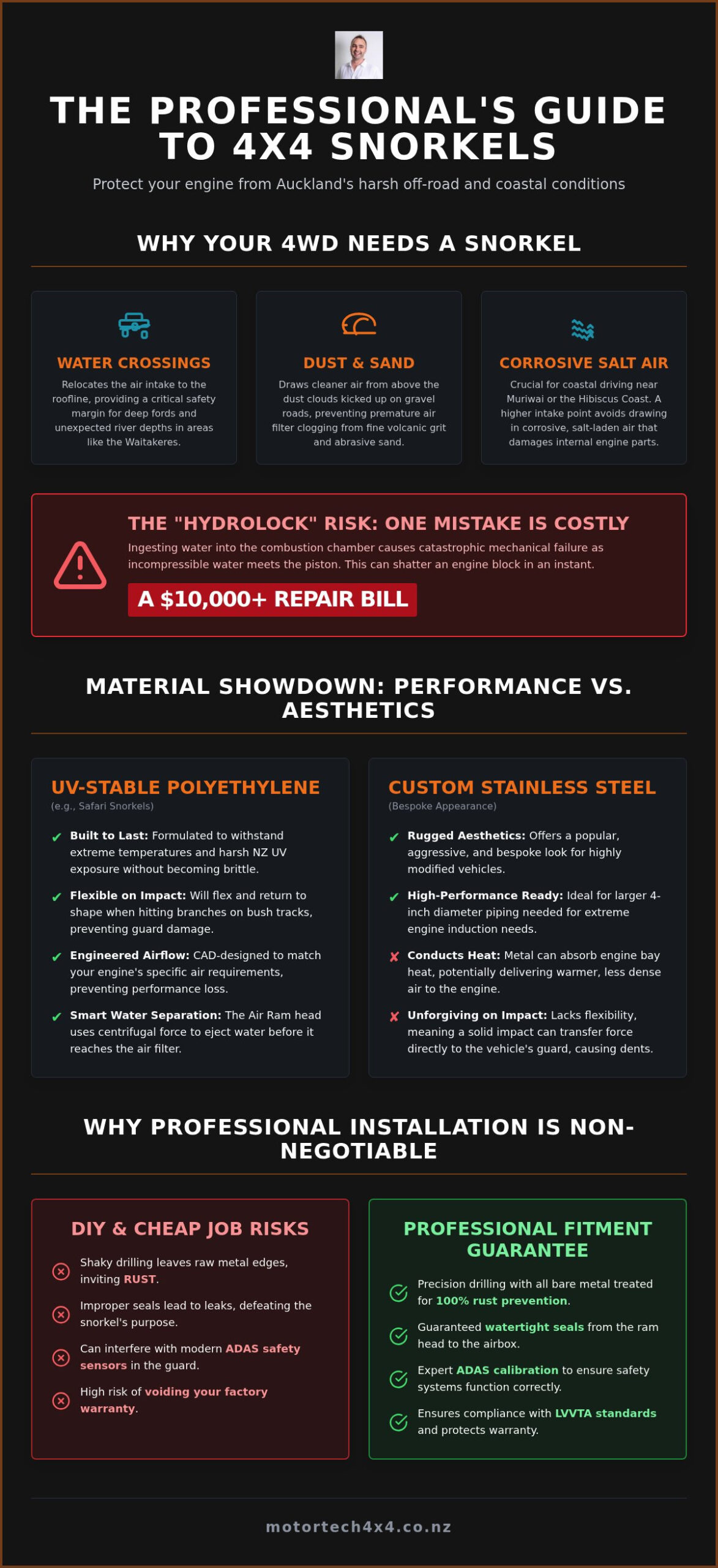
A standard factory air intake is typically tucked away inside the inner guard, positioned roughly at headlight level. While this design is sufficient for suburban commuting, it becomes a major liability the moment you leave the tarmac. A vehicle snorkel relocates this intake point to the roofline, allowing the engine to draw air from a much safer and cleaner height. This modification isn’t just about preparing for deep water wading; it’s about providing the engine with a consistent supply of cool air. Cooler air is denser and contains more oxygen, which facilitates better combustion efficiency and ensures your vehicle maintains peak performance when climbing steep grades or towing heavy loads.
Beyond Water Crossings: Dust and Salt Air
Auckland’s geography creates specific environmental hazards that many off-roaders overlook. While the Australian Outback is famous for red dust, North Island tracks often consist of fine volcanic grit and abrasive coastal sand. When you’re following another vehicle down a gravel road, your factory intake is positioned right in the thick of the dust cloud kicked up by their tyres. This leads to premature air filter clogging and restricted airflow. For those who frequent Muriwai or the Hibiscus Coast, salt-laden air is a primary concern. Salt is highly corrosive to internal engine components if it manages to bypass a neglected filter. A professional 4×4 snorkel installation Auckland wide ensures that your intake draws from a cleaner air stream well above the concentrated salt spray and road grime. A snorkel is an essential engine protection system for any vehicle used for serious NZ touring.
The “Hydrolock” Risk: Why One Mistake is Costly
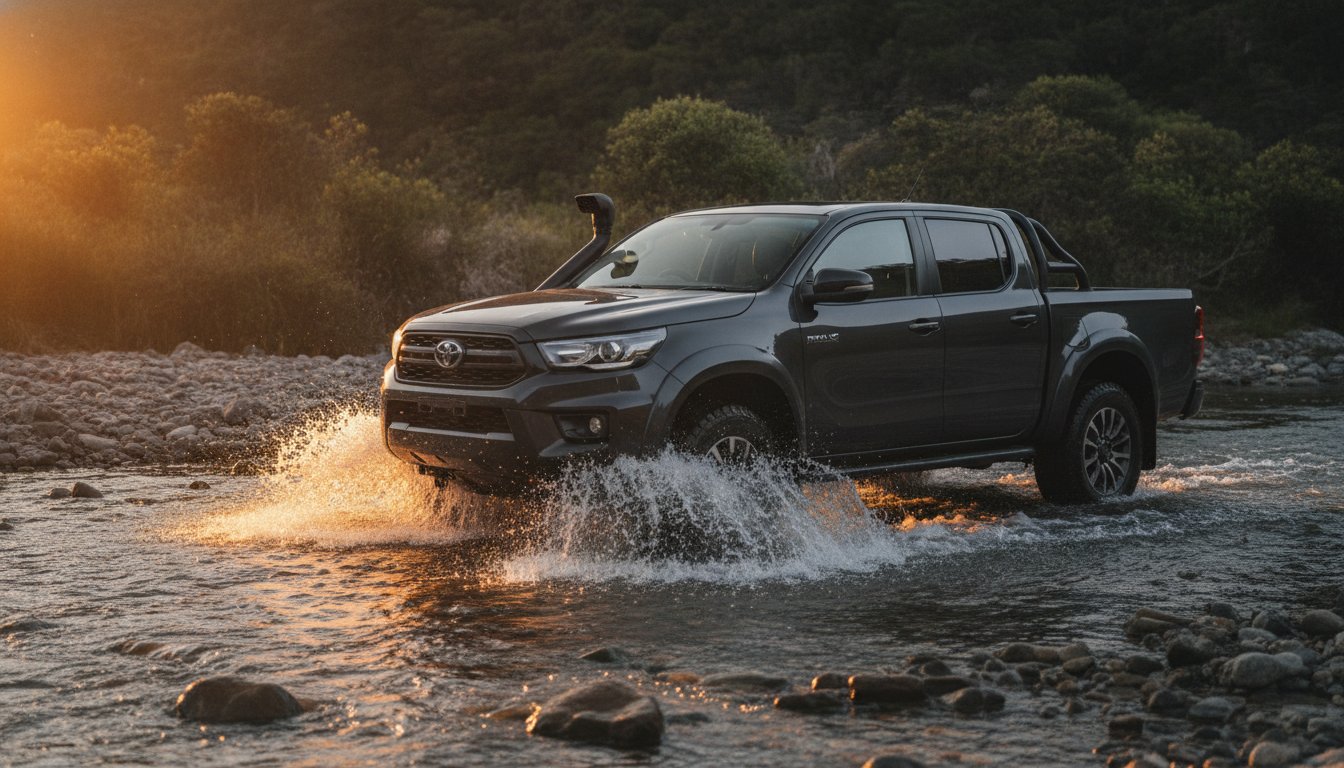
The most critical reason to invest in a snorkel is to prevent “hydrolock.” This occurs when water is sucked into the intake and enters the combustion chamber. Because water is incompressible, the force of the piston attempting to move upward results in catastrophic mechanical failure, often snapping connecting rods or shattering the engine block. Modern common-rail diesel engines are particularly vulnerable to this because they operate with incredibly high compression ratios and extremely tight internal tolerances. Even a small volume of water ingestion can lead to a repair bill that exceeds ten thousand dollars. Opting for a professional 4×4 snorkel installation Auckland service acts as a mechanical insurance policy. It provides the necessary safety margin for those moments when a river crossing in the Waitakeres is deeper than it looks or a hidden hole catches you by surprise during a weekend adventure.
Safari Snorkels vs. Stainless Steel: Performance and Durability
Choosing the right material for your 4×4 snorkel installation Auckland wide depends on whether you prioritise factory-perfect performance or custom aesthetics. Both polyethylene and stainless steel offer protection, but they respond differently to New Zealand’s high UV index and coastal conditions. Selecting the wrong type can lead to brittle hardware or restricted airflow, which compromises the very engine you’re trying to protect.
The Case for UV-Stable Polyethylene
Safari Snorkels are the industry standard for a technical reason. They use high-grade, cross-linked polyethylene specifically formulated to withstand extreme temperature fluctuations and intense UV exposure. In the Auckland sun, inferior plastics can become brittle and crack within a few seasons. Safari units remain flexible. This flexibility is vital if you clip a branch on a tight bush track; the snorkel will often flex and return to shape rather than shattering or denting your vehicle’s guard.
Beyond physical durability, these units are CAD-designed to match your specific engine’s airflow requirements. This prevents the “strangling” effect that poorly designed pipes can cause. A key feature is the Air Ram head. It is engineered to prevent water from entering the engine by using centrifugal force to separate moisture from the air stream. The water is diverted through moisture discharge drains before it ever reaches the filter. This design is highly effective during heavy Auckland winter storms when driving at highway speeds.
Custom Stainless Steel Snorkels
Stainless steel snorkels have gained significant popularity for their rugged, bespoke appearance. They are often the first choice for high-performance builds where a larger 4-inch diameter pipe is required for extreme induction needs. However, there are technical trade-offs. Metal is a conductor of heat. On a hot summer day, “heat soak” can warm the intake air. This is counterproductive to the goal of drawing in the densest, coolest air possible for combustion efficiency.
Sealing a stainless snorkel also requires meticulous attention. Unlike a moulded polyethylene unit that fits the guard contour precisely, stainless pipes often rely on custom silicone joins and internal plumbing. If these aren’t perfectly executed during the 4×4 snorkel installation Auckland process, you lose the watertight integrity needed for river crossings. Maintenance is another factor. While stainless steel is rust-resistant, the Auckland salt air can cause surface pitting or “tea staining” if the metal isn’t regularly cleaned. If you’re unsure which material suits your touring style, our team can help you select the right snorkels for your specific vehicle and performance goals.
The Professional Installation Process: Why Precision Drilling Matters
Performing a 4×4 snorkel installation Auckland wide involves far more than just bolting a plastic tube to the side of a ute. It is a significant structural modification that requires drilling a hole, often exceeding 100mm in diameter, directly through the vehicle’s steel or aluminium guard. This is a permanent change to the bodywork. There is no room for error. A professional installation ensures that the snorkel body aligns perfectly with the vehicle’s specific contours, maintaining a factory-finished appearance while providing a robust path for induction air. Beyond the guard, the connection to the A-pillar must be secure. A poorly fitted pillar bracket leads to constant vibration and eventual metal fatigue, whereas a professional fitment results in a rattle-free, rigid structure that can withstand high-speed wind resistance and off-road impacts.
Sealing the Airbox: The Invisible Step
The most frequent failure in amateur fitments occurs where the snorkel meets the factory airbox. Many owners assume that bolting the components together is sufficient. However, factory airboxes often contain drainage holes or non-watertight joins designed only for standard road use. During a professional 4×4 snorkel installation Auckland project, we inspect and seal every potential leak point. We use high-quality EPDM rubber gaskets and specialised automotive sealants to create a permanent, airtight bond. A snorkel is only as good as its weakest seal. Without this meticulous attention to the internal plumbing, the external hardware is merely cosmetic and provides zero protection during a deep water crossing.
Rust Prevention and Body Integrity
Cutting into a vehicle guard exposes raw metal to the elements. In Auckland’s humid, salt-rich environment, untreated edges will begin to corrode almost immediately. Professional installers take the time to debur every hole and apply multiple layers of professional-grade zinc-rich primer or rust inhibitor to the exposed surfaces. We also ensure there is adequate clearance between the snorkel body and the paintwork. Over time, engine vibrations can cause the snorkel to rub against the guard, leading to paint wear and hidden rust. Motortech 4X4 utilises vehicle-specific templates for every fitment. This ensures that every fastener and intake port is positioned exactly where the manufacturer intended, preserving the structural integrity of your vehicle’s bodywork.
Selecting the Right Snorkel for Your Vehicle Model
Every 4WD has a unique internal architecture. A common mistake is assuming that a snorkel is a universal piece of hardware. In reality, the internal ducting, guard shape, and mounting points differ significantly between a Ford Ranger and a Nissan Navara. Selecting a vehicle-specific kit is vital for ensuring that the intake system provides the exact volume of air required by the engine’s turbocharger. Using a “universal” fitment often leads to poor sealing and restricted airflow, which can trigger engine fault codes or reduce fuel economy. When planning a 4×4 snorkel installation Auckland wide, we prioritise kits that are precision-engineered for the specific make, model, and engine variant of your vehicle.
The Next-Gen Ranger and Everest Challenge
Modern utes like the Next-Gen Ford Ranger and Everest are sophisticated machines equipped with Advanced Driver Assistance Systems (ADAS). Snorkel placement on these vehicles must be exact to avoid obstructing front-facing cameras or interfering with radar sensors located near the guard and windscreen. Because these vehicles are often still under a new car warranty, a professional fitment is non-negotiable. An incorrect installation that damages the electrical loom or requires excessive modification to the inner structure can complicate warranty claims. If you are looking to enhance your Ford, check out our Ranger accessories guide for more information on compatible upgrades.
LandCruiser and Hilux: The Touring Standards
The Toyota Hilux and LandCruiser series remain the benchmarks for New Zealand touring. For the 70 Series LandCruiser, a high-volume snorkel is essential to feed the V8 diesel engine, whereas the newer 300 Series requires a more refined approach to match its twin-turbo setup. A primary concern for these models is ensuring the snorkel doesn’t interfere with other modifications. It must sit flush and clear any existing bullbar mounts or roof rack transitions. If you have already upgraded your front-end protection, you can explore our Bullbar installation services to see how we integrate these components for a seamless, professional finish.
Nissan Navara and Mitsubishi Triton owners face different challenges. The Triton’s guard has a distinct “stepped” profile that requires a snorkel with a very specific footprint to achieve a watertight seal. Similarly, the Navara has limited space within the inner guard, making the internal plumbing connection particularly tight. Our team ensures that every 4×4 snorkel installation Auckland project accounts for these model-specific quirks. We verify that the internal ducting is secured without rubbing against other components, preventing long-term wear and potential leaks. To ensure your vehicle is equipped with the correct hardware for your next adventure, book your vehicle-specific snorkel installation with our specialist team today.
Expert Snorkel Fitting at Motortech 4X4 Auckland
Choosing a specialised mechanical service centre for your 4×4 snorkel installation Auckland project provides a level of technical oversight that retail-only outlets cannot match. We don’t just “fit” a part; we integrate it into your vehicle’s existing mechanical and electronic architecture. Our workshop is equipped with the precision tools required for complex structural modifications, ensuring that every cut is treated for rust prevention and every internal join is pressure-tested for watertight integrity. This professional approach is essential for maintaining the long-term reliability of your engine, particularly when navigating the demanding coastal environments of the North Island.
Our expertise extends beyond simple accessory fitment. We understand how a snorkel interacts with other high-performance components. Whether you are also installing suspension kits, bullbars, or high-output vehicle lighting, our technicians ensure that each modification complements the others. This “one-stop” mentality means your vehicle undergoes a comprehensive mechanical check as part of the installation process. We verify that the increased airflow from your new intake is properly managed by the engine management system, preserving both performance and fuel efficiency.
ADAS Calibration: The Modern Necessity
Modern 4WDs are equipped with a suite of Advanced Driver Assistance Systems (ADAS) that rely on a network of cameras and radar sensors. Adding a large accessory like a snorkel or a bullbar can subtly alter the vehicle’s profile or weight distribution, which may throw these sensitive systems out of alignment. If your lane-keep assist or emergency braking sensors aren’t perfectly calibrated, your safety is at risk. Motortech 4X4 is one of the few Auckland specialists with the dedicated equipment and technical expertise to perform full sensor recalibrations in-house. You can learn more about our ADAS calibration services to understand how we keep your safety tech functioning perfectly after every modification.
Book Your Professional Installation in Auckland
When you book your appointment at our Auckland service centre, you can expect a methodical and organised process. We start with a consultation to confirm the best snorkel model for your specific touring needs and vehicle variant. From there, our team manages the entire build with maximum efficiency, ensuring that all work meets our rigorous professional standards. We take pride in delivering a finished product that looks factory-perfect and performs flawlessly in the field. Precision is paramount. Protection is guaranteed. Don’t risk your engine with an amateur fitment. Visit Motortech 4X4 for a professional consultation and ensure your vehicle is ready for the tracks ahead.
Secure Your Engine for the Tracks Ahead
A snorkel is more than a rugged accessory; it’s a vital insurance policy against Auckland’s corrosive salt air and the unpredictable depths of North Island river crossings. By choosing the right material for your touring style and ensuring a watertight seal at the airbox, you protect your engine from catastrophic mechanical failure. Remember that modern vehicle technology requires a precise approach, where ADAS calibration and structural integrity are just as important as the intake height itself.
As an expert mechanical service centre and authorised installers of premium 4×4 brands, we provide the technical expertise required for a flawless fitment. We handle specialised ADAS calibration on-site, ensuring your safety systems remain accurate after every modification. Don’t leave your vehicle’s safety to chance with a DIY approach. Book your professional snorkel installation at Motortech 4X4 Auckland today and enjoy total peace of mind on your next off-road journey. We look forward to helping you build a vehicle that is truly fit for purpose.
Frequently Asked Questions
Do I really need a snorkel if I do not do deep water crossings?
Yes, a snorkel is essential for drawing cleaner and cooler air from the roofline rather than the dusty inner guard. In Auckland, this is particularly important for avoiding salt spray and fine sand that can clog filters prematurely. Even if you never submerge the vehicle, the reduction in intake temperature and dust ingestion significantly extends the life of your engine and air filter.
Will installing a snorkel void my new vehicle warranty in NZ?
A professional installation typically does not void your entire vehicle warranty, but it may affect the warranty on the specific guard and intake components modified. Under New Zealand law, a manufacturer cannot void a warranty unless the aftermarket part caused the failure. Choosing a professional 4×4 snorkel installation Auckland service ensures the work meets manufacturer standards, which helps protect your overall warranty standing.
How long does a professional 4×4 snorkel installation take?
A standard installation usually takes between three and five hours. This timeframe accounts for the precision drilling of the guard, deburring the metal, applying rust inhibiting primer, and meticulously sealing the airbox. Complex builds that require ADAS calibration or custom ducting for high performance engines may require a full day to ensure every seal is watertight and every sensor is accurate.
What is the difference between a Safari V-Spec and Armax snorkel?
The V-Spec range is designed for general touring and daily driving, offering high UV resistance and standard airflow. The Armax range is a high performance alternative designed specifically for vehicles with engine remaps or larger turbochargers. Armax snorkels feature a larger internal diameter and a specialised head design that provides significantly higher airflow volumes while maintaining full moisture separation.
Can a snorkel improve my fuel economy or engine performance?
Yes, by providing a source of cooler and denser air, a snorkel can improve combustion efficiency. Engines perform better when they aren’t sucking in hot air from the engine bay or struggling with a dust clogged filter. While the gain might be subtle on a stock vehicle, high flow units like the Armax range provide the necessary air volume to support power gains in tuned 4WDs.
Do I need to recalibrate my sensors after fitting a snorkel?
Recalibration is necessary for modern vehicles equipped with Advanced Driver Assistance Systems (ADAS). A snorkel body can subtly change the vehicle’s profile or interfere with the field of view for certain sensors and cameras. We use specialised equipment to ensure your emergency braking and lane keep assist systems are perfectly aligned after the fitment is complete, maintaining your vehicle’s factory safety rating.
Can I install a snorkel myself at home?
While DIY kits are available, home installation carries high risks of permanent body damage and engine failure. Drilling a 100mm hole into a guard requires absolute precision; a single slip can lead to expensive panel repairs. Most home mechanics lack the industrial grade sealants and pressure testing tools needed to guarantee a watertight airbox connection, which is the only thing protecting your engine from hydrolock.
How do I maintain my snorkel and check for leaks?
Regular maintenance involves inspecting the moisture discharge valves to ensure they aren’t blocked by debris. You should also periodically check the external bolts for tightness and inspect the silicone joins for any signs of perishing. To check for leaks, a professional smoke test is the most accurate method to ensure that the entire system from the Air Ram head to the airbox remains airtight.