

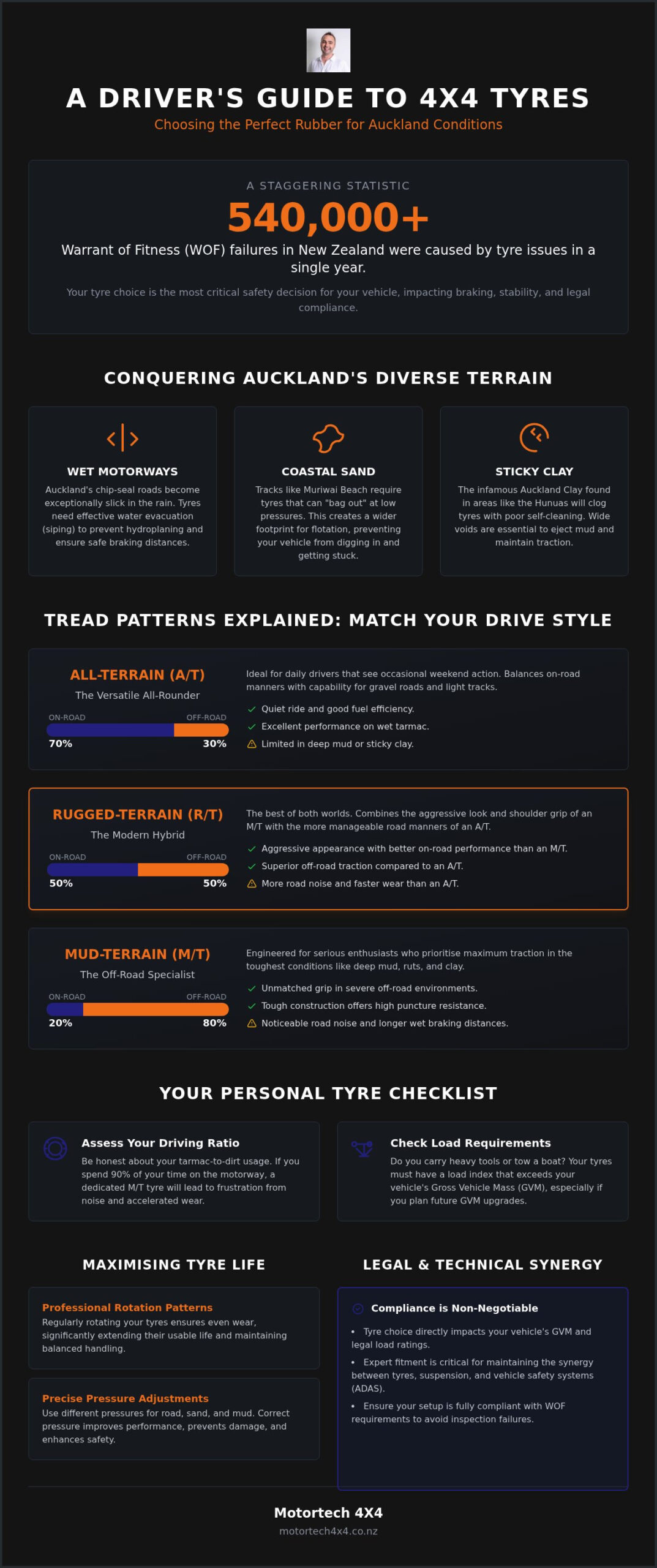
Did you know that over 540,000 Warrant of Fitness failures in New Zealand were caused by tyre issues in a single year? Finding the right 4×4 tyres Auckland wide often feels like a series of compromises between off-road performance and daily driveability. You want the aggressive tread for weekend adventures, but you don’t want the excessive road noise on the motorway or the risk of a failed inspection due to legal size restrictions.
We believe your vehicle should be a technical match for your specific requirements. This guide will help you choose the perfect rubber for Auckland’s varied terrain, ensuring you get maximum traction on the tracks and total safety on wet tarmac. You’ll learn about the latest 2026 tyre technologies, including enhanced puncture resistance and hybrid tread patterns. We also provide a clear breakdown of WOF requirements and professional advice from a team that actually goes off-roading. By the end, you’ll know exactly how to select a setup that offers superior grip, long-lasting tread life, and full legal compliance.
Key Takeaways
- Match specific tread patterns to Auckland’s unique mix of volcanic soil and clay to ensure maximum off-road grip without compromising motorway safety.
- Understand how your choice of 4×4 tyres Auckland impacts your vehicle’s GVM, load ratings, and overall legal compliance on New Zealand roads.
- Discover how to extend tread life through professional rotation patterns and precise pressure adjustments for road, sand, and mud surfaces.
- Learn why expert fitment is critical for maintaining the technical synergy between your rubber, suspension, and ADAS calibration.
- Assess your genuine tarmac-to-dirt ratio to select a tyre that balances aggressive performance with manageable road noise for daily driving.
Understanding 4×4 Tyres for Auckland Conditions
4×4 tyres Auckland are far more than just a cosmetic upgrade for your ute or SUV. They are precision-engineered mechanical components designed to manage specific load ratings, rotational forces, and surface friction. In a city where your vehicle must transition from the smooth tarmac of the Southern Motorway to the unpredictable terrain of the surrounding regions, your choice of rubber is the most critical safety decision you’ll make. It dictates your braking distance, cornering stability, and the ability of your suspension system to function as intended.
Selecting the right tyre requires an understanding of how different tread designs interact with the ground. A tyre that provides exceptional grip in deep mud might be dangerously loud or prone to hydroplaning on a rain-soaked Auckland motorway. Conversely, a highway-terrain tyre will fail the moment you hit the soft sand or greasy inclines found on our local tracks. We view tyres as part of a total vehicle solution, where the rubber must work in perfect synergy with your suspension and GVM requirements.
The Auckland Terrain Factor: From Muriwai to the Hunuas
Auckland’s geography is notoriously diverse, demanding a lot from a single set of tyres. If you frequent Muriwai or Northland, sand performance is your priority. You need a tyre that can “bag out” at low pressures to create a wide footprint, preventing the vehicle from digging in. However, the Hunuas and Woodhill Forest present a completely different challenge: the infamous Auckland Clay. This substance is incredibly sticky and will clog a tyre with poor self-cleaning properties in seconds. Once the tread is filled with clay, you effectively have a slick tyre with zero traction.
Safety on the tarmac is equally vital. Auckland’s chip-seal roads are unique; they become exceptionally slick during the first rainfall after a dry spell. Your tyres must have adequate siping—small slits in the tread blocks—to evacuate water and maintain contact with the road. Balancing these off-road requirements with wet-weather motorway safety is the hallmark of a well-chosen 4×4 tyre.
Tread Patterns 101: A/T vs M/T vs R/T
Choosing a tread pattern is about being honest with your actual vehicle usage. We categorise these into three primary groups:
- All-Terrain (A/T): Typically designed for a 70% road and 30% off-road split. These are the standard for daily drivers and weekend warriors. They offer a quiet ride and good fuel efficiency while providing enough bite for gravel roads and light mud.
- Mud-Terrain (M/T): These are for the serious enthusiast. They feature massive tread blocks and deep voids designed to eject debris and bite into deep ruts. While they are unmatched in the Woodhill mud, they do produce more road noise and generally have longer braking distances on wet tarmac.
- Rugged-Terrain (R/T): The modern hybrid. These tyres feature the aggressive sidewalls and shoulders of an M/T but use a tighter centre tread pattern similar to an A/T. It’s an ideal middle ground for those who want aggressive looks and off-road capability without the constant “hum” on the highway.
Each of these patterns affects your vehicle’s dynamics differently. At Motortech 4X4, we ensure your chosen tread doesn’t just look the part, but also maintains the integrity of your vehicle’s handling and safety systems.
How to Choose the Right 4×4 Tyres for Your Ute
Selecting the correct set of 4×4 tyres Auckland involves a realistic assessment of your vehicle’s primary duties. While aggressive tread looks impressive in the driveway, the reality of Auckland driving often includes significant highway mileage. You must strike a balance between off-road capability and everyday utility. If your ute spends 90% of its time on the Southern Motorway, a dedicated mud-terrain tyre will likely become a source of frustration due to noise and accelerated wear.
Load requirements are equally critical. Heavy-duty utes often carry permanent tool setups or tow large boats and caravans. Your tyres must have a load index that exceeds your vehicle’s maximum gross weight. If you are considering a GVM upgrade or a suspension lift in the future, your tyre choice must be compatible with these modifications. Choosing the wrong specification now could lead to double-handling costs when you decide to enhance your vehicle’s carrying capacity.
Matching Tyres to Your Driving Style
Ask yourself several practical questions before committing to a specific model. Do you carry heavy tools for work every day? Do you tow a boat to the ramp on weekends? These factors dictate the required sidewall strength and load rating. You should also consider your tolerance for cabin noise. If you regularly drive to the Coromandel or Northland, the constant drone of an aggressive tread pattern can become fatiguing. Furthermore, the increased weight of heavy-duty tyres adds to unsprung mass. This directly impacts fuel economy and can increase your braking distances on wet tarmac.
Sizing and Clearance: Will They Rub?
The trend of “plus-sizing” is a popular way to increase ground clearance, but it requires technical precision. Increasing the tyre diameter can cause the rubber to rub against the wheel arches or suspension components, especially during full steering lock or when the suspension is fully compressed. This is not just a nuisance; it is a safety risk and a guaranteed WOF failure.
Auckland WOF regulations are strict regarding tyre fitment. Any tyre that protrudes beyond the bodywork or flares is illegal. Additionally, a significant change in tyre height will alter your speedometer accuracy, which may require electronic recalibration. A professional fitment centre understands these tolerances. We ensure that your 4×4 tyres Auckland are fitted within legal limits, maintaining both your safety and your vehicle’s compliance with New Zealand road standards.
Technical Specs: Load Ratings, GVM, and Legality
Technical specifications are the structural and legal foundation of your vehicle. Every tyre fitted must meet or exceed the manufacturer’s original equipment (OE) load and speed ratings to remain compliant on New Zealand roads. For modern diesel utes, this is particularly vital due to high torque outputs and significant front-axle weight. Selecting 4×4 tyres Auckland that lack the correct load index doesn’t just risk a WOF failure; it compromises the structural integrity of the tyre under heavy braking or cornering.
Light Truck (LT) construction is a non-negotiable requirement for anyone venturing off the tarmac. Unlike passenger-rated tyres, LT tyres feature reinforced carcasses and thicker sidewalls. This design is specifically engineered to handle high-pressure towing and the sharp volcanic rock often found on North Island tracks. This added durability is your primary defence against sidewall punctures when you’ve reduced pressures for increased traction in the mud.
GVM Upgrades and Tyre Selection
If you have invested in GVM Upgrades Auckland, your tyre selection becomes even more critical. An increased GVM means your vehicle is legally permitted to carry a heavier total weight. However, your legal payload is only as strong as its weakest link. If your new GVM exceeds the combined load rating of your tyres, the vehicle remains non-compliant. We ensure that every wheel and tyre package is specifically rated to handle your vehicle’s upgraded capacity, maintaining safety and insurance validity.
Speedometer Calibration and WOF Compliance
New Zealand transport regulations allow for a maximum outer diameter increase of 5% over the OE tyre size before requiring a Low Volume Vehicle (LVV) certificate. While a larger tyre provides better ground clearance, it also changes your speedometer reading. A larger diameter means your speedo will under-report your actual speed. This is a frequent cause for WOF failure. Accurate calibration is essential to ensure your vehicle’s safety systems, such as Electronic Stability Control, continue to receive correct data.
Beyond diameter, “tyre poke” is a common legal hurdle. New Zealand law states that the tyre tread must not protrude beyond the edge of the mudguard or flare. If you are fitting wider 4×4 tyres Auckland, you may need to install aftermarket flares or adjust your wheel offset to stay within legal limits. The legal minimum tread depth is 1.5mm across the principal grooves, but for any serious off-road use, we recommend replacement well before reaching this limit to ensure adequate self-cleaning and grip.
Maximising the Life of Your 4×4 Tyres
Purchasing a premium set of 4×4 tyres Auckland is a significant investment. Protecting that investment requires a proactive maintenance schedule that goes far beyond a standard passenger car service. Because off-road driving subjects the rubber to extreme lateral forces and varying heat cycles, a “set and forget” mentality will lead to premature wear and compromised safety. We recommend a four-step approach to ensure your tread lasts as long as the manufacturer intended.
- Step 1: Maintain Precise Pressures. Running road pressures on a trail or sand track leads to punctures and poor traction. Conversely, failing to reinflate before hitting the motorway causes rapid heat build-up and shoulder wear.
- Step 2: Regular Rotation Patterns. Aggressive tread blocks are prone to “cupping” or “feathering,” where the leading edge of the block wears differently to the trailing edge. Rotating your tyres every 5,000 to 7,500 kilometres is essential to keep the wear even.
- Step 3: 4×4-Specific Wheel Alignments. A standard alignment shop often lacks the data for lifted vehicles. Every significant track day or suspension adjustment should be followed by a professional alignment to correct toe and camber settings.
- Step 4: Post-Trip Inspections. Always check your sidewalls for “rock rash” or deep gouges after a weekend away. A small cut in the sidewall can become a high-speed blowout on the trip home.
Tyre Pressures for the Auckland Off-Roader
If you are heading to Muriwai or the Northland beaches, dropping your PSI is mandatory. For soft sand, reducing pressure to 15-18 PSI increases the tyre’s footprint, allowing you to “float” over the surface rather than digging a hole. However, this comes with the risk of “de-beading,” where the tyre literally pops off the rim during a sharp turn. Always carry a high-quality portable compressor to reinflate before you return to the tarmac. Driving on under-inflated tyres at motorway speeds will destroy the internal structure of the sidewall within minutes.
ADAS Calibration: The Modern Safety Essential
Modern 4x4s are equipped with Advanced Driver Assistance Systems (ADAS), including Lane Keep Assist and Adaptive Cruise Control. These systems rely on cameras and radar sensors positioned at specific heights and angles. When you install larger 4×4 tyres Auckland, you change the vehicle’s rolling diameter and its physical pitch. This seemingly minor change can throw your sensors out of alignment by several degrees. On the motorway, an uncalibrated sensor might fail to detect a vehicle in front or may apply emergency braking incorrectly.
We provide specialized ADAS Calibration in-house to ensure your safety tech remains accurate after any tyre or suspension modification. This is a critical step that generic tyre shops often overlook, leaving your vehicle technically unsafe despite having brand-new rubber.
Why Choose Motortech 4X4 for Your Tyres in Auckland?
Selecting the right rubber is only half the battle. The quality of the fitment and the technical understanding of the installer determine how those tyres perform in the real world. At Motortech 4X4, we don’t just sell tyres; we build high-performance off-road machines. Our team understands the complex relationship between your 4×4 tyres Auckland, your suspension geometry, and your vehicle’s GVM requirements. We ensure that every set of tyres we fit is a technical match for your specific build and driving style.
As a full-service mechanical workshop, we provide a level of precision that generic retail outlets cannot match. We handle everything from the initial consultation to the final ADAS calibration and wheel alignment. Our staff are passionate 4×4 enthusiasts who regularly test equipment on the same Auckland tracks you visit. This first-hand experience allows us to provide grounded, results-oriented advice that prioritises your safety and vehicle performance.
The One-Stop Shop for Auckland 4×4 Enthusiasts
Efficiency is central to our service model. Because we offer a comprehensive range of services, you can combine your tyre fitment with a scheduled 4×4 service or the installation of accessories like bullbars, snorkels, or winches. This “one-stop” approach saves you time and ensures that all modifications are organised and executed by the same team of experts. We only stock industry-leading brands that have been proven to withstand the harsh conditions of the New Zealand landscape. Our Auckland facility is equipped with the latest diagnostic and fitment technology, ensuring your vehicle is handled with professional care.
Book Your Professional Tyre Fitment Today
Don’t settle for a generic recommendation from a shop that doesn’t understand the nuances of a modified 4WD. We provide tailored advice based on your vehicle’s weight, planned usage, and existing modifications. Our installation process is thorough, respecting your vehicle’s complex electronic safety systems and mechanical tolerances. Whether you need a set of rugged all-terrains for the daily grind or aggressive mud-terrains for the weekend, we have the expertise to get it right the first time.
Ready to upgrade your rig with the best rubber for local conditions? Enquire about 4×4 tyres at Motortech 4X4 to discuss your requirements and receive a professional recommendation from our technical team.
Equip Your Vehicle for the Auckland Wilds
Selecting the right 4×4 tyres Auckland involves more than just picking an aggressive tread pattern. It requires technical precision and a deep understanding of how rubber interacts with your vehicle’s suspension and the unique clay and sand found on our local tracks. Maintaining this setup through regular rotations and precise pressure adjustments is essential for both tread longevity and safety on the Southern Motorway.
We provide a comprehensive service that generic tyre shops cannot replicate. As Auckland local 4×4 specialists, we integrate tyre fitment with our wider expertise as GVM and suspension experts. Our workshop features specialist ADAS calibration on-site, ensuring your vehicle’s safety sensors are perfectly aligned with your new rolling diameter. This meticulous attention to detail keeps your rig legal, compliant, and high-performing in any environment.
Upgrade Your Rig with Expert 4×4 Tyres at Motortech 4X4
Your next off-road adventure is just around the corner. Get your vehicle ready for the challenge with professional advice and expert fitment you can trust.
Frequently Asked Questions
What are the best all-terrain tyres for Auckland driving?
The best all-terrain tyres for Auckland conditions are those that balance wet-weather tarmac safety with off-road durability. Recently released 2026 models like the Pirelli Scorpion XTM AT and the BFGoodrich All-Terrain T/A KO3 are top performers. These tyres provide the necessary grip for Woodhill clay while maintaining manageable noise levels on the Southern Motorway.
Do I need a lift kit to fit 33-inch tyres on my Hilux or Ranger?
Yes, fitting 33-inch tyres to a standard Hilux or Ranger typically requires a suspension lift or body modifications to prevent rubbing. While some utes may accommodate larger rubber with minor trimming, a professional lift kit ensures full articulation without damaging your wheel arches. This modification often requires recalibrating your vehicle’s safety systems to maintain factory standards.
How much louder are mud-terrain tyres on the motorway?
Mud-terrain tyres are noticeably louder than all-terrain alternatives, often producing a rhythmic humming sound at motorway speeds. This noise is caused by the large voids between tread blocks trapping and releasing air. While this design is essential for self-cleaning in Auckland’s heavy clay, it can lead to driver fatigue during long trips to the Coromandel or Northland.
Will bigger tyres void my vehicle warranty in New Zealand?
Fitting larger 4×4 tyres Auckland won’t void your entire vehicle warranty, but it can affect claims related to the drivetrain, suspension, and steering. If a failure is directly attributed to the increased weight or diameter of the tyres, the manufacturer may decline coverage. We recommend staying within the legal 5% diameter increase to minimise stress on mechanical components.
How often should I rotate my 4×4 tyres?
You should rotate your 4×4 tyres every 5,000 to 7,500 kilometres to ensure even tread wear. Aggressive off-road tyres are particularly prone to “cupping,” where tread blocks wear at uneven angles. Regular rotation patterns, including the spare tyre if it matches, will significantly extend the life of your rubber and maintain a quieter ride.
What is the legal limit for tyres sticking out past the guards in NZ?
New Zealand law requires that the tyre tread must not protrude beyond the outermost edge of the mudguard or fender flare. If your new wheel and tyre package sticks out, you must install aftermarket flares to remain legal. Vehicles with “tyre poke” will fail a Warrant of Fitness and can attract fines from road policing units.
Do I need to calibrate my ADAS sensors after getting new tyres?
Yes, you must calibrate your ADAS sensors if your new tyres significantly change the vehicle’s ride height or pitch. Systems like Lane Keep Assist and Adaptive Cruise Control rely on precise camera and radar angles. Even a small diameter change can cause these systems to misinterpret distances, potentially leading to dangerous emergency braking events on the motorway.
Can I use 4×4 tyres for my daily commute in Auckland?
You can certainly use 4×4 tyres for a daily commute, provided you choose an All-Terrain (A/T) or Rugged-Terrain (R/T) pattern. These designs offer a compromise that handles Auckland’s wet chip-seal roads safely without the excessive fuel consumption of a Mud-Terrain tyre. For the best results, ensure your pressures are set correctly for tarmac use to prevent premature shoulder wear.