A cheap LED light bar isn’t a bargain if it flickers out halfway through a winter loading shift or earns you a fine during a roadside inspection. Most Kiwi tradies have dealt with the frustration of gear that can’t handle the constant vibration of corrugated roads or the ingress of water after a heavy downpour. You need a setup that provides absolute clarity on the job site without compromising your vehicle’s electrical integrity. Finding the right work ute lighting solutions NZ means looking beyond the price tag to focus on durability, beam patterns, and professional integration.
We agree that your ute is your most important tool, and its lighting should be just as reliable as its engine. In this guide, you’ll discover how to equip your vehicle with professional, compliant lighting systems that survive the toughest local conditions. We’ll walk you through the essential regulations of the Land Transport Rule 2004, the importance of correct mounting heights, and how a specialised installation ensures your auxiliary lights won’t leave you with a flat battery on a remote site.
Key Takeaways
- Understand how professional lighting reduces workplace accidents and improves efficiency during night-time loading in demanding Kiwi conditions.
- Identify the specific configurations, including scene and reverse assist lamps, required to optimise tray access and site safety.
- Learn to distinguish between raw and effective lumens and why IP69K ratings are vital for gear that must survive high-pressure cleaning.
- Navigate NZTA regulations to ensure your work ute lighting solutions NZ remain fully compliant while avoiding the fire risks associated with DIY wiring.
- Discover why professional electrical integration is critical to prevent CAN bus interference and ensure your lighting system lasts the life of the vehicle.
Why Professional Work Ute Lighting is Critical for NZ Sites
New Zealand winters mean daylight is at a premium. For a tradie on a remote South Island site or a forestry track in the Kaimais, the workday often begins and ends in total darkness. Relying on factory-fitted headlamps isn’t just inefficient; it’s a liability. High-quality work ute lighting solutions NZ provide the illumination required to transform a pitch-black site into a controlled, safe environment. Professional lighting isn’t a luxury accessory. It’s a fundamental tool that ensures you can perform your job with the same precision at 6:00 PM as you do at noon.
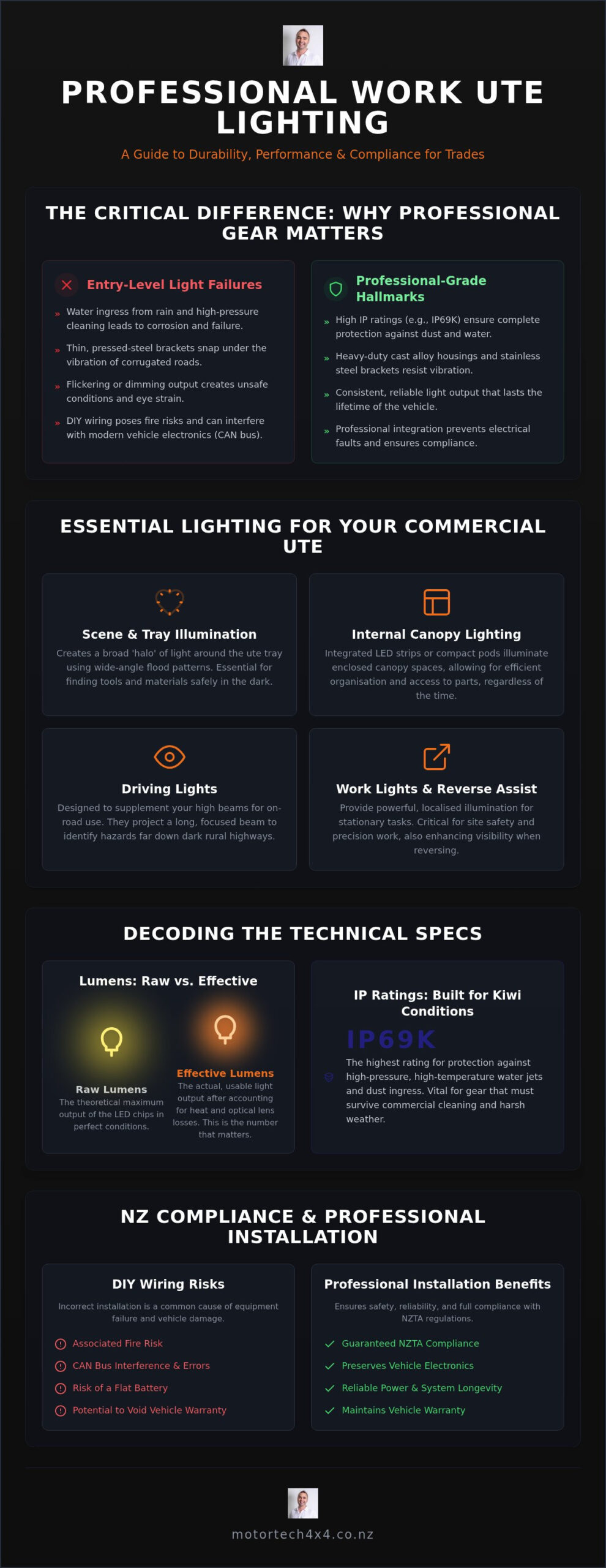
The gap between entry-level retail lights and professional-grade units is vast. While a cheap light bar might look impressive in a showroom, it often fails when subjected to the reality of Kiwi conditions. Auckland-based tradies, in particular, require gear that can withstand high-humidity salt air and the relentless vibration of gravel access roads. Professional systems are engineered to maintain a consistent output without flickering or dimming, providing a reliable light source that lasts the life of the vehicle.
Visibility as a Safety Standard
Safety on-site starts with what you can actually see. Professional lighting allows you to identify trip hazards, soft ground, or discarded materials before they cause an incident. Beyond hazard detection, proper illumination reduces the cognitive load and eye strain associated with working in low-light conditions. This is a critical factor for maintaining focus and accuracy during long shifts. If you’re squinting to find a specific tool in the tray, you’re already losing time and increasing the chance of a mistake.
Your ute also needs to be seen by others. In environments where heavy machinery like excavators or loaders are operating, a well-lit vehicle acts as a safety beacon. Clear, high-intensity automotive lighting technology ensures your position is obvious to other operators. This visibility is vital for preventing vehicle-to-vehicle collisions on busy, unlit work sites.
The Cost of Failure: Why Durability Matters
Inexpensive lights frequently suffer from water ingress because their seals aren’t designed for the pressure of a commercial water blaster or a sustained New Zealand downpour. Once moisture enters the housing, the electronics begin to corrode, leading to premature failure. Professional units carry higher IP (Ingress Protection) ratings, ensuring they remain bone-dry inside regardless of the weather. This reliability is essential when you’re kilometres away from the nearest town and need to pack up a site in the rain.
Mounting hardware is another common failure point for low-grade gear. Cheap brackets are often made from thin, pressed steel that snaps when subjected to the relentless corrugations of rural tracks. Specialist lighting solutions utilise heavy-duty cast alloy housings and reinforced stainless steel brackets to ensure the beam stays exactly where it’s aimed. Vibration resistance is the primary benchmark for longevity because it prevents internal circuit boards from shaking loose and causing total component failure.
Essential Lighting Types for Your Commercial Ute or Fleet
A high-performance vehicle requires more than just a single light bar bolted to the bumper. Building effective work ute lighting solutions NZ involves designing a system where each component serves a specific tactical purpose. From navigating dark rural highways to illuminating a complex job site, the configuration must balance output with legal compliance. Understanding the distinction between driving lights and work lamps is the first step toward a professional setup. While driving lights are designed to extend your high-beam range on the road, work lights provide localised illumination for stationary tasks. Adhering to NZ vehicle lighting regulations ensures your setup remains legal while providing the visibility your crew needs to work safely.
Scene and Tray Illumination
Tool access is a primary concern for any tradie working after sunset. Scene lighting creates a broad “halo” of light around the perimeter of the ute tray, making it easy to locate equipment without fumbling for a torch. We typically recommend mounting these units to the sides of roof racks or the rear headboard. Utilising a wide-angle flood pattern ensures the light is evenly distributed rather than concentrated in a single blinding spot. For those with enclosed setups, integrating LED strips or compact pods into the internal canopy space is essential for organising parts and materials during late-night pack-downs.
Safety and Warning Beacons
Contractors involved in civil engineering or roadside maintenance are often required by site protocols to fit amber warning beacons. Modern LED strobes have largely replaced traditional rotating beacons because they offer superior durability with no moving parts to wear out. These units provide high-intensity warning patterns while maintaining a low current draw on your battery. When planning your fleet fit-outs, consider low-profile mounting options. This positioning protects the beacon from being sheared off by low-hanging branches or garage entrances while maintaining 360-degree visibility for other site operators.
Reverse assist lighting is another critical addition for commercial fleets. Standard factory reverse lights are often insufficient for backing a loaded ute into narrow, unlit sites. Fitting dedicated rear-facing work lights, wired to trigger with the reverse gear or an auxiliary switch, provides the clarity needed to avoid obstacles and protect your vehicle’s bodywork. This comprehensive approach to lighting ensures every angle of the vehicle is covered, turning your ute into a mobile, well-lit workstation.
Technical Performance: Lumens, IP Ratings, and Beam Patterns
Technical performance is often obscured by marketing jargon and inflated specifications. When selecting work ute lighting solutions NZ, you must look past theoretical figures to understand how a light performs under sustained load in the field. A professional lighting system is defined by its ability to maintain consistent output while withstanding the physical abuse of a commercial environment. While a light might look bright in a showroom, its real-world utility depends on thermal management, optical precision, and environmental sealing. Selecting the wrong specifications often leads to premature component failure or a beam pattern that creates more glare than usable light.
Understanding Light Output
The most common area of confusion is the difference between raw and effective lumens. Raw lumens are a theoretical calculation based on the maximum potential of the LED chips. Effective lumens represent the actual light that exits the lens after accounting for optical losses and thermal throttling. High-quality units prioritise effective output. Heat is the primary enemy of LED longevity; without substantial aluminium heatsinks to dissipate thermal energy, a light will automatically dim its output to protect the internal circuitry. Precision-engineered reflectors further enhance performance by directing every available lumen exactly where it’s needed, rather than scattering light into the sky or onto the bonnet of your ute.
Colour temperature is equally important for operational safety. We recommend a “Natural White” range between 5000K and 5700K. This spectrum closely mimics daylight, which significantly reduces eye fatigue during long night shifts. Lights with a higher, blue-tinted Kelvin rating (6500K and above) often cause harsh reflections off rain, dust, and fog, making it harder to distinguish detail on the ground.
Environmental Protection Standards
New Zealand’s coastal climate and mud-heavy job sites demand rigorous ingress protection. The IP (Ingress Protection) rating system identifies how well a unit is sealed against dust and moisture. While IP67 is sufficient for basic immersion, commercial fleets should look for IP69K ratings. This standard ensures the light can withstand the high-pressure, high-temperature wash-downs common in heavy industry and civil contracting. For vehicles operating in coastal Auckland or near salt spray, corrosion resistance in the housing and brackets is non-negotiable.
- Spot Beams: Designed for long-distance illumination, essential for high-speed rural driving.
- Flood Beams: Provide a wide, even spread of light for broad area coverage at low speeds.
- Scene Optics: Utilise specialised lenses to create a 120-degree task light, perfect for illuminating the immediate perimeter of the vehicle.
Durability also extends to the lens material. Professional-grade units utilise high-impact polycarbonate lenses. Unlike glass, polycarbonate is virtually shatterproof, offering protection against stone chips and accidental impacts from tools or debris on-site. This ensures the internal reflectors and LEDs remain protected throughout the life of the vehicle.
NZ Compliance and Professional Installation Standards
Compliance is more than a box-ticking exercise for your next Warrant of Fitness. In New Zealand, auxiliary lighting must adhere to the Land Transport Rule: Vehicle Lighting 2004 to ensure the vehicle remains road-legal and safe for other drivers. While work lamps are classified as optional, they must be fitted correctly to avoid fines or safety failures. Professional work ute lighting solutions NZ require a deep understanding of these regulations, particularly regarding how additional lamps are switched and where they are positioned on the chassis or bodywork. Failure to meet these standards doesn’t just risk a failed inspection; it can compromise your insurance coverage in the event of an incident.
Staying Legal on NZ Roads
NZTA regulations specify that work lamps must be used for their intended purpose: illuminating a task while the vehicle is stationary or moving slowly off-road. These lights must be wired to an independent switch, meaning they cannot operate automatically with your high beams. This distinction is vital for preventing accidental dazzle on public roads. Additionally, mounting heights are restricted to ensure the beam doesn’t interfere with the driver’s line of sight or create excessive glare for oncoming traffic. If you’re adding driving lights to your high-beam circuit, remember that most vehicles are limited to a total of four main-beam headlamps, including the factory units.
Modern utes like the Next-Gen Ranger or Hilux utilise complex CAN bus wiring systems. Tapping into these circuits without the correct interface can trigger dashboard error codes or even shut down safety systems. Professional installation ensures that your lighting is integrated seamlessly with the vehicle’s electronics, often utilising specialised piggyback looms that don’t require cutting the factory harness. If your new lighting setup or bullbar obstructs any part of the vehicle’s radar or camera field of view, you must perform professional ADAS calibration to ensure emergency braking and lane-keep assist functions continue to operate accurately.
Power Management and Dual Batteries
A common mistake in DIY setups is underestimating the current draw of high-intensity LED systems. Even though LEDs are efficient, a full suite of scene, tray, and reverse lights can quickly drain a primary starting battery during a long night shift. We recommend installing low-voltage cutouts to ensure you always have enough cranking power to start the engine. For heavy-duty users who require sustained illumination without the engine running, a dual battery system is the most reliable solution. This setup isolates your lighting and accessories from the starting battery, providing peace of mind on remote job sites.
Voltage drop is another technical hurdle that often plagues amateur installations. Using thin, inferior cabling over long runs, such as from the engine bay to the rear of a canopy, results in dim lights and excessive heat build-up. Specialist technicians utilise high-quality heavy-gauge cabling and marine-grade heat shrink to protect connections from the elements. This methodical approach prevents the fire risks associated with short circuits and ensures your lighting maintains its maximum effective output for years to come.
Custom Fleet Fit-Outs and Lighting Solutions at Motortech 4X4
A high-performance work vehicle is the sum of its parts. Achieving the best work ute lighting solutions NZ requires more than just high-quality components; it demands a strategic approach to vehicle integration. At Motortech 4X4, we specialise in comprehensive fleet fit-outs that align with the specific operational demands of your trade. Whether you are managing a single vehicle or a large commercial fleet, our Auckland-based technicians ensure that every lighting component is positioned for maximum utility and wired for long-term reliability. We treat lighting as a core system rather than an afterthought, ensuring it works in harmony with your vehicle’s existing structural and electronic configurations.
Tailored Solutions for Auckland Tradies
Every job site has unique requirements. A civil contractor working on motorway projects needs different illumination than a mobile mechanic or a forestry worker. Our consultative approach begins by identifying exactly where and when you need light. We help you find the right balance between high-intensity output and cost-efficiency, ensuring you don’t over-specify for simple tasks or under-equip for complex ones. Because we understand that a vehicle off the road is a vehicle not making money, our team focuses on efficient, professional installations that minimise downtime while maintaining the highest technical standards.
Our gear is selected specifically for its ability to survive the rugged New Zealand environment. We prioritise components that have been tested against the high-vibration and high-moisture conditions typical of local job sites. By integrating your lighting with other essential accessories, such as bullbars, roof racks, and canopies, we create a seamless, professional finish that enhances both the capability and the resale value of your ute. This holistic approach prevents the common issues seen in piecemeal builds, such as obstructed sensors or cluttered wiring looms.
The Motortech 4X4 Advantage
Choosing a specialised workshop provides a distinct “one-stop” advantage. Our expertise spans both mechanical performance and advanced electrical upgrades. This dual capability is critical when fitting modern work ute lighting solutions NZ, as it ensures that physical mounting solutions don’t compromise vehicle cooling or structural integrity. From GVM upgrades to professional vehicle lighting, we manage the entire modification process under one roof. This ensures that every aspect of your build, including necessary ADAS calibration after bullbar or lighting installation, is handled by technicians who understand the full scope of the project.
Quality assurance is at the centre of everything we do. We stand behind the durability of our wiring and mounting solutions, providing a level of reliability that off-the-shelf retail kits simply cannot match. If you are ready to upgrade your visibility and ensure your vehicle meets all safety and compliance standards, it is time to speak with the experts. Get a professional lighting quote for your ute or fleet and experience the difference that specialist electrical integration makes to your workday safety and efficiency.
Optimise Your Work Site Visibility Today
Equipping your vehicle with professional work ute lighting solutions NZ is a direct investment in both site safety and long-term operational efficiency. As we have explored, a high-performance system requires more than just high lumen counts; it demands technical precision, from selecting IP69K-rated components to ensuring full CAN bus compatibility. By prioritising durability and NZTA compliance, you protect your vehicle’s electrical system while providing your crew with the clarity needed to work safely in any environment.
Motortech 4X4 is Auckland’s leading 4×4 and fleet specialist, offering a complete package that includes expert ADAS calibration and mechanical services alongside professional-grade component selection. We ensure every modification is integrated seamlessly, maintaining your vehicle’s reliability and resale value. Don’t leave your site safety to chance with inferior gear or amateur wiring that could lead to flat batteries or electrical failure.
Contact Motortech 4X4 for a Professional Ute Fit-Out Quote to discuss your specific trade requirements. Our team is ready to help you build a more capable, well-lit work vehicle that is ready for the toughest Kiwi job sites.
Frequently Asked Questions
Are LED work lights legal for road use in New Zealand?
Work lights are legal as optional lamps under the Land Transport Rule: Vehicle Lighting 2004. They must emit a substantially white or amber light and are intended only for task-related illumination when the vehicle is stationary or moving slowly off-road. You can’t use them as additional headlamps on public roads, and they must be wired to an independent switch to ensure they don’t dazzle other drivers accidentally.
Do I need a dual battery system for my ute lighting?
A dual battery system is highly recommended if you intend to operate high-intensity work ute lighting solutions NZ for extended periods without the engine running. While modern LEDs have a lower current draw than halogen bulbs, a full array of scene and tray lights can still deplete a standard starting battery. Installing a dedicated secondary battery ensures you have reliable power for your lights while preserving the cranking power needed to start the ute.
What is the best IP rating for a work ute in NZ?
For the demanding New Zealand environment, an IP69K rating is the gold standard for durability. While IP67 provides protection against temporary immersion, IP69K ensures the unit is sealed against high-pressure, high-temperature water jets. This is essential for tradies who frequently use commercial water blasters to remove mud and salt spray from their vehicles after working on coastal or heavy-industry sites.
Can I install high-powered work lights myself?
While DIY kits are available, professional installation is the only way to guarantee CAN bus compatibility and electrical safety. Modern vehicle electronics are highly sensitive; improper tapping into factory looms can trigger ECU errors or even cause electrical fires. A specialist installer ensures that all wiring is correctly fused, uses the appropriate gauge for the current load, and meets all NZTA compliance standards for a Warrant of Fitness.
Will adding auxiliary lights affect my vehicle’s ADAS or sensors?
Yes, auxiliary lights can interfere with Advanced Driver Assistance Systems (ADAS) if they’re mounted in a way that obstructs the radar or camera field of view. This is a common issue when fitting lights to bullbars or roof racks on newer utes. If any modification alters these sensor paths, professional ADAS calibration is required to ensure safety features like autonomous emergency braking and lane-keeping assist remain accurate.
How many lumens do I actually need for a work site?
For close-range tasks like accessing a tool tray, 1,000 to 2,000 effective lumens are usually sufficient. If you need to illuminate a broader work zone or a building site perimeter, look for units providing 2,000 to 4,000 effective lumens. It’s vital to focus on effective rather than raw lumen figures, as the effective output accounts for light lost through the lens and thermal management throttling.
What is the difference between a work light and a driving light?
The difference lies in their legal application and beam pattern. Driving lights are designed to supplement your high beams for long-distance visibility while driving on the road. Work lights are task-oriented lamps with a wider flood or scene pattern, intended for use when the vehicle is stationary or off-road. Legally, work lights must be switched independently and can’t be integrated into your high-beam circuit.
How do I prevent my work lights from draining the battery?
To prevent battery drain, you should install a low-voltage cutout or a dual battery system. A low-voltage cutout automatically disconnects the lights if the battery charge drops below a specific threshold, ensuring there’s always enough power to crank the engine. For heavy-duty users, a dual battery setup isolates the lighting circuit entirely from the starting battery, providing the most reliable power management for long night shifts.