If your 2-inch lift kit hasn’t been paired with a professional ADAS recalibration, your modern safety systems might actually be your biggest liability on the Southern Motorway. It’s a frustrating reality for many owners; you invest in high-end gear only to find your vehicle handles poorly or, worse, fails its next WOF because of a technical oversight. You want a rig that’s as capable on the rugged west coast as it is reliable on a demanding job site, but the path to a legal, high-performance build is often cluttered with confusing GVM limits and evolving NZTA regulations.
We understand that you’re looking for more than just aesthetic upgrades. You need a vehicle that can safely handle increased payloads and towing demands without compromising on-road stability. This guide provides the definitive roadmap for ute modifications Auckland drivers can trust, covering everything from essential suspension geometry to the precise engineering required for LVV certification. You’ll discover how to professionally enhance your 4×4’s performance while maintaining total peace of mind regarding New Zealand road legalities. We’ll examine the critical intersection of mechanical upgrades and electronic safety systems to ensure your built rig is truly fit for purpose.
Key Takeaways
- Identify the specific modifications required to transition your vehicle from a standard workhorse to a high-performance rig capable of tackling Auckland’s unique coastal and bush terrain.
- Learn why a 2-inch suspension lift is considered the optimal balance for performance and stability when planning your ute modifications Auckland project.
- Master the technical requirements for GVM upgrades and ADAS calibration to ensure your vehicle remains road-legal and safe after significant modifications.
- Explore the functional differences between canopies and hardlids to determine the most effective secure storage solution for your professional tools and camping gear.
- Understand the importance of professional mechanical installation over simple bolt-on accessories to maintain vehicle structural integrity and long-term reliability.
Planning Your Ute Modifications in Auckland: Where to Start?
Professional ute modifications represent a series of engineered enhancements designed to improve the performance, utility, and protection of your vehicle for specific New Zealand conditions. Auckland owners face a unique challenge; your rig might need to navigate the tight confines of a CBD construction site on Friday and the slippery clay tracks of the Waitakere Ranges on Saturday. This duality requires a tailored approach to ute modifications Auckland specialists must understand to ensure the vehicle remains both capable and compliant.
The most successful builds follow a clear “Build Philosophy”. This approach balances hardcore off-road capability with the refinement needed for daily driveability. Before choosing parts, you must identify your primary use case. A long-distance touring rig requires different priorities than a heavy-duty trade vehicle or a dedicated weekend crawler. Each path dictates a different selection of four-wheel drive systems and accessories to ensure the vehicle performs as intended without compromising reliability.
Assessing Your Vehicle’s Current Capabilities
Every project starts with a technical baseline. You must check your factory Gross Vehicle Mass (GVM) and payload limits before adding any weight. It’s easy to overlook how quickly a steel bullbar, winch, and canopy can consume 200kg to 300kg of your available payload. Most factory suspension setups are tuned for unladen comfort on bitumen. They often struggle with the corrugated backroads and heavy loads common in the Auckland region. Additionally, modern utes are packed with Advanced Driver Assistance Systems (ADAS). Modifications like lift kits can shift the field of view for radar sensors and cameras, which makes professional assessment critical.
Setting a Realistic Modification Budget
A professional build is an investment in your vehicle’s safety and longevity. We recommend prioritising “Phase 1” essentials that provide the most significant functional gains:
- Suspension Upgrades: To handle increased loads and improve ground clearance.
- Frontal Protection: High-quality bullbars to safeguard against animal strikes and debris.
- Snorkels: To ensure clean air intake in dusty or wet environments.
While the DIY route might seem cost-effective initially, the risks to your vehicle’s warranty and WOF status are significant. Professional installation ensures that every component is fitted to manufacturer specifications. In the New Zealand market, a vehicle with a documented history of professional ute modifications Auckland often holds its resale value better than a rig with mismatched, uncertified parts.
Performance and Protection: Essential 4×4 Modifications for NZ Terrain
Auckland’s geography demands versatility from any utility vehicle. The ute modifications Auckland enthusiasts prioritise are those that bridge the gap between suburban practicality and rugged back-country durability. Achieving this balance requires a focus on four core areas: suspension, frontal protection, engine breathing, and underbody shielding. These components work together to ensure your vehicle survives the transition from the Southern Motorway to the slippery clay tracks of the Hunua Ranges.
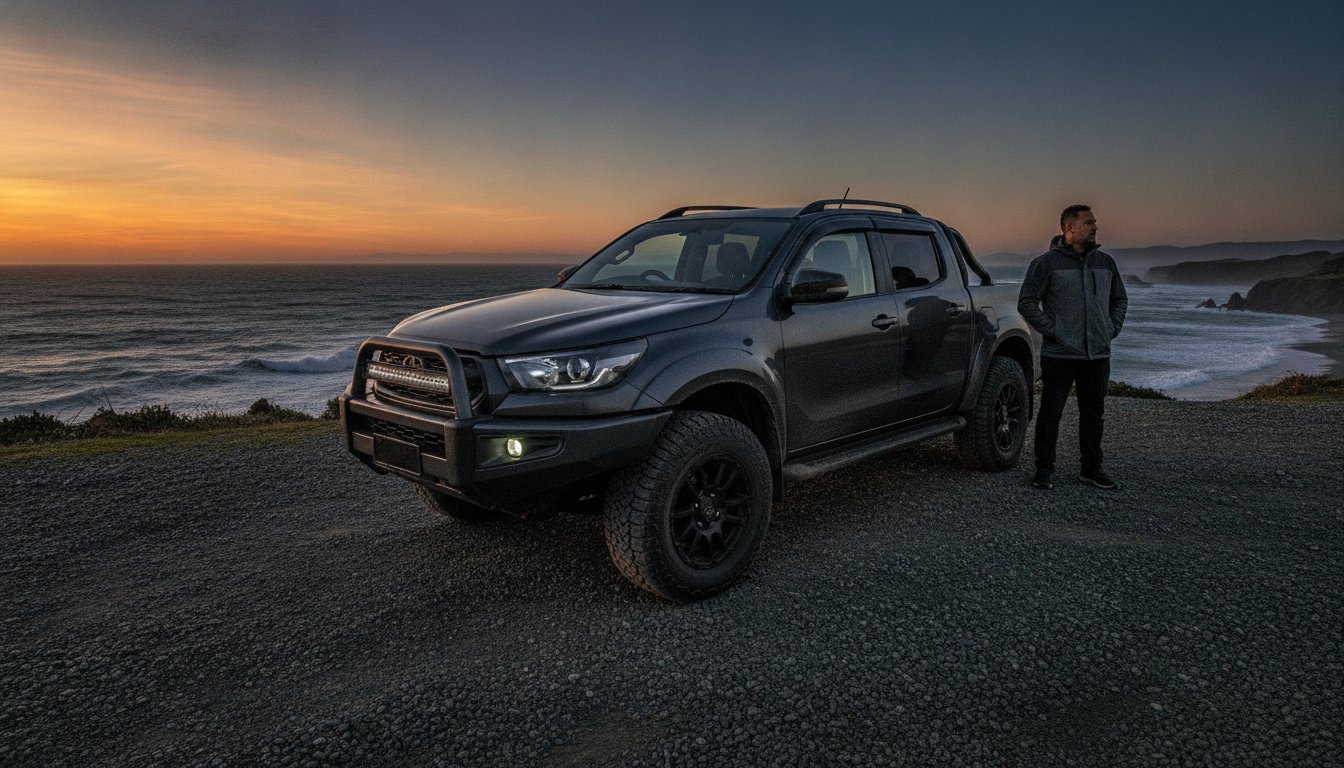
A 2-inch suspension lift is widely regarded as the “sweet spot” for New Zealand roads. This height provides enough ground clearance to navigate deep ruts on a farm or forest track while maintaining a manageable centre of gravity for high-speed highway driving. Beyond just height, a professional kit improves the vehicle’s ability to handle the heavy payloads typical of Auckland tradies and weekend adventurers. It’s about control, not just clearance.
Suspension Upgrades for Better Handling
Choosing the right components depends heavily on your vehicle’s constant load. Heavy-duty springs are essential if you’ve fitted a permanent canopy and drawer system; otherwise, the rear will sag and compromise steering geometry. Conversely, comfort-tuned dampers are better suited for family utes that occasionally tow a boat to the ramp. Upgrading your suspension also significantly enhances towing stability, reducing the “pitching” motion common when hauling heavy trailers. After any lift, a professional wheel alignment is non-negotiable. It prevents premature tyre wear and ensures the vehicle tracks straight on the motorway.
Front-End Protection and Recovery Points
Bullbars are your first line of defence against animal strikes and track debris. Steel bars offer maximum strength for winch mounting and heavy-duty recovery, though they add more weight to the front end. Alloy alternatives provide a lighter solution for those conscious of their remaining payload. For solo adventurers, a winch-compatible bar is a critical safety feature that can be the difference between a minor delay and an overnight stranding.
Equally important are rated recovery points. Factory tie-down points are not designed for the stresses of a kinetic snatch recovery on Muriwai beach. Installing dedicated, rated points ensures that if you do get bogged, you can be recovered without risking structural damage or personal injury. Underbody armour completes the protection package, shielding vital components like the sump and transmission from “NZ scree” and jagged rocks. When modifying modern vehicles, remember that any change in ride height requires ADAS calibration to keep your emergency braking systems functioning accurately. If you’re unsure which setup suits your specific needs, consulting the specialists at Motortech 4X4 can help you design a balanced build.
Maximising Utility: Canopies, Hardlids, and Tray Solutions
Once you’ve established a solid mechanical foundation with suspension and protection, the focus shifts to how your vehicle carries its load. For many, utility is the primary driver for ute modifications Auckland wide. Whether you’re a contractor needing to secure expensive power tools or an adventurer packing for a week in the Far North, your storage solution must be both weather-proof and structurally sound. Professional fit-outs ensure that these additions don’t just sit on the vehicle but are integrated into its overall engineering.
Canopy vs. Hardlid: The Great Debate
Choosing between a canopy and a hardlid involves a trade-off between volume and profile. Canopies provide the ultimate solution for secure, high-volume storage. They effectively turn your tray into a van-like space, protecting gear from Auckland’s unpredictable rain and keeping dust out on unsealed roads. However, they add significant weight and can impact your rear-view visibility. Hardlids, on the other hand, maintain the sleek lines of the ute while providing a robust, lockable cover for the tub. They are often preferred by those who carry heavy items on top of the lid or those who want to retain the vehicle’s factory aesthetics.
Weight is a critical factor here. A heavy-duty canopy can weigh between 60kg and 100kg before you even begin loading it. This consumption of payload reinforces the need for the GVM assessments discussed earlier in this guide. For those requiring even more versatility, modular flat-trays are becoming a popular choice among Auckland tradies. These systems replace the factory wellside entirely, offering more floor area and the ability to mount custom toolboxes or removable service bodies that can be swapped out depending on the job.
Internal Storage and Drawer Systems
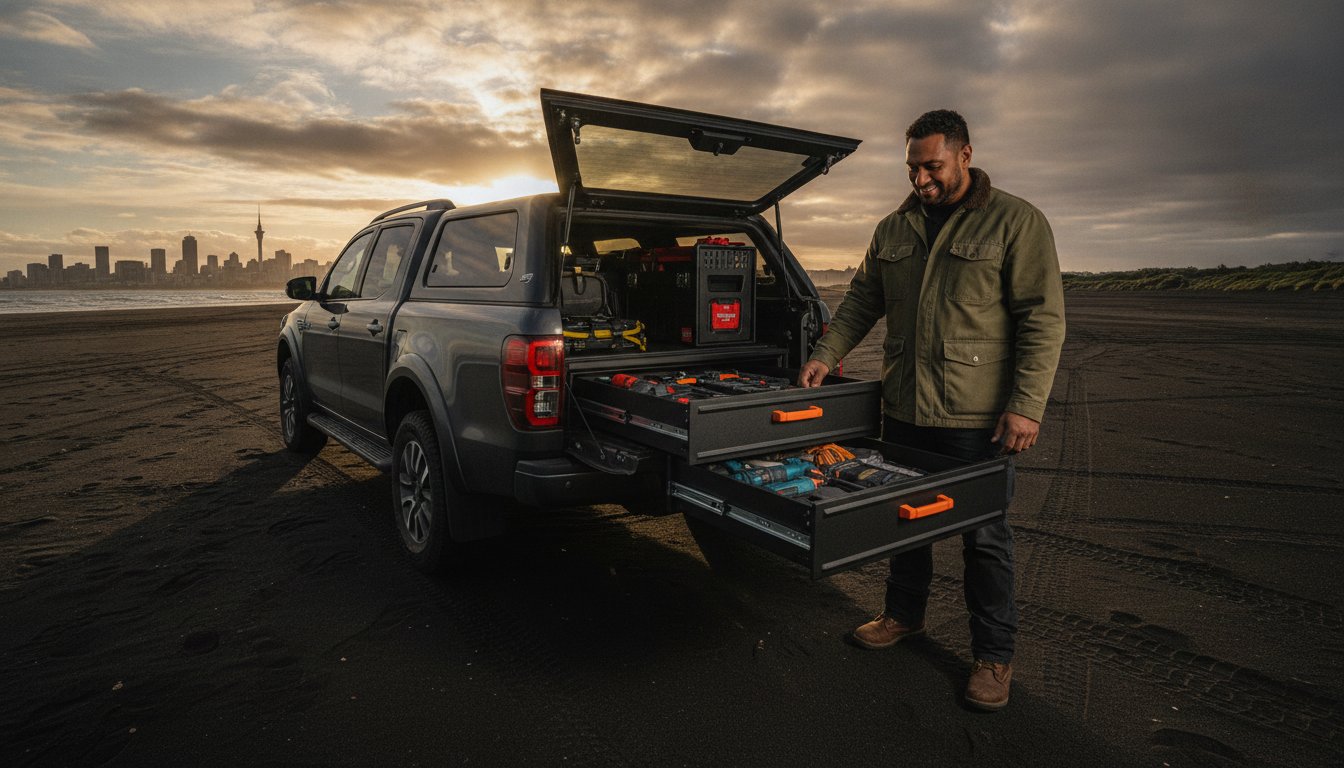
A well-organised tray is a productive one. Professional drawer systems eliminate the frustration of digging through a cluttered tub to find a specific tool or piece of camping gear. These units are typically constructed from galvanised steel or heavy-duty aluminium, featuring high-quality runners that can withstand the vibrations of corrugated NZ backroads. They provide a secure, rattle-free environment for everything from recovery gear to expensive site equipment.
Integrating a fridge slide is a game-changer for long Northland trips, allowing easy access to refreshments without unpacking the entire vehicle. The ‘one-stop’ advantage of professional ute modifications Auckland services is having your storage and 12V electrics fitted together. This ensures that your dual-battery system, lighting, and fridge are all wired safely and won’t fail when you’re off the grid. Roof rack systems complete the utility package, providing a secure platform for long items like kayaks or bulky gear like roof-top tents. By organising your gear efficiently, you ensure that every kilogram of your payload is used effectively and safely.
Compliance and Safety: Navigating GVM Upgrades and ADAS Calibration
Compliance and safety are the most overlooked aspects of ute modifications Auckland owners undertake. While a lift kit and larger tyres look excellent, they fundamentally alter the vehicle’s geometry and electronic brain. Failing to account for these changes doesn’t just risk a “failed” sticker at your next WOF; it can lead to insurance claim denials if the vehicle is involved in an accident while over its legal weight limit. True performance is only achieved when the vehicle remains stable, predictable, and fully legal under all load conditions.
The Legal Side of Heavy Loads
Increasing your Gross Vehicle Mass (GVM) is a legal requirement if your modifications, such as heavy steel canopies and bullbars, push the vehicle past its factory weight rating. In New Zealand, these upgrades must be approved by Waka Kotahi (NZTA) and require a Low Volume Vehicle (LVV) certification. This certification confirms that the vehicle’s braking systems and structural integrity are sufficient for the increased load. For those performing ute modifications Auckland wide, securing GVM Upgrades Auckland is the only way to remain legally compliant while carrying heavy trade tools or permanent canopy setups. It’s a professional necessity that protects your liability and ensures the vehicle’s longevity.
Safety Tech and Modern 4x4s
Modern utes rely on Advanced Driver-Assistance Systems (ADAS) to manage emergency braking, lane assist, and adaptive cruise control. When you install a suspension lift, you effectively “blind” these factory sensors by changing their field of vision and pitch. This is why ADAS calibration is mandatory after any modification affecting ride height. At Motortech 4X4, we use specialised in-house equipment to ensure these systems are recalibrated to the new vehicle height. DIY sensor adjustments are a major safety risk and often result in erratic system behaviour or total failure during an emergency.
To reclaim the performance lost to larger wheels and the added weight of protection gear, ECU remapping provides a professional solution. It optimises the engine’s power delivery and torque curve to handle the increased rolling resistance of oversized tyres. This ensures your ute doesn’t feel sluggish or “hunt” for gears on the motorway. If you want to ensure your build is both high-performing and fully legal, you can book a compliance consultation with our technical team to review your specific requirements.
Professional Ute Fit-Outs in Auckland: The Motortech 4X4 Difference
Choosing a mechanical service centre over a simple parts retailer is the most critical decision in any vehicle build. While many shops can sell you a bullbar or a set of wheels, few possess the engineering depth to integrate these components into a cohesive, high-performance system. Motortech 4X4 operates as a specialised technical hub where ute modifications Auckland drivers receive end-to-end mechanical support. This “one-stop-shop” capability means your vehicle doesn’t just look the part; it’s backed by professional labour, precise calibration, and a deep understanding of New Zealand’s unique road and track requirements.
Fleet and Commercial Solutions
For businesses, a ute is a tool of trade that must perform reliably every day. We specialise in customising tradie utes for maximum efficiency, safety, and longevity. Our approach to Fleet Fit-Outs Auckland involves standardising accessories across your entire commercial fleet. This standardisation simplifies ongoing maintenance and ensures that every driver in your team operates a vehicle with identical handling characteristics and safety standards. Whether you need a single custom build or a rollout of standardised rigs, our workshop provides the technical capacity to deliver consistent, high-quality results.
Ongoing Maintenance for Modified Rigs
A modified ute works harder than a factory-standard vehicle. The added weight of canopies, the rolling resistance of larger tyres, and the stresses of heavy towing mean a basic oil change is rarely sufficient. Specialised 4×4 servicing is essential to protect your investment. We pay particular attention to components under increased strain, such as the drivetrain and braking system. Our team understands that a rig built for the Waitakere tracks requires a different maintenance profile than a CBD-based workhorse.
Professional transmission flushes are a vital part of this maintenance schedule, especially for those frequently towing heavy boats or trailers. Overheated transmission fluid is a leading cause of gearbox failure in modified 4x4s; regular flushes ensure your vehicle remains reliable under pressure. Our Auckland-local expertise means we recognise the specific wear patterns caused by local conditions, from the salt air of the coast to the steep gradients of the surrounding ranges. We treat every vehicle as a complete mechanical project, not just a collection of bolt-on parts.
If you’re ready to start your build or need a professional assessment of your current setup, book your Auckland ute consultation today to ensure your rig is engineered for excellence and remains fully compliant on NZ roads.
Engineering Your Ultimate Build
Building a high-performance rig requires a shift in perspective from simply buying accessories to managing an integrated mechanical project. The most effective ute modifications Auckland owners can invest in are those that balance rugged off-road capability with precision safety standards. Whether you are preparing a commercial fleet for the job site or a private vehicle for coastal touring, the foundation of your build must always be structural integrity and legal compliance.
Professional GVM upgrades and precise ADAS recalibration are no longer optional extras; they are essential components of a responsible build. As Auckland’s leading ADAS calibration specialists and GVM upgrade experts, Motortech 4X4 provides the technical depth required to keep your vehicle safe and road-legal. Our full mechanical service centre ensures that every component, from heavy-duty suspension to frontal protection, is fitted to withstand the harshest New Zealand conditions. We focus on the engineering so you can focus on the drive.
Don’t leave your vehicle’s performance or safety to chance. Book Your Professional Ute Consultation at Motortech 4X4 Auckland to ensure your next modification project is engineered for long-term success. We look forward to helping you build a rig that truly performs.
Frequently Asked Questions
Will modifications void my new vehicle warranty in NZ?
Modifications do not automatically void your entire new vehicle warranty in New Zealand. Under local consumer law, a manufacturer can only refuse a warranty claim if they can prove that the aftermarket component or its installation directly caused the failure. For example, fitting a snorkel won’t affect your transmission warranty, but it will affect claims related to the intake system. Using a professional mechanical centre for your installation helps maintain a clear record of quality workmanship.
How much of a lift kit is legal without a low volume vehicle (LVV) cert?
You can generally install a suspension lift of up to 50mm without requiring a Low Volume Vehicle (LVV) certification, provided the kit uses the original mounting points and doesn’t compromise the vehicle’s structural integrity. Any lift exceeding this height, or modifications that involve cutting or welding the chassis, will require a formal inspection by an LVVTA certifier. It is vital to ensure your ute modifications Auckland project stays within these legal bounds to avoid WOF failures.
Do I really need to recalibrate my sensors after a 2-inch lift?
Yes, recalibrating your Advanced Driver Assistance Systems (ADAS) is a critical safety requirement after any change to your ride height. A 2-inch lift alters the pitch and field of vision for the cameras and radar sensors used for emergency braking and lane-keep assist. Without professional recalibration, these systems may react late or trigger unexpectedly. This is a standard part of a professional build to ensure your safety tech remains accurate and reliable.
What is the difference between a GVM upgrade and just adding heavy-duty springs?
A GVM upgrade is a legally recognised increase in your vehicle’s total allowable weight, while heavy-duty springs simply provide better support for a load. Adding springs might stop your ute from sagging when loaded, but it does not change your legal payload limit on the door placard. A GVM upgrade involves an engineered suspension system and a certification process that officially increases your vehicle’s legal carrying capacity for insurance and compliance purposes.
How do I choose between a steel and an aluminium bullbar?
The choice between steel and aluminium depends on your specific priorities for protection and payload. Steel bullbars offer the highest level of impact resistance and are the preferred choice for heavy winching and serious off-road recovery. Aluminium bars are significantly lighter, which helps preserve more of your available payload for other accessories like canopies or roof racks. Both options provide essential protection against animal strikes on rural Auckland roads, but steel remains the benchmark for pure durability.
Can Motortech 4X4 handle fleet fit-outs for multiple vehicles?
Yes, we specialise in providing standardised fleet fit-outs for commercial operators across the region. We can coordinate the installation of identical storage solutions, safety gear, and ute modifications Auckland wide to ensure your entire fleet maintains consistent handling and maintenance requirements. This approach simplifies fleet management and ensures every vehicle in your team meets the same high standard of professional engineering and safety compliance.
What are the most essential modifications for beach driving at Muriwai?
Rated recovery points and a high-quality snorkel are the most critical upgrades for beach driving. Factory tie-down points are not designed for the high-stress loads of a snatch recovery in soft sand and can be extremely dangerous if they fail. A snorkel is equally important to protect your engine from salt spray and water ingress during tide changes. We also recommend a professional suspension tune to handle the undulating sand tracks without bottoming out.
How often should I service my modified 4×4 compared to a standard car?
Modified 4x4s require more frequent servicing than standard vehicles due to the increased mechanical stress of carrying extra weight and driving in dusty or wet conditions. We recommend a comprehensive service every 10,000km or six months. This allows for the regular inspection of suspension bushes, steering components, and driveline oils that work harder in a modified rig. Regular transmission flushes are also advised if you frequently tow heavy loads or navigate steep terrain.