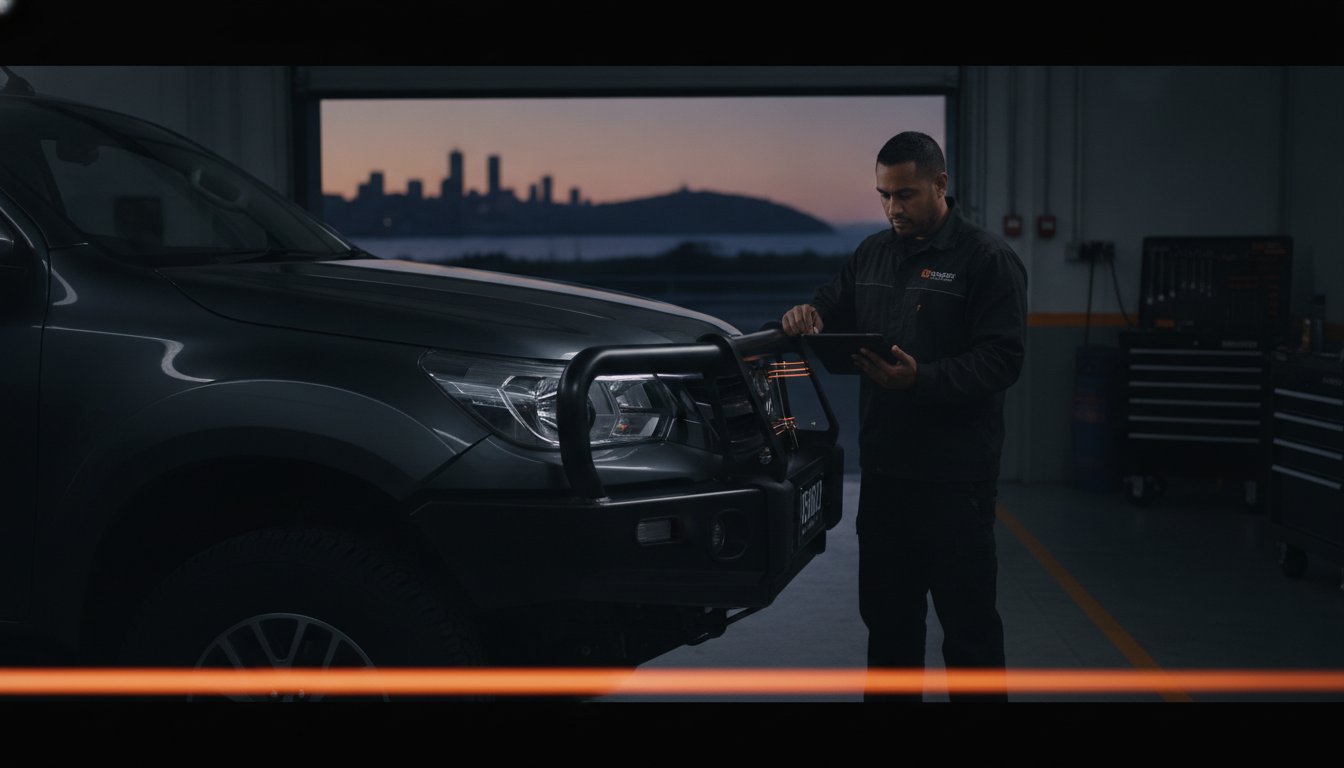
Could your front-end protection actually be the biggest risk to your vehicle’s safety systems? While a heavy-duty bar is essential for off-road protection, an incorrect installation can trigger airbag errors or disable your emergency braking. Most Auckland 4×4 owners want the rugged security of a steel bar, yet they are rightfully concerned about failing a Warrant of Fitness or voiding their vehicle warranty. Choosing a professional bullbar fitting service Auckland ensures your vehicle is not just tougher, but remains fully compliant with New Zealand transport regulations.
You shouldn’t have to choose between structural protection and the advanced safety features of a 2026 model vehicle. We will show you how precision engineering and expert ADAS recalibration keep your sensors functional and your insurance valid. This guide explores the technical necessity of professional fitting, covering everything from frontal impact compliance tags to the intricate wiring required for modern lighting and winches. You will learn how to achieve a high-performance look without compromising the mechanical integrity or safety of your rig.
Key Takeaways
- Understand why professional installation is the only way to ensure your rig remains compliant with New Zealand Warrant of Fitness (WoF) standards and avoids insurance claim denials.
- Learn why a specialist bullbar fitting service Auckland is critical for recalibrating ADAS sensors and maintaining the function of autonomous emergency braking systems.
- Compare the structural benefits of steel versus aluminium alloy to determine which material best suits your vehicle’s payload and off-road requirements.
- Discover the importance of a pre-installation suspension check and precision mounting to prevent chassis damage and ensure a perfectly level fit.
- Explore how integrating bullbar installation with GVM upgrades and fleet fit-out services provides a comprehensive protection solution for commercial and private utes.
Why Professional Bullbar Fitting is Essential for Auckland 4x4s
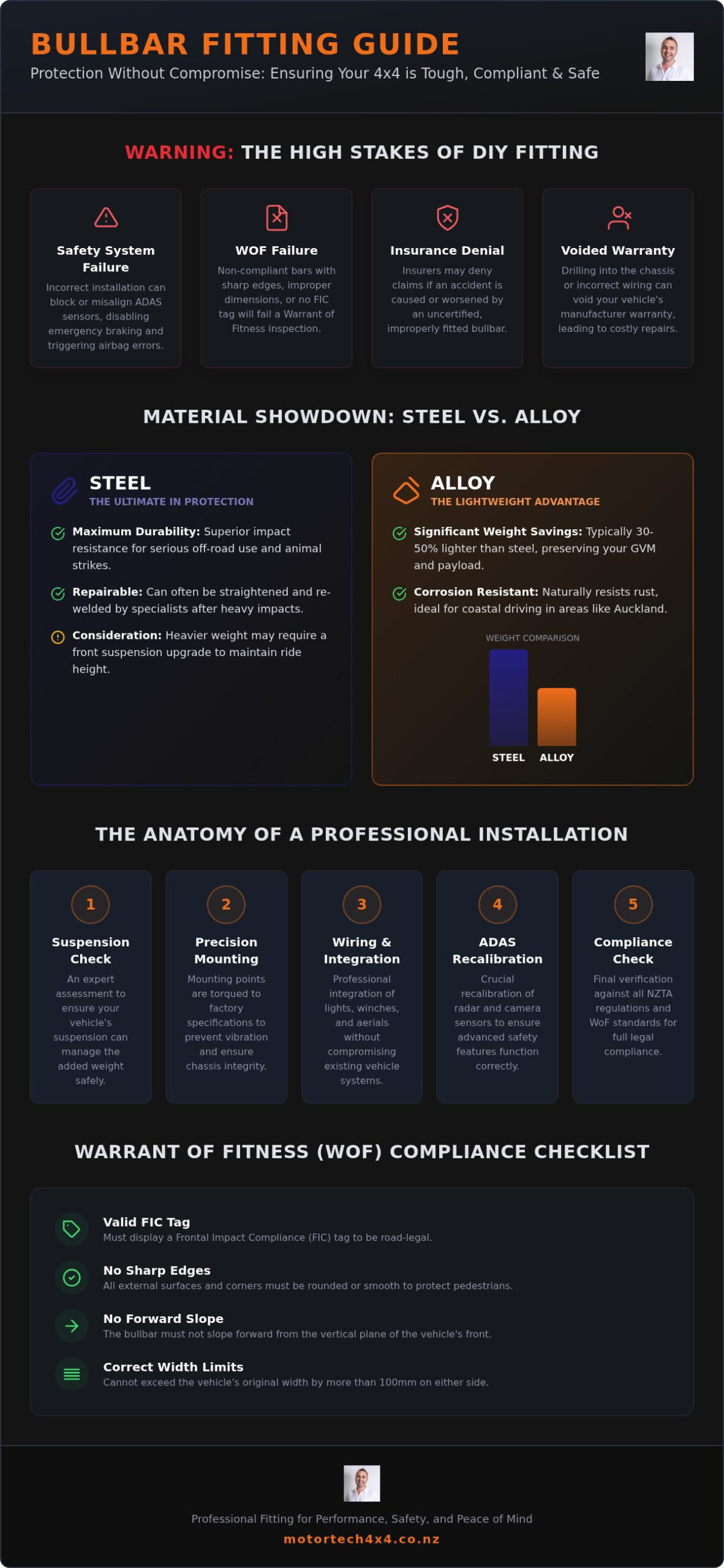
A bullbar serves a dual purpose for the modern Auckland driver. It provides essential protection on rugged tracks like Muriwai Beach while maintaining safety on the Southern Motorway. By 2026, these units have evolved from simple steel rails into integrated tech hubs. They now house winch cradles, high-output lighting, and complex radar sensors. Attempting a “backyard” fit-out is a significant gamble. Incorrect mounting can lead to immediate WOF failure or, even worse, an insurance denial after an accident. Professional installation ensures your approach angles are optimised for off-road weekend trips without compromising the vehicle’s structural integrity during daily commutes.
Modern utes require more than just a few bolts to stay safe. For a comprehensive overview of bullbars and their engineering history, it’s clear that impact absorption must be balanced with chassis rigidity. Using a specialist bullbar fitting service Auckland ensures that every mounting point is torqued to factory specifications. This precision prevents the bar from vibrating loose on corrugated gravel roads or shifting during a recovery. It’s the difference between a bar that protects your radiator and one that causes secondary damage to your engine bay.
Auckland’s Unique Driving Challenges
Driving in the Auckland region presents specific environmental risks. Rural roads through the Hunua Ranges or the North Shore hinterland carry a high risk of animal strikes, particularly at dawn and dusk. For local tradies, a bullbar is a practical tool for urban protection on busy construction sites where minor bumps are common. Furthermore, Auckland’s salty coastal air from the Waitematā and Manukau harbours accelerates corrosion. Professional fitting includes ensuring all drill points are treated and sealed to prevent rust from taking hold in your vehicle’s chassis rails.
Legal Compliance and WOF Standards
New Zealand transport regulations are strict regarding frontal impact protection. To pass a Warrant of Fitness, your bar must display a Frontal Impact Compliance (FIC) tag and meet specific protrusion limits. NZTA inspectors will fail a vehicle if the bar has sharp edges, slopes forward, or exceeds the vehicle’s width by more than 100mm on either side. A professional bullbar fitting service Auckland guarantees your rig stays road-legal. This compliance is vital for insurance payout security; if an uncertified modification is found to have contributed to an accident, your insurer may refuse to cover the damage. We ensure your installation meets every 2026 safety standard.
Selecting the Right Bullbar: Materials, Styles, and Hoops
Selecting the right frontal protection requires a balance between structural strength and vehicle payload. Every kilogram added to the front axle impacts your Gross Vehicle Mass (GVM) and front suspension geometry. While aesthetics matter, the primary goal is functional performance. This involves choosing a bar that accommodates high-tensile recovery points and winch cradles without compromising the vehicle’s crumple zones. The choice between a traditional hooped design for maximum headlight protection or a sleek hoopless bar for a modern look depends entirely on your intended use case.
Steel Bullbars: The Ultimate Protection
Steel remains the industry standard for maximum durability. For commercial fleets and serious off-roaders in New Zealand, steel offers superior impact resistance and is easier to repair if damaged. Unlike other materials, steel can be straightened and re-welded by specialists if it sustains a heavy hit. Most modern steel bars are finished in durable powder-coating. This can be colour-matched to your ute’s factory paint, providing a seamless look that doesn’t sacrifice toughness. When opting for a heavy steel unit, a professional bullbar fitting service Auckland will often recommend a front-end suspension upgrade to manage the additional weight and maintain ride height.
Alloy and Plastic Alternatives
Aluminium alloy bars provide a significant weight-saving advantage, typically weighing 30% to 50% less than their steel counterparts. This is a critical consideration for drivers already carrying heavy tools or canopy setups who are nearing their GVM limit. Alloy is also naturally resistant to corrosion, making it an excellent choice for coastal Auckland driving where salt spray is a constant factor. When you book a bullbar fitting service Auckland for an alloy bar, you gain protection without the same heavy penalty on your front tyres. For those seeking a lighter touch, high-density polyethylene options offer a resilient alternative that flexes on impact.
Technical decisions should be backed by data. For example, academic research on bullbar safety highlights how different bar designs and materials influence impact physics. Understanding these variables is why we focus on precision engineering during every installation. Whether you require a triple-hoop bar for rural work or a low-profile bar for the city, the mounting system must be rated for your specific vehicle. If you’re unsure which material suits your payload, our team can help you evaluate your vehicle’s current setup to ensure the best fit.
The Technical Side: Airbags, Sensors, and ADAS Calibration
Modern vehicle technology has transformed the humble bullbar from a simple impact barrier into a complex structural component that must interface with sophisticated electronic safety systems. Most 2026 utes are equipped with Advanced Driver Assistance Systems (ADAS), which rely on a network of radar sensors and cameras usually located behind the front grille or bumper. When you engage a professional bullbar fitting service Auckland, the primary challenge is ensuring these “eyes” of the vehicle aren’t blinded or confused by the new hardware. If a sensor is even slightly misaligned by the installation, it can lead to erratic Autonomous Emergency Braking (AEB) or the complete failure of Adaptive Cruise Control during a motorway commute.
Airbag triggering remains the most critical safety factor for any frontal modification. A correctly engineered bar must preserve the vehicle’s factory crush rate to ensure occupant protection is not compromised. This is achieved through specialised mounting systems designed to fold and absorb energy during a high-speed collision. Adhering to the NZ Transport Agency bullbar regulations is not just about passing your next WOF; it’s about ensuring these life-saving systems function exactly as the manufacturer intended. At Motortech 4X4, we prioritise technical calibration over simple mechanical bolting to guarantee your rig remains as safe as it was on the showroom floor.
Airbag Compatibility Standards
Every bar we install is verified as airbag compatible for New Zealand roads. This means the mounting brackets are engineered with specific “crush cans” that mimic the energy absorption characteristics of your original bumper. In a serious accident, these components allow the vehicle’s crumple zones to activate correctly. We don’t use generic brackets that turn your front end into a rigid battering ram. Instead, we use vehicle-specific kits that have undergone rigorous crash testing to ensure they meet international safety standards and local NZTA requirements.
ADAS Recalibration Post-Fitting
Fitting a bar often requires physically moving radar sensors or cameras from their original factory housing into new positions on the bullbar. This shift, even by a few millimetres, necessitates a full recalibration using specialised diagnostic tools designed for 2026 vehicle models. We re-align the radar’s field of view and ensure the camera systems can accurately identify hazards on the road ahead. ADAS calibration is a mandatory safety step that must be performed after every bullbar installation to maintain vehicle compliance. Without this precise adjustment, your vehicle’s safety tech is essentially operating in the dark.
The Motortech 4X4 Fitting Process: What to Expect
A high-quality bar is only as effective as the engineering behind its installation. While many retailers simply ship a product and leave the rest to you, our bullbar fitting service Auckland focus is on a comprehensive technical execution. We begin with a rigorous pre-installation inspection of your vehicle’s front suspension and chassis. This ensures your rig can handle the additional load without sagging or compromising handling. We look for existing stress points or corrosion that might interfere with a secure mount, providing a professional foundation before a single bolt is turned.
Precision is the hallmark of our workshop. We don’t just bolt it on; we ensure perfectly level alignment and consistent gaps between the bar and the bodywork. This attention to detail prevents vibrating components from rubbing against your paintwork or headlights. Every mounting point is torqued to specific mechanical standards, ensuring maximum impact distribution across the chassis rails in the event of a collision. This methodical approach is why Auckland drivers trust us with their high-value 2026 model vehicles.
Step-by-Step Installation Service
The process starts with the careful removal of the factory bumper. We don’t rush this stage, as it’s vital to preserve delicate clips and paintwork for future use or resale. Once the front end is prepped, we move to the structural mounting phase. The bar is secured directly to the chassis using vehicle-specific high-tensile hardware. Electrical integration is equally critical. We don’t use generic clips that fail over time. Instead, all wiring for fog lights, indicators, and winches is professionally soldered and heat-shrunk. Given Auckland’s high rainfall, every electrical loom is sealed to prevent water ingress and long-term corrosion.
Post-Fit Quality Assurance
The job isn’t finished when the last bolt is tightened. We conduct a final safety check that includes a complete ADAS sensor diagnostic to verify that your emergency braking and cruise control are perfectly aligned. Every vehicle undergoes a road test in local Auckland conditions to confirm there are no rattles or sensor interference. We provide each customer with a certificate of professional installation, which is vital for your insurance records and future WOF inspections. You can book your technical consultation today to discuss your specific vehicle requirements.
Initial maintenance is part of our service package. We provide clear advice on bolt-tightening and structural checks after your first 1000km of driving. This is essential, especially if you’ve been putting your new winch or recovery points to use on the tracks. Our goal is to ensure your protection remains as solid as the day it was fitted, providing long-term reliability for your fleet or private rig.
Complete Fleet and 4×4 Solutions in Auckland
A bullbar is rarely a standalone modification. It sits at the heart of a vehicle’s protection and performance ecosystem. When you invest in a bullbar fitting service Auckland, you must consider how that additional front-end weight affects your overall vehicle dynamics. For many 2026 utes, a heavy-duty steel bar may necessitate a GVM upgrade or a matched suspension lift to maintain factory handling and safety margins. We view the bullbar as one piece of a larger puzzle, ensuring your entire rig is balanced for both the job site and the trail.
Commercial and Fleet Fit-Outs
Managing a fleet of commercial vehicles in Auckland requires a focus on standardisation and employee protection. Our fleet fit-out services allow businesses to equip multiple utes with consistent, high-quality protection that meets every health and safety requirement. We customise bars for trade-specific needs, integrating aerial mounts for remote communication, winch cradles for recovery, and high-output vehicle lighting for night work. By choosing a specialised bullbar fitting service Auckland, you ensure that your fleet is road-legal and ready for the toughest New Zealand conditions. This systematic approach ensures that every driver in your organisation is protected by the same rigorous safety standards, regardless of the terrain they encounter.
Comprehensive 4×4 Mechanical Care
Efficiency is key for our customers. We provide a genuine one-stop shop where you can combine your bullbar installation with regular 4×4 servicing or the fitment of snorkels and roof racks. This integrated approach allows us to check your suspension health during every bullbar fitment, identifying worn components before they become a safety risk on the motorway. Whether you are preparing for a commercial contract or a trans-island expedition, we ensure every modification works in harmony with your vehicle’s mechanical systems. You can Organise your bullbar fitting at Motortech 4X4 today! to begin your build.
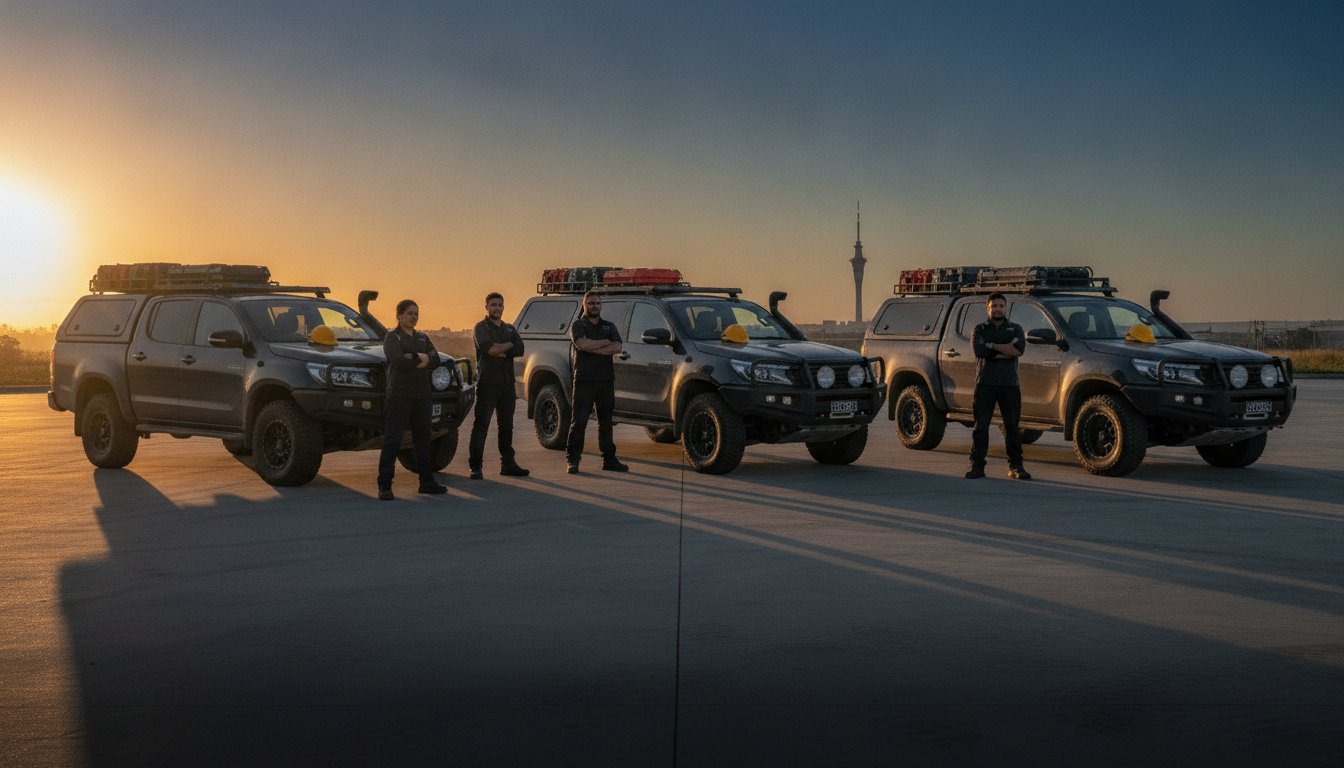
Our team consists of seasoned professionals who spend their weekends driving the same Auckland tracks you do. This enthusiast-led expertise means we don’t just follow a manual; we understand how these products perform under real-world stress. We guarantee a level of technical precision that retail-only outlets cannot match. From ECU remaps to transmission flushes, we provide the comprehensive care required to keep your 4×4 at peak performance for years to come.
Prepare Your Vehicle for Every Auckland Challenge
Choosing the right frontal protection is a careful balance of mechanical engineering and modern aesthetics. You’ve seen how critical ADAS calibration and NZTA compliance are for maintaining the safety of your 4×4. A high-quality bar only performs as well as its installation. By selecting a specialist bullbar fitting service Auckland, you ensure your vehicle remains 100% road-legal while gaining the structural protection needed for rural tracks or demanding commercial job sites. We help you avoid the pitfalls of uncertified modifications that could compromise your insurance or safety tech.
Motortech 4X4 stands as Auckland’s leading ADAS calibration specialist and a trusted fleet fit-out partner. As authorised installers of premium 4×4 brands, we provide the technical precision required for the sophisticated electronics of 2026 models. Our workshop brings together mechanical expertise and advanced diagnostic tools to deliver a complete vehicle solution. Don’t leave your safety to chance. It’s time to build a rig that is as dependable as it is tough. Get a Professional Bullbar Fitting Quote from Motortech 4X4 and get your vehicle track-ready with total confidence.
Frequently Asked Questions
Will fitting a bullbar void my new vehicle warranty?
Fitting a bullbar will not automatically void your new vehicle warranty, provided the accessory is professionally installed and compliant with manufacturer standards. However, if an incorrectly fitted bar causes structural damage or interferes with the electrical system, the manufacturer may decline related claims. Using a professional bullbar fitting service Auckland ensures that your installation maintains the engineering integrity required to protect your warranty status.
Do I need to upgrade my suspension when fitting a heavy steel bullbar?
Yes, we generally recommend a front suspension upgrade when installing a heavy steel bar. Adding 60kg to 90kg to the front of your vehicle changes the centre of gravity and can cause the factory springs to sag. This leads to reduced braking performance and poor handling. A matched suspension kit ensures your rig maintains its ride height and remains stable under the additional load.
How long does a professional bullbar fitting take at your Auckland workshop?
A standard bullbar installation typically takes between four to six hours to complete in our workshop. This timeframe allows for the careful removal of factory components, structural mounting to the chassis, and professional wiring for indicators and fog lights. If your vehicle requires complex ADAS calibration or winch integration, the process may extend to a full day to ensure every system is verified.
Can I fit a bullbar myself if I have the right tools?
While DIY fitting is possible for those with mechanical experience, it is not recommended for modern vehicles equipped with safety sensors. Incorrect mounting can prevent airbags from deploying or trigger persistent dashboard errors. A professional bullbar fitting service Auckland provides the technical precision and specialised diagnostic tools needed to ensure your vehicle remains 100% road-legal and safe for your family or employees.
What is the difference between a winch-bar and a standard bullbar?
A winch-bar is specifically engineered with an internal reinforced cradle designed to withstand the high-tensile loads of vehicle recovery. Standard bullbars provide excellent frontal protection against animal strikes but lack the structural bracing required to house a winch safely. If you intend to fit a winch now or in the future, you must select a winch-compatible bar to ensure the chassis isn’t damaged during recovery.
Are all bullbars sold in NZ airbag compatible?
No, not all bars sold in New Zealand are certified for use with airbag-equipped vehicles. To be legal on NZ roads, a bar must be Frontal Impact Compliant (FIC) and display a permanent compliance tag. We only install bars that have undergone rigorous crash testing. This ensures the mounting brackets are designed to fold at a specific rate, allowing the factory airbags to deploy exactly when needed.
Do bullbars affect the fuel economy of my ute?
You may experience a slight increase in fuel consumption due to the additional weight and changes to the vehicle’s aerodynamics. Typically, this impact is minimal, often resulting in a change of less than one litre per 100km. If fuel efficiency is your primary concern, choosing a hoopless design or a lighter aluminium alloy bar can help mitigate the penalty while still providing essential front-end protection.
What happens if my ADAS sensors aren’t recalibrated after fitting?
Failing to recalibrate your ADAS sensors can lead to dangerous malfunctions in your vehicle’s safety systems. Your autonomous emergency braking may engage unexpectedly while driving on the motorway, or your adaptive cruise control might fail to detect vehicles ahead. Precise recalibration is a mandatory safety step that aligns the sensors with the new geometry of your bar, ensuring your safety tech remains fully functional.