What if the most expensive piece of gear in your 4×4 was actually the one most likely to leave you stranded deep in the Northland bush? Selecting the right car fridge is only half the battle; the real challenge lies in the electrical architecture that keeps it running without flattening your starter battery. Most Kiwi tourers agree that there is nothing worse than a lukewarm beer or spoiled steaks after a long day on the tracks. You want a setup that performs reliably, regardless of how corrugated the road gets or how high the temperature climbs.
This guide will help you master the technicalities of compressor technology and dual-battery integration to ensure your food stays fresh for three days or more. You’ll learn how to navigate the confusion over litre capacities and the critical importance of secure mounting for rugged terrain. We also preview the latest AS/NZS 3001.2 compliance standards, ensuring your power system is not only efficient but also meets the legal requirements for New Zealand vehicle installations. From DIY considerations to professional fit-outs, we provide the specialised knowledge needed for a dependable cooling solution.
Key Takeaways
- Learn why 12V compressor technology is the only reliable method for maintaining food safety during a 30°C Kiwi summer.
- Determine the correct litre capacity for your touring style while managing the weight impact of your car fridge on vehicle GVM.
- Understand the technical necessity of dual-battery systems to provide isolated power and prevent starter battery failure in the bush.
- Improve cooling efficiency through strategic packing techniques and by providing adequate ventilation for the compressor unit.
- Evaluate the benefits of professional fit-outs to ensure your setup complies with current AS/NZS 3001.2 electrical safety standards.
Understanding Car Fridge Technology: Beyond the Chilly Bin
For a long-haul trip through the Coromandel or a multi-day stint in the Southern Alps, a standard chilly bin is essentially a ticking clock. Once the ice melts, your food safety is compromised and your perishables are at risk. A 12V car fridge solves this problem by providing active, continuous cooling that doesn’t rely on messy bags of ice. These units are engineered to operate in high-ambient temperatures, ensuring your supplies remain at food-safe levels regardless of the conditions outside the vehicle.
The efficiency of these portable units stems from advanced refrigeration cycle technology. Unlike a standard ice box, a compressor fridge uses a motor to circulate refrigerant through a closed system. The evaporator coil absorbs heat from the internal cabinet, while the condenser releases that heat into the surrounding air. A precise thermostat control manages this process, cycling the compressor on and off to maintain a steady temperature. This mechanical approach allows high-quality units to achieve sub-zero temperatures even when the New Zealand summer pushes past 30°C.
Compressor vs. Thermoelectric: The Real Difference
It’s a common mistake to confuse a true compressor fridge with a cheaper thermoelectric cooler. Thermoelectric units rely on the Peltier effect, which generally only lowers the internal temperature by 15 to 20 degrees Celsius below the ambient air. In a vehicle interior that hits 35 degrees on a humid afternoon, your milk would sit at a dangerous 15 degrees. A compressor fridge is a dedicated 12V appliance designed for sustained cooling and genuine refrigeration performance. It operates with significantly higher efficiency, drawing less current from your battery system once the desired temperature is reached.
Durability Standards for NZ Off-Roading
New Zealand’s rugged tracks are brutal on electrical appliances. Constant corrugations can easily fatigue internal components or crack solder joints in inferior units. When selecting a car fridge, the build quality of the casing is just as important as the motor. High-grade plastic casings are excellent for absorbing impacts and resisting dents during heavy off-road use. Conversely, powder-coated steel provides maximum structural rigidity for permanent fit-outs. For units mounted in open ute trays, ensure the seals and venting are designed to withstand the fine dust and moisture common on remote gravel roads. Reliable cooling in the bush requires a unit that can handle the physical punishment of the trail without a mechanical failure.
Selecting Your Ideal Setup: Chest, Upright, and Drawer Fridges
Choosing the right configuration requires an objective look at your vehicle’s payload and your touring style. While a large car fridge offers the convenience of home-style catering, it also introduces significant weight and space challenges. A 40-litre unit is the industry standard for a couple on a three-day trip, whereas a 75-litre dual-zone model is better suited for families. You must account for the weight of the unit plus the thermal mass of its contents. A large, fully stocked fridge can weigh upwards of 80kg, which directly impacts your Gross Vehicle Mass (GVM) and can alter your vehicle’s centre of gravity if poorly positioned.
According to a recent Popular Mechanics review, the best portable refrigeration options balance power draw with usable internal volume. Understanding the capacity requirements for your specific needs is the first step in planning your build:
- 30-40 Litres: Ideal for day trips or a couple for a long weekend.
- 50-60 Litres: The standard for a family of four for 2 to 3 days.
- 70+ Litres: Necessary for long-range remote touring and large groups.
Dual-zone models provide the luxury of a separate freezer compartment, allowing you to store frozen meats or ice cream alongside chilled drinks. However, this often comes at the cost of increased footprint and higher power consumption from the 12V system.
Chest Fridges: The Traditional Touring Choice
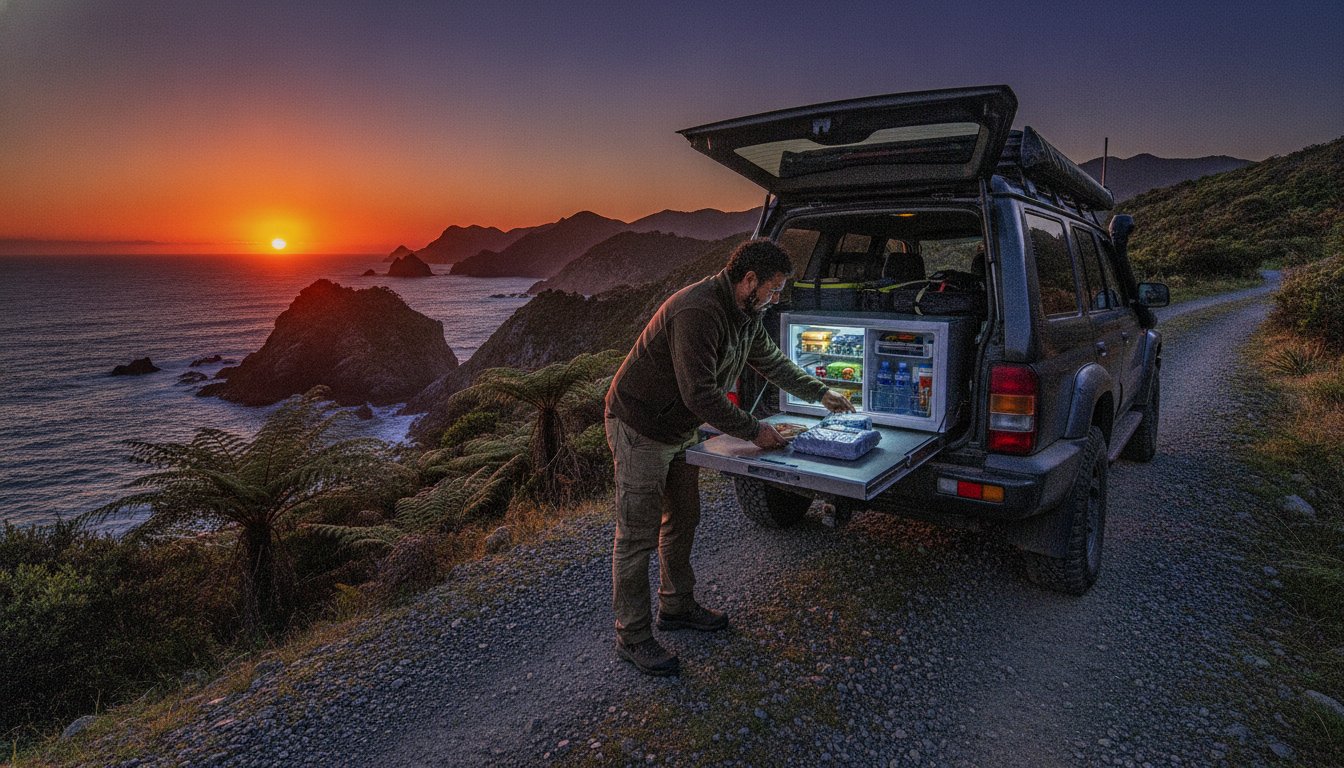
Chest-style fridges remain the most popular choice for rugged New Zealand tracks. Their top-opening design is thermally efficient because cold air, which is denser than warm air, stays trapped at the bottom of the cabinet when the lid is opened. The main drawback is accessibility. In a lifted 4×4, reaching into a chest fridge can be difficult without a heavy-duty fridge slide. These slides add further weight and complexity but are essential for ergonomics and safety on the trail.
Upright and Drawer Fridges for Canopies
Modern 4×4 builds frequently utilise drawer or upright fridges to maximise space in custom canopies. Drawer fridges are particularly effective for high-clearance vehicles, as they allow you to pull the contents out at waist height. Upright fridges, similar to a domestic unit, offer excellent visibility of your supplies and are often preferred for specialised fleet fit-outs where quick access is required. While uprights can lose cold air more rapidly when opened, their compact footprint makes them ideal for tight canopy configurations where floor space is at a premium.
Powering Your Car Fridge: Solving the Battery Drain Dilemma
While some retail outlets suggest a simple plug-in approach, running a car fridge off your primary starter battery is a high-risk strategy that often leads to a stranded vehicle in isolated camping spots. Starter batteries are engineered for high-amp bursts to crank an engine; they are not designed for the slow, constant discharge required by a compressor. A dedicated dual-battery system is the professional standard for reliable touring. This setup isolates your starting power, ensuring that no matter how cold you keep your drinks, the engine will always turn over in the morning.
Voltage drop is the silent enemy of 12V efficiency. Using thin, factory-grade wiring often causes the fridge’s low-voltage cutout to trip prematurely, even if the battery has significant charge remaining. High-quality 6B&S or 8B&S cable paired with heavy-duty Anderson plugs provides a secure, low-resistance connection that maintains consistent power delivery. This technical detail is often highlighted in the Popular Mechanics review of the best portable refrigerators as a critical factor in real-world performance. For total peace of mind, modern systems integrate Bluetooth-enabled shunts or voltmeter displays that allow you to monitor your remaining amp-hours via a smartphone app.
DCDC Chargers and Battery Isolators
Most modern utes and SUVs utilise smart alternators that reduce output once the starter battery is full, which leaves your auxiliary battery chronically undercharged. A DCDC charger acts as a multi-stage battery charger that overcomes these voltage limitations, providing a dedicated charging profile that ensures the auxiliary battery reaches 100% capacity while the vehicle is in motion. These units often include a built-in Maximum Power Point Tracking (MPPT) regulator. This allows you to plug in a solar blanket at camp to maintain your car fridge indefinitely without needing to start the engine.
AGM vs. Lithium (LiFePO4) for Cooling
Choosing between AGM and Lithium (LiFePO4) comes down to your budget and vehicle payload. AGM batteries are cost-effective for casual weekenders but are heavy and only offer about 50% usable capacity before voltage drops too low. Lithium batteries provide up to 90% usable capacity and weigh roughly a third of an equivalent AGM. If you are fitting out a professional touring rig with a large battery bank and a 75L fridge, you should consider the impact on your vehicle’s total weight and the potential need for GVM upgrades to remain legal and safe on the road.
Maximising Efficiency on the Track: Packing and Ventilation Tips
Mechanical reliability is only one part of the equation for successful remote touring. To get the best performance from your car fridge, you must manage the thermal environment both inside and outside the cabinet. Efficiency begins before you even hit the road. Pre-cooling your unit on 240V mains power at home in Auckland for at least 24 hours ensures the internal insulation and the food itself reach the target temperature using domestic electricity. This prevents the compressor from running at a 100% duty cycle during the first leg of your trip, which preserves your auxiliary battery capacity for when you are stationary at camp.
The science of thermal mass plays a vital role in sustained cooling. A full fridge is significantly more efficient than an empty one because chilled solids and liquids retain their temperature far better than air. Every time the lid is opened, cold air escapes and is replaced by ambient warm air. By keeping the unit packed, you reduce the volume of air that needs to be re-cooled. If you find your supplies dwindling during a trip, fill the empty gaps with water bottles to maintain that thermal mass and reduce the workload on the compressor motor.
Smart Packing for Airflow
Internal organisation is critical for maintaining temperature consistency. High-quality fridges rely on internal fans to circulate cold air throughout the cabinet. Overpacking the unit or blocking these fans with soft plastic bags will create warm spots and cause the compressor to run longer than necessary. Utilise the provided baskets to separate your supplies. We recommend storing raw meats at the bottom, which is typically the coldest zone, while keeping dairy and delicate vegetables in the upper sections. This methodical approach prevents the “warm beer” effect where newly added beverages force the compressor to work overtime to stabilise the internal climate.
Managing Ambient Heat in the Tray
The external temperature of your vehicle tray or canopy directly impacts power consumption. Direct sunlight hitting a metal fridge casing can increase the compressor’s energy draw by up to 40%. Fitting a high-quality insulated fridge cover provides a necessary thermal barrier and protects the unit from the dust and vibrations discussed in previous sections. Furthermore, ventilation is non-negotiable for units installed in enclosed canopies. Without adequate airflow, the heat generated by the condenser has nowhere to go, leading to a heat-soak effect that can eventually cause a thermal cutout. Using a heavy-duty fridge slide not only improves access but also allows you to pull the unit out into the open air during meal prep, facilitating better heat dissipation. For those looking to optimise their setup, you can find a range of specialised camping gear designed to handle these environmental challenges.
Professional 4×4 Fit-outs in Auckland: Integrating Your Fridge System
While a “plug and play” approach might suffice for a quick day trip to the coast, a professional installation is the only way to ensure long-term reliability on rugged Kiwi tracks. Motortech 4X4 provides the technical expertise required to turn a standalone car fridge into a fully integrated component of your vehicle’s ecosystem. A DIY setup often relies on flimsy tie-down points or temporary wiring that can fail under the stress of constant vibrations. In contrast, a professional fit-out focuses on structural integrity and electrical precision, ensuring your cooling system remains operational when you are miles from the nearest service centre.
Safety is a critical consideration that many casual campers overlook. An unsecured 50-litre fridge can weigh over 70kg when fully stocked; this essentially becomes a lethal projectile in the event of a sudden stop or collision. Our team ensures that all mounting solutions are WOF-compliant and engineered to withstand the forces of off-road driving. Beyond basic mounting, we specialise in custom 12V control panels. These centralised hubs allow you to manage your car fridge, lighting, and water pumps from a single, professional-grade interface, providing serious adventurers with total control over their power consumption.
Custom Canopy and Drawer Systems
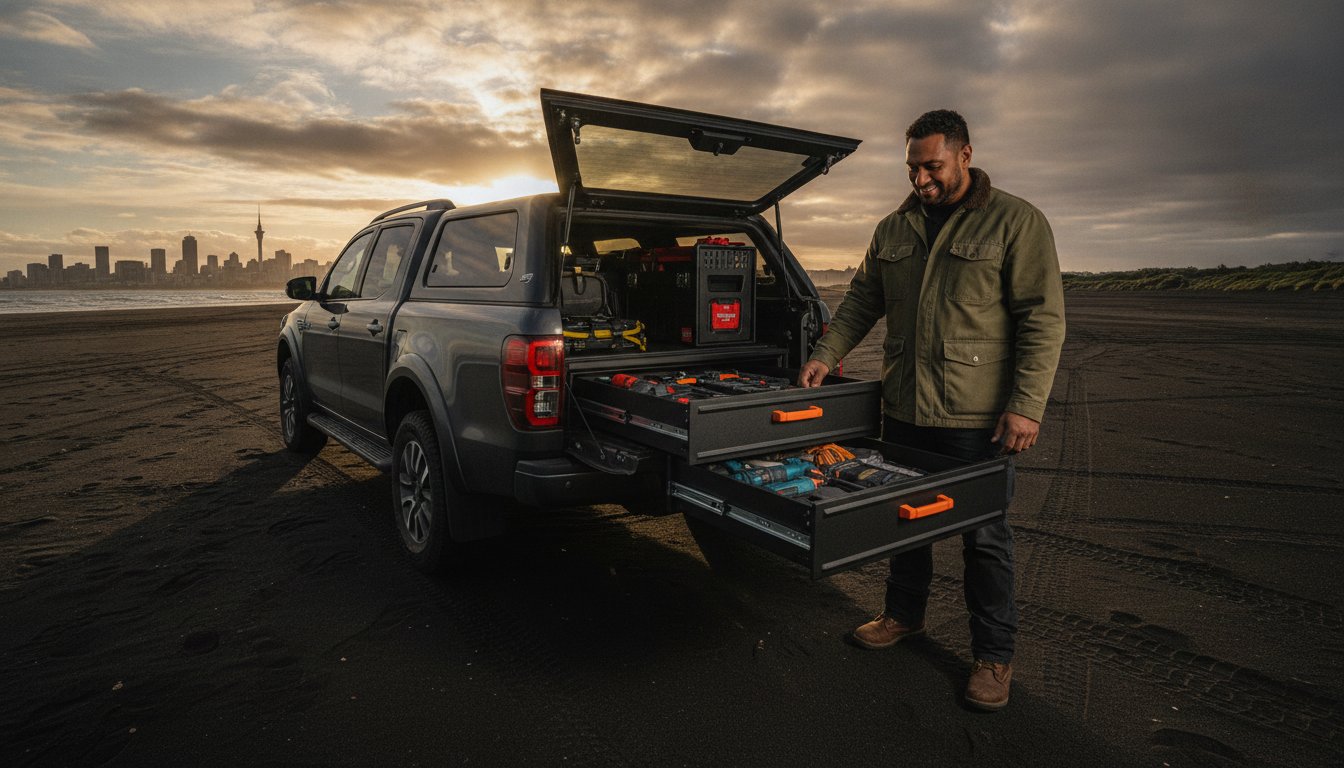
Maximising the utility of your ute tray requires a strategic layout that balances storage with accessibility. We integrate fridge slides and drop-down mechanisms into existing drawer systems, allowing you to access your supplies without straining your back or needing to unload other gear. Planning the electrical layout is equally vital; we position DCDC chargers and battery monitors to allow for easy maintenance and heat dissipation. For a complete build that includes everything from suspension upgrades to internal shelving, explore our range of 4×4 accessories Auckland.
Fleet and Trade Solutions
A reliable cooling system is not just a luxury for weekend campers; it is a vital tool for tradies working on remote Auckland construction sites or forestry projects. Keeping hydration and meals at safe temperatures throughout a ten-hour shift requires a heavy-duty mounting solution that can handle the daily abuse of a commercial environment. We provide fleet fit-outs that prioritise durability and ease of use, ensuring that your team stays productive and safe in the field. To discuss a tailored power and cooling setup for your vehicle, organise a professional 12V consultation with our Auckland team today.
Optimise Your Touring Rig for the Long Haul
Integrating a reliable car fridge into your 4×4 is more than just a convenience; it is a technical upgrade that requires a balanced approach to power management and physical mounting. You now understand that maintaining sub-zero temperatures in the New Zealand summer depends as much on your DCDC charging system as it does on the compressor itself. By prioritising thermal mass and ensuring adequate ventilation, you can extend your time in the bush without risking a flat starter battery or spoiled supplies. A successful setup is an integrated one where every component works in harmony.
Professional installation remains the definitive way to ensure your setup is safe, compliant, and durable enough for the most demanding tracks. As Auckland’s leading 4×4 specialist centre, Motortech 4X4 applies authoritative mechanical and fleet service standards to every project. Our technicians provide expert DCDC and dual-battery installations that manage themselves, giving you the freedom to focus on the adventure ahead. Whether you are prepping a weekend tourer or a commercial fleet, we ensure your electrical architecture is built to last.
Get a Professional 4×4 Fit-Out Quote in Auckland
We look forward to seeing your rig fully equipped and ready for the rugged beauty of the Kiwi backcountry. Safe travels on the tracks.
Frequently Asked Questions
Can I run a car fridge off my car’s cigarette lighter socket?
You can run a car fridge from a standard 12V cigarette lighter socket, but it is rarely the most reliable solution for off-road use. These sockets often suffer from significant voltage drop and can vibrate loose on corrugated tracks, leading to inconsistent cooling. For sustained performance and safety, we recommend upgrading to a hardwired Merit or Anderson plug connection with heavy-gauge cabling.
How long will a 100Ah battery run a car fridge for?
A 100Ah AGM battery typically powers a medium-sized fridge for 48 to 60 hours before reaching the 50% discharge limit required to protect the battery’s lifespan. If you utilise a Lithium (LiFePO4) battery of the same rating, you can expect closer to 80 to 90 hours of runtime due to the higher usable capacity. Ambient temperature and how often the lid is opened will ultimately dictate the exact duration.
What is the best temperature to set my car fridge to?
Set your fridge to 3°C for general refrigeration to ensure food stays safely below the 5°C threshold while preventing accidental freezing of delicate produce. If you are using a freezer compartment, -18°C is the professional standard for long-term storage. Using an external thermometer can help verify that the internal temperature matches the digital display on the unit, especially in humid conditions.
Do I need a dual-battery system for a weekend camping trip?
A dual-battery system is essential for any weekend trip where you plan to remain stationary for more than a few hours. Without a dedicated auxiliary battery, a car fridge will quickly drain your starter battery to the point where the engine won’t crank. This is particularly risky in remote New Zealand locations where mobile coverage is sparse and recovery services are difficult to coordinate.
What is the difference between a single zone and dual zone car fridge?
A single zone fridge maintains one uniform temperature throughout the entire cabinet, while a dual zone unit features two isolated compartments with independent thermostats. Dual zone models allow you to run a fridge and freezer simultaneously in the same unit. While versatile, dual zone units are generally larger and consume more power because the compressor must work harder to maintain sub-zero temperatures in one section.
How much ventilation does a car fridge need in a closed canopy?
Most manufacturers require a minimum of 50mm to 100mm of clear space around the compressor vents to ensure adequate heat dissipation. In a closed canopy, this airflow is critical; without it, the ambient temperature around the unit rises, forcing the compressor to run indefinitely. Installing a canopy vent or a 12V extraction fan can significantly improve cooling efficiency during the peak of the New Zealand summer.
Can a car fridge run while the vehicle is turned off?
Yes, a compressor fridge is designed to run continuously while the vehicle is turned off, provided it is connected to a stable auxiliary power source. High-quality units feature a low-voltage cutout to protect the battery from deep discharge, but relying on this with a single starter battery is a high-risk strategy. An integrated 12V system allows the fridge to cycle as needed while you are parked at camp.
Is a lithium battery worth the extra cost for running a fridge?
Lithium batteries are worth the investment for tourers who prioritise weight savings and maximum usable capacity. While the initial cost is higher than AGM, a Lithium battery provides up to 90% usable amp-hours and can be recharged significantly faster via a DCDC charger. For professional fleet builds or weight-restricted utes, the reduction in mass and increased cycle life justify the premium.