
If you think your Toyota Hilux is legally rated to carry that new steel canopy, bullbar, and a full tray of gear, you’re likely driving an insurance claim waiting to happen. Most Kiwi owners don’t realise how quickly heavy accessories eat into the factory payload, often leaving less than 300kg for passengers and fuel once the tools are loaded. It’s a common trap that leads to sagging suspension, poor handling, and the constant fear of being fined for an overloaded ute. A professional toyota hilux gvm upgrade nz is the only way to ensure your rig remains safe and fully compliant when the work gets heavy.
This guide will help you master the technical and legal requirements for increasing your Hilux payload while ensuring your vehicle stays stable on NZ roads. You’ll learn exactly how to navigate the LVVTA certification process, understand the difference between factory and aftermarket solutions, and why ADAS calibration is critical for your safety systems. We provide a clear roadmap to achieving a legally certified GVM increase, giving you the peace of mind that your fleet or personal rig is built to perform under pressure.
Key Takeaways
- Understand the legal necessity of a certified toyota hilux gvm upgrade nz to protect your insurance and ensure compliance with LVVTA regulations.
- Identify the specific suspension components, such as heavy-duty coil and leaf springs, required to handle constant loads without compromising ride quality.
- Learn why ADAS calibration is a non-negotiable step after any ride height change to keep safety systems like emergency braking operational.
- Determine how to calculate your vehicle’s constant load to select a suspension kit tailored for either a commercial workhorse or a weekend tourer.
- Discover the benefits of a comprehensive service that manages the entire process from professional fitment to final legal sign-off.
Understanding GVM Limits for the Toyota Hilux in New Zealand
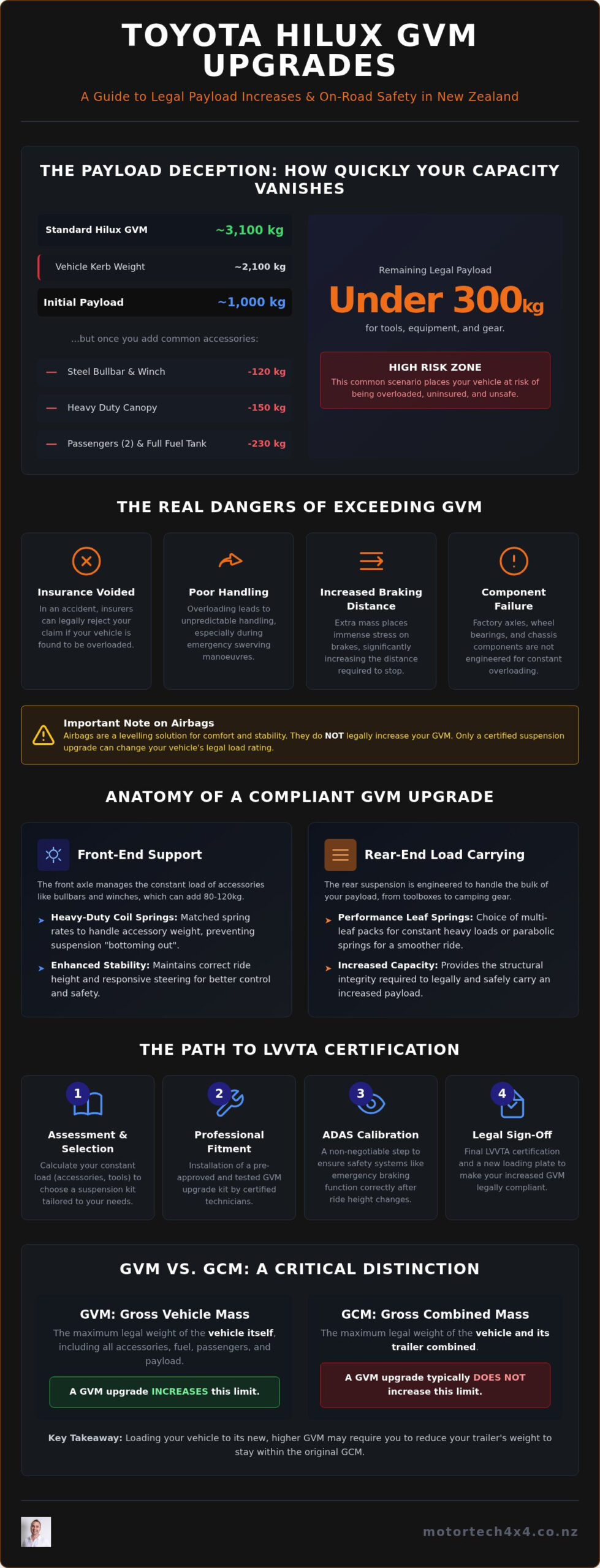
The Toyota Hilux is a staple of New Zealand’s commercial and recreational landscape, yet many owners operate their vehicles outside legal weight limits without realising it. Understanding Gross Vehicle Mass (GVM) is the first step in ensuring your vehicle remains compliant. GVM is the maximum allowable weight of the vehicle when fully loaded, including the chassis, body, fuel, accessories, and passengers. For most modern Hilux models, the factory GVM sits between 3,000kg and 3,100kg. While this sounds substantial, the actual payload capacity is often less than 1,000kg. Once you bolt on a steel bullbar, a winch, and a heavy canopy, you’ve already sacrificed hundreds of kilograms of your legal carrying capacity.
Driving an overloaded Hilux carries severe legal risks on NZ roads. If you’re involved in an accident while exceeding your GVM, your insurance provider can legally reject your claim, leaving you personally liable for damages. For commercial operators, non-compliance represents a significant health and safety risk that can lead to WorkSafe investigations or heavy fines under the Land Transport Rule: Vehicle Dimensions and Mass 2016. It’s also vital to distinguish between GVM and Gross Combined Mass (GCM). While a toyota hilux gvm upgrade nz increases the weight the vehicle can carry, it doesn’t typically increase the GCM; the total weight of the vehicle and trailer combined. If you increase the vehicle’s weight to its new GVM limit, you must often reduce your trailer weight to stay within the legal GCM.
Calculating Your Current Hilux Payload
Finding your Hilux’s limit starts with the manufacturer’s placard, usually located in the door jamb. However, the payload figure quoted in brochures is often based on a dry vehicle with no accessories. You must account for hidden weights: a full tank of fuel adds approximately 70kg, and two adult passengers can easily add 160kg. A toyota hilux gvm upgrade nz is essential for any ute fitted with a permanent canopy or service body because these additions often consume over 50% of the factory payload before a single tool is loaded.
The Impact of Overloading on Vehicle Dynamics
Exceeding GVM isn’t just a legal issue; it’s a safety concern. Overloaded vehicles suffer from increased braking distances and unpredictable handling during emergency swerving manoeuvres. The extra mass places immense stress on factory axles, wheel bearings, and chassis components not engineered for those loads. Many owners attempt to fix a sagging rear end by installing airbags, but it’s critical to understand that airbags are a levelling solution designed for comfort, not a legal GVM increase. Only a certified suspension upgrade can change the figure on your vehicle’s loading plate.
Key Components of a High-Performance Hilux GVM Upgrade Kit
A professional toyota hilux gvm upgrade nz involves a coordinated system of high-tensile components. It isn’t a simple lift kit; it’s a precision recalibration of the vehicle’s structural capacity. Each part must work in unison to handle increased mass while maintaining stability under heavy braking and cornering. To stay compliant with NZ GVM Upgrade Legalities, these kits must be specifically tested and approved for the Toyota platform. This ensures the chassis can cope with the revised loading without compromising safety or structural integrity.
Front-End Support: Managing Accessories
The front axle is often the first point of failure for modified Hiluxes. Adding a steel bullbar and winch puts roughly 80kg to 120kg directly over the front wheels. Factory coils aren’t rated for this constant load, which leads to reduced suspension travel and “bottoming out” on rough terrain. High-performance kits use heavy-duty coil springs with higher spring rates. We match these rates to your specific accessory weight to ensure the front end remains level and responsive. Maintaining this travel is vital for both driver comfort and the longevity of your steering components and wheel bearings.
Rear-End Stability: Leaf Springs and Load Carrying
Rear suspension handles the bulk of your payload. Choosing between parabolic and traditional multi-leaf packs depends on your specific use case. Parabolic springs offer a smoother ride and better articulation, while heavy-duty multi-leaf packs are better suited for constant, maximum-capacity commercial loads. High-quality suspension kits significantly improve ride quality by eliminating the harshness often associated with empty factory trays. They ensure your axle alignment remains true even under maximum compression, preventing the “tail-wagging” effect common in overloaded utes.
Shock absorbers are the unsung heroes of any toyota hilux gvm upgrade nz. They require sophisticated valving to control the increased kinetic energy generated by a heavier vehicle. Standard shocks often overheat and fade when working with heavy loads on corrugated NZ backroads. Upgraded shocks feature larger bores and heat-dissipating designs to provide consistent damping. They provide the necessary rebound control to prevent the vehicle from feeling floaty or taking too long to settle after hitting a bump. Reinforced shackles and high-grade polyurethane bushes are also essential to keep the axle housing true under load. If you’re unsure which setup fits your needs, our team can help you configure the ideal Hilux suspension package for your specific payload requirements.
Navigating NZ GVM Upgrade Legalities and LVVTA Certification
In New Zealand, any modification that increases a vehicle’s Gross Vehicle Mass must be certified by the Low Volume Vehicle Technical Association (LVVTA). Without this official sign-off, a toyota hilux gvm upgrade nz is legally non-existent. This means that even if you have installed high-performance components, the vehicle is still legally bound by its factory weight rating. Operating an uncertified vehicle at weights above the original placard limit is identical to being overloaded in the eyes of the law. This status can lead to immediate fines, failed Warrants of Fitness, and the rejection of insurance claims following an incident.
Legal certification provides a robust layer of protection for both private owners and commercial fleet managers. It ensures that the vehicle meets the Land Transport Rule: Vehicle Dimensions and Mass 2016. A permanent “Cert Plate” is fixed to the engine bay or door pillar, serving as definitive proof of compliance for enforcement officers and insurance adjusters. As of August 2026, the LVVTA charges a fixed fee of $270 for the certification paperwork alone; this is a cost paid by the certifier to the association and is separate from the certifier’s physical inspection and testing fees. This investment secures your OHS liabilities by proving you’ve provided a fit-for-purpose vehicle for your staff.
The 5-Step Certification Process in Auckland
We manage the transition from a standard ute to a legally certified heavy-hauler through a structured five-step workflow. This process eliminates ambiguity and ensures your vehicle meets all technical standards before it hits the road. It starts with a consultation and load assessment to determine your constant and peak payload requirements. Following this, we perform the installation of a certified GVM upgrade kit tailored to your Hilux model. An LVVTA-authorised certifier then conducts a physical examination of the components and installation quality. Technical data, including brake performance testing results, is submitted to the association for review. Once approved, the official Cert Plate is issued and NZTA records are updated.
Pre-Registration vs. Post-Registration Upgrades
A toyota hilux gvm upgrade nz can be performed at two distinct stages of the vehicle’s life. Pre-registration upgrades occur before the vehicle is first registered in NZ, which often streamlines the administrative process. For instance, high-quality aftermarket solutions for a new-generation HiLux fitted before registration typically range between NZ$3,733 and NZ$4,161. Post-registration upgrades are performed on used vehicles already on the road and require a full LVVTA inspection after the new components are installed. Regardless of when the upgrade occurs, ADAS calibration is mandatory. Changing the ride height alters the field of vision for cameras and sensors, requiring precise recalibration to ensure safety systems like lane-keep assist and emergency braking function correctly.
Selecting the Right GVM Upgrade: Tradie Workhorse vs. Weekend Tourer
Selecting the correct toyota hilux gvm upgrade nz requires a precise audit of your vehicle’s daily operating weight. A “one size fits all” approach often results in a ride that is either dangerously soft under load or punishingly stiff when empty. We categorise builds into two primary profiles to ensure the suspension valving and spring rates match the intended use. This precision prevents the vehicle from topping out on extension or losing the off-road articulation required for New Zealand’s demanding tracks and back-country roads.
If you frequently tow a 3.5-tonne trailer or a large caravan, your GVM needs are even more acute. The tow ball download weight counts towards your vehicle’s GVM, not the trailer’s weight. A 300kg tow ball mass can immediately push a standard Hilux over its legal limit before you’ve even packed a suitcase. A certified upgrade ensures your rear end doesn’t sag, maintaining vital steering geometry and braking efficiency while towing at maximum capacity.
The Tradie Setup: Service Bodies and Tools
For commercial Hiluxes fitted with heavy service bodies, the rear axle often carries a permanent 600kg to 800kg load. This requires high-rate leaf springs that maintain a level stance and keep the centre of gravity stable during urban cornering. We specialise in Professional Fleet Fit-Outs that prioritise durability and legal compliance for business owners who cannot afford vehicle downtime or insurance liability issues.
The Touring Setup: Canopies, Tents, and Fridges
Recreational tourers face the challenge of variable weight. The vehicle might be empty for the daily commute but carry a rooftop tent, fridge, and water tank for a trip to Cape Reinga. In these cases, we often recommend adjustable shock absorbers that allow you to firm up the damping when the vehicle is laden and soften it for unladen comfort. Remember that every item, including your roof racks and canopy, must be included in your final toyota hilux gvm upgrade nz calculation to ensure you stay within the law.
Ready to secure your rig’s performance and compliance? You can book a payload assessment with our Auckland team to determine the exact spring rates required for your Hilux setup.
Professional Hilux GVM Upgrades at Motortech 4X4 Auckland
Choosing a specialist for your toyota hilux gvm upgrade nz ensures that your vehicle modification is treated as a precision engineering project rather than a simple part swap. At Motortech 4X4, we provide a comprehensive service that bridges the gap between mechanical installation and legal compliance. Our Auckland-based facility is equipped to handle the entire lifecycle of a GVM increase, ensuring that every component is selected based on a factual analysis of your vehicle’s constant and peak loads. This meticulous approach protects your investment and ensures your Hilux remains a reliable tool for work or adventure.
A critical advantage of our service is the integration of Advanced Driver Assistance Systems (ADAS) calibration. As discussed in previous sections, altering the ride height of a Hilux changes the geometry of the forward-facing cameras and radar sensors. Many general suspension shops lack the specialised equipment to recalibrate these systems, leaving safety features like autonomous emergency braking or lane-keep assist compromised. We perform this calibration in-house as part of the upgrade process. This ensures that your vehicle’s safety technology remains as dependable as its new heavy-duty suspension.
Why Choose Motortech 4X4 for Your Hilux?
Our “one-stop” mentality is designed to save fleet managers and private owners time and administrative frustration. We manage the entire coordination with LVVTA-authorised certifiers, removing the burden of paperwork from the customer. Our mechanical team possesses deep-seated knowledge of the Toyota Hilux drivetrain and chassis, allowing us to identify potential wear issues before they become failures. We offer:
- Precision fitting of authorised GVM upgrade kits, including Old Man Emu (OME) systems.
- In-house ADAS calibration for total safety system restoration.
- Direct coordination of the LVVTA inspection and certification plate issue.
- Comprehensive support and warranty for all mechanical labour and components.
Located conveniently in Auckland, our service centre is positioned to support local businesses and enthusiasts who require high-performance modifications with a professional finish. We provide a seamless transition from a standard factory setup to a fully compliant, heavy-duty workhorse.
Book Your GVM Assessment Today
The first step toward a toyota hilux gvm upgrade nz is a personalised load assessment. We recommend bringing your vehicle to us in its “working state”, fully loaded with your usual tools, canopies, or touring gear. This allows our technicians to weigh the axles accurately and determine the exact spring rates required for your setup. Before your installation date, ensure any permanent accessories like bullbars or winches are already fitted, as these determine the final engineering requirements for the LVVTA sign-off. Contact our Auckland team today to secure a booking and begin the process of making your Hilux legally fit for purpose.
Secure Your Hilux’s Performance and Compliance
Operating a modified ute on New Zealand roads requires more than just heavy-duty parts; it demands a total commitment to legal and mechanical standards. We’ve explored how a certified toyota hilux gvm upgrade nz protects your insurance, improves vehicle dynamics, and ensures you aren’t caught out by strict payload limits. By matching spring rates to your specific constant load and ensuring your ADAS systems are correctly calibrated, you transform your Hilux into a tool that is both capable and safe under pressure.
As Auckland’s leading 4×4 modification specialists, we take the guesswork out of the process by providing full LVVTA certification coordination and expert on-site ADAS calibration. This integrated approach ensures your vehicle is returned to you ready for the job site or the back-country track with zero compliance gaps. Don’t risk the safety of your crew or the validity of your insurance by driving an overloaded vehicle. Enquire about a Toyota Hilux GVM Upgrade at Motortech 4X4 today and experience the confidence of a rig that is truly engineered for the heavy lifting.
Frequently Asked Questions
Will a GVM upgrade void my Toyota Hilux factory warranty?
A GVM upgrade does not void your entire vehicle warranty, but it does mean Toyota is no longer responsible for the suspension components or failures directly attributed to the modification. If you choose the Toyota factory GVM upgrade arriving in August 2026, the factory warranty remains intact. For aftermarket kits, the manufacturer of the kit provides the warranty for the new components. This is a standard industry practice that ensures your vehicle remains supported.
Does a GVM upgrade increase the towing capacity (GCM) of my Hilux?
A toyota hilux gvm upgrade nz increases your payload capacity but does not increase your Gross Combined Mass (GCM). The GCM is the maximum allowable weight of the vehicle and trailer combined, which is set by the manufacturer. If you increase the weight of your Hilux to its new GVM limit, you must often reduce the weight of your trailer to ensure the total combination stays within the legal GCM.
How much does an LVVTA certification cost for a GVM upgrade in NZ?
The Low Volume Vehicle Technical Association (LVVTA) charges a fixed administrative fee of $270 for the certification paperwork. This fee is current as of August 2026 and is paid by the certifier to the association. You must also budget for the certifier’s independent inspection fee and any technical testing required, such as brake performance assessments. These costs are separate from the price of the suspension components and professional installation.
Can I install a GVM upgrade kit myself to save money?
You cannot legally perform a GVM upgrade yourself if you want it to be certified for NZ roads. To meet LVVTA requirements, the kit must be fitted by a technician authorised by the manufacturer. This ensures the installation meets specific engineering standards and safety protocols. A self-installed kit will not receive the necessary certification plate, meaning your vehicle remains legally limited to its original, lower factory payload rating.
What happens to my insurance if I am involved in an accident while overloaded?
Your insurance policy typically requires your vehicle to be in a roadworthy and legal condition at all times. If an investigation reveals your Hilux was exceeding its GVM at the time of an accident, the insurer has grounds to reject the claim entirely. This leaves you personally liable for vehicle repairs and third-party damages. A certified toyota hilux gvm upgrade nz provides the legal documentation needed to prove your vehicle was compliant.
Do I need a GVM upgrade if I only tow a heavy trailer occasionally?
You need a GVM upgrade if your occasional towing setup pushes the vehicle over its legal weight limit. Tow ball download weight is part of the vehicle’s GVM, not the trailer’s weight. Even if you only tow a heavy caravan once a year, being over the limit for that single trip is illegal. It compromises your braking and emergency handling, making the upgrade a vital safety investment for any heavy towing scenario.
Will a GVM upgrade make my Hilux ride higher?
Most GVM upgrade kits will increase the ride height of your Hilux, typically by 30mm to 50mm. This increase is necessary to provide the suspension travel required to manage heavier constant loads without bottoming out. While the primary goal is payload capacity rather than a “lift”, the heavy-duty springs naturally sit higher than factory units. This extra clearance is often a secondary benefit for owners who frequent off-road tracks or construction sites.
Is ADAS calibration necessary after a GVM suspension upgrade?
ADAS calibration is a non-negotiable requirement following a GVM upgrade because the change in ride height alters the camera and radar angles. These sensors are tuned to specific factory heights to accurately detect lane markings and obstacles. If you don’t recalibrate the system, safety features like autonomous emergency braking may activate incorrectly or fail when needed. We perform this calibration on-site in Auckland to ensure your safety technology remains fully functional.