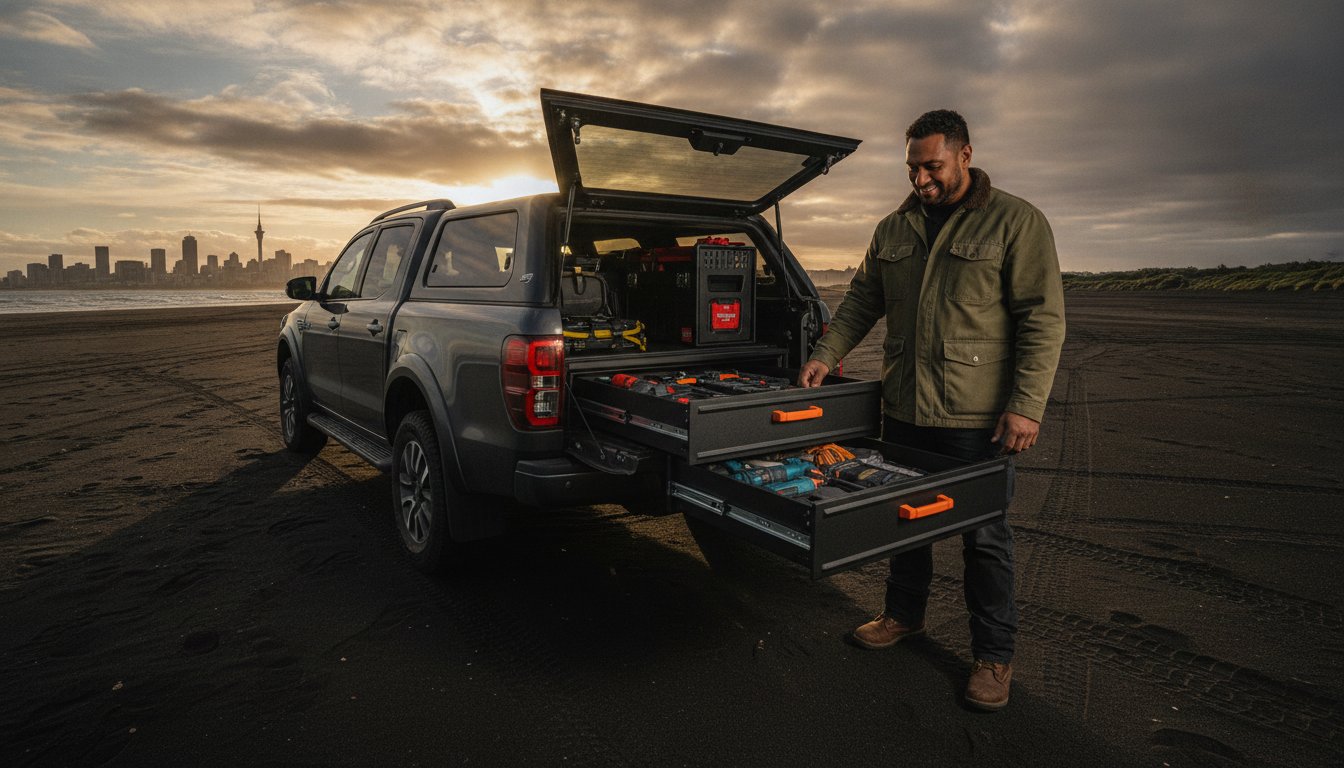

Most Kiwi 4×4 owners believe that fixing a sagging rear end is simply a matter of installing the stiffest springs available, but the reality is that raw stiffness often compromises safety and vehicle geometry. You’ve likely felt that unsettling “light” sensation in the steering or watched your headlights point at the sky while hauling a heavy caravan. It’s a common frustration for those seeking the best suspension for towing NZ roads safely. Managing weight distribution is far more critical than just adding height, as an imbalanced rig increases braking distances and wears tyres prematurely.
We understand you want a level rig that handles predictably, whether you’re fully loaded for a long haul or heading to the job site empty. This 2026 guide helps you discover the ideal suspension setup to eliminate sag, improve safety, and ensure your rig stays legal on Kiwi roads while hauling heavy loads. We’ll preview the latest in certified GVM upgrades, the necessity of ADAS calibration for modern safety systems, and how the right components keep your insurance valid and your WOF secure. By the end of this article, you’ll have a clear path to a professional, legal, and high-performing towing setup that works for your specific vehicle.
Key Takeaways
- Learn why standard factory suspension often fails under load and how the “lever effect” can dangerously compromise your steering and braking performance.
- Discover how to select the best suspension for towing NZ by matching specific spring rates and shock absorbers to your vehicle’s typical payload and towing frequency.
- Understand the critical importance of Gross Vehicle Mass (GVM) upgrades to ensure your rig stays within legal limits and remains fully covered by insurance.
- Identify why professional installation must include ADAS calibration to keep your vehicle’s modern safety sensors functioning correctly after a suspension lift.
- Gain insights into the difference between constant load springs for permanent fit-outs and versatile setups for 4x4s used for both work and weekend adventures.
Understanding Towing Dynamics: Why Standard Suspension Struggles
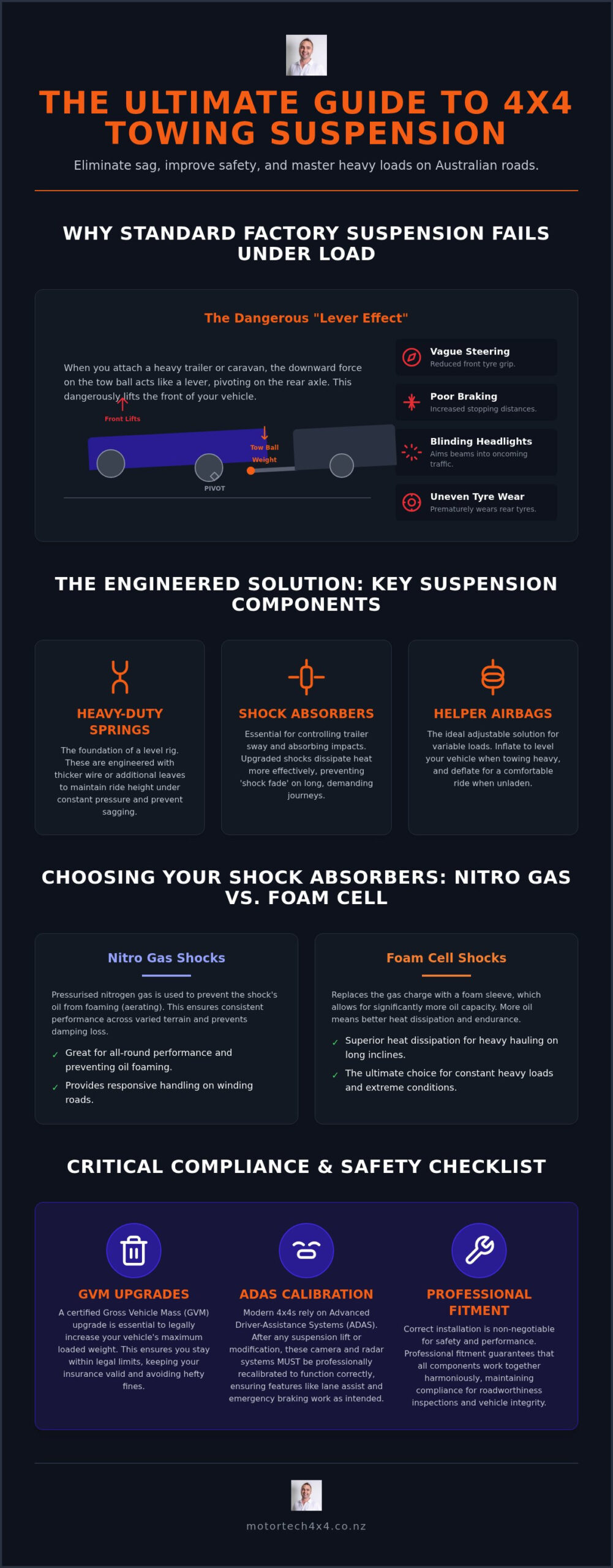
A dedicated towing suspension is a system engineered to manage dynamic weight shifts rather than providing a soft ride for an empty vehicle. Most 4x4s come off the showroom floor with car suspension systems tuned for passenger comfort. While this is great for the daily commute, it lacks the spring rate and damping control required for heavy hauling. When you hitch up, you’re dealing with the “lever effect”. The tow ball sits behind the rear axle, meaning every kilogram of downward pressure acts as a pivot, lifting the front of your vehicle. This unloads the front tyres, leading to vague steering, poor braking performance, and headlights that blind oncoming traffic.
Finding the best suspension for towing NZ conditions requires moving past these “comfort” factory settings. Inadequate setups manifest as excessive trailer sway and increased braking distances, both of which are serious safety risks on winding Kiwi roads. High-performance towing kits replace these soft components with valving and spring rates designed to keep the chassis level under load.
The Problem with “Bum Drag” and Sagging
Rear-end sag, often called “bum dragging”, does more than just look bad. It fundamentally alters your vehicle’s steering geometry. When the rear sits too low, the front suspension reaches the end of its travel too quickly, and the rear shocks often bottom out against the bump stops. This sends harsh, direct impacts through the chassis, which can lead to structural fatigue over time. Many owners try a quick fix by simply adding an extra leaf to the pack; however, this often results in a harsh, bouncy ride when the vehicle is unladen. A complete, engineered solution is necessary to maintain balance and ride quality.
Towing a Boat vs. a Caravan: Different Loads, Different Needs
The type of load you haul changes how your springs respond. A boat trailer often has a different weight distribution compared to a tandem-axle caravan. You must account for both static weight and dynamic loads. The way a caravan pitches and rolls on the highway puts immense stress on your shock absorbers, requiring superior heat dissipation. In New Zealand, adhering to tow ball weight limits is a legal and safety requirement. Tow Ball Mass is the weight the fully loaded trailer applies to the tow ball, and as a rule of thumb, it should be approximately 10% of the total loaded trailer weight. Selecting the best suspension for towing NZ means choosing a kit that can handle these specific vertical forces without compromising the vehicle’s stability.
Key Components of a Heavy-Duty Towing Suspension System
A robust setup starts with heavy-duty coil or leaf springs designed for high-stress applications. Unlike factory springs, these are manufactured with thicker wire diameters or additional leaves to maintain ride height under pressure. This hardware is the foundation of the best suspension for towing NZ, ensuring that your vehicle doesn’t just sit level but stays stable during sudden manoeuvres. For comprehensive safety, refer to the NZ Transport Agency’s safe loading and towing guide to understand how component ratings impact your total legal capacity. Key spring types include:
- Heavy-duty coils: Utilise advanced metallurgy to resist sagging over years of heavy use.
- Parabolic or multi-leaf packs: Engineered to distribute weight evenly across the rear axle while maintaining flexibility.
Shock Absorbers: Nitro Gas vs. Foam Cell for NZ Roads
Controlling the kinetic energy of a heavy trailer requires superior damping. Nitro gas shocks use pressurised nitrogen to prevent oil foaming, which keeps them responsive across varied terrain. Foam cell shocks replace the gas charge with a foam sleeve, allowing for significantly more oil capacity and better heat dissipation. This extra cooling is vital when hauling over demanding New Zealand routes like the Kaimais or the Crown Range. Constant oscillation on these inclines generates extreme temperatures that can cause standard shocks to fade. Specific valving often matters more than the basic shock type. It’s the key to reducing trailer sway and maintaining high-speed stability.
The Role of Airbags in a Towing Setup
Airbag helpers provide an adjustable solution for vehicles that switch between being empty and fully loaded. By inflating the bags, you can level the vehicle without committing to the harsh ride of permanent heavy-duty springs. It’s a versatile addition to any Suspension Systems: The Complete Guide approach. However, a common mistake is using airbags as a substitute for a proper GVM upgrade. Airbags level the load but don’t increase the legal carrying capacity of the chassis or axles. They should be viewed as a levelling tool rather than a weight-increasing modification.
Finally, don’t overlook the bushes and shackles. These are the unsung heroes of durability in any heavy-duty setup. They act as the primary pivot points for your springs. Upgrading to high-durability polyurethane bushes and greasable shackles ensures the system operates smoothly under the increased friction and pressure of heavy loads. Choosing the best suspension for towing NZ is about more than just springs; it’s about the entire ecosystem of parts working in unison. For those unsure which combination suits their rig, consulting the specialists at Motortech 4×4 ensures your hardware is matched for both performance and New Zealand compliance.
GVM Upgrades & NZ Compliance: Staying Legal on the Road
Gross Vehicle Mass (GVM) is the maximum legal weight your 4×4 can carry, encompassing everything from your bullbar and winch to the fuel in your tank and the tow ball mass of your caravan. Many owners confuse a simple suspension lift with a GVM upgrade. While a lift provides clearance, only a certified GVM upgrade legally increases your payload capacity. This distinction is vital when choosing the best suspension for towing NZ, as an uncertified lift kit provides no legal weight-bearing benefit. You may have the height, but without the correct rating, you’re still restricted to factory limits.
In New Zealand, any modification that alters a vehicle’s factory GVM requires certification from the Low Volume Vehicle Technical Association (LVVTA). This process ensures that the upgraded springs, shocks, and braking systems can safely handle the increased mass without compromising the chassis or structural integrity. A certified upgrade can legally increase a vehicle’s payload capacity by up to 1,000kg in some cases. It’s a precise engineering exercise that guarantees your vehicle remains safe and predictable under the most demanding conditions.
Is Your Rig Legal? WOF and Insurance Implications
Operating a vehicle beyond its plated GVM carries significant risks. If you’re involved in an accident while overloaded, your insurance provider has grounds to void your policy, leaving you personally liable for damages. WOF inspectors are increasingly diligent regarding modified suspension. They look for adequate spring travel and signs of “bum dragging” that suggest a vehicle is operating beyond its limits. It’s important to remember that the purchaser’s responsibility is to ensure all modifications are road-legal and correctly certified. Relying on “heavy-duty” stickers isn’t enough; you need the paperwork to match.
Auckland GVM Upgrades: The Process
Professional installation is a mandatory part of the certification process. At Motortech 4×4, the process involves a thorough engineering assessment followed by the fitment of a compliance plate that reflects the new, higher GVM rating. This ensures your vehicle remains a legal, high-performance tool rather than a liability. We manage the technical requirements, including the necessary LVVTA inspections, to provide a “one-stop” solution for local drivers. For owners in the region, our GVM Upgrades Auckland service provides a streamlined path to full compliance and enhanced safety.
Selecting the Best Setup for Your Specific Load
Selecting the best suspension for towing NZ depends entirely on your vehicle’s duty cycle. A 4×4 that serves as a dedicated tourer with a permanent canopy, steel bullbar, and drawer system requires a different engineering approach than a weekend warrior hauling a jet ski. You must evaluate your usage profile honestly. If your vehicle carries a heavy load 100% of the time, constant load springs are the correct choice. These are manufactured to sit at the designed ride height only when under specific weight. Conversely, for those with a 50/50 split between trade work and weekend towing, progressive rate springs offer a versatile middle ground. They remain supple over small road imperfections but provide increasing resistance as the load grows.
Evaluating ball weight versus total trailer weight is a critical step. A trailer might be within your towing capacity, but if the ball weight exceeds your vehicle’s rear axle rating, you will experience dangerous instability. High ball weights, common with large caravans, necessitate a focus on rear leaf pack strength and shackle durability to manage the vertical leverage. This ensures the best suspension for towing NZ remains effective across different loading scenarios without compromising the vehicle’s structural integrity.
Best Setup for Large Caravans and Horse Floats
Large caravans and horse floats typically exert significant downward pressure on the tow ball. This high ball weight demands heavy-duty rear leaf packs to prevent the rear-end sag mentioned earlier. Integrating adjustable shock absorbers allows you to fine-tune the damping for varying road surfaces, such as moving from smooth tarmac to corrugated gravel. This setup works in tandem with electric brake controllers to ensure the entire rig remains stable under heavy braking. Professional installers will often suggest a matched kit where the spring rate and shock valving are specifically tuned for these high-inertia loads.
Best Setup for Boats and Lightweight Trailers
Towing a boat or a small utility trailer often presents a different challenge: maintaining ride quality when unladen. If you over-spec your springs for a light load, you’ll endure a back-breaking ride for the majority of the time you aren’t towing. While spring rate determines the weight-carrying capacity, dampening refers to how effectively the shock absorber controls the spring’s oscillation and energy release. For lightweight applications, the focus should be on high-quality shocks with refined valving rather than simply increasing the spring rate. This approach preserves the vehicle’s versatility while still providing the necessary control when hitched. To ensure your rig is perfectly balanced, you can book a suspension consultation with our Auckland team for a professional weight assessment.
Professional Installation & ADAS Calibration in Auckland
Securing the best suspension for towing NZ is only half the battle; the precision of the installation determines the final safety and performance of your rig. Professional fitting is a non-negotiable requirement for heavy-duty systems. A comprehensive wheel alignment is mandatory after any suspension modification because even a minor change in ride height alters the steering geometry. Without this, you risk uneven tyre wear and compromised handling. At Motortech 4×4, our approach integrates precision engineering with a focus on how new hardware interacts with your vehicle’s Electronic Stability Control (ESC). Correct installation ensures that these electronic systems can still intervene effectively during an emergency manoeuvre while hauling a heavy load.
Choosing a “one-stop shop” for both fitting and calibration is the most efficient way to maintain safety standards. Using multiple providers for different stages of a build often leads to communication gaps regarding technical specifications. By managing the entire process in our Auckland workshop, we ensure that every component, from the heavy-duty shackles to the electronic sensors, is synchronised for maximum reliability. This holistic service model is essential for maintaining the structural and electronic integrity of modern 4×4 vehicles.
The ADAS Factor: Safety After the Lift
Modern utes rely on Advanced Driver-Assistance Systems (ADAS) to provide features like lane-keep assist and autonomous emergency braking. When you lift a vehicle to accommodate the best suspension for towing NZ, you change the height and pitch of the cameras and radar sensors. This alteration can cause the system to miscalculate distances, potentially leading to ghost braking or a failure to detect obstacles. Recalibrating these sensors to the new vehicle height is a mandatory safety requirement after any suspension lift. Our ADAS Calibration Auckland service uses specialised equipment to reset these parameters, ensuring your safety tech remains a help rather than a hazard.
Booking Your Fit-Out at Motortech 4X4
The process begins with a detailed consultation to match a specific suspension kit to your typical towing needs and payload requirements. We analyse your vehicle’s constant weight and peak towing loads to provide a balanced solution. Once the installation begins, we follow a strict timeline that includes the physical fit-out, the mandatory ADAS calibration, and final safety checks. We also provide the necessary compliance documentation for your records. It remains the purchaser’s responsibility to ensure all modifications meet current NZ road legalities, and our team provides the technical support to make that process seamless. Precision and safety are our priorities, ensuring your vehicle is ready for the most demanding Kiwi roads.
Secure Your Rig for the Long Haul
Achieving the best suspension for towing NZ is a matter of balancing heavy-duty mechanical hardware with modern electronic precision. You’ve seen how managing the lever effect and ensuring GVM compliance protects both your vehicle’s structural integrity and your insurance validity. A level rig doesn’t just look better; it ensures your steering remains responsive and your braking distances stay within safe limits on winding Kiwi roads. Proper weight distribution is the difference between a stressful drive and a confident journey.
Motortech 4×4 stands as a definitive source for Auckland drivers, combining high-end mechanical expertise with specialist ADAS calibration technology. As specialist GVM upgrade providers and a leading expert 4×4 mechanical workshop, we ensure your vehicle is legally compliant and technically sound. Don’t leave your safety to chance with a basic lift kit that ignores sensor geometry. You can Get a Professional Towing Suspension Quote from Motortech 4X4 today to ensure your next haul is handled with absolute precision. Your rig is a significant investment; let’s make sure it’s engineered to perform safely for years to come.
Frequently Asked Questions
Do I really need to upgrade my suspension for towing a boat in NZ?
Upgrading for a boat depends on the specific tow ball mass and how the vehicle handles the dynamic load on Kiwi boat ramps. While boat trailers often have lower vertical pressure than caravans, the high centre of gravity and water-filled hulls create significant sway. High-quality shock absorbers are essential for controlling this movement. We recommend a professional consultation to determine if your current setup manages these shifting forces safely.
What is the difference between a lift kit and a GVM upgrade?
A standard lift kit is designed to increase ground clearance and improve off-road approach angles, whereas a GVM upgrade is an engineered solution to increase your vehicle’s legal carrying capacity. While both might use similar components, only a GVM upgrade includes the official certification and compliance plating required by NZ law. It’s the most effective way to ensure the best suspension for towing NZ while remaining completely road-legal.
Will upgrading my suspension affect my vehicle warranty?
Installing aftermarket suspension doesn’t automatically void your entire vehicle warranty, but the manufacturer is no longer responsible for the modified components. If a failure occurs in a part directly affected by the upgrade, such as a CV joint or a factory bush, the claim might be rejected. It’s best to discuss modifications with your dealer and choose a professional installer like Motortech 4×4 to ensure high-quality fitment and component reliability.
How much does a GVM upgrade cost in Auckland?
The total investment for a GVM upgrade in Auckland depends on your vehicle’s make and the specific requirements of the LVVTA certification process. A comprehensive package typically covers the heavy-duty hardware, professional installation, and the engineering inspection required for the compliance plate. Because every 4×4 has different axle ratings and chassis strengths, we provide tailored quotes after assessing your vehicle’s current state and your intended towing loads.
Do I need to recalibrate my ADAS sensors after a suspension upgrade?
Yes, recalibrating your ADAS sensors is a mandatory requirement after any suspension modification that alters the vehicle’s ride height. Even a minor lift changes the angle of cameras and radar sensors used for lane-keep assist and emergency braking. Failing to recalibrate these systems can lead to dangerous malfunctions or false interventions. At Motortech 4×4, we use specialist technology to ensure your safety systems remain accurate and compliant after every fit-out.
What happens if I tow over my vehicle’s GVM limit?
Towing over your vehicle’s plated GVM limit leads to severe legal and mechanical consequences. You risk heavy fines, a failed Warrant of Fitness, and the immediate voiding of your insurance policy in the event of an accident. Mechanically, overloading puts extreme stress on the chassis, brakes, and cooling system. It significantly increases your braking distance and makes the vehicle prone to dangerous trailer sway, especially on undulating New Zealand highways.
Can I install a towing suspension kit myself?
While some basic kits can be installed at home, we strongly advise against DIY fitting for towing applications. Heavy-duty suspension requires specialised tools for safe spring compression and precise torque settings. Furthermore, GVM upgrades require professional installation to meet LVVTA certification standards. Without the correct wheel alignment and ADAS calibration equipment, you cannot guarantee the vehicle’s safety or legal compliance for use on Auckland roads.
How do I know if my rear suspension is sagging too much?
You can identify excessive sag by measuring the distance from the centre of the wheel hub to the bottom of the wheel arch. If this measurement is significantly lower when hitched compared to the unladen height, or if your headlights are pointing upwards, your springs are likely under-rated. Persistent “bum dragging” or bottoming out on speed bumps are clear indicators that you need to invest in the best suspension for towing NZ.