Did you know that a tiny one-degree offset in your vehicle’s sensor alignment can result in a massive 2.6-metre error on the road ahead? When you’re cruising at highway speeds, that’s the difference between your emergency braking system identifying a hazard or missing it entirely. You’ve likely invested in a quality suspension lift or a heavy-duty bullbar to prepare for your next weekend mission, yet these modifications fundamentally change how your vehicle’s technology "sees" the environment. It’s a common concern for Auckland drivers who want a rugged setup without compromising the sophisticated safety features they’ve paid for.
Ensuring your rig remains safe and compliant requires specialised 4×4 ADAS calibration Auckland owners can trust to handle complex geometry changes. We understand the frustration of technical confusion and the genuine fear of "phantom braking" while towing a heavy trailer. This article explores why recalibration is the essential final step for any modification project. You’ll learn about the latest 2026 WOF verification standards, how to maintain full insurance compliance, and why professional sensor alignment is the only way to guarantee your emergency systems work when you need them most.
Key Takeaways
- Understand how suspension lifts and bullbar fitments alter your vehicle’s sensor geometry, requiring a technical reset to maintain safety system accuracy.
- Learn why even a minor one-degree misalignment can lead to “phantom braking” or delayed emergency responses at highway speeds.
- Discover why specialised 4×4 ADAS calibration Auckland services are required to handle the unique heights and targets of modified rigs compared to standard cars.
- Identify the critical modification milestones—including GVM upgrades and tyre size changes—that necessitate a professional recalibration to stay road-legal.
- Ensure your vehicle remains fully insurance-compliant and meets the latest 2026 WOF standards by integrating technical calibration into your build process.
Why Your 4×4 Mods Require ADAS Recalibration
Modern dual-cab utes and off-roaders are no longer purely mechanical machines. They are sophisticated mobile computers that rely on a suite of electronic sensors to keep you safe. To understand the necessity of a reset after modifications, you first need to understand what ADAS is and how it functions. Advanced Driver Assistance Systems use a combination of front-facing cameras, usually mounted behind the rearview mirror, and radar units typically located in the front grille or bumper. These components work together to manage everything from Adaptive Cruise Control to Autonomous Emergency Braking (AEB).
When you install a suspension lift or larger tyres, you aren’t just gaining ground clearance; you are physically moving the "eyes" of your vehicle. A 50mm lift kit raises the camera’s field of view and alters the pitch of the radar. If the vehicle’s computer still thinks it’s sitting at factory height, its calculations for distance and time-to-collision will be mathematically incorrect. On Auckland’s busy motorways, where traffic can stop abruptly, a sensor that is "blind" or misaligned by even a fraction can fail to trigger the brakes when required. Professional 4×4 ADAS calibration Auckland services ensure these digital systems are re-taught how to interpret the road from their new, elevated perspective.
Common 4×4 Upgrades That Trigger Calibration
- Suspension Lift Kits: Even a standard 2-inch lift changes the vehicle’s rake and height, forcing sensors to look further down the road than intended.
- Bullbar Installations: Heavy-duty bars often require the factory radar unit to be relocated. If the new mounting point is even slightly offset from the original position, the system’s triangulation is compromised.
- GVM Upgrades: Increasing your Gross Vehicle Mass often involves heavy-duty springs that change how the vehicle sits when unladen, directly affecting sensor pitch.
The Legal and Insurance Angle in New Zealand
Precision engineering isn’t just about performance; it’s about staying on the right side of the law. In New Zealand, any suspension lift exceeding 50mm (2 inches) requires Low Volume Vehicle (LVV) certification.
Insurance compliance is another critical factor. Most New Zealand insurers require all modifications to be "road legal" for cover to remain valid. If you’re involved in a collision and it’s discovered that your AEB failed because the sensors were misaligned after a lift kit installation, your claim could be declined. Securing a professional 4×4 ADAS calibration Auckland wide provides the technical paper trail needed to prove your rig is both rugged and responsible.
The Science of Sensor Alignment: Why a 1-Degree Error Matters
Precision is the foundation of every modern safety system. ADAS sensors operate using a principle called triangulation, where multiple data points are used to calculate the exact position, speed, and trajectory of objects in your path. When you install a lift kit or a bullbar, you alter the baseline geometry the vehicle’s computer relies on. A sensor that is physically tilted by just one degree might seem insignificant at the bumper, but the error compounds as the distance increases. This geometric drift is why 4×4 ADAS calibration Auckland services are a technical necessity rather than an optional extra for modified rigs.
Misalignment often manifests as "phantom braking." This occurs when a radar unit, angled slightly too low after a suspension modification, detects a manhole cover or a bridge expansion joint and misinterprets it as a stationary hazard. The vehicle may then apply full emergency braking at motorway speeds without warning. Conversely, if the front-facing camera is tilted upward, your Lane Keep Assist might struggle to track road markings accurately. This can cause the system to pull the steering wheel toward the centre line or the shoulder, forcing the driver to constantly fight the vehicle’s own safety logic. Ensuring your sensors are aligned to official safety standards is the only way to prevent these electronic glitches from becoming physical hazards.
Radar vs. Camera: Two Different Ways of Seeing
Most modern 4x4s, such as the Hilux, Ranger, or Triton, use a dual-sensor approach. Grille-mounted radar is excellent at measuring distance and relative speed, making it the primary tool for Adaptive Cruise Control. Windscreen-mounted cameras focus on object recognition and lane positioning. These systems must work in perfect synergy. If your new bullbar relocates the radar unit but the camera remains in its factory position, the two sensors will provide conflicting data to the ECU. Our team at Motortech 4×4 specialises in synchronising these components to ensure they speak the same language after your build is complete.
The Auckland Environment Challenge
Driving in Auckland presents unique stresses for modified vehicles. On the Southern Motorway, high-speed travel requires split-second sensor accuracy to manage merging traffic and sudden stops. Furthermore, New Zealand’s frequent rain and road spray can coat sensors in grime, which further degrades the performance of a system that is already struggling with poor alignment. A 1-degree offset in sensor alignment results in a 5.24-metre offset from the centreline at a distance of 300 metres for a radar unit. At that range, your vehicle isn’t just looking at the car in front; it’s potentially tracking a vehicle two lanes over or a road sign on the verge.
4X4 Specific Calibration vs. Standard Passenger Vehicle Services
General tyre shops and high-volume fleet centres often rely on standard calibration targets designed for factory-height sedans and hatchbacks. These facilities frequently lack the specialised, height-adjustable equipment required to service a lifted Hilux or a wide-track Ranger. A modified off-roader presents a unique set of geometric variables, including altered wheelbases and increased track widths, that standard software profiles don’t always account for. Choosing a specialist for 4×4 ADAS calibration Auckland wide ensures that your vehicle’s specific modifications are the baseline for the reset, rather than an afterthought.
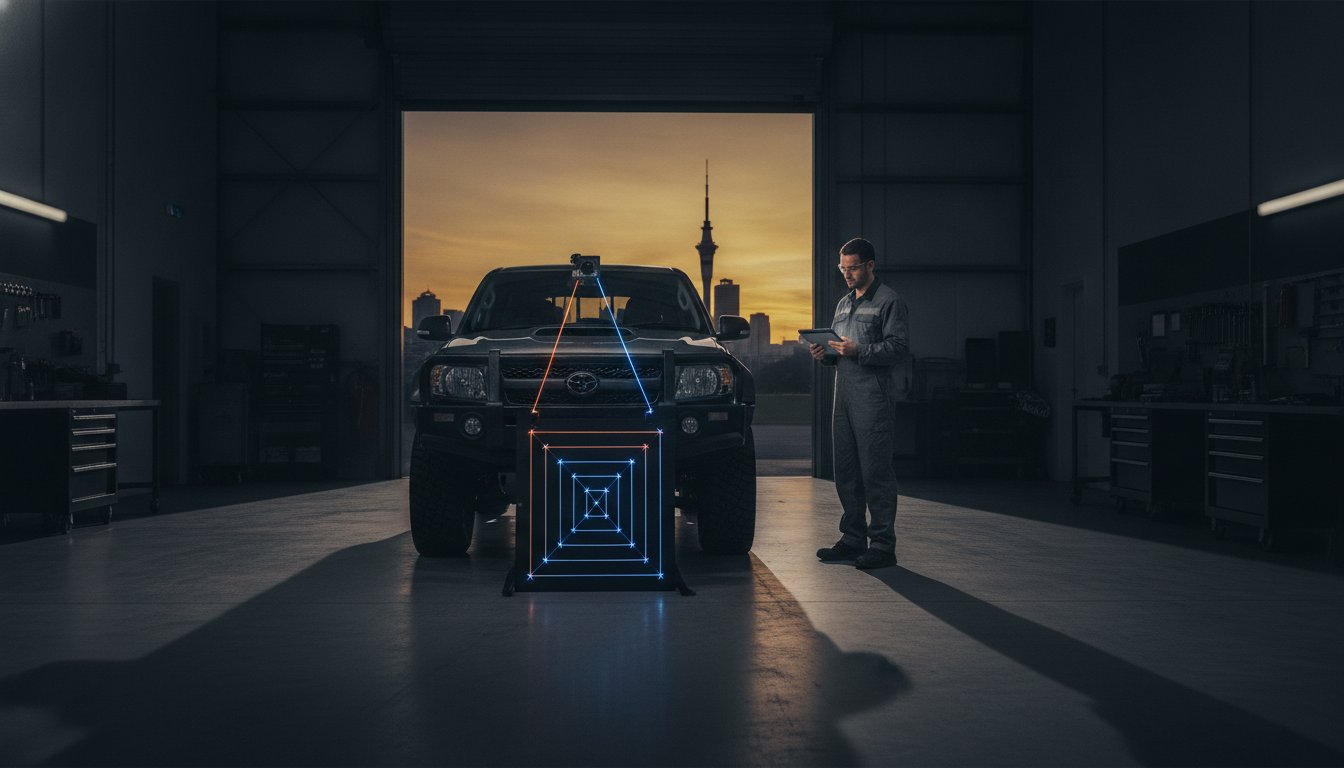
The technical process involves two distinct phases: static and dynamic calibration. Static calibration takes place in a controlled workshop environment using precision targets and laser levelling. Dynamic calibration involves a road test where the vehicle’s onboard computer "learns" to identify road markings and obstacles in real-time. For heavy-duty 4x4s, getting this right is complex. Official NZTA research on ADAS calibration highlights that changing a vehicle’s ride height or rake angle can significantly degrade the performance of safety systems. We use high-end diagnostic tools to bridge the gap between your rugged hardware and the manufacturer’s original safety logic.
Integration with Suspension and Wheel Alignments
Mechanical alignment is the foundation of electronic safety. If your thrust angle is out or your steering wheel isn’t perfectly centred, your ADAS sensors will be "looking" in the wrong direction before the calibration even begins. At Motortech 4×4, we integrate our 4×4 ADAS calibration Auckland services with professional wheel alignments and suspension tuning. This is especially critical after GVM upgrades. Heavy-duty springs alter the static rake of the vehicle, which changes the pitch of your radar. We ensure the vehicle is levelled and aligned mechanically before we touch the digital sensors.
Handling Aftermarket Accessories
Off-road accessories introduce physical obstructions that standard shops aren’t trained to manage. A winch-compatible bullbar often requires the factory radar unit to be relocated to a new mounting point. If this unit isn’t perfectly levelled and centred within the bar’s housing, the system’s ability to track vehicles during Adaptive Cruise Control will be compromised. We also consider the field of view for windscreen cameras, ensuring that snorkels, light bars, or large roof racks don’t create "blind spots" in the software’s peripheral vision. Our team understands how the physical build affects the digital performance.
Essential Checklist: When to Book Your ADAS Calibration in Auckland
Identifying the exact moment your vehicle requires a technical reset is vital for maintaining both safety and road legality. While many owners associate recalibration only with major accidents, the reality for 4×4 enthusiasts is that common performance upgrades are the most frequent triggers. Any modification that alters the physical orientation of a sensor or the vehicle’s static ride height necessitates a professional 4×4 ADAS calibration Auckland wide. Waiting until a warning light appears on your dash is often waiting too long, as many systems will continue to operate with incorrect data rather than shutting down entirely.
You should book a calibration service immediately following these events:
- Suspension Modifications: This includes the installation of lift kits, levelling kits, or heavy-duty springs for GVM upgrades.
- Front or Rear Bar Fitment: Any bullbar or rear bar installation that requires the removal, relocation, or replacement of factory radar units or ultrasonic sensors.
- Steering and Alignment Work: Major wheel alignments or steering rack adjustments that change the "straight ahead" position of the steering wheel.
- Windscreen Replacement: For vehicles with camera-based systems, a new windscreen can have slight glass distortions or mounting variances that require a camera reset.
- Tyre Size Changes: Significant increases in tyre diameter change the vehicle’s rolling radius and overall height, impacting the computer’s speed and distance calculations.
Signs Your System is Out of Whack
Your vehicle often provides subtle clues that its electronic "eyes" are misaligned. You might notice your Adaptive Cruise Control "hunting" for the lead car, where it struggles to maintain a consistent gap or reacts late to vehicles merging into your lane. Lane Departure Warning systems may trigger erroneously on straight sections of the Auckland motorway or fail to recognise lane markings altogether. Most dangerously, you may experience "phantom braking" events where the car abruptly slows down for non-existent obstacles. These are clear indicators that your sensors are providing conflicting data to the ECU.
Booking Your Service at Motortech 4×4
To ensure the highest level of precision, we require a few specific preparations before your appointment. Please arrive with a clean vehicle and a full tank of fuel. A full tank ensures the vehicle sits at its true static ride height, which is critical for accurate sensor levelling. A standard 4×4 ADAS calibration Auckland service typically takes between two to four hours, depending on whether static, dynamic, or dual calibration is required. Upon completion, we provide a comprehensive digital report. This document is essential for your insurance records and serves as proof of compliance for WOF inspectors and LVV certifiers. If you have recently modified your rig, book your 4×4 ADAS calibration with our technical team today to ensure your safety systems are operating at peak performance.
Motortech 4×4: Auckland’s Specialists in Technical Off-Road Performance
Auckland 4×4 owners often face the challenge of coordinating multiple workshops to complete a single build. One shop fits the suspension, another handles the bullbar, and a third might attempt the wheel alignment. Motortech 4×4 eliminates this fragmentation by providing a comprehensive, one-stop technical centre. We have invested heavily in the specialised equipment required for precision 4×4 ADAS calibration Auckland wide, ensuring that every modification is backed by a digital verification of your safety systems. This integrated approach means your vehicle doesn’t just look the part; it functions exactly as the manufacturer intended, even with significant structural changes. Our team bridges the gap between rugged off-road capability and high-end mechanical precision.
Our commitment to the local off-road community is built on a foundation of engineering excellence. We understand the specific demands of New Zealand roads, from the high-speed requirements of the Southern Motorway to the technical challenges of remote North Island tracks. We don’t just sell parts; we provide a total solution that ensures your rig is safe, compliant, and performing at its peak. By choosing a specialist who understands both the hardware and the software, you gain the peace of mind that your emergency braking and lane-keeping systems will work when they are needed most.
Comprehensive 4×4 Care
Our expertise extends beyond simple accessory fitting. We view the vehicle as a complete ecosystem where mechanical upgrades must work in harmony with electronic logic. For instance, after performing complex GVM upgrades or installing high-performance suspension kits, our technicians immediately move to the calibration phase. This seamless transition ensures that your vehicle’s pitch and rake are accounted for before it leaves the workshop. We also provide essential maintenance like transmission flushes and mechanical servicing to keep your rig reliable under heavy loads. Book your ADAS calibration with the Motortech 4×4 team today to experience a workshop that understands the intersection of rugged performance and technical precision.
Auckland’s Trusted Partner for Fleet and Trade
Commercial fleet managers carry a significant responsibility for driver safety and legal compliance. A tradie rig loaded with tools and fitted with a heavy-duty bullbar requires more than just a standard service. It needs to meet the latest 2026 WOF standards and maintain full insurance coverage. Our Auckland centre provides specialised solutions for commercial fleet fit-outs, ensuring that every vehicle in your fleet is safe, legal, and ready for work. We provide the documentation and technical reports required to prove that your 4×4 ADAS calibration Auckland has been completed to manufacturer specifications. This protects your business from liability and keeps your team safe on the road. Contact us at our Auckland centre to organise a consultation for your fleet or private vehicle.
Future-Proof Your Build with Technical Precision
Building a truly capable off-roader involves more than just bolting on heavy-duty hardware. Every millimetre of lift and every new sensor mounting point on a bullbar shifts the mathematical baseline of your safety systems. Maintaining the integrity of your Autonomous Emergency Braking and Adaptive Cruise Control is essential for both your safety and your vehicle’s legal compliance. By choosing a professional 4×4 ADAS calibration Auckland service, you ensure that your rig’s electronic "eyes" are perfectly aligned with its new physical geometry.
Motortech 4×4 provides the technical expertise required to bridge the gap between rugged modifications and precision engineering. As an Auckland specialised 4×4 workshop, we have invested in precision ADAS diagnostic equipment to support our work as certified GVM and suspension experts. This allows us to deliver a complete solution that keeps your vehicle road-legal and insurance-compliant. Don’t leave your safety to chance after a major upgrade.
Secure your 4×4 safety—book your ADAS calibration at Motortech 4×4 Auckland now. We look forward to helping you get the most out of your modified rig with total confidence.
Frequently Asked Questions
Do I really need ADAS calibration for a 2-inch lift?
Yes, any suspension lift changes the camera’s height and the radar’s pitch relative to the road. While a 50mm lift is the legal threshold for a standard WOF in New Zealand, the vehicle’s safety computer still operates on factory height data. This creates a mathematical mismatch that can delay emergency braking. A professional 4×4 ADAS calibration Auckland service resets these digital baselines to match your new ride height.
How much does ADAS calibration cost in Auckland?
The cost varies depending on your vehicle’s make and the complexity of its sensor suite. Some 4x4s require only a static workshop calibration, while others need a dynamic road test or a combination of both. Modified vehicles with bullbars often require more time to ensure relocated sensors are perfectly levelled. It’s best to request a specific quote that accounts for your unique suspension and bar setup.
Can any Auckland mechanic do 4×4 ADAS calibration?
No, this service requires specialised diagnostic software and precision targets that many general workshops don’t carry. 4x4s present a unique challenge because their increased height requires height-adjustable calibration stands. We’ve invested in specific 4×4 ADAS calibration Auckland equipment designed to handle lifted rigs and wide-track off-roaders that standard tyre shops or small garages cannot service accurately.
Will my bullbar interfere with my Adaptive Cruise Control?
A bullbar shouldn’t interfere if it’s a high-quality, winch-compatible unit, but it almost always requires relocating the factory radar sensor. If this sensor is mounted even slightly off-centre or at an incorrect angle in the new bar, your Adaptive Cruise Control will struggle to track vehicles ahead. Recalibration is mandatory after a bar fitment to ensure the relocated radar and windscreen camera are still in perfect harmony.
What happens if I don’t recalibrate my 4×4 after a lift?
Driving without recalibration can lead to "phantom braking" where the car abruptly stops for non-existent hazards like road signs or shadows. You may also find your Lane Keep Assist pulls the steering wheel toward the centre line or that your emergency alerts fail to trigger entirely. Beyond the safety risks, an uncalibrated vehicle can lead to declined insurance claims if a safety system failure contributes to an accident.
Is ADAS calibration required for a Warrant of Fitness (WOF)?
While ADAS isn’t a standalone WOF check, your vehicle must be road-legal and safe. WOF inspectors must verify LVV plates for modifications like suspension lifts. If your safety systems are throwing fault codes or malfunctioning due to a lack of calibration, the inspector can fail the vehicle. Proper calibration ensures your rig meets the technical requirements for modified vehicle certification in New Zealand.
How long does the calibration process take?
The entire process usually takes between two and four hours. This includes the initial diagnostic scan, the physical setup of laser-guided targets in our Auckland workshop, and the subsequent road-learning phase. We take the time to ensure every sensor is reporting correctly and provide you with a comprehensive digital report for your insurance and maintenance records.
Does a wheel alignment include ADAS calibration?
No, these are two separate procedures, though they are closely linked. A wheel alignment is a mechanical adjustment of your suspension and steering geometry, whereas ADAS calibration is an electronic reset of the vehicle’s safety software. You must always perform a professional wheel alignment first to ensure the vehicle is tracking straight before the 4×4 ADAS calibration Auckland process begins.