Is your current tray setup a liability waiting to happen, or is it a professional-grade storage solution? Most Auckland ute owners understand the frustration of balancing a secure, dust-proof canopy with the strict realities of GVM compliance and axle loads. You need a space that protects thousands of dollars in tools from the unpredictable New Zealand elements and opportunistic theft; however, you cannot afford to compromise your vehicle’s structural integrity or legal standing. It’s a complex calculation that goes beyond simple aesthetics.
We understand that choosing the right housing for your gear is a significant mechanical investment. This guide will help you master the technical differences between aluminium, fibreglass, and composite materials so you can select a setup that enhances your vehicle’s performance rather than hindering it. You’ll gain the clarity needed to navigate weight limits and structural requirements with confidence.
We are going to break down the latest 2026 industry standards for weatherproofing, weight distribution, and high-load accessory compatibility. From ensuring your rig remains water-tight on unsealed roads to integrating heavy-duty roof racks, this comparison provides the engineering-backed insights required to build a truly capable and compliant workhorse.
Key Takeaways
- Identify the structural and weight-bearing differences between aluminium, fibreglass, and ABS plastic to ensure your choice matches your payload requirements.
- Master the technical requirements for achieving a dust-proof and water-tight storage environment for your tools and camping gear.
- Compare lift-up, sliding, and solid window configurations to select a canopy that provides the best balance of ventilation and accessibility.
- Understand the intersection of accessory compatibility and GVM limits to maintain vehicle safety and legal standards on the road.
- Learn why precision alignment and professional sealing are essential to avoid the common leaks and structural fatigue associated with DIY installations.
Understanding the Role of a 4×4 Canopy: Beyond Simple Storage
A ute canopy is far more than a simple lid for your tray; it is a rigid, engineered shell designed to transform an open tub into a fully enclosed, protected environment. While an open tray offers versatility for oversized loads, it leaves expensive equipment vulnerable to theft and the elements. Transitioning to a secure enclosure allows for a highly organised mobile workspace or a weatherproof touring setup. This modification is a structural addition that must be integrated correctly to ensure long term reliability and vehicle balance.
For those frequently traversing New Zealand gravel roads, dust suppression is a critical technical requirement. Unlike basic covers, a high quality canopy utilises positive pressure vents to create a higher air pressure environment inside the shell. This engineering feature effectively pushes air out through the seals, preventing fine dust from being sucked into the storage area through the tailgate gaps. Without this system, even the best seals can fail during long stints on dry, unsealed tracks.
Understanding weight distribution requires a clear distinction between dynamic and static load ratings. A dynamic load rating refers to the maximum weight the roof can safely support while the vehicle is in motion, which is typically lower due to the forces of cornering and braking. Conversely, a static load rating applies when the vehicle is stationary, such as when supporting a rooftop tent and occupants. Selecting a unit with an appropriate rating is essential for maintaining your vehicle’s centre of gravity and ensuring the roof does not buckle under stress.
Security and Protection for Tradies and Travellers
Security is a primary driver for enclosure installations. Modern systems often feature integrated central locking that syncs directly with the vehicle’s factory key fob, providing a seamless “lock and walk” experience. For heavy duty applications, internal reinforcement frames are utilised to support external roof racks while adding an extra layer of structural security against forced entry. These frames ensure the shell remains rigid even when subjected to the high vibrations of corrugated outback tracks.
The Impact on Vehicle Aerodynamics and Fuel Efficiency
Adding a vertical structure to the rear of a dual-cab ute significantly alters its drag profile. A cab-high model sits flush with the vehicle’s roofline, minimising wind resistance and maintaining relatively stable fuel consumption. High-rise models offer increased internal volume for bulky gear, but the larger frontal area creates more drag. This trade-off between storage capacity and aerodynamic efficiency is a key consideration for long distance tourers who are conscious of their fuel range and engine load.
Comparing Canopy Materials: Aluminium, Fibreglass, and ABS Plastic
Selecting the right material for your enclosure is a decision that dictates the long term durability and utility of your vehicle. Each substrate offers distinct mechanical advantages depending on whether your priority is structural strength, aesthetic integration, or weight minimisation. A high performance canopy must withstand the rigours of corrugated tracks while maintaining its structural integrity under load. Understanding these material properties is the first step in building a reliable setup.
Heavy duty aluminium is widely regarded as the gold standard for professional and off-road applications. Its primary advantage lies in its exceptional strength to weight ratio and modularity. Because it is a metallic substrate, it allows for easy customisation; you can drill, bolt, or weld additional components like internal shelving and external recovery gear mounts with ease. While it presents a more rugged, utilitarian appearance, its ability to handle high vibration environments without fatigue makes it the preferred choice for serious tourers.
Fibreglass (FRP) and ABS plastic serve different market segments. Fibreglass is prized for its superior aesthetics, as it can be moulded into complex shapes and colour matched to your vehicle’s factory paint. It provides a seamless, SUV-like finish that many owners prefer for a polished look. ABS plastic is a modern, cost-effective alternative that is surprisingly impact resistant and lightweight. It is often the best choice for those who need a basic, weatherproof enclosure without the heavy duty price tag or weight penalty of metal alternatives.
Durability and Repairability Comparison
Mechanical failure in the field requires a solution that is easily addressed. Aluminium excels here; dents can often be hammered out, and structural cracks can be repaired by any competent welder. In contrast, fibreglass is prone to “spider-web” cracking when subjected to extreme chassis flex or heavy impacts. Repairing fibreglass requires specialised resin work and paint blending, which is rarely a quick or simple process. Longevity also varies across hinge and seal designs. Aluminium units typically utilise heavy duty stainless steel hinges, whereas plastic or fibreglass models may rely on integrated components that can become brittle over time when exposed to high UV levels.
Weight and Payload Considerations
Every kilogram added to your tray directly reduces your legal carrying capacity. A standard aluminium unit typically weighs between 60kg and 100kg, while ABS and fibreglass models usually fall within the 50kg to 80kg range. Steel options, though nearly indestructible, can exceed 150kg, which significantly impacts your remaining payload. Choosing a lightweight material is often the most efficient way to avoid a GVM breach, especially when you factor in the weight of tools, water, and fuel. If you are concerned about your vehicle’s total weight after a fit-out, we recommend a professional GVM assessment to ensure your rig remains compliant and safe on the road.
Key Features for Work and Play: A Side-by-Side Comparison
Once you have selected a material substrate, the focus shifts to the functional configuration of the enclosure. The specific features you choose will determine whether your canopy acts as a seamless extension of your workflow or a constant source of frustration. In 2026, the market has moved toward highly specialised configurations that allow owners to tailor their tray space for specific trade or touring requirements. Every latch, seal, and window must be evaluated based on its intended environment.
Window configurations represent the most significant ergonomic choice. Sliding windows are the preferred option for those requiring ventilation, particularly if pets are transported in the tray; however, they offer restricted access to gear stored at the front of the tub. Lift-up side doors provide a much larger aperture, allowing you to reach tools or camping equipment from the side of the vehicle without climbing into the tray. For maximum security, solid aluminium or composite panels eliminate visibility into the storage area, significantly reducing the risk of “smash and grab” theft in urban areas.
Roof rack compatibility is another technical hurdle. While some lightweight shells use simple track systems for basic crossbars, heavy duty applications require a canopy with an integrated internal support frame. This skeletal structure transfers the weight of a rooftop tent or timber rack directly to the vehicle’s tray bed, preventing the shell from cracking under dynamic stress. Effective pressurisation also remains a priority for Auckland’s unsealed backroads. High-flow intake vents ensure that the internal air pressure remains higher than the external pressure, which is the only proven method for keeping fine silt and dust out of your clean gear.
Access and Ergonomics
Aperture size is a critical factor that is often overlooked until a large item, such as a 2kVA generator or a 75L fridge, needs to be loaded. You should verify that the side door openings are wide enough to accommodate your largest pieces of equipment. Modern designs now feature one-handed slam-latches, which are essential for busy tradies carrying heavy toolboxes. Additionally, ensure the rear door provides sufficient clearance for your trailer or caravan hitch when fully opened, as some high-rise models can interfere with vertical accessories.
Power and Electrical Integration
Electrical integration is now a standard requirement for professional fit-outs. High-end enclosures come equipped with pre-wired looms for brake lights, internal LED strips, and central locking. This reduces the need for invasive drilling and complex wiring during installation. When planning your setup, look for dedicated mounting points for dual battery systems and solar controllers. Proper cable management is vital; ensure all wiring is tucked into internal channels or protected by conduit to prevent snagging when sliding heavy gear in and out of the tray.
Selection Framework: Matching a Canopy to Your Vehicle and Lifestyle
Choosing the right canopy requires a methodical assessment of your daily operational needs. A vehicle used as a mobile workshop on Auckland construction sites has vastly different requirements than a rig built for remote touring in the Southern Alps. Whether you drive a Toyota Hilux, Ford Ranger, Mitsubishi Triton, or Nissan Navara, the base vehicle’s mounting points and tub dimensions will dictate the initial selection. You must also account for the specific chassis flex characteristics of your model, as some modern dual-cabs require more sophisticated mounting systems to prevent stress fractures in the tub over time.
Roof load capacity is a critical technical variable that often determines the success of a build. If you intend to transport heavy ladders or long lengths of copper piping, you need a system with high dynamic load ratings and reinforced internal bracing. Conversely, if your goal is to mount a rooftop tent for weekend escapes, you must consider both the dynamic load for travel and the static load for when you are parked. Budgeting for this investment should prioritise long-term durability over initial savings. A cheaper unit that develops leaks or structural cracks under vibration will ultimately cost more in damaged gear and professional repairs.
The Tradie Setup: Focus on Security and Access
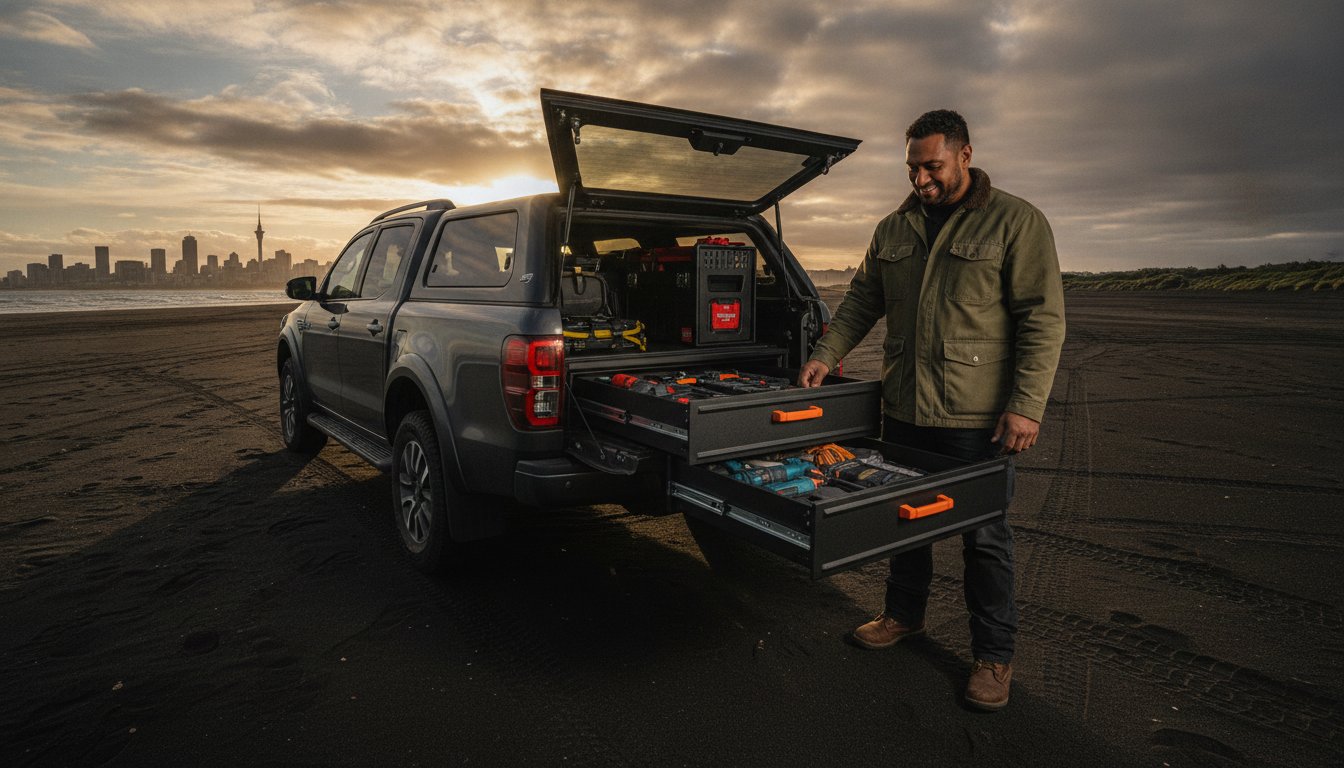
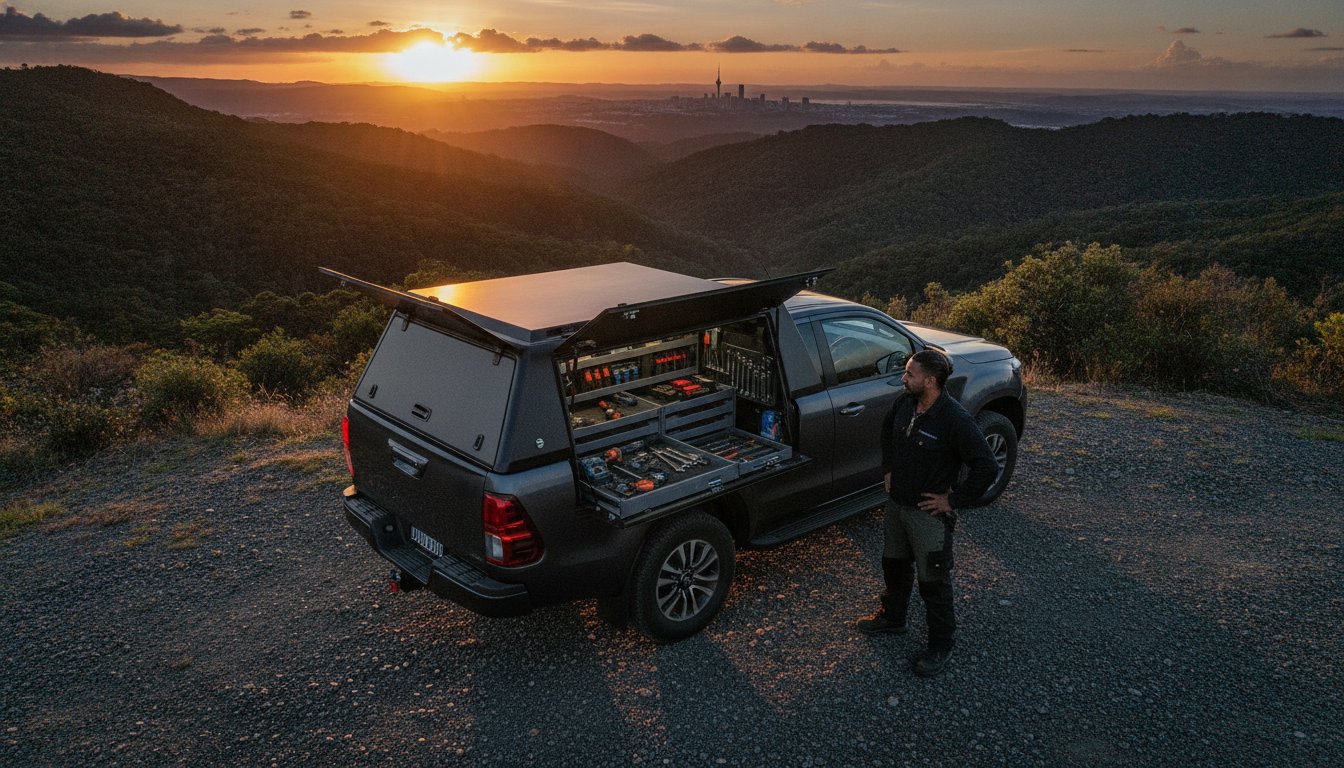
For trade professionals, security is the non-negotiable priority. Solid side panels are superior to glass windows because they keep expensive power tools out of sight and provide a more robust barrier against forced entry. A professional fit-out should integrate internal shelving and drawer systems that bolt directly to the vehicle’s chassis or the canopy’s internal frame. This ensures your equipment remains organised and secure even on rough terrain. If you need to maximise your carrying capacity, ensure your roof rack setup is compatible with conduit carriers and heavy-duty ladder rollers to streamline your workflow.
The Touring Setup: Focus on Comfort and Weight
Tourers must prioritise weight management to stay within legal payload limits while carrying water, fuel, and camping gear. Lightweight composite or aluminium materials are ideal for these applications. Ventilation is another key factor; if you are running a portable fridge in the tray, you need consistent airflow to prevent the compressor from overheating in the summer sun. A touring-focused canopy should also feature reinforced mounting points for 270-degree awnings and rooftop tents. To ensure your vehicle remains safe and legal with these additions, you can book a professional GVM upgrade consultation with our technical team to verify your total vehicle mass.
Professional Fitting and Fleet Solutions at Motortech 4X4 Auckland
While many owners are tempted by a DIY approach, a professional canopy installation requires technical precision that goes beyond basic bolting. Incorrect alignment often leads to chronic water leaks and structural fatigue in the vehicle’s tub. At Motortech 4X4 Auckland, our approach prioritises high-grade sealing and exact structural alignment to ensure the enclosure remains dust-proof and secure over thousands of kilometres. We understand the specific mounting requirements for the latest dual-cab models, ensuring that the installation does not compromise your vehicle’s factory warranty or structural integrity.
For commercial operators, our fleet fit-out services provide a standardised solution that ensures every vehicle in the company is equipped with consistent, reliable storage. Standardising your setup simplifies maintenance and protects your assets, which is critical for maintaining high resale values. We integrate these installations with our broader mechanical services, ensuring that every modification is legally compliant and fit for purpose. This “one-stop” mentality allows fleet managers to receive vehicles that are fully equipped and ready for the worksite from day one.
As established in previous sections, the weight of a fully loaded tray can quickly exceed factory limits. We specialise in integrating these enclosures with GVM upgrades to ensure your vehicle remains safe and legal on the road. This holistic approach prevents the common issue of a “saggy” rear end and compromised braking performance. By addressing the suspension and storage as a single package, we create a vehicle that handles predictably under full load, whether you are on a suburban street or a remote forest track.
The Importance of ADAS Calibration After Installation
Adding a heavy canopy and potentially modifying the suspension changes your vehicle’s rake and ride height. This shift can significantly displace the field of vision for Advanced Driver Assistance Systems (ADAS). Our Auckland facility provides specialised ADAS calibration to ensure that your lane-keep assist, adaptive cruise control, and autonomous emergency braking function exactly as the manufacturer intended. Neglecting this step after a major modification can render your safety systems unreliable, which is a serious risk for both private owners and commercial fleets.
Customising Your Build: Beyond the Shell
A truly capable rig requires a coordinated suite of modifications. We offer a comprehensive service that allows you to pair your new enclosure with bullbars, snorkels, and high-performance suspension kits. Our technicians handle everything from the initial supply to the final mechanical fitting, ensuring that all components work in harmony. This eliminates the hassle of coordinating multiple workshops and ensures a single point of accountability for your entire build. We focus on delivering a complete package that enhances protection, performance, and utility.
Enquire about a custom canopy fit-out for your ute today
Optimising Your Vehicle for Performance and Utility
Selecting the right canopy is a technical decision that impacts your vehicle’s safety, legal compliance, and operational efficiency. You now understand that material choice is the foundation of any build; whether you prioritise the rugged modularity of aluminium or the lightweight aesthetics of ABS plastic. Beyond the shell, the success of your setup depends on precise weight distribution and the integration of high-performance accessories that complement your lifestyle. Getting these technical details right ensures your rig remains a dependable asset for years to come.
At Motortech 4X4, we act as your professional guide through this complex process. As an Auckland specialised service centre and authorised installers for industry-leading 4×4 brands, we provide more than just retail products. Our team are expert GVM upgrade and ADAS calibration specialists, ensuring that every modification is safe, precise, and fully compliant with New Zealand standards. We take the guesswork out of complex fit-outs so you can focus on the job or the journey ahead.
Ready to transform your tray into a professional-grade storage solution? Explore our range of 4×4 canopies and professional fit-out services in Auckland and let our master technicians build the rig you need. Your ultimate 4×4 setup is within reach.
Frequently Asked Questions
Do I need to upgrade my suspension when fitting a canopy?
You should consider a suspension upgrade if the added weight of the shell and your gear causes the rear to sag or affects handling. Most factory leaf springs are tuned for an unladen tray, so adding a permanent 80kg to 120kg load requires heavier duty springs to maintain correct geometry and safety. This is especially important for maintaining ADAS sensor accuracy and braking performance under full load.
Is an aluminium canopy better than fibreglass for off-roading?
Aluminium is generally superior for off-roading because it resists the stress of chassis flex and high frequency vibrations better than composite materials. While fibreglass offers great aesthetics, it can develop structural cracks on corrugated tracks over time. Aluminium also allows you to bolt recovery gear directly to the shell, making it a more versatile choice for remote touring and heavy duty use.
Can I fit a roof-top tent to any ute canopy?
You cannot fit a roof-top tent to a standard shell unless it has an engineered internal support frame or a high static load rating. Many basic ABS or fibreglass models are only rated for 50kg dynamic loads, which is insufficient for the combined weight of a tent and occupants. Always verify the manufacturer’s load specifications to ensure the structure can support the weight while stationary and in motion.
How do I stop dust from getting inside my canopy on gravel roads?
Installing a positive pressure vent is the most effective way to prevent dust ingress on unsealed roads. This vent forces clean air into the enclosure, creating a high pressure zone that pushes air out through the tailgate gaps. Combining this with a high quality tailgate seal kit will significantly reduce the amount of silt and fine dust that enters your clean storage area.
Will fitting a canopy void my vehicle warranty?
Fitting a canopy will not void your entire vehicle warranty, but it may affect claims related specifically to the tray or rear suspension if the installation is found to be the cause of a fault. In New Zealand, standard installations are considered allowable modifications. It is always best to use a professional installer to ensure the fitment meets all manufacturer and legal requirements without compromising the vehicle’s integrity.
What is the difference between a canopy and a hardlid?
The primary difference lies in volume and vertical height. A canopy provides a full height enclosure that typically matches the vehicle’s roofline, allowing for upright fridge slides and large toolboxes. A hardlid is a flat, hinged cover that sits flush with the top of the tray. While a hardlid offers better fuel efficiency and a lower profile, it lacks the vertical storage capacity and side access of a full shell.
How much weight can I safely put on top of my canopy?
Safe roof loads are determined by the dynamic load rating, which typically ranges from 50kg to 150kg depending on the material and internal bracing. You must also account for the vehicle’s roof load limit specified by the manufacturer. Exceeding these limits can lead to structural failure of the shell or dangerous body roll during emergency manoeuvres, so it’s vital to check the ratings of both the shell and the vehicle.
Are canopies completely waterproof?
Most high quality units are designed to be highly weather resistant, but few are completely waterproof under all conditions. Water often enters through the gaps around the factory tailgate rather than the shell itself. Using automotive grade bulb seals and professional fitment helps, but you should always store moisture sensitive equipment in protective cases during heavy rain or when using high pressure washing equipment.