Is your 4WD truly a self-sufficient mobile basecamp, or is it just a ute loaded with loose boxes and a flat battery waiting to happen? Most tourers have felt the frustration of gear taking up every millimetre of space in the tray or finding the food has spoiled because a traditional chilli-bin couldn’t keep up. It’s a common struggle to balance the desire for adventure with the reality of complex tent setups and the constant worry about battery drain when running essential camping gear.
We’ll show you how to transform your vehicle into a streamlined, professional touring rig that meets the rigorous standards of 2026. You’ll learn how to integrate specialised solutions that provide reliable power for fridges and lights while ensuring your payload remains legal and safe. We will also cover the critical updates to self-containment regulations; including the June 2026 green warrant deadline and fixed toilet requirements, to ensure your setup is both comfortable and fully compliant for your next remote expedition.
Key Takeaways
- Learn why transitioning from traditional tramping to a vehicle-integrated basecamp offers superior insulation and protection from the elements.
- Discover how to replace your chilli-bin with a reliable 12V refrigeration system and a dual-battery setup to prevent vehicle stranding.
- Identify the essential camping gear and roof rack configurations required to organise bulky equipment and maintain a streamlined tray.
- Understand the technical requirements for GVM upgrades and professional bullbar installations to keep your rig road-legal and safe.
- Master the latest 2026 self-containment regulations, ensuring your vehicle meets the fixed toilet requirements for the new green warrant system.
The Evolution of Camping Gear: Why Your Vehicle is the Ultimate Basecamp
Traditional tramping requires a minimalist mindset where every gram counts and comfort is often sacrificed for mobility. Vehicle-based touring flips this equation. By utilising your 4WD as a mobile foundation, you can carry sophisticated camping gear that transforms a remote site into a fully functional basecamp. This shift from “roughing it” to self-sufficient touring is driven by the integration of mechanical and electrical systems directly into the vehicle’s architecture.
New Zealand’s volatile weather patterns demand more than just a nylon fly for protection. A professional 4WD rig provides a structural barrier against high winds and heavy rain that ground-based setups cannot match. When your shelter is physically bolted to a two-tonne vehicle, you gain a level of stability and insulation that ensures a recovery-focused sleep, regardless of the conditions outside. It’s about moving away from basic survival and toward a high-performance outdoor experience.
The Advantage of Integrated Systems
Mounting equipment directly to your vehicle drastically reduces the setup and pack-down workflow. Instead of unpacking loose crates from a tray, integrated solutions like canopies and roof racks allow for permanent, organised storage. Overlanding is a vehicle-supported journey where the vehicle itself serves as the primary resource for survival and comfort. These integrated systems protect your investment from road debris and UV exposure while ensuring that weight is distributed safely across the chassis.
Transitioning from Ground Tents to Vehicle Rigs
Traditional camping often involves wrestling with complex poles in the dark or dealing with damp gear on the ground. Vehicle-based camping gear solves these pain points by elevating the experience. For many Aucklanders, the appeal lies in the “ready-to-go” nature of a professional fit-out. You can finish work on a Friday and be at a remote coastal site within hours, knowing your gear is already secured and ready for deployment.
Durability is a non-negotiable factor in this transition. Equipment must withstand constant highway speeds and high-frequency off-road vibrations without failure. High-quality vehicle-integrated gear is engineered to meet these mechanical stresses, providing a level of reliability that standard retail equipment simply cannot provide. This professional approach ensures that your setup remains functional for years, rather than just a single season.
Shelter and Sleeping Systems: From Swags to Roof Top Tents
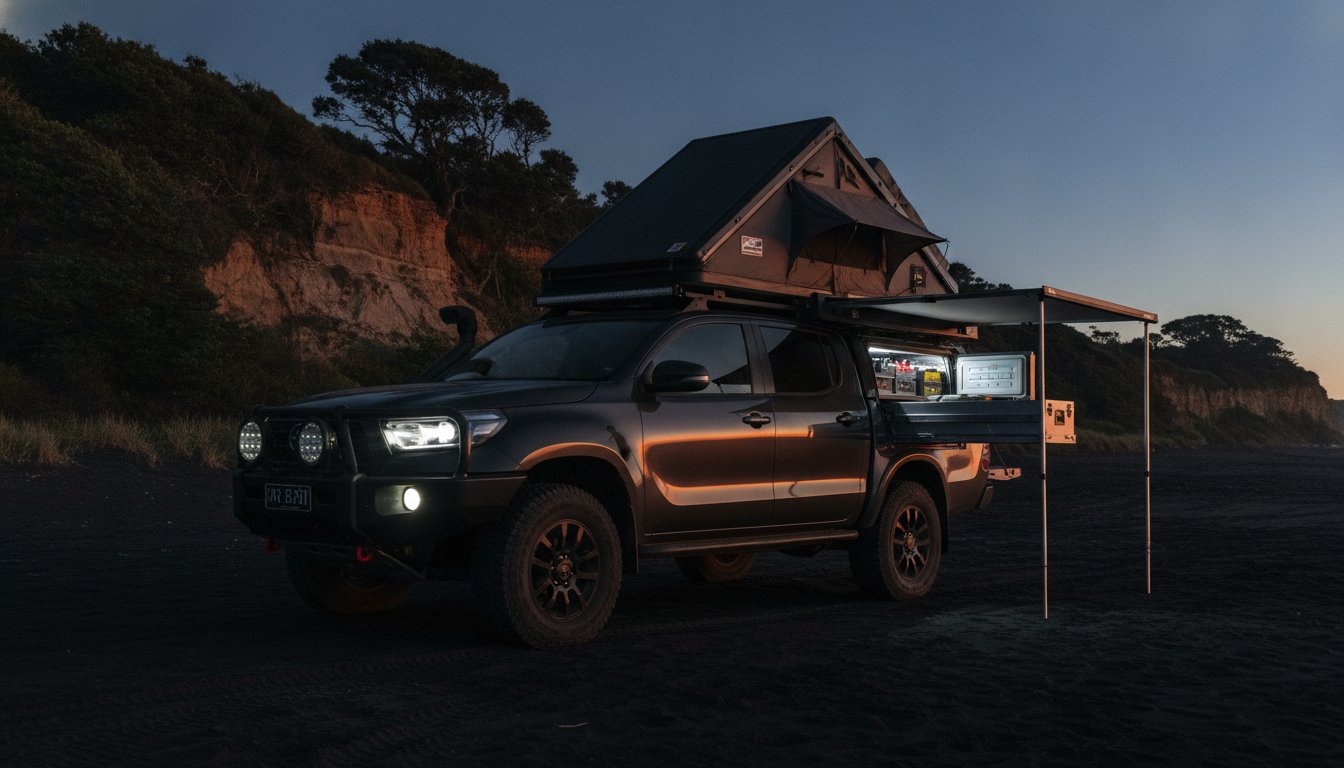
Selecting the right shelter is a critical decision in your touring build. While heavy-duty ground swags offer simplicity for solo missions, roof top tents (RTTs) have become the standard for long-term comfort. The primary advantage is elevation. By moving your sleeping quarters off the damp New Zealand ground, you eliminate issues with rising moisture and mud. This elevation also provides a natural thermal break, keeping you warmer than any ground-based camping gear could manage in alpine or coastal environments.
Weight management is a professional concern when mounting an RTT. Adding 60kg to 90kg to the highest point of your vehicle significantly alters its centre of gravity and handling characteristics. It is essential to ensure your roof rack system is rated for the dynamic load of the tent while in motion. Following established camping safety tips regarding weight distribution will prevent excessive body roll on off-road tracks. High-quality mattresses are another non-negotiable; look for high-density foam or hybrid air-foam designs that support your spine during multi-week expeditions.
Choosing the Right Roof Top Tent
Auckland’s humid coastal climate makes material choice vital. Hard-shell tents offer faster setup times but generally carry a higher price point. They provide superior aerodynamics and protection from salt spray when travelling. Soft-shell models often provide a larger footprint, which is better for families. Key features to prioritise include:
- Ripstop canvas with a high GSM rating for tear resistance.
- Internal storage pockets to keep electronics off the floor.
- Integrated 12V lighting to eliminate the need for handheld torches.
- Anti-condensation mats to prevent moisture build-up under the mattress.
Awnings and External Shelter
An awning is more than just a sunshade; it is a structural extension of your vehicle. A 270-degree awning creates a sheltered “living room” that protects your kitchen and entry points from the elements. Securing these units against high winds on exposed ridgelines requires heavy-duty pegging and tensioning systems. For a setup that handles the vibration of corrugated roads without rattling loose, consider a professional fit-out for your camping gear to ensure every bracket is torqued to mechanical specifications.
12V Power and Refrigeration: Ditching the Chilli-Bin
Relying on ice for multi-day expeditions is a logistical failure point. A dedicated 12V compressor fridge is the single most significant upgrade you can make to your vehicle-based camping gear. It eliminates the “soggy sandwich” syndrome and ensures meat remains at safe temperatures regardless of the ambient heat. Unlike a traditional chilli-bin, a car fridge provides consistent thermal management, allowing you to stay off-grid for weeks rather than days.
To support this, a dual-battery system is mandatory. Drawing power from your primary cranking battery is a recipe for a stranded vehicle. A secondary deep-cycle battery, managed by a high-quality DCDC charger, ensures your fridge runs 24/7 while your engine remains ready to start. In remote North Island locations where you might be stationary for days, portable solar blankets provide the necessary replenishment to maintain battery health. These systems work in tandem to create a closed-loop power environment that requires zero external input.
Choosing between a chest-style fridge and an upright model depends on your vehicle’s layout. Chest fridges are thermally efficient because cold air doesn’t “fall out” when opened, but they require a fridge-slide for access in a ute tray. Upright fridges are increasingly popular in canopy fit-outs, offering kitchen-like convenience and easier organisation. However, they generally have a higher power consumption and require more precise mounting to handle off-road vibrations.
Powering Your Adventures
The transition from AGM to Lithium (LiFePO4) batteries represents a massive leap in efficiency. Lithium batteries provide a deeper depth of discharge and a significantly lower weight profile, which is crucial for maintaining your vehicle’s payload. It is vital to calculate your total amp-hour draw against your battery capacity to avoid unexpected shutdowns. Professional wiring is non-negotiable; undersized cables lead to voltage drop, meaning your fridge might shut off even if the battery is full. Adhering to professional camping safety guidelines regarding electrical installations prevents the risk of fire or system failure in the bush.
Modern Camping Kitchens
Organisation is the foundation of a functional campsite. A heavy-duty fridge-slide allows you to access your cold storage without climbing into the tray or canopy. For those looking to move away from gas, 12V ovens and induction cooktops are the new standard for smoke-free, wind-resistant cooking. Lighting also requires a technical approach. High-output LED strips provide clear visibility for food prep, while using amber-toned camp lights ensures you don’t attract every moth and beetle in the region. This integrated approach to camping gear turns your vehicle into a high-performance kitchen that operates in any environment.
Intelligent Storage and Organisation: Making Every Millimetre Count
Efficient storage is the difference between a high-performance touring rig and a chaotic ute tray. Off-road travel subjects your camping gear to constant G-forces and vibrations that can quickly turn loose items into projectiles. Implementing a “place for everything” philosophy ensures that weight remains static, preventing damage to sensitive equipment and maintaining vehicle balance. A well-organised setup reduces the time spent searching for tools, allowing you to focus on the track ahead.
Roof racks serve as the structural foundation for bulky items that cannot fit within the cabin or tray. Platform-style racks are superior to traditional crossbars because they offer a larger surface area and more versatile mounting points for recovery boards, shovels, and spare tyres. When packing, always place the heaviest items as low as possible in the vehicle. Roof load limits must be strictly followed to ensure vehicle stability during cornering and to prevent excessive body roll on technical tracks.
Roof Rack Solutions for Heavy Loads
Selecting between platform racks and crossbars depends on your specific payload requirements. Platforms allow for the direct mounting of brackets for awnings and lighting, creating a sleek, integrated profile. For recovery gear, specialised brackets ensure your boards are accessible but secure. This professional approach to mounting prevents the rattling and wind noise common with DIY solutions.
Canopy and Tray Organisation
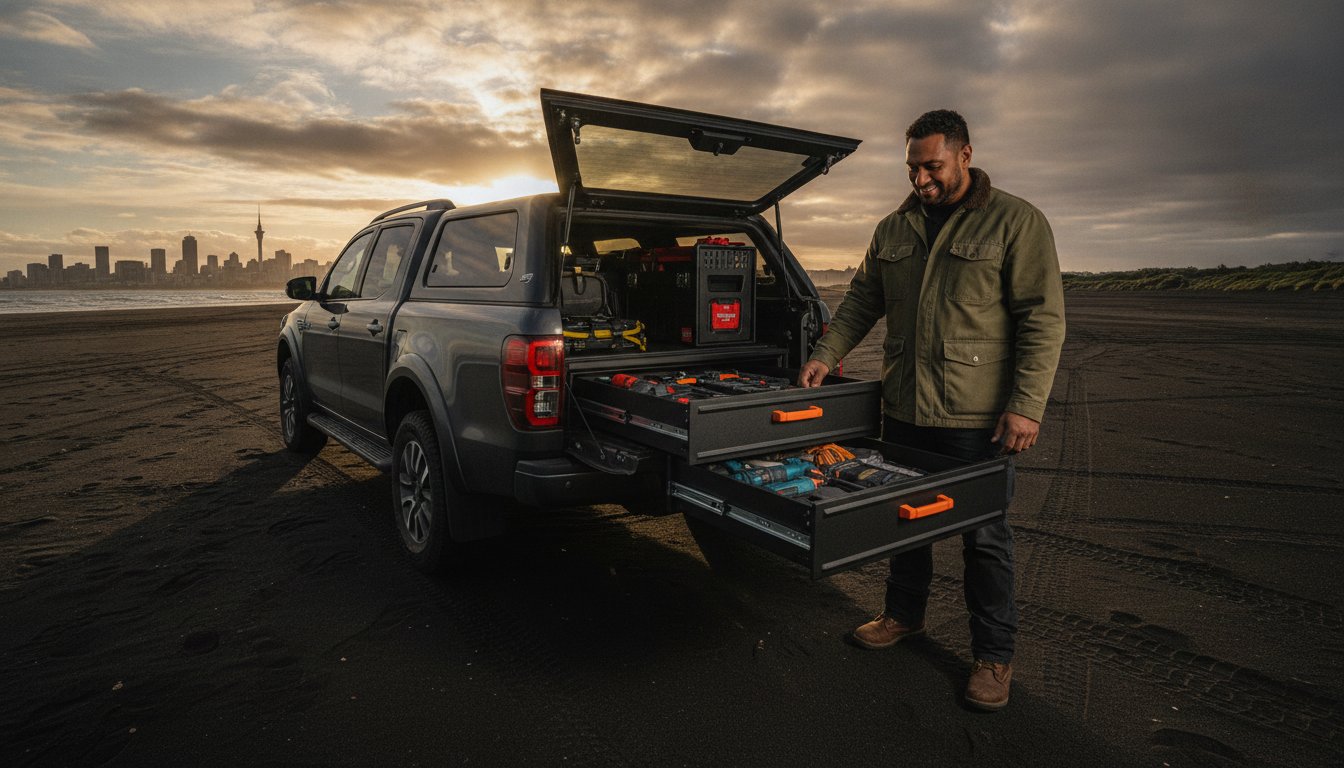
For many owners, a vehicle must serve as both a workhorse and a weekend escape. Professional canopy fit-outs allow for this dual-purpose utility by using modular drawer systems. Unlike loose crates, fixed drawers provide lockable security and high-load bearings that operate smoothly even when full of heavy camping gear. Utilising “dead space” is equally important; internal roof shelves and door organisers can house smaller items like first-aid kits or torches that would otherwise get lost in deep drawers.
Water storage is another critical factor in self-sufficiency. While portable jerry cans are a budget-friendly starting point, integrated chassis-mounted or canopy-integrated tanks are far superior. These systems keep the weight of the water low and central, which significantly improves handling compared to roof-mounted containers. If you are ready to optimise your vehicle’s layout, you can book a professional storage fit-out to ensure your rig is balanced and trail-ready.
Professional Fit-Outs and Safety: Getting Your Rig Ready in Auckland
The most common objection to building a fully equipped touring rig is the concern over weight. Once you install a canopy, dual-battery system, and a fridge, your vehicle quickly approaches its legal Gross Vehicle Mass (GVM). Exceeding this limit is not just a performance issue; it is a legal and insurance liability. A professional GVM upgrade is often required to ensure your vehicle can carry all your camping gear while remaining road-legal and safe. At our Auckland centre, we specialise in integrated solutions that balance high-performance capability with strict regulatory compliance.
Safety systems in modern 4WDs are highly calibrated. Fitting heavy accessories like bullbars and winches requires technical precision to maintain airbag compatibility and sensor accuracy. Any significant modification to your vehicle’s height or weight distribution necessitates professional ADAS calibration. This ensures that features like autonomous emergency braking and lane-keep assist continue to function correctly. Additionally, with the June 7, 2026 deadline for the new “green warrant” self-containment system now in effect, ensuring your vehicle meets fixed toilet requirements is essential for legal freedom camping.
The Impact of Gear on Suspension
Factory suspension systems are designed for unladen comfort, not the constant weight of a touring setup. When you add a permanent load such as a drawer system or a roof top tent, the original springs will inevitably sag. This leads to reduced ground clearance and poor handling. Choosing the correct spring rate for your constant load is vital for maintaining vehicle geometry. A correctly tuned suspension kit improves tyre contact with the ground, which directly translates to better off-road traction and shorter braking distances on bitumen.
Auckland Specialised 4×4 Services
Preparing for the rugged terrain of the Coromandel or Northland requires more than just a list of accessories. It requires a mechanically sound foundation. Significant structural modifications may trigger the need for Low Volume Vehicle (LVV) certification to pass a Warrant of Fitness. A comprehensive pre-trip inspection at our Auckland facility is the most effective way to identify potential failure points in your drivetrain or cooling system before you hit the tracks. Our team provides a one-stop solution, managing everything from basic servicing to complex electrical and mechanical fit-outs.
Organise your professional 4×4 fit-out with the Motortech team today to ensure your camping gear is supported by a rig that is safe, legal, and engineered for the long haul.
Building Your Self-Sufficient Mobile Basecamp
Transforming your vehicle into a professional touring rig requires more than just loading up the tray with boxes. It’s about the precision integration of 12V power systems, intelligent storage, and structural upgrades that ensure your setup remains safe and legal under 2026 regulations. By investing in specialised camping gear and prioritising a vehicle-integrated approach, you eliminate the common frustrations of food spoilage and complex campsite workflows. This allows you to focus on the terrain rather than the logistics of survival.
As an Auckland-based specialist service centre, Motortech 4X4 provides the technical expertise required for complex GVM upgrades and ADAS calibrations. Our authoritative knowledge of industry-leading 4WD brands ensures that every modification meets rigorous mechanical and safety standards. Whether you’re preparing for a coastal weekend or a remote trans-island expedition, our team is ready to engineer a solution tailored to your specific requirements. Explore our range of specialised 4×4 accessories and camping solutions to start your next adventure with total confidence. Your ultimate basecamp is just a professional fit-out away.
Frequently Asked Questions
Do I need a GVM upgrade if I install a roof top tent and drawers?
A GVM upgrade is highly recommended once you install a roof top tent and a heavy-duty drawer system. These components, combined with a fridge and other camping gear, often exceed the factory payload limit of modern utes and SUVs. Operating over your legal weight limit compromises braking performance and can void your insurance. A certified upgrade provides the structural reinforcement and legal documentation necessary to carry heavy loads safely.
How much solar power do I need to run a car fridge indefinitely?
You generally require between 160W and 200W of solar capacity to run a standard 50-litre car fridge indefinitely in New Zealand conditions. This capacity accounts for the average daily draw of 30 to 40 amp-hours while providing a buffer for overcast days. Pairing this with a high-efficiency MPPT controller ensures you maximise every hour of sunlight, keeping your secondary battery replenished without needing to start the engine.
Can I install a dual-battery system myself, or do I need a professional?
Professional installation is vital for modern vehicles equipped with smart alternators and complex electronic safety systems. DIY attempts often lead to significant voltage drop or interference with sensitive ADAS sensors. A professional technician ensures that wiring gauges are correctly matched to the current draw and that the DCDC charger is integrated seamlessly into the vehicle’s electrical architecture, preventing fire risks and battery failure.
What is the best roof rack for carrying heavy camping gear in NZ?
Platform racks are the superior choice for carrying heavy equipment due to their high static load ratings and modular mounting systems. Unlike traditional crossbars, a platform distributes weight more evenly across the vehicle’s structural roof channels. This design allows for the secure attachment of bulky camping gear while maintaining a lower profile to reduce wind resistance and noise during highway travel to remote coastal spots.
How does adding a bullbar and winch affect my vehicle’s handling?
Adding a bullbar and winch adds significant weight to the front axle, which typically results in front-end sag and increased braking distances. This extra 60kg to 100kg alters the vehicle’s centre of gravity and can cause excessive nose-dive during emergency stops. To counteract this effect, you must upgrade your front springs to a higher rate that is specifically valved to manage the additional constant load safely.
What are the essential recovery items I should carry alongside my camping gear?
You should always carry a high-quality snatch strap, rated bow shackles, recovery boards, and a long-handle shovel as your baseline recovery kit. These items are the foundation of safe vehicle recovery and should be stored in an accessible location, such as on a roof rack or in a dedicated drawer. Ensure all recovery points on your vehicle are rated and professionally fitted, as factory tie-down points are not designed for recovery stresses.
Is a 12V fridge better than a high-end chilli-bin for a 3-day trip?
A 12V compressor fridge is superior even for short trips because it maintains a precise temperature without the mess of melting ice. While a high-end chilli-bin can keep items cold for three days, it requires careful pre-chilling and takes up significant internal volume due to the ice required. A fridge allows you to utilise every litre of storage for actual food, ensuring better hygiene and less waste.
How do I ensure my vehicle remains legal after adding multiple accessories?
Remaining legal requires a combination of GVM compliance, ADAS calibration, and potentially LVV certification for significant structural modifications. Any accessory that significantly alters the vehicle’s weight, height, or safety systems must meet New Zealand transport standards. Regularly checking your axle weights at a weighbridge and using qualified professionals for all mechanical installations ensures your vehicle remains compliant with both the law and your insurance policy.