Is your high-output lighting setup actually making your night drives more dangerous? While a massive light bar might look the part on a weekend trip to Muriwai, poor wiring and non-compliant positioning often lead to electrical failures or a failed Warrant of Fitness. You’ve likely felt the frustration of squinting through the dust on a rural North Island backroad, wondering if your factory high beams are even functioning. It’s a common pain for Auckland off-roaders who need reliable visibility without the headache of flat batteries or legal trouble.
This guide simplifies the process of professional LED light bar installation Auckland wide, ensuring your rig is both a powerhouse of illumination and fully compliant with NZTA Technical Bulletin 14. You’ll discover how to choose the right gear for your bullbar, the technical requirements for main-beam versus work lamps, and why professional calibration is essential for vehicles with modern safety systems. From tidy wiring looms to meeting specific height restrictions, we provide the technical expertise needed to transform your vehicle’s performance after dark.
Key Takeaways
- Understand the specific NZTA Technical Bulletin 14 requirements to ensure your auxiliary lights remain legal and pass every Warrant of Fitness.
- Identify the functional differences between flood, spot, and combo beam patterns to tailor your visibility for Auckland’s unique coastal and forest terrain.
- Ensure long-term reliability with a professional LED light bar installation Auckland wide that protects your vehicle’s ECU and complex electrical architecture.
- Learn why high IP ratings and precision sealing are critical for maintaining performance in Auckland’s high humidity and heavy rainfall.
- Discover the technical advantages of an integrated fit-out where lighting, bullbars, and ADAS calibration are managed by a single specialist workshop.
Why High-Performance 4×4 Lighting is Essential for Auckland Drivers
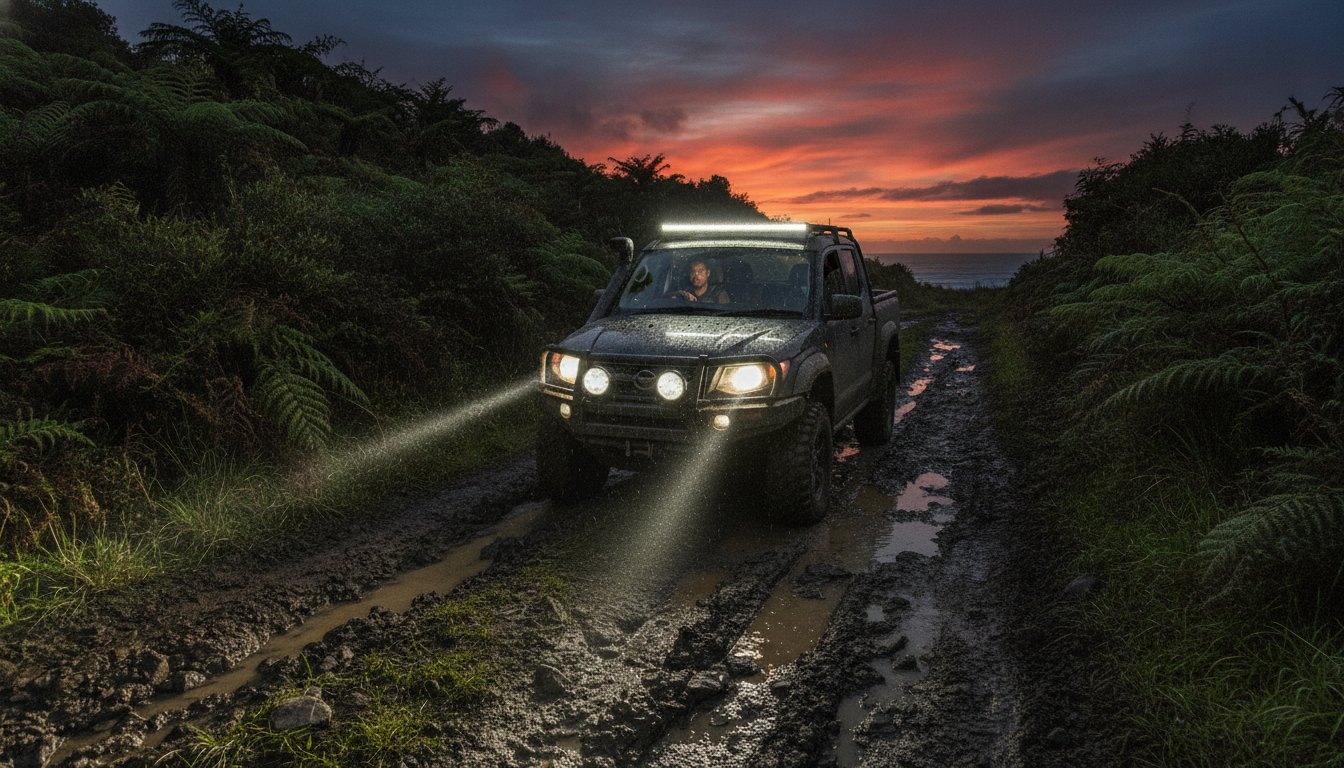
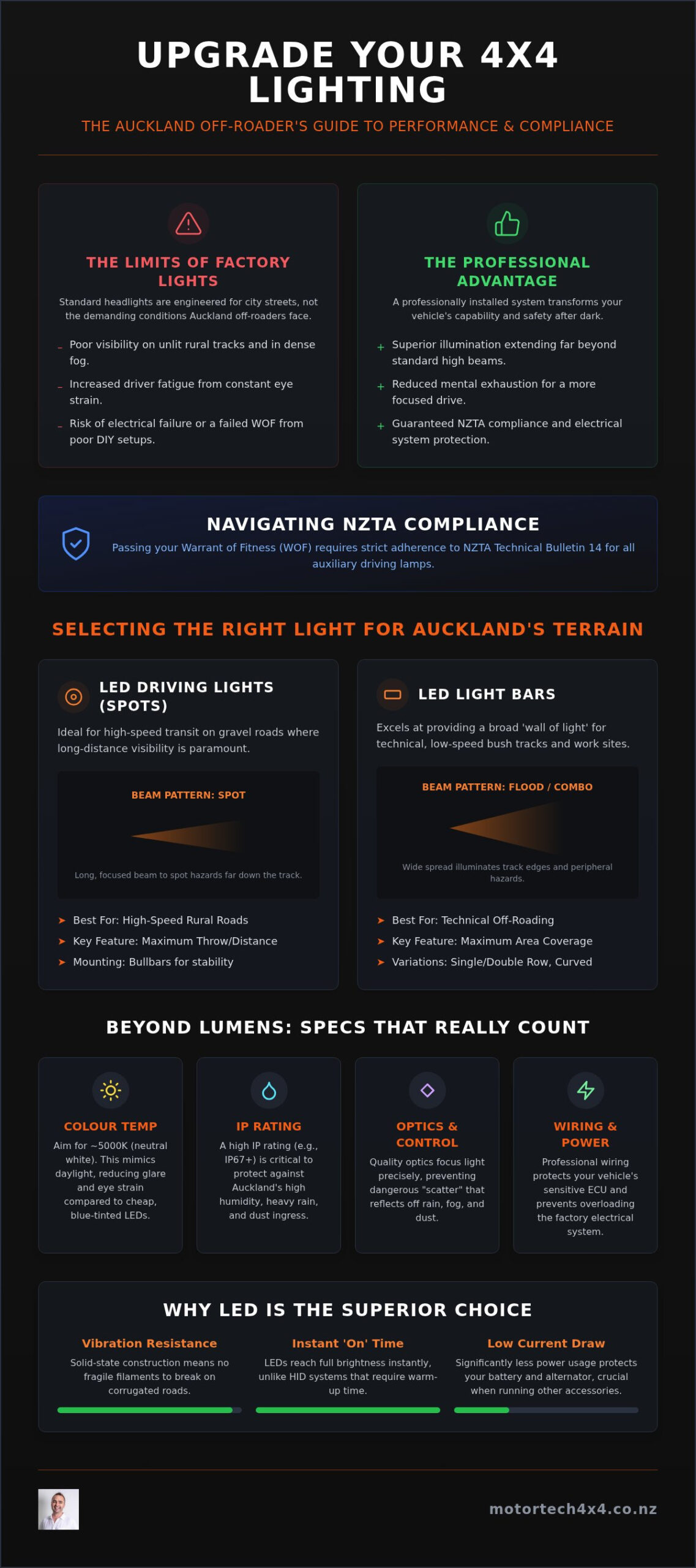
Standard factory headlights are engineered for urban environments and well-lit motorways. However, Auckland drivers frequently face conditions where these systems reach their limits. Whether you are navigating the dense, heavy fog of the Waitakere Ranges or tackling the unlit, corrugated tracks of Northland, factory beams often lack the throw and spread required for safe transit. High-performance auxiliary lighting fills these gaps by providing a controlled, high-intensity beam that extends far beyond the reach of standard halogen or basic LED clusters.
For tradies and fleet operators, the safety benefits are practical and immediate. Working late on unlit rural properties or securing equipment on a dark job site requires more than just a handheld torch. Choosing a professional LED light bar installation Auckland experts can deliver ensures your vehicle’s electrical system is not compromised by high-current draw. This level of fit-out ensures that your entire work area is illuminated, reducing the risk of trips or equipment damage. Additionally, premium lighting systems are a critical tool for reducing driver fatigue. When your eyes constantly strain to pick out the edge of a gravel road, mental exhaustion sets in quickly. A well-designed lighting setup broadens your field of vision, allowing for a more relaxed and focused driving experience during long hauls.
Visibility Beyond the City Lights
Focusing solely on raw lumen counts is a mistake for NZ conditions. High output is useless if the beam creates “scatter” that reflects off rain or dust. Quality optics focus light on the track, while adhering to automotive lighting standards ensures your setup complements factory systems. When booking an LED light bar installation Auckland wide, prioritise neutral colour temperatures (around 5000K). These mimic daylight, reducing glare and the eye strain common with cheap, blue-tinted LEDs found in budget retail outlets.
Protection for Your Investment
High-quality lighting acts as insurance for your rig. In rural Auckland, spotting hazards like stray livestock or washouts early prevents costly collisions. Professional-grade housings are built to survive the vibration of corrugated backroads and heavy debris. By integrating these lights with bullbars, you create a stable mounting platform that protects the units from frontal impacts. This integrated approach ensures your lighting remains a reliable asset on every expedition, providing the structural integrity required for serious off-road use.
LED technology has effectively superseded HID and Halogen systems for most New Zealand rigs. The reasons are technical: LEDs offer superior vibration resistance, an almost instantaneous ‘on’ time, and significantly lower current draw. This reduced power requirement is vital for modern vehicles with sensitive electronics. When planning an LED light bar installation Auckland off-roaders should first consider their vehicle’s total electrical load, especially if running other accessories like winches or fridges. Professional LED light bar installation Auckland wide also involves choosing the correct wattage to prevent overloading the factory harness. Mounting locations also dictate performance; bullbars are ideal for spotlights, while roof racks or stealth grille mounts are preferred for light bars to minimise bonnet glare.
LED Driving Lights (Spotlights)
Driving lights, or spotlights, are the preferred choice for high-speed gravel road transit where long-distance visibility is paramount. Their round profile is often chosen to complement the aesthetics of modern utes and SUVs. Beyond looks, high-quality driving lights feature robust mounting brackets designed to withstand the persistent vibration of corrugated tracks without losing their aim. If you are unsure which housing suits your bullbar, consulting a specialist workshop can help ensure a secure and stable fit.
LED Light Bars
Light bars excel at providing a broad ‘wall of light’ during technical, low-speed bush work. They are available in single-row or double-row configurations. Single-row bars offer a slimmer, more aerodynamic profile that reduces wind noise when roof-mounted. Double-row bars provide higher raw output for maximum flood coverage. For vehicles with curved front ends, curved light bars can follow the body lines while slightly increasing peripheral visibility on winding coastal roads. This broad spread is essential for spotting obstacles on the track edges that traditional spotlights might miss.
NZ Compliance and Professional Installation Standards
Adhering to New Zealand Transport Agency (NZTA) regulations is the most overlooked aspect of vehicle modification. Under Technical Bulletin 14, specific rules dictate how auxiliary lighting must be fitted to remain road-legal. A common mistake in DIY projects is mounting a single, large light bar and wiring it to the high-beam circuit. In New Zealand, any light bar functioning as a main-beam headlamp must be fitted as a pair. A single, centre-mounted unit cannot be classified as a headlamp and may result in an immediate Warrant of Fitness (WOF) failure unless it is strictly wired as an independent work lamp.
Professional LED light bar installation Auckland specialists ensure that your rig meets these precise standards. Beyond physical placement, modern vehicle electrical architectures use complex CAN-bus systems. Splicing into factory headlamp looms without a dedicated, fused wiring kit can trigger ECU errors or, in extreme cases, lead to electrical fires. We utilise professional-grade looms that isolate the auxiliary circuit, protecting your vehicle’s sensitive electronics while ensuring the high-output draw doesn’t compromise factory systems.
Staying WOF-Legal in Auckland
To pass a WOF, your auxiliary lights must be standards-compliant. This means lenses should carry a European “E” or American “DOT” marking if they are intended for on-road use. If your light bar lacks these markings, it must be classified as a work lamp. Work lamps are subject to different rules: they can be fitted singly but must be switched independently of all other lights and are intended for use only when the vehicle is stationary or moving slowly off-road. Ensuring your LED light bar installation Auckland fit-out respects these height and switching restrictions is the only way to avoid the frustration of a “fail” sticker at your next inspection.
The ADAS Factor: A Motortech Speciality
Modern 4x4s like the Ford Ranger or Toyota Hilux rely on Advanced Driver Assistance Systems (ADAS) to manage emergency braking and adaptive cruise control. These systems use radar sensors and cameras often located in the grille or behind the rearview mirror. Mounting a large light bar or set of driving lights without considering these sensor “fields of view” can disable critical safety features. At Motortech 4X4, we specialise in ADAS calibration. When we integrate lighting with bullbars, we perform a full system check to ensure your safety tech remains functional. Ignoring ADAS warnings after a modification isn’t just a nuisance; it’s a significant safety risk that can lead to unpredictable vehicle behaviour in an emergency.
Selecting the Best Lighting for Auckland’s Terrain
Auckland’s unique geography demands more than just raw power. Vehicles operating near the coast are subject to salt-spray, while those in the bush face relentless humidity. When selecting gear, Ingress Protection (IP) ratings are the primary technical metric to consider. An IP68 or IP69K rating ensures the unit is sealed against high-pressure water jets and prolonged submersion. Without these standards, moisture ingress will inevitably lead to internal corrosion and diode failure within the housing.
Beyond durability, the intended application dictates the beam configuration. Touring requires a balance of distance and spread, while hunting or technical off-roading prioritises immediate peripheral visibility. Managing the resulting power draw is equally critical. A high-output setup can quickly deplete a standard cranking battery. For extensive lighting arrays, we recommend integrating a dual-battery system to isolate auxiliary draw from the vehicle’s starting circuit. This ensures your LED light bar installation Auckland remains a reliable asset rather than a liability in remote locations.
Lighting for the Auckland Tradie
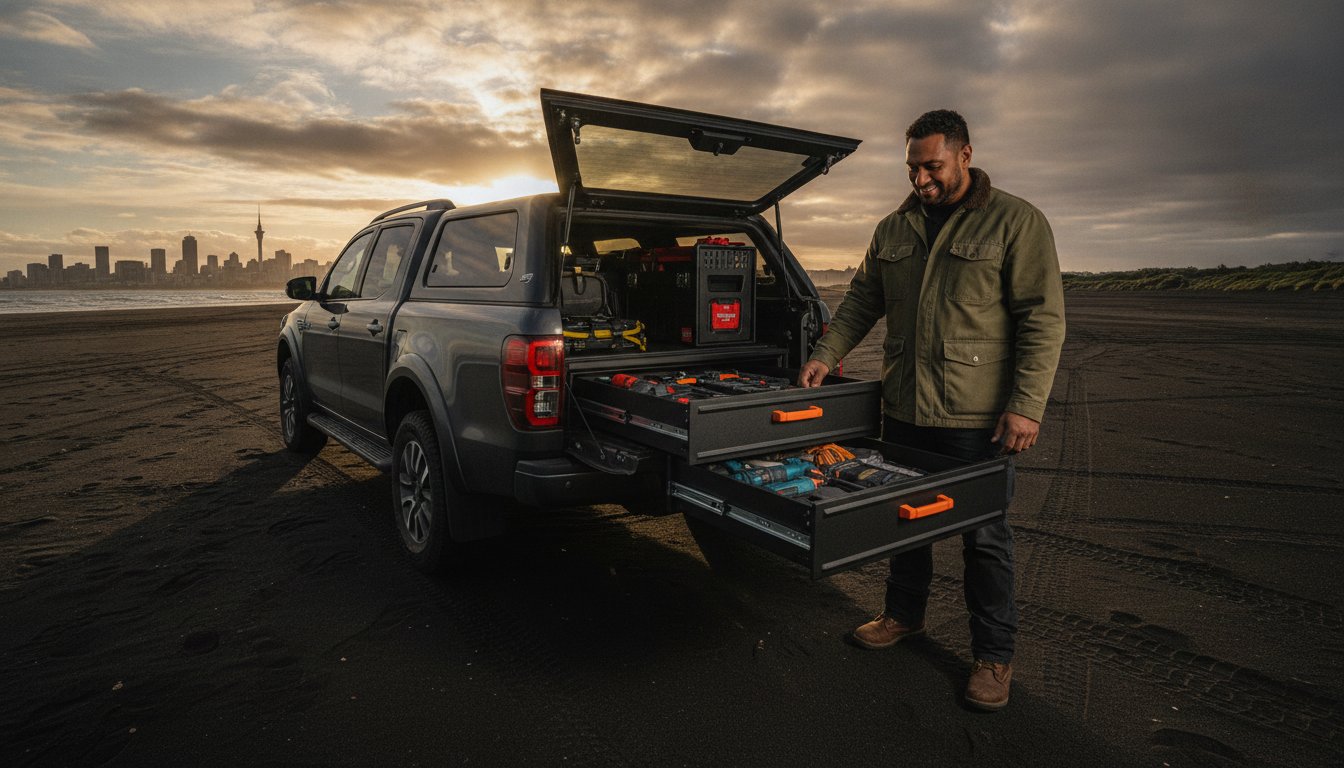
For commercial fleets and tradespeople, lighting is a productivity tool. Rear-facing work lights mounted to a canopy or headboard are essential for loading gear during early winter mornings or late site finishes. Side-mounted “ditch lights” are another practical addition, providing 45-degree illumination for navigating narrow, unlit rural driveways. These units must be built to withstand the daily grind of vibration and debris common on Auckland construction sites. Durable, professional-grade housings ensure your fleet stays operational without frequent bulb replacements or wiring failures.
The Weekend Warrior Setup
Recreational users often benefit from amber lighting options. Amber light has a longer wavelength that cuts through heavy rain and dust more effectively than white light, which tends to reflect off particles and cause “white-out.” For those heading into the Hunua Ranges or Northland tracks, this can significantly improve safety. Additionally, low-draw campsite LEDs allow for hours of illumination without risking a flat start-battery. If you need a custom setup tailored to your specific travel plans, contact our workshop for a professional consultation. We provide integrated solutions that combine high-performance output with the reliability required for multi-day expeditions.
Motortech 4X4: Auckland’s Experts in Lighting and Fit-Outs
Motortech 4X4 operates as a specialised mechanical workshop, providing a total solution for vehicle performance and protection. Our one-stop approach integrates the supply and fitment of high-quality accessories, ensuring that every component works in harmony with your vehicle’s factory systems. Whether you are managing a single rig or a commercial fleet, our Auckland-based technicians apply rigorous standards to every project. We move beyond basic retail sales to deliver professional engineering results, ensuring your vehicle is equipped for the most demanding New Zealand conditions.
As authorised installers for leading accessory brands, we provide access to industry-leading lighting technology and robust mounting solutions. Our workshop is equipped to handle complex electrical tasks that go far beyond simple bolt-on parts. For commercial operators, we offer custom fleet fit-outs designed to meet specific occupational health and safety requirements. This ensures that every vehicle in your fleet provides consistent performance and reliability, regardless of the terrain or the time of day.
Why Choose Professional Fitting?
DIY methods often underestimate the complexity of modern vehicle ECUs and sensitive electronic architectures. A professional LED light bar installation Auckland service ensures that all wiring is tidy, fused, and completely concealed within the vehicle’s trim. This meticulous attention to detail protects your vehicle’s resale value by avoiding the “spaghetti wiring” and exposed looms common in home installs. Additionally, we focus on the precise calibration and aiming of your auxiliary lights. Correct alignment is essential to maximise the effective throw of the beam while ensuring you don’t endanger other road users with excessive glare or unintended dazzle. Our workshop environment provides the specialised tools required for these adjustments, backed by expert support and comprehensive vehicle servicing.
Start Your Build with Motortech
Building a capable off-road vehicle requires a holistic view of the entire fit-out. We consult with clients to select the optimal lighting and bullbar combination, ensuring mounting points are secure and airflow to the radiator remains unobstructed. This integration extends to other performance modifications. We can synchronise your LED light bar installation Auckland project with the fitment of suspension kits or GVM upgrades, creating a balanced and compliant vehicle. This comprehensive service model means you only deal with one expert team for your entire build, from electronic systems to structural enhancements. Contact the Motortech 4X4 team to organise your lighting upgrade today.
Optimise Your Rig for Total Off-Road Visibility
Achieving superior off-road visibility requires more than just high-output hardware. It demands a technical approach that balances raw performance with NZTA compliance and vehicle safety systems. By prioritising professional LED light bar installation Auckland wide, you ensure that your auxiliary lighting is correctly integrated with your vehicle’s ECU and structural components. This level of precision ensures you don’t face electrical failures and guarantees your rig remains fully WOF-legal on New Zealand roads.
As Auckland’s specialists in ADAS calibration and expert fleet fit-out services, Motortech 4X4 provides the specialised knowledge required for complex mechanical modifications. Being authorised installers for leading accessory brands, we ensure every component is fitted to the highest workshop standards. Whether you are preparing a commercial fleet or a private tourer, our team ensures your lighting setup is durable, effective, and safe for the region’s diverse terrain.
Book your 4×4 lighting installation at Motortech 4X4 Auckland and experience the difference that professional engineering makes to your night driving. We look forward to helping you build a safer, more capable vehicle for your next adventure.
Frequently Asked Questions
Are LED light bars legal on NZ roads?
Yes, LED light bars are legal provided they comply with NZTA Technical Bulletin 14. To be used as main-beam headlamps, they must be fitted in pairs, be standards-compliant with “E” or “DOT” markings, and be able to be dipped from the driver’s seat. A single centre-mounted bar is generally classified as a work lamp. These must be switched independently and used only when the vehicle is stationary or moving slowly off-road.
Do I need a relay for my 4×4 driving lights?
A relay is essential for any high-performance lighting setup. It allows a low-current switch to control a high-current circuit directly from the battery, protecting your factory wiring and dashboard switches from overheating. During a professional LED light bar installation Auckland technicians use heavy-duty relays to ensure maximum voltage reaches the diodes. This prevents the dimming and potential electrical fires associated with overloading thin factory harnesses.
Can I mount lights on top of my bullbar?
You can mount lights on a bullbar, but they must not obstruct the driver’s view of the road or interfere with the vehicle’s primary lighting. NZTA regulations specify that auxiliary lights should not protrude in a way that creates a safety hazard for pedestrians. We typically recommend mounting units within the frame of the bullbar to provide physical protection for the housings and maintain a clear, legal line of sight.
How many driving lights can I have on my vehicle in NZ?
NZ regulations permit a maximum of two pairs of main-beam headlamps, which includes your factory high beams and any additional driving lights. If you install a light bar as a headlamp, it must be part of a pair. Any additional units beyond this four-light limit must be wired as work lamps. These require independent switching and are restricted to off-road or stationary use to remain compliant.
Will fitting a light bar affect my vehicle sensors or ADAS?
Mounting hardware can easily obstruct radar sensors or cameras used for Advanced Driver Assistance Systems (ADAS). This is a significant concern for modern utes like the Ford Ranger or Toyota Hilux. At Motortech 4X4, we provide specialised ADAS calibration to ensure your emergency braking and adaptive cruise control remain fully functional after your LED light bar installation Auckland fit-out is completed by our technical team.
What is the best colour temperature for off-road lighting?
A neutral white colour temperature between 5000K and 5700K is considered ideal for off-road use. This range mimics natural daylight, which reduces eye strain and helps you distinguish terrain details more accurately. You should avoid “cool white” LEDs above 6000K; the blue tint increases glare and reflects heavily off rain, dust, and fog, which significantly reduces your effective visibility in Auckland’s humid coastal conditions.
Is it difficult to wire 4×4 lights to the high beam?
Modern vehicles with CAN-bus electrical systems make DIY high-beam tapping quite complex. Simple splicing can trigger ECU fault codes or disable the lighting circuit entirely. Professional installers use vehicle-specific piggyback looms that safely pick up the high-beam signal without interfering with the vehicle’s computer. This ensures your auxiliary lights activate seamlessly with your factory stalks while maintaining the full integrity of your vehicle’s sensitive electronic architecture.