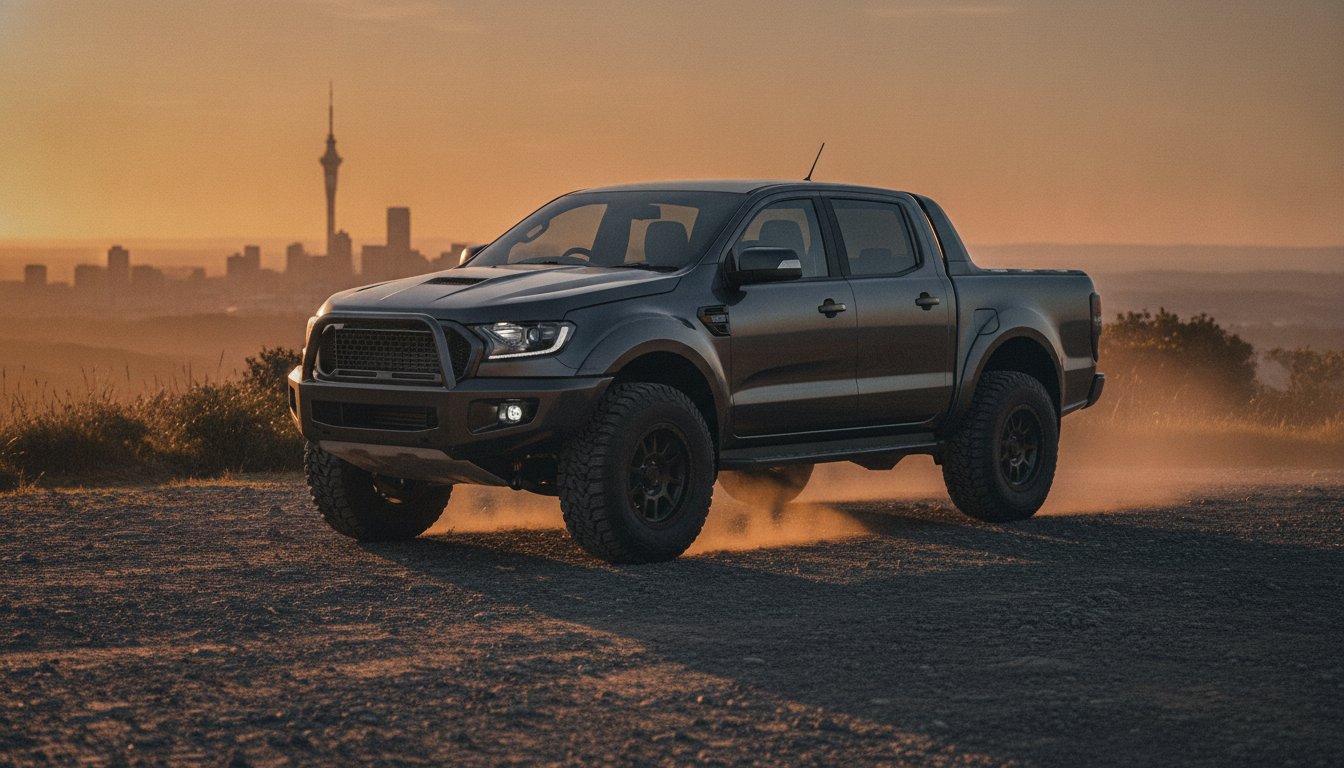
A 50mm lift might provide the ground clearance you crave, but without precise calibration, it could turn your vehicle’s safety systems against you on the Southern Motorway. Executing a professional Ford Ranger build Auckland isn’t just about bolting on the biggest bullbar or the tallest springs. It’s a technical engineering project that requires a delicate balance between off-road prowess and strict road legality.
You want a rig that can tackle rugged North Island tracks and still breeze through a WOF check on Monday morning. It’s common to feel concerned about WOF rejections or poor handling after fitting heavy accessories. This guide promises to help you plan a high-performance build that remains fully LVVTA compliant while enhancing capability. We’ll explore the essentials of GVM upgrades, why wheel alignments are mandatory after any suspension work, and how to manage ADAS recalibration. Because LVVTA and WOF rules are constantly changing, we’ll also outline the steps to ensure your custom rig stays on the right side of the law.
Key Takeaways
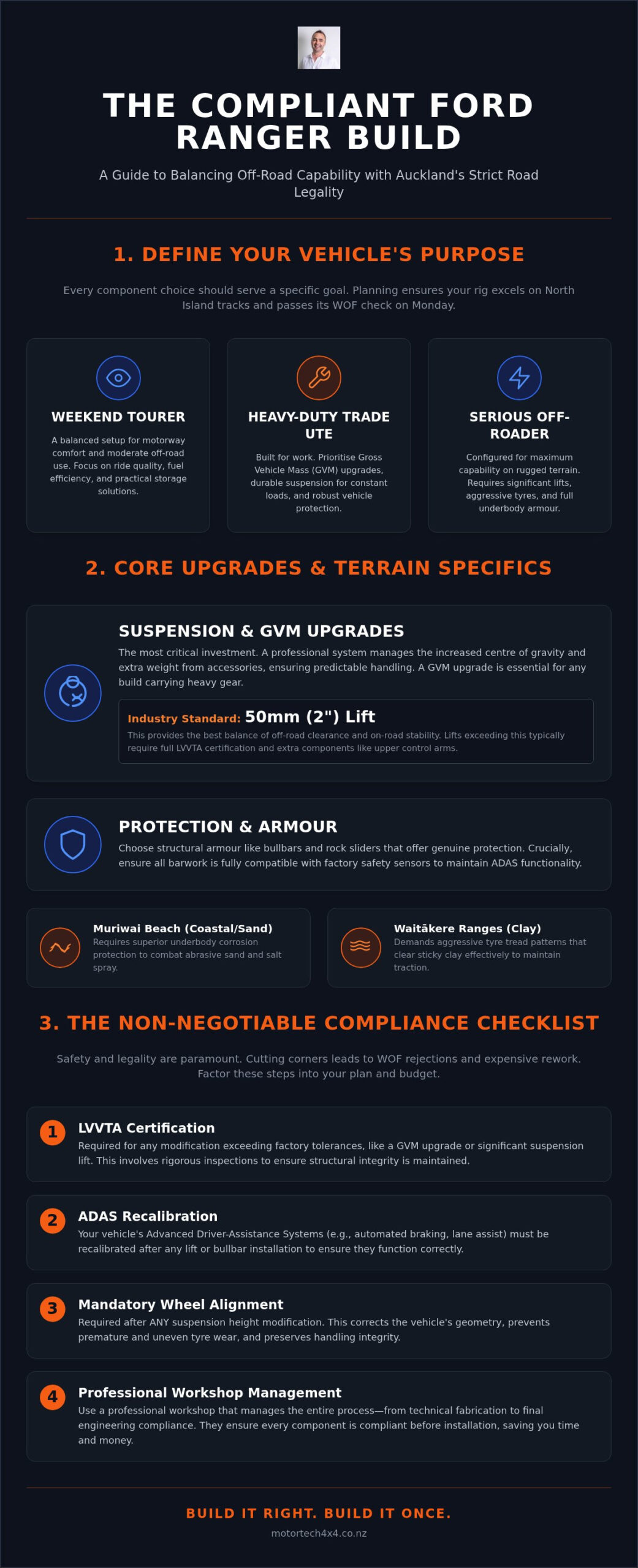
- Define your vehicle’s primary purpose to select gear specifically suited for Auckland’s unique terrain, including Muriwai sand and Waitakere clay.
- Master the requirements for a Ford Ranger build Auckland that balances heavy-duty GVM upgrades with the latest LVVTA and WOF regulations.
- Ensure your vehicle remains safe and road-legal by prioritising ADAS calibration and mandatory wheel alignments following any suspension modifications.
- Select protection upgrades like bullbars and rock sliders that offer genuine structural armour while maintaining full compatibility with factory safety sensors.
- Streamline the modification process by using a professional workshop that manages everything from technical fabrication to final engineering compliance.
Planning Your Ford Ranger Build: Capability Meets Auckland Compliance
Planning a high-performance build starts with a clear objective. Whether you’re configuring a daily driver, a weekend tourer, or a heavy-duty trade ute, every component must serve a specific purpose. The Ford Ranger (T6) platform is an exceptionally versatile base, but the upgrades you choose for a Ford Ranger build Auckland must account for both technical performance and strict regulatory standards. A professional approach ensures your vehicle handles the transition from the Southern Motorway to rugged off-road tracks without compromising safety.
Terrain-Specific Gear for the North Island
Auckland presents a unique set of environmental challenges that dictate your choice of accessories. Coastal driving at Muriwai or Woodhill requires superior underbody corrosion protection to combat salt spray and abrasive sand. Conversely, the sticky clay found in the Waitakere Ranges demands a tyre tread pattern that can clear itself effectively while maintaining traction. A generic setup often fails in these local conditions.
Your choice of barwork also needs a practical edge. While a high-clearance bullbar is excellent for the track, you must ensure the final height of your rig still fits within Auckland’s multi-storey carpark restrictions. A functional Ford Ranger build Auckland doesn’t just survive the bush; it remains practical for the city. This requires a calculated selection of suspension height and roof rack configurations to maintain daily usability.
The Compliance Mindset: WOF and LVVTA Realities
Safety and legality are non-negotiable. In New Zealand, LVVTA and WOF rules are constantly changing, which makes professional mechanical oversight essential. Any modification that exceeds factory tolerances, such as a significant suspension lift or a GVM upgrade, requires formal certification to remain road-legal. This process involves rigorous inspections to ensure the vehicle’s structural integrity isn’t compromised.
It’s vital to remember that purchasers are responsible for checking product compliance before installation. A professional workshop ensures that every accessory is legal before the first bolt is turned. Additionally, wheel alignments are required after suspension modifications to ensure the vehicle’s geometry remains correct. This prevents premature tyre wear and maintains the integrity of your handling and electronic stability systems.
Budgeting for your project should go beyond the sticker price of the parts. You need to factor in professional fitting, ADAS calibration, and the costs of LVVTA certification. Cutting corners on installation often leads to WOF rejections and expensive remedial work later. A well-planned budget prioritises high-quality suspension and safety integration over purely aesthetic additions, ensuring a reliable and durable result.
Suspension and GVM Upgrades: The Foundation of a Ranger Build
Suspension is the single most critical investment for your vehicle. It dictates ride quality, braking performance, and high speed stability. While many owners start a Ford Ranger build Auckland for aesthetic reasons, a professional overhaul focuses on functional engineering. A cosmetic lift might provide the height you want, but it often fails to account for the increased centre of gravity or the additional weight of accessories. A functional suspension system is designed to manage these forces, ensuring the vehicle remains predictable in emergency situations.
Legal standards are the baseline for every modification. Because LVVTA and WOF rules are constantly changing, your build must be planned with current regulations in mind. You can find detailed information on the requirements for Auckland Compliance through official government channels. It is vital to remember that purchasers are responsible for checking product compliance before installation. To maintain safety and prevent uneven tyre wear, professional wheel alignments are required after any height modification.
Choosing the Right Lift Kit for Your Ranger
Selecting the correct lift height involves more than just picking a number. A 2 inch lift is the industry standard for balancing off-road clearance with road manners. Going higher often triggers the need for a full LVVTA certificate and additional components like adjustable upper control arms to correct suspension geometry. Your choice of shock absorbers should reflect your driving split. If you spend most of your time on the Southern Motorway, you need valving that provides highway comfort without the “floaty” feel common in cheap kits.
Spring rates must be matched to your vehicle’s constant load. If your Ranger carries a permanent canopy, drawer system, or heavy trade tools, standard springs will sag. This compromises your departure angles and puts undue stress on other components. We recommend calculating your static weight before selecting springs to ensure the rear end sits level and performs as intended under load.
GVM Upgrades for Auckland Tradies and Tourers
Gross Vehicle Mass (GVM) is the maximum legal weight your vehicle can weigh when fully loaded. For many Auckland tradies and weekend tourers, it’s surprisingly easy to exceed the factory GVM once you add a bullbar, winch, tools, and a full tank of diesel. Exceeding this limit can void your insurance and lead to significant legal issues in the event of an accident. A GVM upgrade increases your legal payload capacity by reinforcing the suspension and providing the necessary engineering documentation.
The process of certifying a GVM upgrade at our Auckland workshop involves fitting heavy duty components and obtaining the relevant LT400 certification. This ensures your Ford Ranger build Auckland is not only capable but also fully compliant with New Zealand heavy vehicle standards. If you are unsure if your current setup is legal, seeking professional suspension fitting and advice is the best way to protect your investment and your safety.
Protection and Storage: Arming Your Ute for the Track
Every Ford Ranger build Auckland requires a strategic approach to armour. While high-quality suspension provides the necessary clearance, protection components safeguard the drivetrain and bodywork from terminal damage on technical tracks. Professional installation is mandatory to ensure these additions align with New Zealand’s vehicle modification standards. Because LVVTA and WOF rules are constantly changing, we recommend verifying that any barwork or external accessory is currently certified for road use before fitting.
Modern bullbars must be more than just steel hoops; they are complex mounting platforms for winches and lighting that must also house critical safety sensors. Airbag compatibility is non-negotiable for any road-legal build. If the bar doesn’t crush at the correct rate during an impact, the supplementary restraint system may fail to deploy. Additionally, the weight of a steel bar and winch places significant stress on the front axle, which reinforces why matching your spring rates to your constant load is essential for maintaining safety.
Side rails and rock sliders provide essential armour for the tight, technical tracks common in the North Island. Unlike factory side steps, true rock sliders are chassis-mounted and engineered to support the vehicle’s weight. Underbody protection plates shield the radiator, steering rack, and transmission from hidden obstacles in long grass or deep ruts. A snorkel completes the protection package by providing a high-level air intake, which is vital for engine longevity in dusty convoys or during deep water crossings.
Selecting the Right Bullbar for a Modern Ranger
Integrating a bullbar into a modern Ranger requires technical precision to maintain factory safety standards. You must ensure the bar is compatible with Advanced Driver-Assistance Systems (ADAS), such as autonomous emergency braking and adaptive cruise control. If the bar obscures these sensors, the vehicle’s safety features will malfunction. Winch mounting also requires a bar with a high structural rating to handle immense recovery stresses without twisting the chassis or compromising the mounting points.
Canopies and Hardlids: Organising Your Gear
Choosing between a canopy and a hardlid depends on your specific storage volume and security needs. A canopy offers maximum vertical space for trade tools or camping fridges, while a hardlid provides a lower profile and excellent security for expensive equipment in the city. With Auckland’s frequent rain, high-quality seals are vital to keep your tray dry. Remember that purchasers are responsible for checking product compliance and ensuring that any rear storage solution doesn’t cause the vehicle to exceed its legal GVM limits.
Tech Integration: ADAS Calibration and Performance Tuning
Modern vehicle technology has changed the way we approach a Ford Ranger build Auckland. While mechanical upgrades provide the physical capability, the electronic systems dictate how that capability is managed on the road. Integrating high-performance hardware with the Ranger’s sophisticated software is essential for maintaining both safety and efficiency. This phase of the build ensures that your modifications don’t compromise the vehicle’s intelligence.
ADAS Calibration: Why It Is Safety-Critical
Advanced Driver-Assistance Systems (ADAS) rely on cameras and radar sensors to monitor the road environment. Even a standard 2-inch lift alters the pitch and height of these sensors, which can cause lane-keep assist to drift or emergency braking to trigger unexpectedly. ADAS calibration is a safety-critical step after modification that ensures these systems accurately interpret their new position relative to the ground.
Our specialised Auckland centre utilises precision equipment to recalibrate these sensors to factory specifications. Because LVVTA and WOF rules are constantly changing, having a documented calibration report is increasingly important for compliance. We recommend this process immediately following your mandatory wheel alignment to ensure all safety systems are functioning as intended. You can book your ADAS calibration through our professional workshop to guarantee your rig remains safe for the Southern Motorway.
Performance Tuning for the NZ Road
Adding heavy accessories like bullbars and canopies increases the load on your engine and drivetrain. ECU remapping is an effective way to recover lost performance by unlocking torque and improving throttle response. This is particularly beneficial for Auckland owners who frequently tow heavy trailers or navigate steep North Island terrain. A professional remap optimises the air-fuel ratio and boost levels, providing a more linear power delivery without sacrificing reliability.
Supporting these power gains requires attention to the vehicle’s mechanical health. Regular transmission flushes are vital for protecting your gearbox during heavy towing, as they remove contaminants and maintain fluid integrity under high heat. While performance is key, we ensure all tuning remains compliant with New Zealand emission standards. This includes maintaining the efficiency of EGR and DPF systems, which prevents costly repairs and ensures your Ford Ranger build Auckland stays road-legal for the long term.
Finally, consider your communication and visibility needs. High-output LED lighting is essential for navigating rural Auckland roads at night, while a UHF radio installation provides reliable communication during group track days in remote areas where mobile signal is non-existent. These final tech integrations turn a capable ute into a truly professional rig.
The Build Journey: Why Motortech 4X4 is Auckland’s One-Stop-Shop
Executing a professional Ford Ranger build Auckland requires more than just a catalogue of parts; it demands a structured engineering approach. At Motortech 4X4, we bridge the gap between rugged off-road ambition and the technical realities of New Zealand’s road regulations. Our Auckland workshop is a comprehensive hub where fabrication meets electronic precision, ensuring your rig is built to perform and engineered to last. We manage the entire project lifecycle, allowing you to focus on the destination while we handle the technical complexity.
Our Five-Step Custom Build Process
- Initial consultation: We begin by matching your vehicle’s specifications to your lifestyle goals, whether that involves heavy towing, trade work, or remote touring.
- Component selection: Our experts help you choose industry-leading brands that fit your budget and performance requirements.
- Professional installation: Every part is fitted by qualified 4×4 mechanics in our specialised workshop.
- Calibration and alignment: We perform essential ADAS recalibration and mandatory wheel alignments to ensure safety and handling.
- Certification and handover: We manage the final engineering checks to ensure your vehicle is 100% road-legal.
This methodical process is essential because LVVTA and WOF rules are constantly changing. While purchasers are responsible for checking product compliance, our team provides the expert oversight needed to navigate these shifting requirements. We ensure that professional wheel alignments are performed after all suspension modifications to protect your tyre investment and maintain vehicle stability. By centralising these services, we eliminate the risk of conflicting modifications that often lead to WOF rejections.
The Motortech Difference: Specialised Expertise
The complexity of modern Rangers means that traditional mechanical work is no longer enough. Our centre integrates mechanics, fabricators, and ADAS technicians under one roof. This “one-stop-shop” model is particularly valuable for managing the paperwork involved in LVVTA certification. We handle the technical documentation and liaison with certifiers, taking the stress out of the legal process. Whether you are managing a commercial fleet or building a personal dream rig, our commitment to technical excellence ensures a result that is both capable and compliant.
Our support doesn’t end at handover. We provide specialised 4×4 servicing designed to meet the unique maintenance needs of modified vehicles, from transmission flushes to suspension re-tensioning. This ongoing care ensures your investment remains reliable on the most demanding North Island tracks. Start your custom Ford Ranger build in Auckland with Motortech 4X4 today to ensure your project is handled with professional precision from start to finish.
Engineering Your Ultimate Off-Road Journey
Building a high-performance rig is a complex engineering task that requires balancing rugged capability with technical precision. A successful Ford Ranger build Auckland relies on a foundation of compliant suspension and the correct integration of modern safety tech. By prioritising ADAS calibration and professional GVM upgrades, you ensure your vehicle remains both capable on North Island tracks and safe for daily use on the motorway. Because LVVTA and WOF rules are constantly changing, working with a specialist who understands the latest legal requirements is essential for long-term reliability.
As an Auckland-owned and operated workshop, Motortech 4X4 provides the specialised expertise needed to manage every stage of your project. Our on-site ADAS calibration specialists and LVVTA experts take the stress out of the certification process, delivering a finished vehicle that is 100% road-legal. We’re committed to helping you achieve a build that reflects your lifestyle without compromising on safety or engineering standards. Book your Ford Ranger in for a custom build consultation at Motortech 4X4 to start your transformation today. Your next adventure is just around the corner.
Frequently Asked Questions
Do I need an LVVTA certificate for a 2-inch lift kit on my Ranger?
In most cases, a 2-inch lift kit doesn’t require an LVVTA certificate provided it uses factory mounting points and remains within specific geometry limits. However, because LVVTA and WOF rules are constantly changing, you should verify your specific setup. If you combine a lift with tyres that exceed the 5% rolling circumference increase or other steering modifications, certification becomes mandatory. Always consult a professional to ensure your Ford Ranger build Auckland remains compliant.
How does a custom 4×4 build affect my Ford vehicle warranty in NZ?
Modifying your vehicle doesn’t automatically void your entire factory warranty in New Zealand. Under the Consumer Guarantees Act, the manufacturer is only entitled to refuse a claim if the aftermarket modification directly caused the failure. For example, fitting a lift kit won’t void your infotainment warranty, but it may affect claims related to CV joints. We recommend discussing your build with your dealer and using professional installers to minimise any risk to your coverage.
What is the most important first modification for a Ford Ranger build?
High-quality suspension is the most critical first step for any build. It provides the necessary foundation to support the weight of future accessories like bullbars, winches, or canopies. Without upgraded springs and shocks, your Ranger will suffer from poor handling, increased braking distances, and premature component wear. Starting with suspension ensures your vehicle’s geometry is correct from the outset, making every subsequent modification more effective and safer on rugged Auckland tracks.
How much does a full custom 4×4 build in Auckland typically cost?
The total investment for a Ford Ranger build Auckland varies significantly based on your performance goals and component selection. Total costs are influenced by the quality of the suspension kit, the complexity of the barwork, and whether you require specialised ADAS calibration or LVVTA certification. You must also factor in professional labour and engineering fees. A well-planned build prioritises safety and compliance over cheap parts to avoid expensive WOF rejections and remedial work later.
Can Motortech 4X4 help with GVM upgrades for my trade Ranger fleet?
Yes, we specialise in GVM upgrades specifically tailored for trade fleets and heavy-duty commercial users. Our Auckland workshop provides the necessary mechanical upgrades and manages the LT400 engineering documentation required for legal compliance. This process allows your fleet to carry heavier payloads, such as tools and site equipment, without compromising safety or voiding insurance policies. We ensure each vehicle is built to handle the rigours of professional use while remaining road-legal.
Why is ADAS calibration required after fitting a bullbar or lift kit?
ADAS calibration is necessary because lift kits and bullbars alter the height and pitch of the vehicle’s factory sensors. Systems like autonomous emergency braking and lane-keep assist rely on precise camera and radar angles to function correctly. If these aren’t recalibrated after a modification, the vehicle may misinterpret road data, leading to dangerous safety system malfunctions. Using our on-site calibration equipment ensures your Ranger’s electronic systems are accurately aligned with its new physical height.
How long does a typical full Ranger build take at your Auckland workshop?
The duration of a build depends entirely on the scope of the modifications. A straightforward suspension and tyre upgrade might be completed within one to two business days. Conversely, a comprehensive build involving barwork, GVM upgrades, and full LVVTA certification can take several weeks to finalise. We provide a clear timeline during the initial consultation, ensuring that fabrication, professional installation, and technical safety checks are all completed to the highest standard without rushing the process.
Are all the accessories sold at Motortech 4X4 road-legal in New Zealand?
We supply industry-leading accessories designed for New Zealand conditions, but it’s important to note that purchasers are responsible for checking product compliance. While the components themselves are high-quality, the way they are combined may trigger the need for low volume vehicle certification. We focus on providing road-legal solutions and professional fitting to ensure your vehicle meets current safety standards. We always advise checking the latest NZTA guidelines as modification rules are subject to change.