
Over 540,000 New Zealand vehicles fail their Warrant of Fitness every year due to tyre issues alone. With the infringement fee for non-compliant wheels and tyres rising to $350 on 1 November 2026, selecting the right 4×4 tyres Auckland wide is now a matter of both performance and significant financial compliance. You likely already know the frustration of excessive tyre drone on the motorway or the lack of grip on Auckland’s notoriously slippery wet bitumen. It’s a common struggle for owners who need a rig that looks the part but remains composed during the daily commute.
This guide provides the professional expertise required to choose a tyre setup that masters Auckland’s unique terrain while ensuring your vehicle stays fully legal. We’ll explore the latest “Rugged Terrain” hybrid trends that bridge the gap between mud and all-terrain performance. You will also learn why precision ADAS calibration and correct load ratings are non-negotiable for modern modified vehicles. From technical durability on rugged tracks to maintaining safety system integrity, we cover everything you need to keep your 4×4 performing at its peak.
Key Takeaways
- Learn how to balance motorway refinement with off-road durability by selecting a tyre profile that suits Auckland’s mix of high-speed bitumen and muddy weekend tracks.
- Ensure your rig remains legal and safe by matching tyre load ratings to your vehicle’s specific GVM requirements and modification level.
- Navigate the performance differences between All-Terrain and Mud-Terrain treads to find the optimal grip for New Zealand’s unique bush conditions.
- Discover why fitting 4×4 tyres Auckland requires specialised ADAS calibration to maintain the integrity of your vehicle’s electronic safety systems.
- Understand the critical role of professional alignment and specialist installation in extending tyre life and preventing common issues like motorway drone.
Understanding the Auckland 4×4 Tyre Landscape
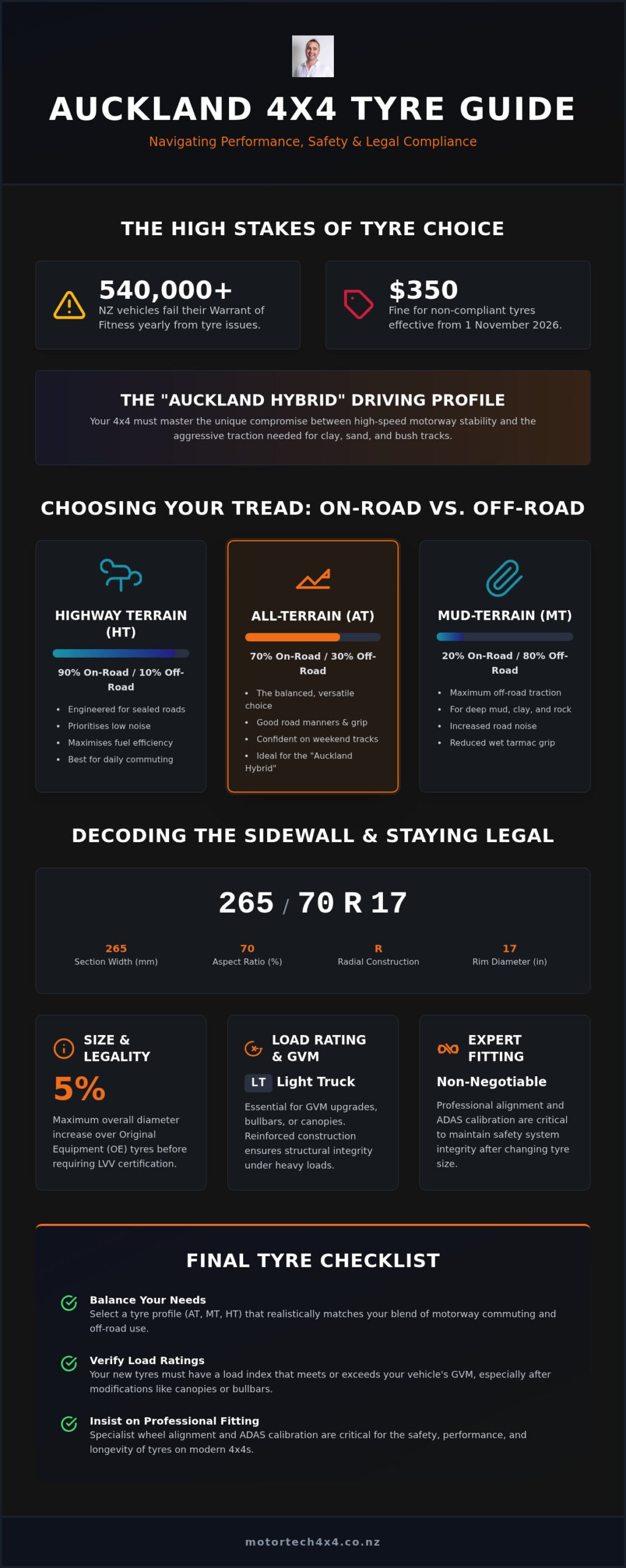
Auckland presents a unique set of variables for any 4×4 owner. The city’s geography forces a compromise that few other regions demand: the need for high-speed motorway stability on the Southern Motorway alongside the aggressive traction required for the clay-heavy tracks of Woodhill or the soft sands of Muriwai. This “Auckland Hybrid” driving profile means your choice of 4×4 tyres Auckland must be versatile enough to handle high-rainfall bitumen without sacrificing weekend utility.
Your tyre selection is the most critical safety decision you will make for your rig. It affects everything from braking distances on slippery urban streets to the electronic stability of your vehicle. Understanding Off-road tyre basics is the first step in categorising your needs:
- Highway Terrain (HT): Engineered for 90% on-road use, prioritising low noise and fuel efficiency.
- All-Terrain (AT): The balanced choice, typically offering a 70/30 split between road manners and off-road capability.
- Mud-Terrain (MT): Maximum traction for deep mud and rock, though often at the cost of increased road noise and reduced wet-weather grip on tarmac.
Auckland Terrain: From the Southern Motorway to Woodhill
Auckland’s high annual rainfall makes wet-weather performance a priority. On slippery bitumen, the role of siping, small slits in the tread blocks, becomes vital. These sipes clear water and provide additional biting edges, preventing aquaplaning during heavy downpours. A tyre that performs well in the dry may fail you on a rain-slicked motorway off-ramp if it lacks these technical features. Transitioning from city tarmac to regional forest tracks requires a tyre that doesn’t just look aggressive but possesses the structural integrity to handle varying pressures and sharp debris.
The True Cost of a ‘Budget’ 4×4 Tyre
While budget options appear attractive at the point of sale, they often represent a false economy. New Zealand’s road surfaces use a specific, abrasive chip that can rapidly degrade softer, low-quality rubber compounds. Poor quality tyres often lead to increased fuel consumption due to higher rolling resistance and significantly longer braking distances in emergencies. Choosing a tyre designed for local conditions ensures better tread life and maintains the safety standards required for your vehicle’s ADAS and braking systems. Investing in quality rubber is a fundamental part of responsible vehicle maintenance and long-term cost management.
Technical Specifications: Load Ratings, Sizes, and GVM
Decoding the alphanumeric sequence on a tyre sidewall is essential for any Auckland 4×4 owner. A common size like 265/70R17 tells a specific story: 265 is the section width in millimetres, 70 is the aspect ratio (height as a percentage of width), R indicates radial construction, and 17 is the rim diameter in inches. Selecting 4×4 tyres Auckland requires more than just picking a tread pattern that looks aggressive. It involves understanding how these dimensions affect your vehicle’s final drive ratio and speedometer accuracy.
Changing your tyre diameter has immediate mechanical consequences. Larger tyres increase your gearing, which can reduce effective torque at the wheels and make your speedometer read slower than your actual speed. In New Zealand, the law is clear. The overall diameter of a modified tyre cannot be more than 5% greater than the original equipment (OE) tyres without requiring a low-volume vehicle (LVV) certification. Failing to adhere to this can result in a failed Warrant of Fitness or a $350 infringement fee under the regulations effective from 1 November 2026.
Load and Speed Ratings for the Modern Ute
Modern dual-cab utes carry significant weight, especially when fitted with steel bullbars or canopies. You must match your tyre’s load index to your vehicle’s maximum payload to ensure structural integrity under stress. Light Truck (LT) designation indicates a tyre with reinforced internal construction, featuring extra plies in the sidewall and tread area to withstand higher pressures and resist punctures in off-road environments. When comparing all-terrain and mud-terrain tyres, the LT construction is often the deciding factor for those frequenting rugged regional tracks where sharp rocks are common.
Tyres and GVM Upgrades: Staying Legal
If you have invested in a Gross Vehicle Mass (GVM) upgrade to increase your carrying capacity, your tyres must be rated to handle the new limits. Standard factory tyres often lack the load index required for an upgraded GVM. The relationship between suspension and tyre load distribution is critical; a heavy-duty spring pack is useless if the rubber underneath cannot support the weight. Ensuring your tyre choice supports your vehicle’s upgraded capacity is a fundamental safety requirement. If you are planning a build, our specialists can help you select a compliant wheel and tyre package that meets all technical and legal standards.
All-Terrain vs. Mud-Terrain: Choosing Your Tread
Selecting the correct tread pattern for 4×4 tyres Auckland is a balancing act between daily refinement and weekend capability. For the majority of drivers, the All-Terrain (AT) category represents the “sweet spot,” engineered for a 70% road and 30% dirt split. These tyres provide the necessary grip for gravel access roads and light trails without compromising your vehicle’s behaviour on the Southern Motorway. However, for those who spend their weekends in the deep clay of the Waikato or the technical tracks of Woodhill, a more aggressive solution is often required.
A significant trend in 2026 is the rise of Rugged Terrain (RT) or hybrid tyres. These designs blend the aggressive shoulder blocks of a Mud-Terrain (MT) with the tighter centre tread of an All-Terrain. This configuration addresses the common complaint of excessive Noise, Vibration, and Harshness (NVH) on the motorway while providing enhanced durability on rugged tracks. It’s an ideal middle ground for Aucklanders who want the “tough” aesthetic and off-road security without the constant hum of a dedicated mud tyre during the Monday morning commute.
The All-Terrain Advantage for Daily Drivers
Modern AT compounds have evolved to offer impressive longevity, with many high-quality patterns delivering significant mileage before reaching the legal 1.5mm tread depth. In Auckland’s high-rainfall climate, the tighter tread blocks and extensive siping of an AT tyre provide superior water evacuation on sealed roads. This leads to more predictable handling and shorter braking distances on wet bitumen. Top-performing patterns currently favoured in New Zealand are designed specifically to resist “chipping” on our abrasive road surfaces, ensuring the tread remains intact even after frequent transitions from tarmac to gravel.
Mud-Terrain: For the Serious Off-Roader
When the terrain shifts to sticky NZ clay or sharp, rocky inclines, the Mud-Terrain tyre becomes essential. These tyres feature large, widely spaced tread blocks designed for “self-cleaning,” a process where centrifugal force ejects mud from the grooves to maintain constant traction. Features like reinforced “side-biters” provide additional grip when climbing out of deep ruts and offer extra protection against sidewall punctures. The trade-off is a measurable reduction in wet-braking performance on sealed roads. Because MT tyres have a smaller contact patch on flat bitumen, they require a more disciplined driving style in the city, particularly during the first rains after a dry spell when road oils surface.
The Motortech Difference: Fitting, Alignment, and ADAS
Fitting 4×4 tyres Auckland is often treated as a simple drive-in, drive-out service. However, modern vehicles are complex integrated systems where the rubber on the road directly communicates with the computer in the dash. A standard fitment that ignores these connections risks both mechanical wear and safety system failure. At Motortech 4X4, we treat tyres as a core component of your Auckland 4×4 modifications, ensuring every upgrade works in harmony with your vehicle’s factory engineering. This holistic approach prevents the common issues of premature tread wear and compromised handling that follow basic retail installations.
ADAS Calibration: Safety in the Digital Age
Modern 4x4s rely on Advanced Driver Assistance Systems (ADAS) like Lane Keep Assist and Adaptive Cruise Control. These systems use cameras and sensors calibrated to a specific vehicle height and tyre diameter. When you increase your tyre size, you physically shift the sensor’s field of view. From 1 November 2026, New Zealand Warrant of Fitness inspections will include checks for ADAS malfunction lights, making professional calibration a legal necessity. We perform on-site electronic safety calibration to ensure your sensors interpret the road accurately. Precision is vital; even a minor discrepancy can cause autonomous emergency braking or lane-departure warnings to trigger incorrectly.
4X4 Wheel Alignment: Beyond the Basics
Standard wheel alignments often fail to account for the geometry changes in lifted or modified vehicles. When you fit larger tyres, the steering axis and pivot points shift. Precision adjustment of caster and camber is essential to prevent “feathering” or uneven tread wear that can ruin a new set of tyres in months. Our comprehensive mechanical workshop uses specialised equipment to ensure your tracking is true and your steering wheel is perfectly centred. We understand the specific requirements of heavy-duty suspension systems and how they interact with aggressive tread patterns.
Tyre pressure also plays a vital role in this system. While lower pressures are necessary for traction on soft Auckland sand, maintaining correct on-road pressures is critical for heat management and structural stability. A professional alignment at Motortech 4X4 considers your typical load and usage patterns, protecting your investment from premature degradation. To ensure your rig is both safe and high-performing, book a specialist tyre consultation and ADAS check today.
Selecting Your 4×4 Tyres at Motortech 4X4
Selecting the right 4×4 tyres Auckland requires a technical perspective that goes beyond a simple retail price list. At Motortech 4X4, we conduct an expert-led selection process that focuses on your vehicle’s specific application. We don’t just look at the tyre size; we analyse your typical payload, the frequency of your off-road excursions, and your tolerance for road noise. This methodical approach ensures you don’t end up with a tyre that performs well in the mud but makes your daily motorway commute unbearable.
Our workshop is staffed by 4×4 specialists who understand the intricate relationship between tyre choice and vehicle dynamics. Unlike general tyre shops, we have the mechanical expertise to handle vehicles with significant modifications, including GVM upgrades and custom suspension. This is particularly valuable for commercial operators requiring fleet fit-outs. We ensure every vehicle in your fleet meets the rigorous safety and compliance standards required in 2026, protecting your business from the increased $350 infringement fees for non-compliant equipment.
Premium Brands and Expert Fitting
We offer access to industry-leading brands such as Maxxis, which have proven their durability on New Zealand’s abrasive road surfaces and slick clay tracks. Our specialists provide expert advice on matching wheels and tyres to achieve the perfect stance while maintaining legal clearance and guard integrity. Every installation includes high-precision balancing. This is a critical step to eliminate high-speed steering wobble, a common issue for larger 4×4 setups that generalist fitters often overlook during a standard installation.
Your Auckland 4×4 Tyre Partner
Our facility is strategically located to serve the wider Auckland region, providing a comprehensive ‘one-stop’ service for enthusiasts and professional drivers alike. Efficiency is key to our operation. You can easily combine your tyre replacement with professional 4×4 servicing to ensure your rig is mechanically sound from the engine bay to the tread. This integrated service model saves you time and provides the peace of mind that comes from having a master technician oversee every aspect of your vehicle’s performance. Book your consultation today to find the perfect tyre solution for your rig’s specific requirements.
Mastering Your Rig’s Performance and Compliance
Selecting the right 4×4 tyres Auckland involves balancing technical compliance with the rugged demands of New Zealand tracks. You now understand that a tyre is more than just a tread pattern; it’s a critical safety component that dictates your vehicle’s braking distance, legal load capacity, and the accuracy of its ADAS sensors. From the 1 November 2026 regulatory updates to the geometry of a precision wheel alignment, staying informed is the only way to protect your investment. A rig that’s technically sound performs better on the tarmac and lasts longer in the bush.
Motortech 4X4 stands as Auckland’s 4×4 modification specialists, providing on-site ADAS calibration technology and deep expertise in GVM and legal compliance. We ensure your vehicle isn’t just capable of tackling the technical tracks at Woodhill, but is also fully legal and refined for the Southern Motorway. To ensure your setup meets every standard, Get a Professional 4×4 Tyre Consultation at Motortech 4X4. We’ll help you find the perfect balance of performance and protection for your specific build. Your next adventure starts with the right foundation.
Frequently Asked Questions
Will fitting larger 4×4 tyres void my vehicle warranty?
Fitting 4×4 tyres Auckland won’t automatically void your entire vehicle warranty. However, a manufacturer may decline a specific claim if they can prove the larger tyres caused a failure in the drivetrain or suspension. It’s vital to choose a setup that stays within legal limits and is professionally fitted. We recommend consulting with our specialists to ensure your modifications don’t compromise your coverage while maintaining peak performance and safety.
How much noise should I expect from Mud-Terrain tyres on the motorway?
Mud-Terrain tyres produce a noticeable rhythmic drone or hum on the motorway due to their large, open tread blocks. As speed increases, this noise can become a significant distraction inside the cabin. For drivers who spend most of their time on Auckland motorways, a Rugged Terrain hybrid is often a better choice. These provide the aggressive look of a mud tyre with significantly reduced noise, vibration, and harshness for daily driving.
Do I really need to calibrate my ADAS sensors after getting new tyres?
Yes, you must calibrate your ADAS sensors whenever you change your vehicle’s ride height or tyre diameter. From 1 November 2026, New Zealand WoF inspections will check for ADAS malfunction lights, making this a compliance issue as well as a safety one. Larger tyres shift the camera’s field of view, which can cause Adaptive Cruise Control to malfunction. Motortech 4X4 provides specialised on-site calibration to ensure these systems function correctly.
What is the best tyre pressure for driving on Auckland’s west coast beaches?
For soft sand on Auckland west coast beaches like Muriwai, dropping your pressure to between 15 and 18 psi is generally recommended. This increases the tyre’s footprint, allowing your vehicle to float over the sand rather than digging in. Remember to reinflate your tyres immediately once you return to the bitumen. Driving at high speeds on the road with low pressures causes extreme heat build-up and can lead to catastrophic sidewall failure.
How many kilometres should a set of quality All-Terrain tyres last?
A set of quality All-Terrain tyres should typically last between 50,000 and 80,000 kilometres. However, Auckland’s abrasive road chip and hilly terrain can accelerate wear if you don’t maintain regular rotations and alignments. To maximise the life of your 4×4 tyres Auckland, we suggest rotating them every 10,000 kilometres. Maintaining correct pressures for your specific load is also essential to prevent uneven tread wear and ensure you get the best value from your investment.
Can I fit 33-inch tyres to my standard Hilux or Ranger without a lift kit?
Fitting 33-inch tyres to a standard Hilux or Ranger without a lift kit is not recommended as it will lead to significant rubbing on the chassis or guards. While some owners attempt minor trimming, the correct approach involves a suspension lift to provide the necessary clearance for full articulation. We specialise in integrating wheels and tyres with high-performance suspension systems to ensure your rig remains functional and safe both on and off the road.
What is the difference between a passenger (P) and Light Truck (LT) tyre rating?
Passenger (P) rated tyres are designed for comfort and fuel efficiency on sealed roads, whereas Light Truck (LT) tyres feature reinforced internal construction. LT tyres use extra plies in the sidewall and tread to handle higher payloads and resist punctures on sharp gravel tracks. If your vehicle has undergone a GVM upgrade or carries heavy tools daily, LT tyres are a technical necessity. They provide the structural integrity required for heavy-duty applications across New Zealand.
Why is my 4×4 pulling to one side after fitting new tyres?
If your 4×4 pulls to one side after fitting new tyres, it’s usually due to a wheel alignment issue or a variation in tyre construction. Even a minor discrepancy in caster or camber can be amplified by a more aggressive tread pattern. Our comprehensive mechanical workshop uses precision alignment equipment to correct these issues. We ensure your steering wheel is centred and your vehicle tracks true, preventing premature wear and maintaining a stable driving experience on the motorway.