That heavy-duty platform you’ve been eyeing might actually be the least efficient way to carry your gear if you haven’t accounted for your vehicle’s dynamic load limit. While a large deck looks the part, the roof rack vs roof platform decision is a technical calculation of weight distribution and GVM compliance rather than just aesthetics. We know the stress of trying to fit recovery boards and awnings onto a setup that whistles on the motorway or, more importantly, pushes your Ford Ranger or Hilux over its legal roof capacity during a weekend away.
This guide clarifies the critical mechanical differences between standard crossbars and full platforms so you can make an informed investment. You will learn how to maximise your storage volume without compromising the structural integrity of your rig or its fuel efficiency during the Auckland work week. We provide a professional breakdown of mounting versatility, safety standards, and how to ensure your storage solution remains compatible with future accessories like rooftop tents while keeping your vehicle’s centre of gravity in check.
Key Takeaways
- Understand the structural and functional differences in the roof rack vs roof platform debate to determine which system best supports your specific gear footprint.
- Learn how to accurately calculate your net payload by accounting for dynamic load limits and the physical weight of the storage hardware itself.
- Identify the ideal configuration for your lifestyle, whether you require a streamlined setup for trade tools or a modular tray for heavy recovery gear.
- Reduce wind noise and fuel consumption by selecting a low-profile system that balances aerodynamic performance with maximum storage capacity.
- Recognise why professional installation is vital to maintain watertight seals and preserve your vehicle’s structural integrity against the elements.
Crossbars vs Platforms: Defining the Two Main Roof Storage Systems
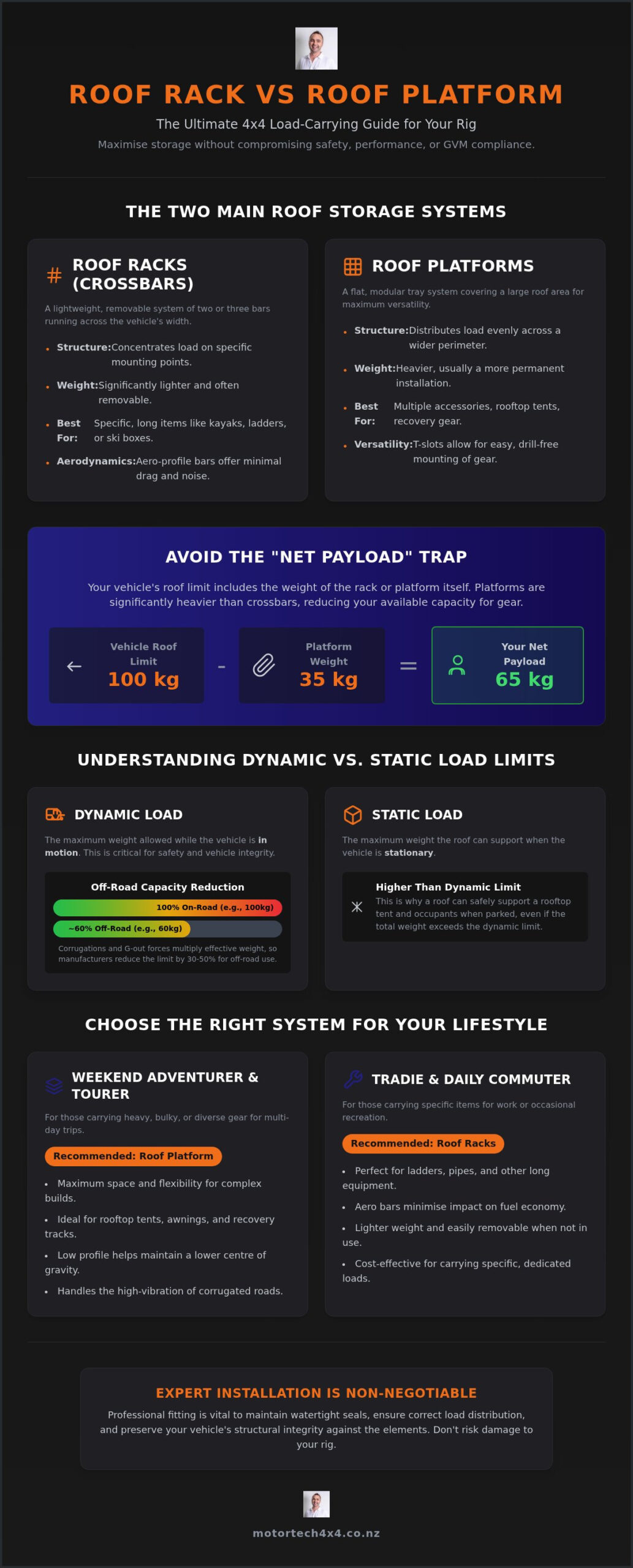
Selecting the correct hardware for your 4×4 starts with understanding the mechanical architecture of your vehicle’s roof. The choice between a roof rack vs roof platform is not merely a matter of gear capacity; it’s about how that load interacts with your vehicle’s structural pillars. A traditional roof rack consists of two or three crossbars running across the width of the vehicle. These bars focus weight on specific points along the roof ditch or rails. In contrast, a roof platform is a flat, modular tray system that covers a significant portion of the roof surface, distributing weight across a wider perimeter frame.
A “one-size-fits-all” approach rarely succeeds for serious New Zealand touring rigs. Our corrugated backroads and steep alpine tracks subject your gear to high-vibration environments. If you don’t have a rigid setup, you risk equipment failure or damage to the vehicle’s gutter system. The structural split is clear. Bars are lightweight and removable, while platforms offer a permanent, high-strength base for complex builds.
The Anatomy of a Roof Rack System
A standard rack setup is a three-piece puzzle consisting of legs, vehicle-specific fit kits, and the bars themselves. The fit kit ensures the legs sit flush against the roof profile, maintaining a secure connection to the vehicle’s factory mounting points. You will generally choose between two bar profiles. Aero bars feature a wing-like shape to minimise drag, making them ideal for Auckland commuters. Heavy Duty (HD) square bars prioritise structural integrity and are often made from high-tensile aluminium or steel. Aluminium is preferred for its weight-to-strength ratio and natural resistance to corrosion in our salt-heavy coastal air.
The Anatomy of a Modern Roof Platform
Modern platforms are engineered for modularity. Plank orientation is a critical factor in performance. Longitudinal slats running front-to-back are generally quieter than latitudinal designs that can catch the wind. These platforms feature integrated T-slots, which allow you to bolt on recovery tracks, fuel cans, or awnings without drilling into the frame. Because platforms typically use a low-profile mounting system, they sit closer to the roofline than traditional bars. This lower mounting height helps maintain a decent centre of gravity, which is vital when your vehicle is loaded for a multi-day expedition. When weighing up the roof rack vs roof platform options, consider how this lower profile affects your clearance in Auckland parking buildings.
Calculating Payloads: How Racks and Platforms Affect Your Vehicle’s GVM
Calculating the total load on your roof is a precision task that directly impacts vehicle safety and legal compliance. Many drivers fall into the “net payload” trap. If your vehicle has a factory roof limit of 100kg and you install a 35kg platform, you only have 65kg remaining for your actual gear. This is a vital consideration in the roof rack vs roof platform debate, as platforms are significantly heavier than simple crossbars. Even before you add cargo, the weight of the mounting system contributes to the drag on fuel economy and your total Gross Vehicle Mass (GVM).
Placing too much weight high up raises your centre of gravity. On off-camber tracks, this increases the risk of a rollover. You must account for every kilogram of hardware, including the brackets and the accessories themselves, to ensure you stay within the manufacturer’s specified limits. Overloading the roof doesn’t just risk a fine; it can cause structural fatigue in the vehicle’s pillars over time.
Dynamic Load Limits Explained
Dynamic load limit is the maximum weight allowed while the vehicle is in motion. While a ute might be rated for 100kg on a sealed road, this limit often drops by 30% to 50% when you head off-road. Corrugations and “G-out” forces on steep tracks multiply the effective weight of your cargo. A 60kg load can briefly exert forces equivalent to several hundred kilograms when you hit a washout at speed. If your mounting system isn’t engineered to handle these dynamic stresses, you risk the entire assembly shifting or shearing the mounting bolts.
Static Load Limits for Rooftop Tents
Static load limits refer to the weight the roof can support when the vehicle is stationary. This is why a platform can safely support a rooftop tent and two adults even if the dynamic limit is relatively low. The vehicle’s pillars are designed to withstand the weight of the car in a rollover, providing a solid foundation when parked. However, you must still ensure the weight is distributed across the pillars rather than the roof skin. For heavy items like spare tyres, always mount them as far forward or rearward as possible to align with the strongest points of the internal frame. If your touring requirements exceed these factory specifications, you may need to consult a specialist about GVM upgrades to remain legal and safe on New Zealand roads.
Choosing for Your Lifestyle: Tradie Workhorse vs Weekend Adventurer
The decision between a roof rack vs roof platform often comes down to the shape and frequency of the gear you carry. If your vehicle is primarily a tool of trade, your requirements differ vastly from someone planning a three-week expedition through the South Island. A tradie setup typically prioritises long, narrow items like ladders or timber lengths. For these applications, crossbars provide the necessary support without the added weight or cost of a full tray. You aren’t paying for a floor you don’t need, which keeps your vehicle agile for daily Auckland site visits.
Conversely, an overlander setup demands a modular floor to secure irregular items like swags, jerry cans, and recovery tracks. The engineering behind these systems must align with official vehicle safety standards to ensure that the roof structure can handle the stress of these loads during a sudden stop or impact. Many Auckland owners face the “work to weekend” challenge, where a single Hilux or Ranger must transition from carrying conduit on Friday to a heavy-duty awning on Saturday. Evaluating your gear footprint is essential. Ask yourself if your equipment needs a solid base to sit on or simply two points of contact to be strapped down.
Best Scenarios for Roof Racks
Crossbars are the superior choice for carrying long, narrow equipment that naturally bridges the gap between bars. This includes surfboards, kayaks, and standard extension ladders. They are ideal for budget-conscious builds where every kilogram of weight is at a premium. If your vehicle already has factory-fitted roof rails, a set of bars is a simple, non-permanent addition. This setup is perfect for those who want to maintain the sleekest possible profile when the gear is removed. For businesses managing multiple vehicles, our fleet fit-outs often utilise this configuration for its cost-efficiency and ease of use.
Best Scenarios for Roof Platforms
A platform is the definitive solution for bulky or irregular gear that lacks its own structural rigidity. Items like gazebos, plastic storage bins, and double swags require the continuous support of a tray. Platforms excel when you need to mount multiple accessories simultaneously. You can easily integrate a 270-degree awning, high-lift jack, and recovery gear onto a single modular surface using T-slot fasteners. This “set and forget” durability is vital for long-distance NZ touring, where corrugated roads can rattle less secure setups loose. While the initial investment is higher, the versatility for future accessory upgrades is unmatched in the roof rack vs roof platform comparison. For enthusiasts looking to join a community of remote travel and camping experts, adventurerz.com offers a wealth of shared knowledge and inspiration for outdoor exploration.
Every object added to your roofline alters the vehicle’s aerodynamic profile. In the roof rack vs roof platform debate, the drag factor is often the deciding point for daily drivers. For those interested in how these aerodynamic and storage principles are integrated into full vehicle designs, you can explore Sale of VW campervans and bespoke conversion services to see professionally engineered touring solutions. At 100km/h on the Southern Motorway, a large platform acts as a significant wind sail, increasing resistance and your L/100km fuel consumption. However, modern low-profile platforms often sit much closer to the roof than high-rise bar setups. This reduced air gap can actually minimise the turbulence that occurs between the roof skin and the storage hardware, potentially offering a sleeker profile than a set of bulky, high-mounted crossbars.
Wind noise is more than just a cabin nuisance; it serves as an audible indicator of aerodynamic inefficiency. Noise is often a sign of drag, which directly correlates to fuel loss. High-pitched whistles usually stem from narrow gaps or exposed channels in the bars, while low-frequency buffeting is caused by large, flat surfaces catching the air. Using wind deflectors or fairings can help bridge the gap between the windscreen and the platform, redirecting airflow over your gear and reducing the drone during long hauls to the Coromandel or Northland.
Fuel Economy Comparisons
Empty crossbars typically cause a negligible increase in fuel consumption, but a full-sized empty platform can lead to a 2% to 5% rise in L/100km depending on the vehicle’s height and speed. Gear placement is the next critical variable for your wallet. Placing bulky items like fuel cans or spare tyres at the very front of the rack creates a massive pressure wall. By shifting these items further back, you allow the vehicle’s natural aerodynamic “bubble” to push air over the load more effectively. Leaving a heavy platform on your daily commuter through Auckland traffic results in a measurable long-term cost that many owners overlook until their first few service intervals.
Noise Mitigation Strategies
Professional manufacturers use vortex stripping to manage airflow. These are rubber inserts with serrated edges that break up wind speed over the bars to quieten the ride. The placement of your accessories, such as awnings or light bars, also dictates the noise level. A poorly positioned awning can vibrate against the mounting brackets, creating a persistent rattle at highway speeds. If your current setup is too loud, it’s a sign the geometry is incorrect. You can book an appointment at our Auckland installation centre to have your system professionally adjusted for maximum efficiency and minimum noise.
Expert Installation: Why Professional Fitting Matters in Auckland
Professional installation is the final, critical step in the roof rack vs roof platform selection process. High-end builds often require a backbone system; this rigid frame replaces factory roof rails to provide superior load distribution. In many cases, this involves drilling into the roof ditch or using track mounts that require precise alignment. Unlike basic crossbar clamping, these permanent solutions demand a mechanical understanding of the vehicle’s structural pillars to ensure the mounting points don’t fatigue under the stress of corrugated tracks. A professional fitter understands that the hardware must be integrated into the vehicle’s frame rather than just sitting on top of it.
Auckland’s high humidity and coastal salt spray make watertight seals a priority during fitting. A DIY error in sealing a single mounting hole can lead to internal rust and significant headliner water damage. We use professional-grade neutral cure sealants that remain flexible under extreme temperature shifts. Beyond the physical mount, torque settings are vital. Using a calibrated torque wrench ensures that captive nuts are not stripped, which is a common failure when relying on a “hand tight” feel. This precision is what maintains the structural integrity of your rig over years of heavy use.
Modern 4×4 safety depends on Advanced Driver Assistance Systems (ADAS). Because a heavy roof load can slightly alter the vehicle’s pitch or rake, it can impact the accuracy of lane-keep assist and autonomous braking sensors. Professional fitting includes a visual check of how the load affects the vehicle’s stance and whether the storage solution obstructs any camera fields of view. This ensures your safety tech remains functional even when you’re fully loaded for an expedition.
The Risks of DIY Roof Storage Fitting
- Over-tightening: This can shear bolts or strip the threads in the vehicle’s roof frame, leading to expensive repairs.
- Inadequate Sealing: Poorly applied sealant allows water to seep into the cabin, often going unnoticed until mould develops in the headliner.
- Warranty Implications: Many vehicle manufacturers and rack brands will void warranties if the installation doesn’t follow strict engineering guidelines.
The Motortech 4X4 Installation Advantage
Our workshop provides professional calibration and safety checks for heavy-duty builds. We offer expert advice on GVM compliance to ensure your setup is legal and safe for New Zealand roads. We verify that your weight distribution is optimised to maintain a stable centre of gravity. Organise your professional roof storage fit-out at our Auckland workshop to ensure your rig is prepared for the most demanding conditions.
Optimise Your Rig for the Road Ahead
Selecting the right hardware in the roof rack vs roof platform debate requires a technical assessment of your intended payload and vehicle dynamics. You’ve seen how platforms offer unmatched modularity for complex touring setups, while crossbars remain the efficient choice for long, narrow gear. Success lies in respecting your vehicle’s dynamic load limits and ensuring your setup doesn’t compromise your GVM or safety systems.
As NZ-owned 4×4 experts, we specialise in more than just hardware sales. Our specialist Auckland workshop provides professional installation, ensuring your storage solution is structurally sound and your ADAS calibration remains precise. Whether you’re building a weekend overlander or a professional fleet vehicle, getting the engineering right from the start is vital. View our range of Heavy Duty Roof Racks and Platforms and let our team help you calculate the safest configuration for your vehicle. We look forward to seeing you at our Auckland centre soon.
Frequently Asked Questions
Can I put a rooftop tent on standard crossbars?
You can mount a rooftop tent on standard crossbars provided the bars and vehicle roof are rated for the dynamic load of the tent. However, crossbars often have a narrower footprint than platforms, which can lead to increased flex and instability during transport. For heavy hardshell tents, a platform is the superior choice as it distributes the static weight of the tent and occupants more effectively across the vehicle’s pillars.
How much weight can I legally carry on my 4×4 roof in New Zealand?
Legal carry capacity is dictated by your vehicle manufacturer’s specified roof load limit, which for popular models like the Ford Ranger is typically between 75kg and 100kg. Exceeding this limit is illegal and compromises safety. Additionally, Waka Kotahi regulations state a load must not extend more than 3 metres forward of the front seat or 4 metres behind the rear axle. Always subtract the weight of your rack system from this total.
Do roof platforms cause more wind noise than roof racks?
Modern low-profile platforms often generate less wind noise than traditional crossbars because they sit closer to the roofline and feature longitudinal slats. In the roof rack vs roof platform comparison, noise levels depend heavily on accessory placement. While platforms have a larger surface area, their aerodynamic integration with the vehicle’s roof often prevents the high-pitched whistling common with square or improperly fitted crossbars.
Will a roof platform affect my vehicle warranty?
A professionally installed roof platform will not void your vehicle warranty. However, damage caused by improper DIY installation, such as water ingress from poor sealing or structural fatigue from overloading, is generally not covered. It is essential to use vehicle-specific mounting systems that utilise factory-approved points. Our team ensures that every installation maintains the structural integrity required to keep your manufacturer’s warranty intact while meeting New Zealand’s off-road standards.
Can I still use an automatic car wash with a roof platform installed?
Most automatic car washes are not compatible with roof platforms due to height clearance issues and the risk of the brushes snagging on the tray or accessories. The added height of a platform, especially with an awning or light bar, often exceeds the 2.1-metre limit found at many Auckland car wash facilities. We recommend hand washing your vehicle to prevent mechanical damage to the mounting system or the car’s sensors.
What is the best roof rack for a Ford Ranger or Toyota Hilux?
The best solution for a Ford Ranger or Toyota Hilux depends on your intended application. For heavy-duty touring, a backbone-mounted platform is the gold standard because it replaces the factory rails with a high-strength frame. If you only carry light gear like surfboards, aerodynamic crossbars are more efficient. We recommend systems that allow for modular accessory mounting, ensuring your rig remains versatile for both site work and weekend expeditions.
Do I need a GVM upgrade if I install a heavy platform and a tent?
You may require a GVM upgrade if the combined weight of your platform, rooftop tent, and camping gear pushes your vehicle over its legal Gross Vehicle Mass. High-mounted weight is particularly critical as it impacts handling and braking performance. In the roof rack vs roof platform selection process, remember that a platform and tent can use up to 100kg of your payload before you even pack a bag.
How do I stop my roof racks from whistling at high speeds?
To stop roof racks from whistling, ensure all T-track channels are filled with rubber vortex stripping. Whistling is caused by air rushing over open gaps or exposed mounting hardware. Installing a wind deflector or fairing at the front of the rack can also redirect airflow over the load. If the noise persists, check that the bars are positioned correctly according to the manufacturer’s aerodynamic specifications to minimise drag.