What if the cheapest suspension kit you found online ends up being the most expensive mistake you ever make for your vehicle’s legality? You’ve likely spent hours researching parts, only to feel more confused about whether a lift will fail its next WOF or if your modern safety sensors will malfunction on the motorway. Understanding the true cost of 4×4 suspension upgrade Auckland projects means looking far beyond the price tag on a box of shocks and springs. It’s about accounting for the precision engineering and legal compliance required to keep your rig safe, capable, and entirely above board.
We’ll help you navigate the total investment needed for a high-performance, road-legal setup that doesn’t trigger ADAS warnings or compromise your insurance. This guide previews the critical ratio between quality components and professional fitting, including the technical reality of GVM upgrades and the specialised calibration modern 4x4s demand. You’ll discover how a one-degree sensor offset can cause a 2.6-metre error in safety systems; and exactly how to ensure your Auckland build meets every LVVTA standard from the moment you leave the workshop.
Key Takeaways
- Learn how to categorise your build into essential, performance, or professional tiers to accurately budget for your specific off-roading requirements.
- Understand why the total cost of 4×4 suspension upgrade Auckland projects must include professional labour, wheel alignments, and mandatory LVVTA certification fees.
- Discover why ADAS calibration is a non-negotiable safety requirement for modern 4x4s to prevent sensor errors and system failures after a suspension lift.
- Identify how a correctly engineered suspension setup protects your investment by reducing premature tyre wear and improving braking performance under heavy loads.
- See the value of choosing a specialised workshop that offers a complete solution including GVM upgrades and on-site ADAS calibration to ensure your rig remains fully compliant.
Understanding the Factors Influencing 4×4 Suspension Costs in Auckland
Calculating the cost of 4×4 suspension upgrade Auckland requires a shift in perspective. In 2026, a “full suspension upgrade” is no longer a simple swap of shocks and springs. It’s a comprehensive recalibration of your vehicle’s mechanical geometry and its electronic safety net. A professional setup now includes high-performance dampers, coil or leaf springs, upgraded bushings, and often, corrected control arms to maintain proper alignment. Auckland’s mechanical labour rates reflect the specialised technical expertise required for this level of work. You aren’t just paying for a technician to turn a spanner. You’re paying for an expert who understands the intersection of New Zealand’s LVVTA standards and modern vehicle dynamics.
Vehicle age and existing wear play a massive role in the final quote. If your rig has spent years tackling local tracks or coastal roads, seized bolts and perished rubber components can add significant labour time to the project. Pre-existing wear is one of the most common variables that can shift a standard quote into a more complex repair and upgrade job. Every project should begin with a “fit-for-purpose” mindset. A weekend tourer exploring the North Island has vastly different damping requirements compared to a commercial ute carrying a constant 600kg load for work. A suspension lift provides the necessary clearance for larger tyres and improved approach angles, but the investment must match the intended use to ensure longevity.
Vehicle Make and Model Variability
Independent Front Suspension (IFS) rigs, such as the modern Ford Ranger or Toyota Hilux, are generally more complex to upgrade than older solid axle builds. These systems involve more moving parts and require precise alignment to prevent premature tyre wear. Modern utes also feature sophisticated electronic steering and stability systems that interact directly with the suspension. Auckland’s position as a major logistics hub means parts availability is generally excellent, though high-end international components can still face shipping lead times that influence the overall project timeline.
Load Requirements and Intended Use
It’s vital to differentiate between a cosmetic lift and a performance-based overhaul. If your vehicle is fitted with a steel bullbar, winch, and a heavy canopy, your spring rates must be specifically selected to manage that constant weight. Fixed-rate shock absorbers are a cost-effective solution for vehicles with a consistent load. In contrast, adjustable shocks offer the flexibility to tune your ride for different terrains or towing scenarios. Choosing the wrong spring rate for your actual weight is a costly mistake that leads to poor handling and potential safety risks.
Cost Tiers: From Entry-Level Lift Kits to Premium GVM Upgrades
Determining the total cost of 4×4 suspension upgrade Auckland requires categorising your vehicle’s needs into specific performance tiers. The market isn’t a one-size-fits-all environment. A casual beach driver doesn’t require the same hardware as a tradie carrying a constant tonne of tools. We generally divide these investments into three distinct levels: Essential, Performance, and Professional GVM solutions. Each tier represents a significant jump in component complexity and engineering support. Choosing the “cheapest” kit often results in hidden expenses later, such as premature tyre scrubbing or failing a Warrant of Fitness due to poor component quality or lack of documentation.
The Essential 2-Inch Lift Kit
This tier is designed for the weekend warrior or casual enthusiast. An essential kit typically replaces the factory shocks and springs with nitrogen-charged dampers and matched coils or leaf packs. While it provides the desired clearance for larger tyres, there are trade-offs. Basic kits may lack the sophisticated valving found in higher tiers, which can lead to a firmer, less refined ride on Auckland’s sealed roads. High-speed stability can also be affected if the spring rates aren’t perfectly matched to your vehicle’s specific accessories, like bullbars or winches.
High-Performance Touring and GVM Upgrades
For those living out of their rigs or using them for heavy commercial work, a GVM (Gross Vehicle Mass) upgrade is often a legal and functional necessity. These systems are engineered to increase your vehicle’s legal carrying capacity. For example, a GVM upgrade on a Toyota Landcruiser 78 “Troopy” can increase the legal payload from the factory 975kg to between 1,200 and 1,800kg. This tier often utilises remote reservoir shocks, which offer superior heat dissipation during long-distance touring on corrugated tracks. Because these modifications change the vehicle’s legal rating, they require specific engineering documentation and LVVTA certification to remain road-legal.
Premium brands offer better longevity and comprehensive warranties that budget imports simply cannot match. Investing in high-quality components ensures that your suspension geometry remains consistent over years of abuse. If you’re unsure which tier fits your vehicle’s current weight and intended use, a professional assessment of your Suspension Kits options is the best starting point. Avoiding the “budget trap” protects your vehicle’s resale value and ensures you won’t be paying twice for the same upgrade when a cheap component fails in the middle of the Waitakere Ranges.
The ‘Hidden’ Costs: Labour, Compliance, and ADAS Calibration
Purchasing a high-quality kit is only the first step in calculating the total cost of 4×4 suspension upgrade Auckland. The reality of a modern build is that the physical components often account for only a portion of the total investment. Professional labour, precision alignment, and legal certification are the three pillars that transform a box of parts into a road-legal, high-performance machine. Skipping these steps doesn’t just compromise your vehicle’s handling; it puts your insurance coverage and safety at significant risk. A professional installation typically requires between four and eight hours of specialised mechanical work, depending on the complexity of the system and the age of the vehicle.
Every suspension modification necessitates a professional wheel alignment once the components have settled. Without this, your expensive new tyres will suffer from rapid scrubbing and uneven wear within a few hundred kilometres. For modern rigs, the technical requirements go even deeper. Advanced Driver Assistance Systems (ADAS) rely on cameras and radar sensors mounted in the windscreen or grille. When you lift a vehicle, you change the sensor’s height and pitch relative to the road. A mere one-degree offset in a sensor’s alignment can result in a 2.6-metre offset at a 150-metre distance. This discrepancy can cause autonomous braking or lane-keep assist systems to fail or trigger incorrectly at motorway speeds.
Auckland Labour Rates and Specialist Fitting
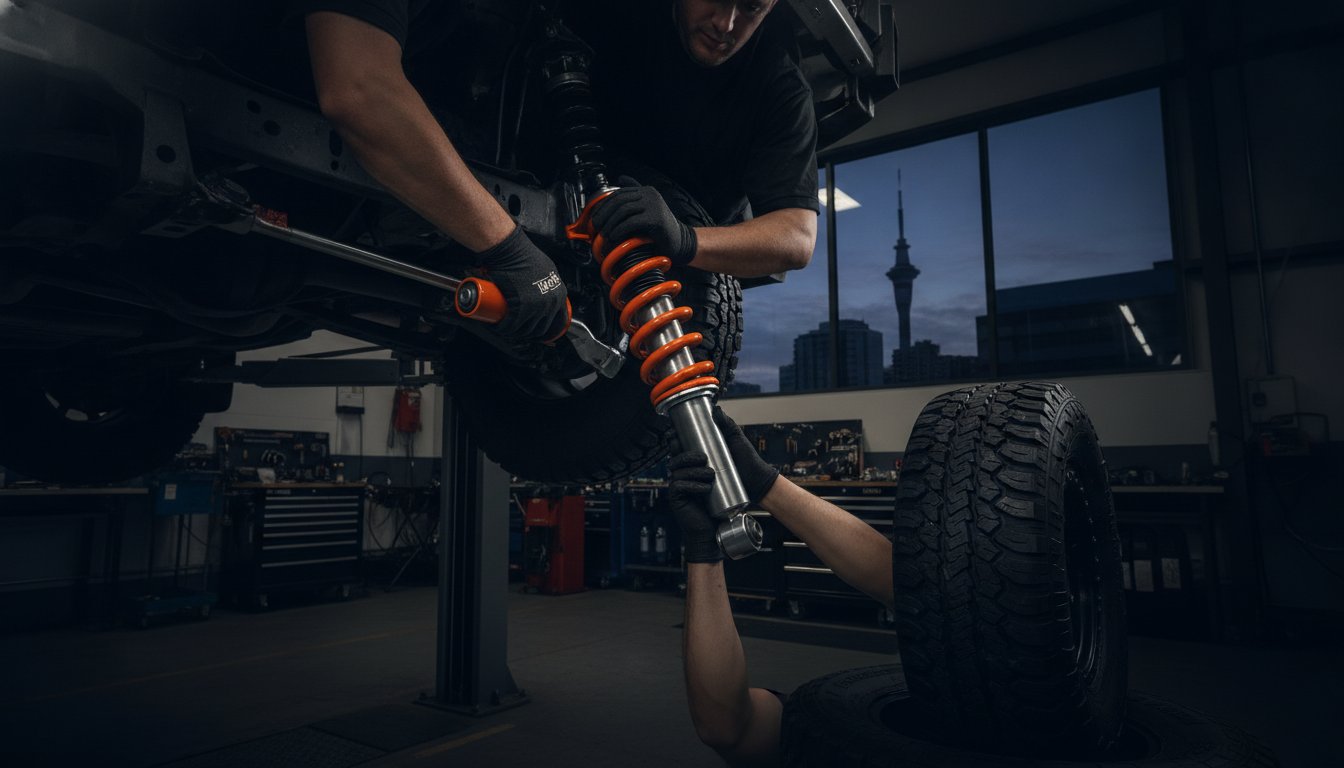
Specialist 4×4 workshops often charge different rates than general mechanical centres because they possess the specific tooling and engineering knowledge required for off-road geometry. Fitting components like Upper Control Arms (UCAs) to correct castor or installing a differential drop to maintain healthy CV angles adds layers of complexity to the job. Professional installation by a qualified technician is a mandatory requirement for maintaining the validity of your vehicle insurance policy. Attempting a DIY install on a modern IFS (Independent Front Suspension) rig without the correct spring compressors and torque sequences can lead to catastrophic component failure.
Legal Compliance: WOF and LVVTA Certification
In New Zealand, the rules regarding vehicle height are strict. Any suspension lift that exceeds 50mm over the original manufacturer specifications generally requires a Low Volume Vehicle (LVV) certification, commonly known as a “Cert.” This process involves a comprehensive inspection by an authorised LVVTA certifier who verifies that the modifications meet all safety and engineering standards. Once passed, a permanent brass plate is riveted to your engine bay. Skipping this certification for a high lift is a guaranteed way to fail your next WOF. More importantly, Auckland insurers are increasingly diligent; an uncertified modification is often used as grounds to deny a claim following an accident.
Maximising ROI: How a Suspension Upgrade Protects Your Investment
Viewing the initial cost of 4×4 suspension upgrade Auckland as a long-term financial strategy is the mark of a seasoned owner. A professional build is not just an expense; it is a method of mitigating future mechanical failures and protecting your vehicle’s most expensive components. When a suspension system is correctly engineered, it maintains the vehicle’s optimal geometry under various load conditions. This precision prevents a cascade of secondary issues, ranging from accelerated CV joint wear to steering rack fatigue. A rig that handles correctly is inherently cheaper to maintain over its lifecycle.
The “cost of failure” in the off-road world is exceptionally high. Choosing budget components often leads to breakage in remote locations, where recovery fees alone can exceed the price of a premium suspension kit. Beyond recovery, the secondary damage caused by a failing shock absorber or a snapped leaf spring can compromise the chassis or drivetrain. Investing in high-quality hardware at the start ensures your vehicle remains reliable on the tracks and holds a significantly higher resale value in the New Zealand market. Kiwi buyers prioritising quality will always pay a premium for a rig with a documented, certified, and professionally installed suspension history.
Tyre Longevity and Fuel Efficiency
Poor alignment resulting from a DIY lift or low-quality components can destroy a $2,000 set of all-terrain tyres in as little as 5,000km. When your suspension geometry is out of spec, the tyres scrub against the road surface rather than rolling cleanly. This increases rolling resistance, which directly impacts your fuel economy. Suspension “sag” also alters the vehicle’s rake, negatively affecting aerodynamics at motorway speeds. A professional setup ensures your contact patch remains flat and your vehicle’s profile stays efficient, saving you thousands in rubber and diesel over the years.
Safety and Handling on Auckland Motorways
Safety is the ultimate return on investment. Lifted 4x4s naturally have a higher centre of gravity, which can lead to excessive body roll and unpredictable handling during emergency manoeuvres. High-quality damping systems are designed to control this movement, providing the stability needed for a sudden swerve-and-recover action on the Southern Motorway. Upgraded suspension also keeps your tyres in better contact with the road during heavy braking, significantly reducing stopping distances when your rig is fully loaded. For those ready to secure their vehicle’s performance and safety, exploring professional GVM Upgrades is the most effective way to protect your automotive investment.
Why Professional Installation at Motortech 4X4 is the Smartest Choice
Choosing the right workshop is just as critical as selecting the components for your build. When you evaluate the total cost of 4×4 suspension upgrade Auckland, the value of an integrated, professional approach becomes clear. Motortech 4X4 operates as a specialised mechanical centre that manages every phase of the suspension lifecycle. We don’t simply bolt on parts; we engineer solutions that account for vehicle weight, intended terrain, and New Zealand’s strict legal frameworks. This comprehensive strategy ensures that your vehicle remains a reliable asset rather than a liability on the road.
One of the most significant advantages of our Auckland workshop is our on-site ADAS calibration facility. Most general mechanical shops are forced to outsource this critical step, which often leads to increased downtime and higher coordination costs for the owner. By housing this technology under one roof, we ensure that your vehicle’s safety systems are precisely aligned the moment the physical suspension work is complete. This “one-stop shop” model extends to wheel alignments and the coordination of LVVTA certification, providing a seamless transition from a standard rig to a fully compliant, high-performance machine.
Our experience with Auckland fleet fit-outs and heavy-duty commercial rigs gives us a unique edge in the GVM upgrade market. We understand the specific demands placed on vehicles used for trade and primary industries. Whether you are managing a single touring vehicle or a fleet of commercial utes, our team applies the same meticulous standards to every project. We prioritise safety and technical excellence, ensuring that every modification meets or exceeds the manufacturer’s original engineering benchmarks.
The Motortech 4X4 Technical Edge
We utilise industry-leading brands and adhere to precision mechanical standards to guarantee the longevity of your upgrade. Our team manages the entire process, from the initial technical quote to the final certification plate. We don’t cut corners on hardware or compliance. Our commitment to Auckland 4×4 safety and performance is reflected in our methodical approach to geometry correction and electronic system integration.
- On-site ADAS calibration for front camera and radar systems.
- Expert coordination of LVVTA certification for lifts over 50mm.
- Specialised experience in high-payload GVM upgrades for commercial fleets.
- Precision wheel alignment tailored to off-road tyre profiles.
Get a Tailored Quote for Your Rig
Generic price lists often fail to account for the specific variables of your vehicle, such as existing accessories or planned load requirements. We prefer a professional consultation to ensure your quote is accurate and fit for purpose. When preparing for your assessment, please have your vehicle’s current weight and a list of fitted accessories ready. This allows our technicians to recommend the exact spring rates and damping profiles your rig requires. For a definitive breakdown of your build requirements, Contact Motortech 4X4 for a professional suspension assessment and ensure your vehicle is ready for any Auckland track or motorway.
Secure Your Build with Professional Engineering Standards
Investing in a comprehensive suspension overhaul is about more than just gaining ground clearance. It’s about engineering a vehicle that remains predictable, legal, and safe on New Zealand roads. Calculating the total cost of 4×4 suspension upgrade Auckland requires accounting for more than just a box of parts. Mandatory compliance steps, such as LVVTA certification and precise ADAS calibration, are essential to ensure your vehicle handles correctly and maintains its insurance validity. By prioritising a professional build, you protect your long-term ROI and avoid the significant “cost of failure” associated with budget components.
Motortech 4X4 offers the technical expertise and specialised equipment required for modern 4×4 builds. As Auckland-owned and operated experts, we provide on-site ADAS calibration and specialist GVM upgrade certification to ensure your rig is entirely fit for purpose. Our one-stop workshop model streamlines the process, taking your vehicle from initial consultation to final certification without the need for multiple service providers. Your next adventure deserves a rig built to the highest mechanical standards.
Request a Professional 4×4 Suspension Quote from our Auckland Team
Frequently Asked Questions
Do I really need an LVVTA certificate for a 2-inch lift in Auckland?
A Low Volume Vehicle (LVV) certificate is generally not required for a 50mm (2-inch) lift if the kit uses original mounting points and doesn’t exceed the 50mm threshold. However, if you combine a suspension lift with a body lift or larger tyres that require guard modifications, you will likely trigger the need for certification. It’s best to check the current NZTA and LVVTA guidelines before proceeding with any height modification.
How much extra does ADAS calibration cost after a suspension upgrade?
The cost of 4×4 suspension upgrade Auckland projects must include a budget for ADAS calibration if your vehicle features modern safety tech. While it adds a specific technical fee to the final invoice, this is a non-negotiable safety requirement. The exact investment depends on whether your rig requires front camera, radar, or blind-spot monitor recalibration to ensure the sensors communicate accurately with the new vehicle height.
Will a suspension upgrade void my new vehicle warranty in New Zealand?
Modifying your suspension won’t automatically void your entire new vehicle warranty. Under New Zealand law, the manufacturer can only refuse a warranty claim if the aftermarket modification directly caused the failure. For example, if a shock absorber mount fails, the factory warranty won’t cover it; however, your engine warranty remains unaffected. Using a professional installer ensures the work meets high mechanical standards and reduces the risk of claim disputes.
Why is my 4×4 pulling to one side after installing a lift kit?
A vehicle pulling to one side after a lift is typically a symptom of incorrect castor angles or a poor wheel alignment. Lifting a vehicle changes the relationship between the steering components and the road. If the alignment hasn’t been professionally corrected to account for the new height, the rig will feel unstable or pull in one direction. A precision four-wheel alignment is mandatory to fix this issue and prevent tyre damage.
Can I install the suspension kit myself and just have you certify it?
While you can physically install a kit yourself, Motortech 4X4 prioritises safety and only certifies work that meets our professional mechanical standards. Many LVVTA certifiers require documentation that the fitting was performed by a qualified technician to verify torque sequences and component compatibility. Professional fitting also ensures your insurance remains valid, as many Kiwi insurers won’t cover DIY suspension modifications on modern vehicles.
How long does it take for a professional suspension fit-out at Motortech 4X4?
A standard professional suspension fit-out typically takes between four and eight hours to complete. This timeframe allows our technicians to install the components, settle the suspension, perform a precision wheel alignment, and complete the necessary ADAS calibrations. More complex projects involving GVM upgrades or upper control arms may require the vehicle for a full day to ensure every technical standard is met.
Is a GVM upgrade necessary if I only tow my boat occasionally?
A GVM upgrade is necessary if the tow ball weight of your boat pushes your vehicle over its legal rear axle or gross mass limit. Even if you only tow occasionally, being over the legal weight limit can lead to insurance denials and safety issues during braking. We recommend weighing your rig fully loaded with the boat attached to determine if your current payload capacity is sufficient for safe towing.
What is the difference between a suspension lift and a body lift in terms of cost?
Body lifts are generally cheaper in terms of initial part costs because they only use spacers to raise the cabin from the chassis. However, they don’t provide any performance benefits or extra wheel travel. A suspension lift is a more comprehensive investment that improves handling, load-carrying capacity, and off-road articulation. This makes it the superior choice for Auckland owners who want better performance rather than just a different look.