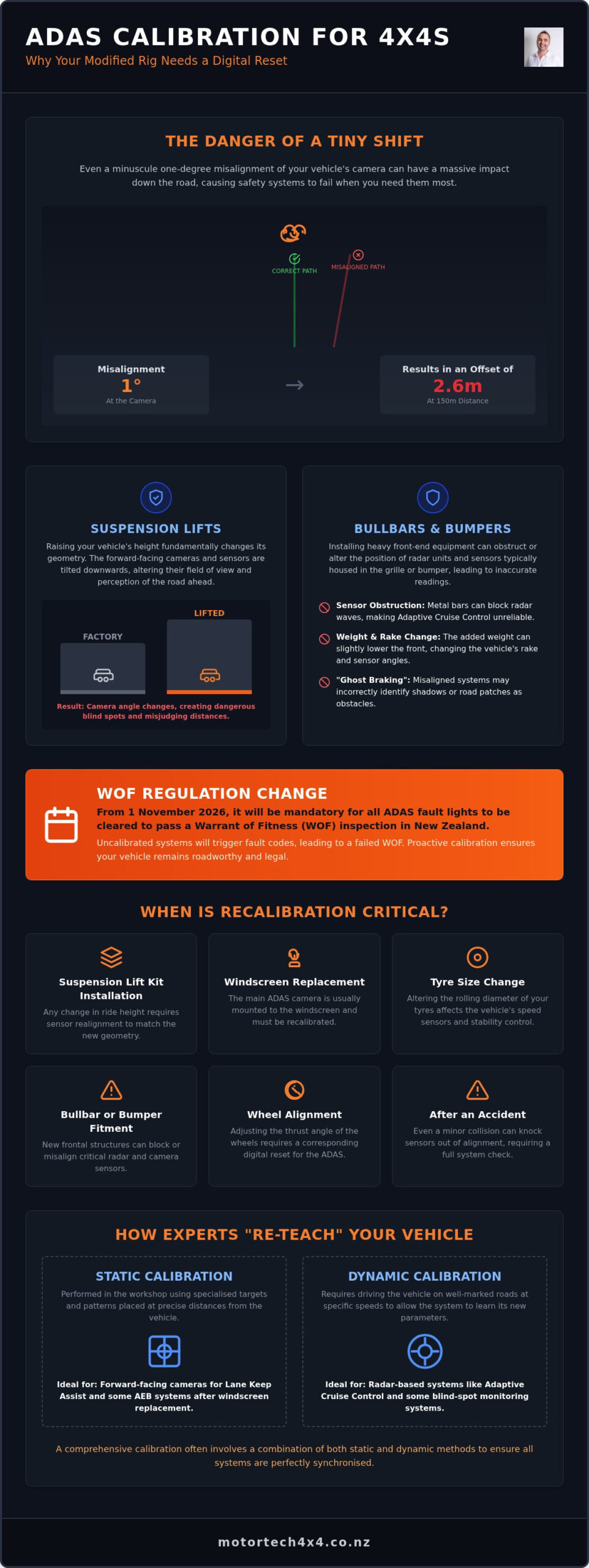
Did you know that a tiny one-degree shift in your vehicle’s camera alignment can lead to a massive 2.6-metre offset just 150 metres down the road? For Auckland 4×4 enthusiasts, adding a lift kit or a heavy-duty bullbar is standard practice for the weekend, but these modifications often throw your vehicle’s electronic brain out of sync. This results in erratic emergency braking or lane-keep warnings that trigger when they shouldn’t. If you’re searching for ADAS calibration Auckland, you’ve likely realised that a standard wheel alignment isn’t enough to keep your modern rig safe.
It’s frustrating when your safety tech fights against your driving, and it’s even more stressful with the 1 November 2026 WOF changes that require all ADAS fault lights to be cleared for a pass. In this guide, we’ll explain why recalibrating your sensors after a suspension upgrade is critical for both performance and legality. You’ll learn how specialised workshop tools restore your vehicle’s precision, ensuring your emergency systems work exactly when you need them most while keeping you fully compliant with New Zealand’s evolving road safety standards.
Key Takeaways
- Learn why suspension lifts and bullbars necessitate recalibrating your vehicle’s safety sensors to prevent dangerous system errors.
- Understand how the November 2026 WOF regulations regarding ADAS fault lights affect your vehicle’s roadworthiness and certification.
- Discover the difference between static workshop targets and dynamic on-road calibration to ensure your safety tech is correctly “re-taught” after modifications.
- Access expert ADAS calibration Auckland to maintain full safety compliance after installing GVM upgrades, bullbars, or suspension kits.
- Realise the critical safety impact of minor sensor misalignments and how precision tuning restores your emergency braking and lane-keep reliability.
What is ADAS Calibration and Why Does Auckland Need It?
Modern utes and SUVs are no longer just mechanical workhorses; they’re sophisticated computers on wheels. Most late-model vehicles arriving in New Zealand come equipped with an Advanced Driver-Assistance System (ADAS). This technology uses a complex network of cameras, radar units, and ultrasonic sensors to act as a digital safety net. However, these sensors are only effective if they’re pointing exactly where the manufacturer intended. Calibration is the technical process of aligning these electronic “eyes” so the vehicle’s software accurately perceives the physical world.
Auckland drivers face unique challenges that make precise calibration non-negotiable. Whether you’re climbing the steep grades of the Bombay Hills or crawling through stop-start congestion on the Southern Motorway, your vehicle’s safety systems are constantly making split-second decisions. If a camera is misaligned by even a fraction of a degree, the system might fail to detect a hazard or, worse, trigger an emergency stop when there’s no danger present. Professional ADAS calibration Auckland services ensure your rig stays on the “Safe Side of Driving” by synchronising your hardware modifications with your vehicle’s electronic brain.
Common ADAS Features in Modern Aussie and Kiwi Utes
The safety tech in your Hilux, Ranger, or Triton isn’t just for show. These systems work together to prevent accidents before they happen:
- Autonomous Emergency Braking (AEB): Scans the road ahead and automatically applies the brakes if a collision is imminent.
- Lane Departure Warning and Lane Keep Assist: Uses forward-facing cameras to monitor road markings and nudges you back into your lane if you drift.
- Adaptive Cruise Control: Maintains a set following distance from the car in front; it’s a vital tool for reducing fatigue during the daily Auckland commute.
When Does Your Vehicle Require Recalibration?
Many drivers don’t realise that common maintenance or upgrades can “blind” their safety systems. You’ll need to book an ADAS calibration Auckland specialist in several specific scenarios. A windscreen replacement is the most common trigger, as the primary camera is usually mounted directly to the glass. Similarly, a standard wheel alignment or a change in tyre size can alter the vehicle’s thrust angle, requiring a digital reset.
For the 4×4 community, the stakes are even higher. Installing a heavy-duty bullbar or a suspension lift kit fundamentally changes the vehicle’s “angle of attack” to the road. When you raise a vehicle by two inches, the cameras are now looking further down the road than the factory settings expect. This creates a dangerous blind spot in the AEB’s field of vision. Every time you modify the height or structural front-end of your rig, a professional recalibration is the final, essential step to ensure your safety tech actually works when you need it.
The 4×4 Connection: Why Lift Kits and Bullbars Demand ADAS Recalibration
Modifying your rig with a 2-inch lift kit or a heavy-duty bullbar changes more than just your ground clearance and approach angles. It fundamentally alters the geometry that your vehicle’s safety systems rely on to function correctly. When you raise the chassis, you’re effectively tilting the forward-facing camera and radar sensors. This change in the “angle of attack” means the system no longer has an accurate view of the road surface or the obstacles ahead. Without professional ADAS calibration Auckland, your ute might suffer from “ghost braking,” where the computer incorrectly identifies a patch of road or a shadow as a solid object and slams on the anchors.
Motortech 4X4 operates as a specialist workshop that understands these mechanical shifts. We don’t just see a lift kit as a set of springs and shocks; we see it as a modification to your vehicle’s electronic horizon. Our team ensures that every structural change is matched by a digital update, keeping your safety tech in sync with your new ride height.
Suspension Lifts and Sensor Misalignment
A suspension lift doesn’t just raise the vehicle; it often changes the rake, which is the angle between the front and rear height. This pitch-sensitive shift can cause your Lane Keep Assist to lose track of road markings or your AEB to misjudge the distance to the car in front. A one-degree error at the sensor level results in a one-metre error on the road. This is why recent NZ Transport Agency research on modified vehicles emphasises that ride-height changes directly impact ADAS reliability. If you’ve also opted for GVM upgrades to carry more gear, the increased static height makes ADAS calibration Auckland even more critical to maintain factory safety standards.
Bullbars and Radar Relocation
Installing a bullbar usually involves moving or working around the radar sensor typically located in the front grille or bumper. Modern aftermarket bars are designed with radar transparency in mind, but even a slight mounting offset can render the system useless. Professional fitment is essential to ensure the radar’s field of view isn’t obscured by the bar’s structure. Attempting a DIY accessory fit can lead to dangerous system failures or persistent dashboard fault lights that will lead to a WOF rejection. If you’re planning a build, it’s best to talk to a team that can handle both the hardware and the software in one go. You can easily book your 4×4 modification and calibration at our specialised facility to ensure your rig is both capable and safe.
Static vs Dynamic Calibration: The Motortech 4X4 Difference
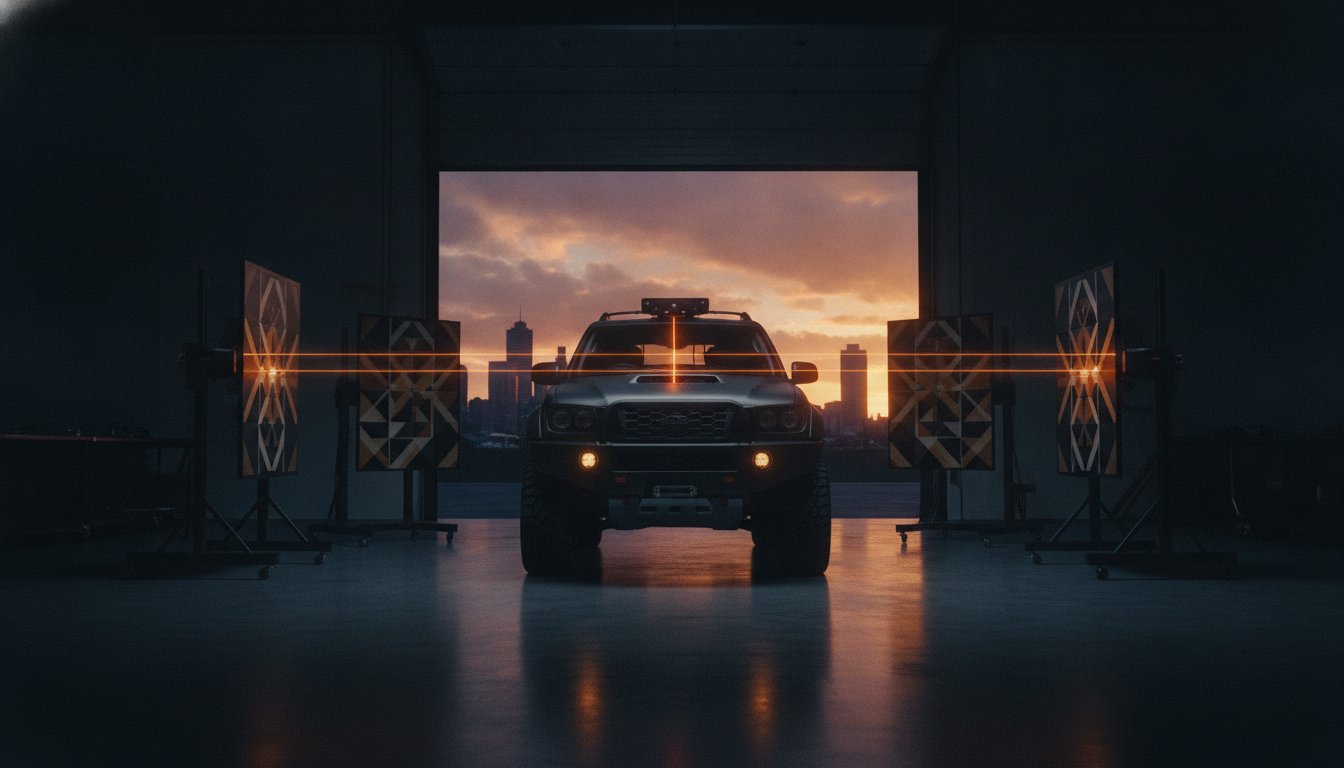
Not all calibration methods are equal, and the right approach depends entirely on your vehicle’s specific technology. Static calibration is a meticulous process performed in a controlled workshop environment. We use specialised targets and boards placed at precise distances and heights to “re-teach” the vehicle’s sensors their correct orientation. This method is essential for front-facing cameras and long-range radar units that require a fixed point of reference. In contrast, dynamic calibration involves connecting a diagnostic tool and driving the vehicle through a specific pattern on well-marked roads, allowing the system to learn from real-world traffic and road structures.
While some vehicles only require one method, many modern rigs with complex safety suites demand both for a 100% safety guarantee. A critical detail that generalist workshops often miss is the importance of a perfectly level workshop floor. If the surface has even a minor slope, the relationship between the sensor and the target board is compromised before the software even starts. At Motortech 4X4, our dedicated bay for ADAS calibration Auckland is engineered to meet these strict environmental requirements, ensuring every measurement starts from a true zero point.
Our Auckland Workshop Setup
We invest in precision equipment designed to meet or exceed OEM (Original Equipment Manufacturer) standards. This isn’t a task that can be handled by a basic handheld scanner. It requires high-end optical alignment tools and manufacturer-specific software to ensure accuracy to within millimetres. This level of technical detail is a standard part of our Specialized 4×4 Servicing. We bridge the gap between heavy-duty mechanical modifications and high-precision electronic tuning, providing a complete solution for Auckland’s most advanced 4×4 builds.
The Recalibration Process Step-by-Step
A professional ADAS calibration Auckland doesn’t begin with a computer; it starts with the chassis. We follow a methodical sequence to ensure the final result is flawless:
- Pre-calibration check: We verify that tyre pressures are exact and the wheel alignment is within factory specs. Even a slightly soft tyre can tilt the vehicle enough to throw a radar sensor off by several metres at highway speeds.
- Digital sensor alignment: Using advanced diagnostic software, we reset the sensor’s parameters relative to the vehicle’s new ride height and centreline.
- Final verification drive: We perform a dynamic road test to confirm the system successfully tracks road markings and traffic. This ensures all dashboard fault lights are cleared and every safety system is “green” and operational.
WOF Compliance and Insurance: Staying Legal on Auckland Roads
Operating a modified 4×4 in Auckland comes with specific legal responsibilities that extend beyond mechanical soundness. A malfunctioning safety system isn’t just a nuisance; it’s a significant liability. If your dashboard displays a warning light for lane assist or emergency braking, your vehicle is currently non-compliant. Under upcoming regulations, this will lead to an immediate failure during your next inspection. Professional ADAS calibration Auckland ensures that your electronic safety net is fully operational, keeping you on the right side of the law and ensuring your rig is fit for purpose.
For fleet managers and business owners, this becomes a matter of professional “Duty of Care.” If a staff member is involved in an accident while driving a company ute with disabled or uncalibrated safety features, the legal repercussions for the business can be severe. Providing a safe working environment includes maintaining the integrity of vehicle safety systems, especially after fitting accessories like bullbars or heavy-duty suspension. A professional calibration certificate serves as vital documentation that you’ve met your safety obligations.
WOF Requirements for ADAS
Current NZTA guidelines are becoming increasingly strict regarding electronic driver aids. From 1 November 2026, any fault or warning light related to ADAS will result in a WOF failure. It’s a common misconception that simply “clearing the code” with a basic scan tool solves the problem. If the underlying alignment issue isn’t fixed, the fault will return, often at the most critical moment. You can check your vehicle’s readiness by reviewing our WOF Pre-Inspection Checklist to see how safety tech integrates with standard mechanical checks. Proper ADAS calibration Auckland is the only way to ensure these systems are actually “green” rather than just temporarily silenced.
Insurance and Liability for Modified Vehicles
Insurance companies rely on the fact that a vehicle is maintained in a roadworthy condition. When you install a lift kit or a GVM upgrade, you’re required to disclose these modifications. Failing to provide proof of recalibration can give an insurer grounds to void your coverage if an accident occurs. For instance, if your Autonomous Emergency Braking (AEB) fails to engage because the sensor was pointing too high after a suspension lift, you may be held personally liable for damages. Protecting your asset and your liability requires more than just high-quality parts; it requires the professional documentation that only a specialised workshop can provide. If you’ve recently modified your vehicle, don’t leave your coverage to chance. You should book an ADAS calibration today to secure your insurance standing and ensure your safety tech is fully verified.
Why Choose Motortech 4X4 for Your ADAS Calibration in Auckland?
Selecting the right partner for ADAS calibration Auckland involves more than just finding a workshop with a diagnostic scanner. At Motortech 4X4, we approach electronic recalibration from a mechanical engineering perspective. We don’t just look at a screen; we look at your entire rig. Because we specialise in 4×4 modifications, we understand how a heavy-duty suspension kit or a GVM upgrade fundamentally changes the way your vehicle sits and moves. This holistic understanding allows us to calibrate your safety systems with a level of precision that generalist workshops simply can’t match. For those looking to research other types of high-end hardware or digital services, SuggestMeTech provides detailed reviews and comparisons to help you make informed decisions.
Our facility operates as a true one-stop shop for Auckland’s off-road and commercial community. You can drop off your vehicle for a bullbar installation and a suspension lift, and pick it up with the ADAS fully recalibrated and certified. This integrated approach eliminates the need to coordinate between multiple service providers. It saves you time and ensures that the technicians performing the calibration know exactly what physical changes were made to the vehicle’s geometry, ensuring total system harmony.
General windscreen repair shops often struggle with modified vehicles because their systems are calibrated for factory-standard heights. When a vehicle’s geometry is altered, standard calibration protocols may fail or produce inaccurate results. Our team has deep experience with the specific ADAS configurations of New Zealand’s most popular utes, including the Toyota Hilux, Ford Ranger, and Mitsubishi Triton. Having a qualified mechanic, rather than just an electronics technician, oversee the process ensures that any underlying mechanical issues are identified before the calibration begins. We focus on the “whole vehicle” to ensure your safety tech works in harmony with your hardware.
Book Your Calibration Today
We’ve streamlined our booking process to cater to both individual weekend adventurers and large commercial fleets. We know that for Auckland tradies, a ute off the road is a ute not making money. Our workshop is organised for fast turnaround times, ensuring your vehicle is back on the tools as quickly as possible without compromising on safety standards. Whether you’ve just finished a build or need to clear a fault light for your next WOF, our expert team is ready to help. You can Book your ADAS Calibration at Motortech 4X4 now to secure your spot and ensure your vehicle is performing at its peak.
Protect Your Build and Ensure Total Compliance
Investing in a high-performance 4×4 build requires a commitment to safety that matches your commitment to capability. As New Zealand’s road safety standards evolve, particularly with the 2026 WOF changes regarding dashboard fault lights, professional ADAS calibration Auckland is no longer optional. It’s the final, essential step in any modification project, ensuring that your lift kit or bullbar works in harmony with your vehicle’s electronic safety suite.
Motortech 4X4 stands as your dependable guide in this complex intersection of mechanics and electronics. Our workshop combines the rugged expertise of expert 4×4 modification specialists with the precision of advanced OEM-grade calibration equipment. We provide comprehensive fleet and commercial support to keep Auckland’s tradies safe and compliant, regardless of the terrain they tackle.
Secure your safety—Book your ADAS Calibration at Motortech 4X4 Auckland today. By choosing a specialist who understands the whole vehicle mechanics, you ensure your emergency systems remain a reliable backup rather than a liability. Get your rig verified and get back to exploring with total confidence.
Frequently Asked Questions
How much does ADAS calibration cost in Auckland?
Professional service costs vary across the region depending on your vehicle’s make and the complexity of the sensor array. While some providers offer basic dynamic resets, a comprehensive recalibration for a modified 4×4 often involves more intensive static workshop time. You should check with your insurer if the service is part of a repair claim. Professional workshops provide specific quotes based on whether your rig requires static, dynamic, or a combination of both calibration methods.
Will my lift kit definitely affect my ADAS sensors?
A lift kit fundamentally changes the pitch and height of your vehicle, which shifts the angle of attack for cameras and radar. NZTA research report 719 confirms that modifying ride height negatively affects ADAS performance. Even a standard 2 inch lift can cause the system to miscalculate distances to hazards. This misalignment can lead to safety systems failing to engage or triggering unexpectedly during normal driving conditions, making a professional reset essential.
Can I drive my vehicle if the ADAS warning light is on?
Driving with an active ADAS warning light means your vehicle’s safety net is compromised or entirely offline. While the mechanical components of your ute still function, features like Autonomous Emergency Braking may not work when needed. From 1 November 2026, any dashboard fault light for these systems will result in an automatic WOF failure. It’s best to address these faults immediately to maintain both safety and legal compliance on Auckland roads.
How long does a professional ADAS calibration take?
A professional ADAS calibration typically takes between one and three hours to complete. This timeframe includes the essential pre-calibration checks like verifying tyre pressures and wheel alignment. If your vehicle requires a static calibration, it involves precise setup with target boards in a controlled environment. Dynamic calibrations require a technician to drive the vehicle under specific conditions. Complex modern rigs often require both processes to ensure the software and hardware are perfectly synchronised.
Does every workshop in Auckland offer ADAS calibration?
No, many local mechanics lack the specialised diagnostic tools and OEM-grade target boards required for this precision work. A successful calibration also requires a perfectly level workshop floor, which many general service centres don’t have. Most Auckland workshops will outsource this task to a specialist. Choosing a 4×4 specialist ensures the technicians understand how your suspension modifications interact with the electronic sensors, providing a more reliable result than a generalist who lacks modification expertise.
Do I need to recalibrate my ADAS after getting new tyres?
Recalibration is necessary if your new tyres change the overall rolling diameter or ride height of the vehicle. Switching from factory tyres to larger all-terrains or mud-terrains alters the camera’s perspective of the road. When upgrading your rubber, you can discover Mobile Tyre Service for expert on-site fitting. This change can confuse the Lane Keep Assist and Adaptive Cruise Control systems. Ensuring your ADAS calibration Auckland is updated after a tyre size change keeps your safety systems accurate and prevents dashboard errors from appearing during highway driving.
Failing to recalibrate after a bullbar installation can lead to ghost braking or the total failure of forward collision systems. Bullbars can slightly shift the mounting position of radar sensors or partially obscure their field of vision. If the system isn’t re-taught its new position, it may perceive the road surface as an obstacle. This creates a dangerous driving environment where your vehicle might suddenly slam on the brakes without any actual hazard present.
Is ADAS calibration covered by my insurance after a windscreen claim?
Insurance companies typically cover the cost of ADAS calibration Auckland if it’s required as part of a glass replacement claim under a standard policy. However, if the calibration is needed because you’ve installed aftermarket modifications like a lift kit or bullbar, the cost is generally your responsibility. It’s vital to disclose all modifications to your insurer and provide proof of recalibration to ensure your liability and vehicle coverage remain valid after any structural changes.