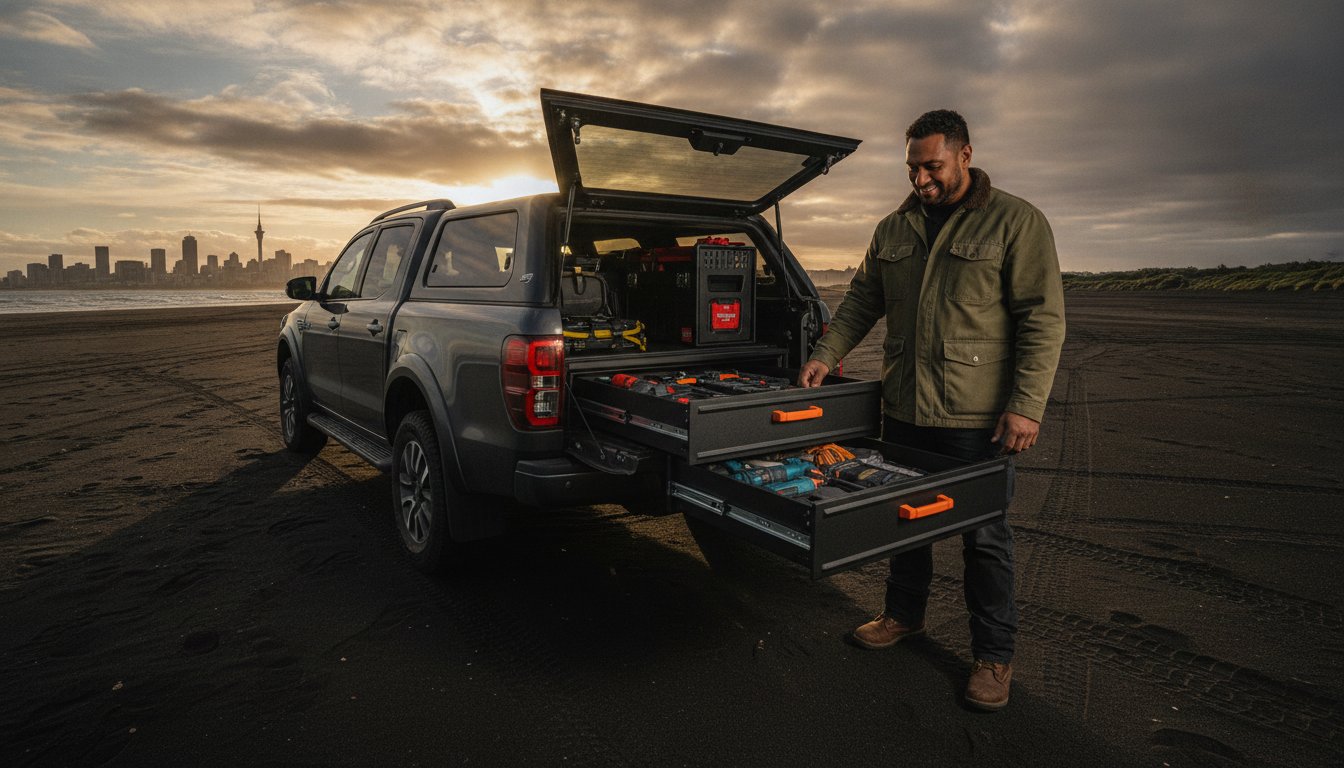
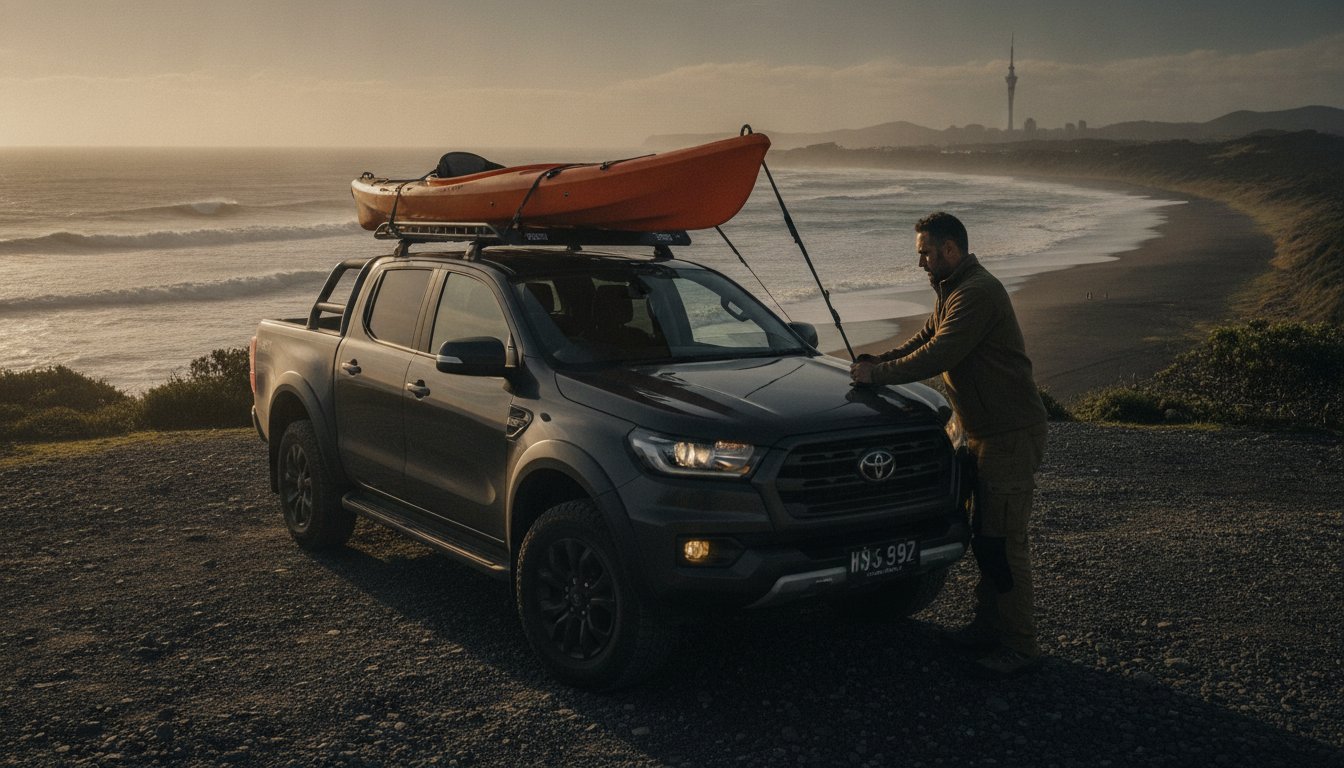
Most drivers treat a roof rack as a simple bolt-on accessory, but on a modern ute, it’s actually a complex structural modification that can compromise your vehicle’s safety systems if handled incorrectly. Finding the right roof racks nz adventurers can trust involves more than just picking a brand. It requires a deep understanding of how additional weight affects your dynamic load rating and ADAS sensors.
You’ve likely felt that hesitation when trying to decipher confusing load limits or worried about the persistent whistle of wind noise and the inevitable hit to your fuel economy. It’s a common concern for Kiwis who want to secure their gear for a trip to the coast without worrying if their emergency braking system will still function. These technical hurdles shouldn’t stand in the way of your next adventure.
This guide provides the technical clarity you need to choose, load, and professionally fit a system that enhances your vehicle’s capability. We’ll break down the critical differences between static and dynamic loads, explain the latest NZTA overhang regulations, and show you why professional installation is the only way to ensure your modern safety tech remains fully calibrated for the road ahead.
Key Takeaways
- Understand why material selection is critical for the New Zealand climate, specifically how aluminium and steel components withstand high UV levels and coastal salt spray.
- Compare the structural versatility of platform systems against traditional crossbars to determine the best balance between cargo capacity and vehicle height clearance.
- Learn the technical distinction between static and dynamic load ratings to ensure your roof racks nz installation remains stable and compliant during high-speed transit.
- Identify how roof-mounted accessories can interfere with modern safety features, requiring specialised ADAS calibration for lane-keep and collision warning systems.
- Prevent long-term vehicle damage by opting for professional fitment to eliminate the risks of water ingress, excessive wind noise, and structural failure.
Understanding Roof Rack Systems for the New Zealand Environment
A roof rack system functions as a structural addition to a vehicle’s chassis, redistributing weight and altering the vehicle’s aerodynamic profile. For those researching Understanding Roof Rack Systems, it’s clear these aren’t just simple bars; they’re modular gear-carrying ecosystems designed to integrate with a vehicle’s specific engineering. In the context of roof racks nz adventurers rely on, material selection is the first line of defence. Aluminium is the gold standard for our local conditions. Unlike steel, which can rust from the inside out if the powder coating is compromised, aluminium remains resistant to the intense salt spray found along our coastlines.
Mounting methods vary significantly depending on your vehicle’s age and design. Modern SUVs and wagons often utilise factory rail mounts, which provide a sleek, integrated look and distribute weight along pre-installed tracks. Older rigs or heavy-duty commercial vehicles might still rely on gutter mounts. These offer exceptional load-bearing strength by clamping directly onto the reinforced roof gutters, though they require precise alignment to avoid paint damage. Choosing the wrong mounting style can lead to structural fatigue or water ingress over time.
Why Local NZ Conditions Dictate Your Choice
The “Coromandel effect” is a real threat to vehicle longevity. Salt-laden air can corrode low-quality fasteners in a single season, leading to seized bolts and unsightly rust streaks. Aerodynamics are equally vital, especially when crossing the Desert Road. High-velocity crosswinds can turn a poorly designed rack into a massive sail, causing intrusive wind noise and a sharp drop in fuel economy. If your weekend plans involve corrugated tracks in the Far North, a budget rack will likely fail. The constant vibration of washboard roads requires a professional-grade system that won’t vibrate loose or shear at the mounting points under stress.
Anatomy of a Professional Rack Setup
A professional setup starts with the base system, consisting of vehicle-specific feet and fitting kits. This foundation determines the total load capacity and safety of the installation. For enthusiasts, the choice between crossbars and platforms is often dictated by their specific hobby. Crossbars are excellent for kayaks and surfboards, providing a simple, lightweight solution. Conversely, flat platforms offer the ultimate versatility for mounting rooftop tents and recovery gear. Security is the final piece of the puzzle. High-quality roof racks nz systems feature integrated locks and anti-theft hardware to ensure your investment stays exactly where you left it.
Choosing the Right Rack: Platforms vs. Crossbars vs. Trays
Selecting the right roof racks nz setup requires a balanced assessment of your vehicle’s primary use and the types of cargo you intend to carry. While traditional crossbars are sufficient for occasional weekend trips, flat platforms represent a modular evolution in gear storage. These systems act as a blank canvas, allowing you to bolt on specific accessories via integrated T-slots as your requirements change. This modularity is essential for those planning to add awnings, recovery boards, or high-lift jack mounts in the future without replacing the entire base system.
Clearance is a critical technical factor often overlooked during the buying process. A high-profile rack combined with a 2-inch suspension lift can easily exceed standard garage or multi-storey car park heights, which typically sit at 2.1 metres. Opting for a low-profile platform reduces the overall height of the rig while maintaining structural integrity. This lower profile also helps manage the vehicle’s centre of gravity, which is vital for safety when the vehicle is fully loaded for a long-distance tour.
For tradespeople, the “tradie factor” dictates a need for extreme durability and ease of access. Carrying ladders, timber, or heavy conduit daily puts significant strain on mounting points and the rack’s surface. Heavy-duty crossbars or reinforced platforms are necessary to handle these repetitive loads without flexing or whistling at highway speeds. If you are unsure which system suits your work vehicle, the team at Motortech 4×4 can advise on the most robust fitment for your specific fleet requirements.
Crossbars: The Aerodynamic Commuter Choice
Crossbars remain the preferred choice for those prioritising aerodynamics and reduced noise. Modern “wing” profiles are specifically engineered to minimise drag, which has a measurable impact on fuel consumption compared to traditional square bars. Flush-bars offer a clean, factory-finished appearance that sits within the roofline, while through-bars provide extra width for carrying multiple kayaks, bikes, or oversized hardware from the local centre. They are the ideal solution for light-duty gear that requires quick, tool-free mounting.
Pioneer Platforms: The Ultimate 4×4 Storage
For overlanding and extended touring, flat deck platforms are the definitive standard. These systems provide a stable foundation for heavy accessories like rooftop tents, which require a wide support area to manage the load effectively. By spreading the weight across multiple internal planks, platforms reduce localised stress on the roof structure. This low-profile design also improves stability on uneven terrain and corrugated tracks, making it the most reliable solution for serious 4×4 enthusiasts venturing into the backcountry.
Load Ratings and Weight Limits: The Technical Side of NZ Touring
Understanding the physics of weight distribution is the most critical aspect of installing roof racks nz owners use for long-distance touring. It is not enough to simply bolt on a platform and load it until it looks full. Every vehicle has a specific roof load limit determined by the manufacturer, and exceeding this figure creates significant safety risks. Adding weight to the highest point of your vehicle raises the centre of gravity, which directly increases rollover risk during emergency manoeuvres or high-speed cornering. Engineering specifications confirm that a nominal 100kg roof rack rating often drops significantly, sometimes by up to 50 percent, when the vehicle is subjected to the high-frequency vibrations of off-road touring.
Compliance is another factor that cannot be ignored. An overloaded roof is not just a safety hazard; it is a legal liability. If you are involved in an accident and your vehicle is found to be over its rated capacity, your insurance provider may void your policy. Additionally, visible signs of roof sagging or structural damage from overloading can lead to a failed Warrant of Fitness (WOF). For detailed information on legal requirements, refer to the NZTA safe loading guidelines to ensure your rig remains compliant on public roads.
Static vs. Dynamic Loads Explained
The distinction between static and dynamic load ratings is a frequent point of confusion. A static rating refers to the weight the roof can support when the vehicle is stationary. This is the figure that matters for rooftop tents, where the combined weight of the tent and the occupants might exceed 200kg. The dynamic rating is the maximum weight allowed while the vehicle is in motion. This figure is much lower because it accounts for the immense kinetic forces applied when hitting a pothole at 100km/h. Most manufacturers slash these load limits by 30 to 50 percent the moment your tyres leave the bitumen, as corrugated dirt roads place extreme stress on mounting hardware.
The GVM Connection: Don’t Overcook Your Rig
Your roof load is part of your total Gross Vehicle Mass (GVM), which is the maximum allowable weight of the vehicle when fully loaded. When calculating your payload, you must include the weight of the roof racks nz system itself, plus passengers, fuel, bullbars, and any camping gear. It is remarkably easy to exceed the factory GVM on a modern dual-cab ute once it is kitted out for a week in the bush. If your calculations show you are nearing the limit, a professional GVM upgrades NZ specialist can provide a certified solution to increase your carrying capacity safely and legally.
Installation and ADAS Calibration: Why Professional Fitment Matters
While many roof racks nz retailers sell kits as a DIY project, the technical reality of modern vehicle construction makes professional fitment a safety requirement. A minor error in bolt torque or the incorrect application of sealant on a drilled roof can lead to catastrophic structural failure or persistent water ingress. Beyond the physical mounting, the geometric alignment of crossbars or a platform is critical. Even a few millimetres of misalignment can create turbulent airflow, leading to the intrusive wind whistles mentioned earlier and a measurable increase in drag. Professional fitment ensures that T-track security and mounting feet are perfectly seated to handle the dynamic forces of highway travel.
The Professional Installation Process
A specialised fit-out follows a methodical three-stage protocol to ensure long-term reliability. This structured approach eliminates the guesswork often associated with home installations.
- Step 1: Roof prep and mounting point inspection. We remove factory trim and inspect the integrity of the mounting points, ensuring no debris or manufacturing defects compromise the base system.
- Step 2: Precision alignment to minimise drag and noise. Using precise measurements, we ensure the rack is perfectly centred and level. This step is vital for maintaining the aerodynamic profile of the vehicle.
- Step 3: Torque-testing all fasteners. Every bolt is tightened to the manufacturer’s exact Newton-metre (Nm) specification. This prevents the fasteners from vibrating loose on corrugated tracks or over-tightening and damaging the vehicle’s internal structure.
ADAS Calibration: The Invisible Safety Step
Modern vehicles rely on Advanced Driver Assistance Systems (ADAS) to function safely. Research from Revv in February 2025 indicates that over 90 percent of new vehicles are now equipped with at least one ADAS feature. These systems use cameras and radar sensors, often located near the top of the windscreen or in the front grille, to manage Forward Collision Warning and Lane Keep Assist. Installing a large roof platform or a bulky load can physically obstruct these sensors or alter the vehicle’s rake and height enough to confuse the system’s logic.
A change in vehicle height or a slight tilt caused by a heavy roof load can cause these sensors to miscalculate distances. This is why ADAS calibration Auckland services are a non-negotiable part of a professional fit-out. At Motortech 4X4, we include comprehensive ADAS checks in our professional installations to ensure your safety tech remains accurate. If your vehicle’s sensors are not correctly aligned with its new physical profile, your emergency braking system may not engage when you need it most. To ensure your vehicle remains safe and compliant, contact our specialist team to discuss a professional roof racks nz installation for your vehicle.
The Motortech 4X4 Advantage: Auckland’s Specialist Roof Rack Centre
Motortech 4X4 operates as a high-performance specialist centre in Auckland, providing a comprehensive solution for those seeking reliable roof racks nz. We don’t just sell boxes. We provide engineered storage solutions. Stocking premium brands like Rhino-Rack and Yakima ensures our customers have access to the highest technical standards in the industry. Whether you are a tradie needing a robust setup for the job site or an adventurer preparing for a trans-island tour, our workshop is equipped to handle the most complex requirements with mechanical precision.
A roof rack is often the first step in a complete vehicle build. Our expertise extends across 4×4 servicing, suspension kits, and the integration of bullbars and snorkels. This holistic mechanical knowledge allows us to plan your build with precision. We ensure your vehicle lighting and winches are positioned to work in harmony with your roof-mounted gear, maintaining the vehicle’s balance and safety. Having qualified mechanics perform your installation means every component is treated as a structural modification, not just a bolt-on accessory.
Beyond the Rack: Complete Vehicle Builds
For commercial operators, our facility is uniquely capable of handling complex fleet fit-outs and fleet servicing for commercial utes. We understand that a work vehicle requires a level of durability that standard retail outlets cannot match. Our team develops custom solutions that integrate your rack system with other essential components like canopies, hardlids, and specialised storage. This “one-stop” mentality ensures that your entire fleet remains compliant with NZTA regulations while maximising operational efficiency on the road.
Visit Our Auckland Workshop
Our Auckland workshop is designed to provide a seamless transition from retail selection to professional implementation. We offer expert advice tailored to your specific vehicle and budget, ensuring you don’t over-invest in features you don’t need or compromise on essential safety. We can perform professional fitting while you wait or coordinate the installation as part of your regular car servicing or 4×4 servicing schedule. This efficiency is a core trait of our business, allowing you to get back on the road with a secure, calibrated, and high-performance storage solution.
We provide the technical clarity needed to navigate the intersection of performance upgrades and legal requirements. If you are ready to enhance your vehicle’s capability with a professional-grade setup, book your roof rack consultation at Motortech 4X4 today! our specialist team is ready to ensure your roof racks nz installation is safe, secure, and built for the long haul.
Secure Your Gear for the Road Ahead
Selecting the right roof racks nz system is a technical decision that impacts your vehicle’s safety, efficiency, and long-term durability. High-quality aluminium construction is essential for resisting New Zealand’s harsh coastal salt spray and intense UV levels. Precision also matters when calculating dynamic load ratings to ensure your vehicle’s centre of gravity remains stable on corrugated tracks. Professional installation remains the only way to guarantee that your Advanced Driver Assistance Systems (ADAS) remain correctly calibrated after structural modifications.
As an authorised Rhino-Rack and Yakima dealer, Motortech 4X4 provides the specialised mechanical expertise required for complex vehicle builds. Our Auckland specialist workshop offers expert ADAS calibration on-site, ensuring your modern safety tech functions perfectly with your new gear. Don’t settle for retail guesswork when kitting out a commercial fleet or preparing a personal 4×4 for a trans-island tour. We deliver a total solution that values technical excellence and customer safety above all else.
Get a Professional Roof Rack Quote from Motortech 4X4 and prepare your rig for its next great adventure with total confidence.
Frequently Asked Questions
Do roof racks affect my vehicle warranty in NZ?
Roof racks won’t void your entire vehicle warranty, but any damage resulting from an incorrect installation or exceeding load limits will not be covered by the manufacturer. If a DIY fitment causes a roof leak or structural cracking, you’ll be liable for the repairs. Choosing professional fitment for your roof racks nz ensures the work meets industry standards and protects your vehicle’s long-term warranty integrity.
How much weight can I safely put on my roof rack?
Your safe load limit is determined by your vehicle manufacturer’s dynamic roof rating, which typically ranges between 75kg and 100kg for modern 4x4s. You must subtract the weight of the rack itself from this total to find your actual gear capacity. Remember that these limits often decrease significantly when driving off-road due to increased kinetic forces. Always consult your owner’s manual for the specific rating for your model.
Will a roof rack cause a lot of wind noise?
Wind noise is largely determined by the aerodynamic profile of the bars and how they are aligned. Modern “wing” shaped bars are engineered to reduce drag and whistling, but square or round bars will naturally create more turbulence. Intrusive noise often indicates a mounting error or an accessory that is disrupting the airflow. Professional alignment is the most effective way to keep your cabin quiet at highway speeds.
Can I go through a car wash with a roof rack on?
You should avoid automatic car washes with overhead brushes while your rack is installed. The mechanical brushes can snag on the rack or its accessories, potentially causing damage to the vehicle’s roof or the rack itself. Touchless car washes are generally safer, but hand washing is the recommended method to ensure no components are bumped out of alignment or subjected to excessive lateral pressure.
Do I need to notify my insurance company about a new roof rack?
You must notify your insurance provider about a new roof rack as it is considered a vehicle modification. In New Zealand, failing to disclose modifications can lead to a declined claim in the event of an accident. Declaring the upgrade ensures that both the rack and any mounted gear are covered under your policy, providing peace of mind during your touring adventures.
How do I know if my roof rack is ADAS compatible?
ADAS compatibility depends on whether the rack or its load obstructs the sensors’ field of vision. High-profile platforms or overhanging gear can interfere with the cameras located near the top of the windscreen. The only definitive way to ensure compatibility is through a professional calibration check. This process confirms that your lane-keep and collision warning systems are still functioning accurately with the new hardware installed.
What is the best roof rack for a Ford Ranger or Toyota Hilux?
Platform systems are the preferred choice for dual-cab utes like the Ford Ranger and Toyota Hilux. These vehicles benefit from the modularity of a flat deck, which allows for better weight distribution across the cabin roof. A low-profile platform provides the versatility needed for trade work during the week and heavy-duty touring on the weekend, making it the most practical all-rounder for Kiwi ute owners.
How often should I check the bolts on my roof rack?
You should check the torque settings on all mounting bolts every 1,000 kilometres of highway driving. If you’ve been travelling on corrugated dirt tracks or heavily loaded for a camping trip, inspect the fasteners immediately after the journey. Vibrations can cause bolts to settle or loosen over time, so regular maintenance is a critical safety requirement for any roof racks nz installation.