Rural roads account for only 36% of crashes in New Zealand, yet they are the site of a staggering 71% of road deaths. For fleet managers and owner-operators, these figures highlight a sobering reality: standard factory setups often fall short when navigating the unpredictable terrain of the South Island or the fog-heavy valleys of the Waikato at night. You likely already know that relying on stock lamps is a gamble, especially when vibration and water ingress on rugged work sites quickly turn cheap alternatives into expensive failures. Investing in high-quality commercial vehicle lighting NZ is no longer just an upgrade; it’s a critical safety requirement for any business operating outside of well-lit metropolitan centres.
We agree that keeping up with technical standards shouldn’t be a guessing game for your business. This guide will show you how to optimise your fleet’s visibility and safety using performance-grade solutions built for our unique conditions. We’ll cut through the confusion surrounding Waka Kotahi (NZTA) regulations, including the Land Transport Rule: Vehicle Lighting 2004, to ensure your vehicles remain fully compliant. You’ll discover how the right LED configurations can reduce night-time crash risks by approximately 30% while boosting shift productivity during winter. We’ll look at everything from CISPR25 Class 3 interference standards to selecting luminaires that survive the harshest work environments to protect your staff and your bottom line.
Key Takeaways
- Identify factory lighting limitations and how high-output driving lights mitigate accident risks on unlit rural roads.
- Ensure regulatory compliance by selecting warning and emergency lighting that meets ECE R65 and light intensity standards.
- Optimise hardware longevity by matching IP ratings and vibration resistance to specific industry demands like civil construction or forestry.
- Protect electronic system integrity by understanding how professional commercial vehicle lighting NZ integration avoids ADAS sensor interference.
- Discover the operational benefits of a comprehensive fit-out where lighting, bullbars, and GVM upgrades function as a single, calibrated unit.
Why Standard Lighting Fails NZ Commercial Fleets
Standard factory lighting is designed for general use in well-lit urban environments. On New Zealand’s rural road network, which accounts for 71% of road deaths despite lower traffic volumes, these stock halogen or basic LED setups often fail to provide the necessary reaction time. When you are operating a heavy commercial vehicle on unsealed tracks in the King Country or navigating the West Coast in a downpour, the limited throw of factory high-beams leaves significant blind spots. Poor visibility isn’t just a safety hazard; it directly contributes to driver fatigue. The human brain works harder to process visual data in low-light conditions, leading to slower reaction times and increased operational downtime.
New Zealand’s environment is particularly brutal on electrical components. High humidity levels and constant vibration from corrugated gravel roads can cause cheap lighting housings to crack or leak. Professional commercial vehicle lighting NZ must feature high Ingress Protection (IP) ratings, typically IP68 or IP69K, to prevent moisture ingress. It also requires high G-force ratings to withstand the structural stress of constant jarring. Understanding basic automotive lighting principles is essential here. You must distinguish between “seeing” (forward-facing illumination) and “being seen” (warning and signal lighting). Both are vital for fleet safety, but they serve entirely different technical purposes.
The Real Cost of Substandard Lighting
The financial impact of poor lighting extends far beyond the initial purchase price of a lamp. In rural areas, the risk of animal strikes is a constant threat to fleet operations. Hitting a deer or livestock on a South Island highway doesn’t just cause vehicle damage; it results in significant repair costs and lost revenue while the vehicle is off the road. During the shorter days of winter, productivity for civil works and forestry crews drops if the lighting setup isn’t sufficient for safe operation after dark. Furthermore, using non-compliant or failed lighting can lead to insurance complications if an accident occurs, potentially leaving the business liable for damages.
Defining “Powerful 4×4” Lighting for Trade
A “powerful 4×4” setup for a tradie ute differs significantly from a weekend off-roader. While an enthusiast might prioritise raw distance, a commercial operator needs a balance of width and depth to illuminate work zones and roadsides. Effective beam control is critical to avoid blinding oncoming traffic on narrow, winding NZ roads. High-performance units use precision optics to keep light on the road rather than scattering it into the sky. Reliability is also a factor. Commercial units must balance raw lumens with effective heat management. If a light bar cannot dissipate heat during a long night shift, the LEDs will dim or fail prematurely. For these reasons, investing in specialised commercial vehicle lighting NZ is a proactive step toward maintaining fleet durability and safety.
Core Categories of Commercial Vehicle Lighting in NZ
Effective commercial vehicle lighting NZ is divided into four distinct functional categories. Each serves a specific operational purpose, from high-speed transit on unlit highways to localised task illumination on a job site. A comprehensive fleet strategy integrates forward-facing performance lights, 360-degree warning systems, and high-intensity work lamps to ensure total site safety across different work environments. Choosing the right category ensures that your drivers have the specific type of illumination required for their task without compromising the safety of other road users.
Performance Driving Lights for Fleet 4x4s
Choosing between round spotlights and LED light bars depends on your vehicle’s mounting points, such as a bullbar or roof rack, and the specific driving environment. Round spotlights typically offer superior distance for long, straight stretches, whereas LED light bars provide a broader spread that is ideal for spotting hazards on winding roads. Many modern fleet 4x4s now utilise hybrid beam patterns, which combine spot and flood optics into a single unit. For heavy-duty commercial 4×4 use, the ideal lumen output should fall between 10,000 and 20,000 effective lumens per pair to ensure maximum visibility without overwhelming the driver with foreground glare.
Safety and Warning Lighting Requirements
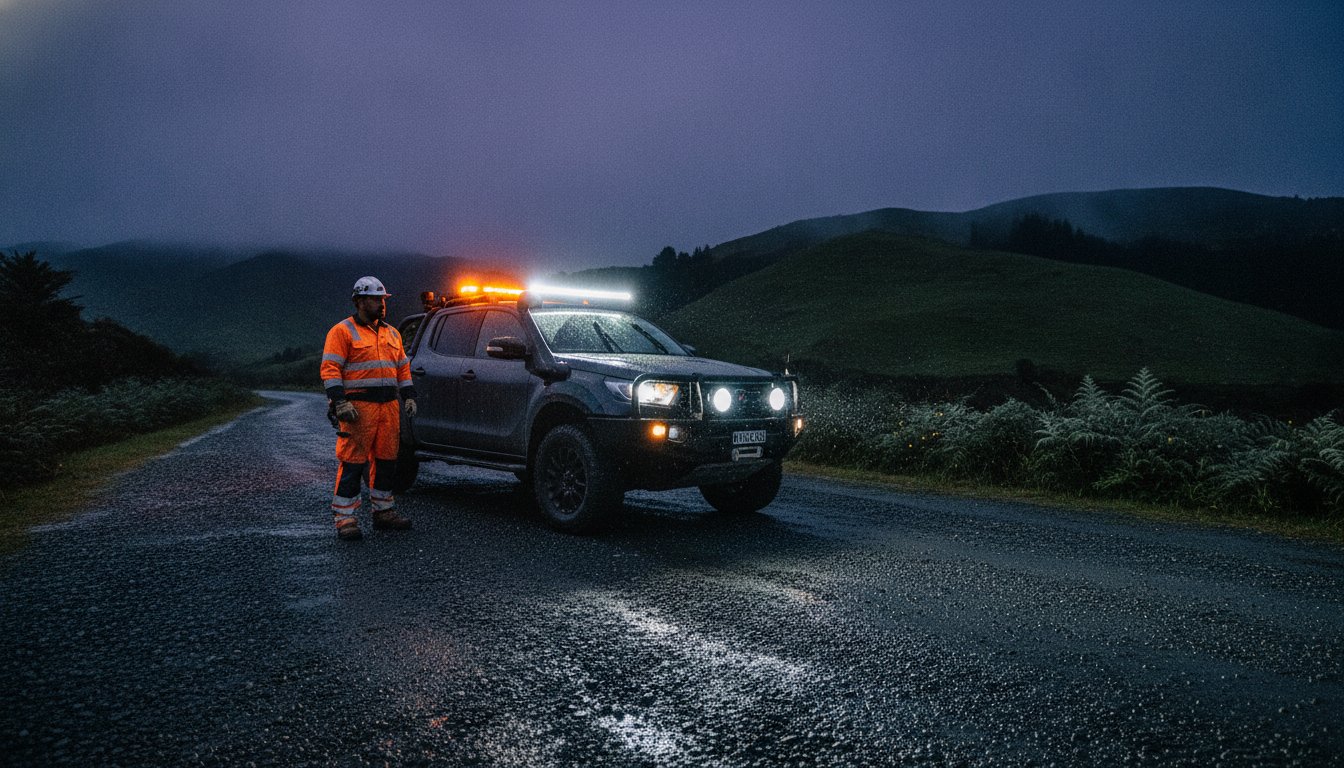
Compliance is non-negotiable for contractors and pilot vehicles. Amber beacons are legally required when a vehicle’s presence or operation poses a hazard to other road users, particularly during oversized load escorting or roadside maintenance. The industry has largely shifted from traditional halogen rotators to high-intensity LED strobes due to their lower power draw and superior longevity. To maintain the highest safety standards, your warning systems should meet SAE J845 Class 1 for maximum daytime visibility and ECE R65 standards for light intensity. Adhering to WorkSafe NZ vehicle safety guidelines ensures that your fleet remains visible in high-risk industrial zones like quarries and forestry blocks.
Work lights provide essential floodlighting for site perimeters, ute trays, and service bodies. Unlike driving lights, these are designed for short-range, wide-angle illumination to prevent accidents during night shifts. Interior cargo lighting is equally critical for vans and service bodies, as it enhances efficiency by allowing staff to quickly locate tools and equipment. Professional commercial vehicle lighting NZ installations ensure these systems are wired independently to avoid battery drain while the vehicle is stationary. If you are looking to standardise your fleet’s equipment, the team at Motortech 4X4 can design a custom lighting package that meets both your operational needs and NZ road rules.
Choosing the Right Lighting for Your NZ Industry
Selecting the correct commercial vehicle lighting NZ setup requires an understanding of the specific operational environment. A civil construction vehicle faces different challenges than a logging truck in the central North Island. For civil works, the primary concern is ingress protection. Equipment is frequently subjected to high-pressure washing and fine dust on site. In contrast, forestry and logging fleets prioritise vibration resistance. Heavy-duty mounting systems are essential to prevent housing failure on unsealed logging tracks where constant jarring is the norm. Agricultural operations often require wide flood patterns for paddock work and stock management at dawn or dusk. These wide-angle beams provide the necessary peripheral vision for safety in open spaces. For urban delivery and security fleets, the focus shifts to low-profile, high-efficiency lighting. These vehicles often navigate height-restricted loading bays, making compact light bars and perimeter lamps the preferred choice for maintaining visibility without risking physical damage to the units.
The Importance of IP Ratings in NZ
Understanding IP ratings is critical for hardware longevity in New Zealand’s varied climate. While IP67 signifies protection against temporary immersion, it isn’t always sufficient for vehicles working in the Waikato mud or coastal Otago. IP69K is the gold standard, indicating the unit can withstand high-pressure, high-temperature jets used during heavy equipment cleaning. However, being waterproof isn’t the only requirement. Due to our high humidity, you must ensure your lighting is condensation-proof. Genuine professional-grade units feature integrated breather valves to equalise pressure and prevent internal fogging. For coastal operations, look for verified salt-spray resistance to prevent housing corrosion. This technical diligence prevents premature failure and ensures your fleet remains operational regardless of the weather.
Beam Patterns: Flood, Spot, or Combo?
Beam patterns determine how effectively you can navigate specific NZ routes. Spot beams provide the long-range throw required for high-speed transit on the Desert Road or through the Haast Pass, where early hazard detection is vital. Flood beams are better suited for technical, low-speed work in the bush or on-site. Most commercial operators find that a combo beam offers the most versatility for a mixed-use fleet. Beyond the pattern, colour temperature plays a major role in driver safety. We recommend a range of 5000K to 5700K. This daylight-white output reduces eye strain and minimises glare from road signs, allowing for better focus during extended night shifts. High-quality optics ensure this light is directed precisely where needed, preventing waste and ensuring the safety of other road users.
Professional Installation and ADAS Integration
Modern vehicle electronics have evolved beyond simple 12V circuits. Most late-model utes and trucks utilise complex Controller Area Network (CAN bus) systems to manage everything from engine timing to safety sensors. Attempting a “DIY” wiring job for commercial vehicle lighting NZ often leads to dashboard error codes, flickering lights, or even permanent damage to the vehicle’s electronic control units (ECUs). Professional installation ensures that auxiliary lighting is integrated correctly without compromising the vehicle’s primary electrical architecture. It’s a matter of protecting a significant business asset while ensuring the hardware performs as the manufacturer intended.
Mounting position is equally critical for safety and compliance. NZTA regulations specify strict rules for mounting heights and switch operations to ensure road safety. For instance, auxiliary driving lights must only operate in conjunction with the high-beam circuit and must have a separate dashboard-mounted switch. Placing a light bar incorrectly on a bullbar or roof rack can also physically obstruct the field of vision for Advanced Driver-Assistance Systems (ADAS). If a camera or radar sensor is partially blocked, features like autonomous emergency braking (AEB) or lane keep assist may malfunction or fail entirely.
Electrical System Integrity
Reliability starts with the quality of the components hidden behind the trim. We use high-quality wiring looms and genuine Deutsch connectors to prevent moisture ingress and terminal corrosion, which are common causes of failure in the New Zealand climate. Managing the total power draw is also a vital consideration for commercial fleets. Depending on the lighting load, you might require an upgraded alternator or a dual battery system to ensure the vehicle starts reliably after using work lights on-site. CAN bus modules are essential for modern commercial vehicle lighting NZ setups because they allow auxiliary lamps to communicate with the vehicle’s computer without triggering fault codes or safety system shutdowns.
ADAS Calibration: The Motortech Difference
A professional fit-out is incomplete without verifying that the vehicle’s safety systems are still functioning as intended. Installing a bullbar or a large light bar can shift the factory mounting angles or sightlines of safety cameras and radar units. We perform professional ADAS calibration of safety cameras and radar after installing any lighting accessories that could affect the vehicle’s sensors. This process ensures you maintain the factory safety rating of your Hilux, Ranger, or Triton, protecting both your staff and your insurance standing. Learn more about our ADAS Calibration services to see how we maintain technical excellence during every installation.
Ensuring your fleet is road-legal and technically sound requires more than just bolting on hardware. By choosing a specialist for your installation, you avoid the risks of electrical fires and safety system failures. If you are planning a comprehensive upgrade, contact the team for a professional fleet fit-out consultation today.
Motortech 4X4: Auckland’s Fleet Fit-Out Specialists
Motortech 4X4 operates as an authoritative specialist in the Auckland region, providing a comprehensive suite of services designed for the rigorous demands of New Zealand business. We understand that a commercial vehicle is a precision tool, and its effectiveness depends on the quality of its components. Our “one-stop” approach ensures that every element of your vehicle, from heavy-duty bullbars to specialised commercial vehicle lighting NZ, is integrated with mechanical excellence. By managing the entire fit-out process in-house, we eliminate the risks associated with fragmented service providers. This allows us to deliver a total solution that includes GVM upgrades, suspension kits, and electronic calibrations, ensuring your fleet is both operationally superior and fully compliant with legal standards.
We service a diverse range of clients, from local tradespeople in the Auckland area to large national fleets requiring standardised configurations. Our reputation is built on technical proficiency and a commitment to reliability. We don’t just sell products; we provide a seasoned partnership that values customer safety and vehicle longevity. By utilising industry-leading brands, we guarantee that the hardware installed on your vehicles will withstand the structural stress and environmental challenges unique to our country’s landscape.
Custom Fleet Lighting Solutions
Designing an effective lighting package requires more than selecting the brightest lamp. We analyse your specific operational data, such as shift patterns and work site environments, to create a tailored solution. For instance, when outfitting a civil works fleet that requires 24/7 reliability, we focus on high-output floodlighting and ECE R65-compliant warning systems. This ensures that crews can operate safely during night shifts and remain visible in high-traffic zones. Our Auckland-based team also provides ongoing support and maintenance for commercial clients, ensuring that your lighting systems continue to perform at peak efficiency throughout the vehicle’s service life.
Get Your Fleet Ready for the Road
Preparing your fleet for the road involves a meticulous audit of current equipment and future requirements. Our Auckland centre offers a comprehensive lighting audit to identify visibility gaps and ensure your vehicles meet all current NZTA regulations. We take the guesswork out of compliance, handling everything from mounting heights to the complex integration of ADAS-compatible hardware. This diligence protects your business from insurance complications and reduces the risk of operational downtime. Explore our Fleet Fit-Out solutions to see how our technical expertise can be applied to your specific vehicle requirements.
Reliability is non-negotiable for a professional fleet. Whether you are upgrading a single ute or a full commercial division, our team provides the grounded, results-oriented service you need to stay productive. Request a Fleet Lighting Quote Today and partner with Auckland’s dependable guide for high-performance vehicle enhancements.
Secure Your Fleet’s Operational Future
Optimising your fleet’s visibility is a strategic investment in staff safety and operational continuity. We have explored how standard factory setups often fail on New Zealand’s demanding rural roads and why choosing commercial vehicle lighting NZ with high IP ratings and vibration resistance is essential for long term durability. Beyond simple illumination, professional integration ensures your vehicles remain compliant with Waka Kotahi regulations and that critical safety systems like ADAS continue to function with precision. Protecting your business assets means moving beyond basic hardware to a fully calibrated, technical solution.
As Auckland’s specialised fit-out partner, Motortech 4X4 provides the engineering expertise required for full scale commercial projects. We operate a specialist ADAS Calibration centre and serve as authorised dealers for premium accessory brands, ensuring every component meets the highest standards for rugged performance. Don’t leave your fleet’s safety to chance or unverified wiring. Upgrade your fleet with Motortech 4X4’s professional lighting solutions to guarantee reliability in the field. Our team is ready to help you build a safer, more productive mobile workforce today.
Frequently Asked Questions
Is it legal to have a light bar on my commercial vehicle in NZ?
Yes, light bars are legal for commercial vehicle lighting NZ use provided they comply with the Land Transport Rule: Vehicle Lighting 2004. The unit must be mounted symmetrically on the vehicle and wired so it only functions when the high-beam headlamps are activated. You also need a separate switch to disable the light bar while keeping standard high beams operational during normal road use.
Will installing powerful 4×4 lights void my vehicle warranty?
Professional installation typically does not void a vehicle warranty, but “DIY” wiring that involves cutting into the factory loom can lead to denied claims. Most manufacturers’ warranties only exclude faults caused by the aftermarket accessory or its incorrect installation. Using a specialist ensures that the integration respects the vehicle’s electrical integrity and uses appropriate CAN bus modules to prevent system errors.
What is the difference between ECE R65 and SAE J845 for warning lights?
ECE R65 is the harmonised European standard governing light intensity, colour, and flash frequency for emergency and warning beacons. SAE J845 is the North American equivalent. New Zealand regulations accept both standards, but for maximum daytime visibility on high-risk work sites, we recommend selecting units rated to Class 1 standards to ensure compliance and worker safety.
How many driving lights can I legally have on my ute in NZ?
New Zealand road rules allow for a maximum of two additional main-beam headlamps, commonly referred to as driving lights or a light bar. This means your ute can have a total of four high-beam lamps operating simultaneously, including the original factory units. All auxiliary lights must be fitted in a way that they don’t dazzle oncoming drivers and must be extinguished when dipping to low beam.
Can I install my own commercial lighting or do I need a professional?
While physical mounting is straightforward, the electronic integration in modern commercial vehicle lighting NZ requires professional expertise. Late-model vehicles use sensitive CAN bus systems that don’t react well to traditional “piggyback” wiring. A professional installer uses the correct interface modules to ensure auxiliary lights communicate properly with the vehicle’s computer without triggering dashboard warning lights or disabling safety features.
What is the best lighting for driving in heavy NZ fog or rain?
Selective yellow or warm white lighting with a colour temperature around 3000K to 4000K is most effective for heavy rain or fog. These warmer tones reduce “backscatter,” which is the blinding white reflection caused by high-intensity light hitting water droplets. For these conditions, a wide flood pattern with a sharp upper cut-off is superior to a long-distance spot beam.
Do I need to recalibrate my sensors after fitting a light bar?
Recalibration is essential if the light bar is mounted in a position that obstructs or reflects into the safety camera or radar sensor. Even a slight obstruction can cause Advanced Driver-Assistance Systems (ADAS) to malfunction, potentially disabling autonomous emergency braking or lane-keep assist. We provide specialist ADAS calibration to ensure all factory safety systems remain accurate after your lighting fit-out is complete.
How much does a professional fleet lighting fit-out cost?
The cost of a fleet lighting fit-out depends on the number of vehicles, the specific hardware required for your industry, and the complexity of the electronic integration. Because every business has different operational needs, we don’t provide generic pricing. We recommend a comprehensive lighting audit to determine the most cost-effective and compliant solution for your specific fleet requirements.