

You’re three hours deep into a corrugated track when a sharp, metallic clank echoes from your wheel arch. Suddenly, your rig feels like it’s floating on a boat rather than gripping the gravel, and every steering input feels like a suggestion rather than a command. It’s a gut-wrenching moment that every tourer dreads, especially when you’re loaded for a week off the grid. Most drivers recognise that unpredictable handling on corrugations is a red flag for 4×4 suspension problems, yet many struggle to pin down the exact cause until a component fails entirely.
We understand the frustration of second-guessing your vehicle’s safety or worrying about whether your latest modifications will pass a WOF. This guide helps you identify the warning signs that compromise your rig’s performance and safety. You’ll learn how to diagnose worn bushings, leaking shocks, and sagging springs before they lead to expensive mechanical failure in the bush. We also clarify the difference between a standard fix and a strategic upgrade, ensuring your vehicle is legally compliant and fully prepared for heavy towing or remote touring.
Key Takeaways
- Identify the specific environmental factors and load requirements that accelerate 4×4 suspension problems across New Zealand’s diverse terrain.
- Master the visual and physical checks needed to spot failing shocks, sagging springs, and perished bushings before your next WOF inspection.
- Recognise critical handling red flags, such as excessive body roll and nose-diving, that signal your rig’s safety is compromised.
- Learn to distinguish between a simple component replacement and the necessity of a GVM upgrade for vehicles carrying permanent heavy gear.
- Understand how professional diagnostic services and precise calibration ensure your modified vehicle remains both high-performing and legally roadworthy.
Common 4×4 Suspension Problems: Why NZ Rigs Face Extra Stress
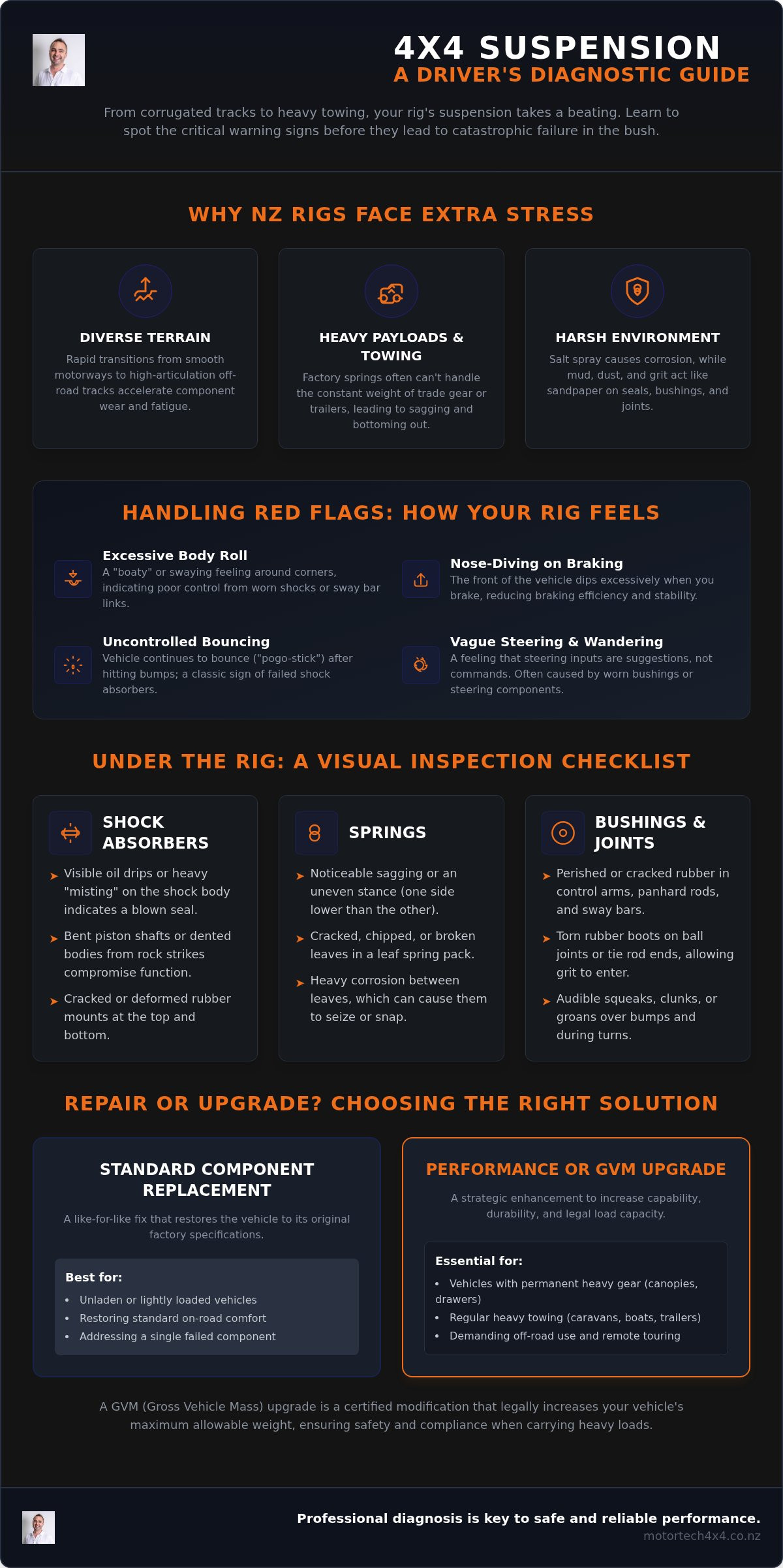
Suspension failure in a four-wheel drive isn’t always as dramatic as a snapped leaf spring or a shattered shock mount. In a professional context, we define it as the system’s inability to effectively manage vehicle weight or absorb kinetic energy. The fundamental role of vehicle suspension systems is to maintain tyre contact with the road while isolating the chassis from impact. When these components degrade, the vehicle loses its ability to reset after a bump, leading to the wallowing, unstable ride often associated with 4×4 suspension problems.
New Zealand’s geography places unique demands on a vehicle’s underpinnings. A rig might spend Monday navigating Auckland’s concrete motorways and Saturday tackling the relentless corrugations of a Coromandel track or a South Island riverbed. This rapid transition between high-speed bitumen and high-articulation off-road environments accelerates component wear. While factory setups are engineered for comfort and unladen efficiency, they rarely possess the damping rates or spring tension required for the rugged Kiwi lifestyle. Suspension fatigue occurs when constant heavy payloads permanently compress the metal, stripping the springs of their elastic memory and ride height.
The Impact of Towing and Heavy Payloads
Many 4×4 suspension problems stem from the reality of how we use our vehicles. A modern ute might have a high tow rating, but factory springs are often under-rated for the constant gear carried by a Kiwi tradie. When you add the downward pressure of a caravan or heavy trailer, the rear end inevitably sags. This doesn’t just look bad; it leads to “bottoming out,” where the suspension hits its bump stops. Over time, these repeated hard impacts can cause structural damage to the chassis and significantly reduce braking efficiency by unloading the front tyres.
Environmental Factors: Salt, Mud, and Corrugations
Our environment is as harsh as our terrain. Beach driving introduces salt spray that corrodes shock shafts and settles between leaf springs, causing them to seize or snap. Fine dust and mud ingress are equally destructive, acting like sandpaper on rubber bushings and seals. Common environmental stressors include:
- Salt-laden air and water causing oxidation on exposed metal surfaces.
- Silt and grit penetrating the seals of ball joints and tie rod ends.
- High-frequency vibrations from corrugations that loosen hardware and fatigue welds.
On long off-road stints, the relentless movement of the piston inside the shock absorber generates immense heat. If the shock isn’t designed to dissipate this thermal energy, the internal oil thins, the damping performance fades, and you’re left with a vehicle that bounces uncontrollably on every ripple.
Identifying the Culprits: Worn Shocks, Sagging Springs, and Perished Bushings
Diagnosing 4×4 suspension problems requires a methodical approach because components rarely fail in isolation. When one part loses its integrity, it places undue stress on the rest of the system. Understanding how car suspensions work helps clarify this relationship; the springs support the weight, while the shocks control the energy. If you ignore a small leak or a faint squeak today, you’re likely looking at a much larger repair bill once the vehicle becomes unsafe to drive.
Shock Absorber Failure Symptoms
Shock absorbers, or dampers, are the most common failure point in high-use rigs. A visual inspection is your first line of defence. Look for “misting” or wet oil patches around the shock body. While a light film of dust-covered oil is sometimes acceptable, a visible drip indicates a blown seal. You should also check for bent shafts, often caused by rock strikes or bottoming out on harsh tracks.
On the road, watch for “pogo-sticking” behaviour. If your vehicle continues to bounce several times after hitting a speed bump, the shocks are no longer controlling the spring’s oscillation. Be wary of the traditional “bounce test” where you push down on a corner of the car. For heavy 4x4s with stiff aftermarket springs, this test is often unreliable as the spring rate is too high for a human to properly compress. Instead, pay attention to “shock fade” during long trips. If your handling feels progressively worse as the day goes on, the internal oil is likely overheating and losing its viscosity.
For those wanting to see how dedicated specialists handle these complex mechanical issues, you can explore Car Suspension Repair for insights into expert shock absorber and suspension maintenance.
Spring Fatigue and Sagging
Springs eventually lose their tension through a process called metal fatigue. To check for this, measure your ride height from the centre of the wheel hub to the bottom of the wheel arch. Compare these figures against factory specifications or your installer’s baseline. If the rear end sits significantly lower than the front, or if one side leans, your springs have likely sagged permanently.
For vehicles with leaf springs, look for “inversion.” A healthy leaf pack should have a distinct upward arch. If the leaves have flattened out or are bowing downwards in the middle, your load-carrying capacity is compromised. Cracked leaves are a major safety risk and an automatic WOF failure, often occurring in older rigs that have been repeatedly overloaded. If you notice your rig is sitting lower than it used to, a professional 4×4 service can provide a precise measurement and health check.
Finally, don’t overlook the smaller hardware. Perished rubber bushings are the primary source of the annoying squeaks and groans you hear over low-speed bumps. If these bushings crack or shift, they can alter your wheel alignment, leading to steering wander and uneven tyre wear. When ball joints or control arms wear out, you’ll often feel a “clunk” through the floorboards or steering wheel, signalling that your rig’s structural geometry is no longer secure.
The Warning Signs: How to Diagnose Issues Before Your Next WOF
Catching 4×4 suspension problems before they escalate is the difference between a routine service and a catastrophic failure on the motorway. While visual leaks are obvious, your rig often communicates its distress through subtle changes in handling and sound. If you’ve noticed your vehicle feels unsettled on Auckland’s uneven surfaces or behaves unpredictably on gravel, it’s time to pay attention. Ignoring these cues doesn’t just lead to a failed Warrant of Fitness (WOF); it puts your safety at risk.
One of the most effective diagnostic techniques is the “stop and listen” method. Drive your vehicle over a variety of surfaces, such as smooth bitumen, speed bumps, and corrugated tracks. Listen for metallic clicking, which often points to worn CV joints, or deep thuds that suggest your shock absorbers are bottoming out. If you feel high-frequency vibrations through the steering wheel or floorboards at motorway speeds, your suspension geometry might be out of alignment, or your bushings may have lost their ability to isolate road noise.
Handling and Braking Instability
When your rear suspension sags due to age or overloading, it creates a dangerous weight imbalance. This “tail-heavy” stance unloads the front axle, making your steering feel light and vague, especially at high speeds. This isn’t just a comfort issue; it significantly affects your vehicle’s electronic stability control (ESC). These modern systems rely on precise sensor data to keep you on the road, and compromised suspension can feed incorrect information to the computer.
Braking performance is equally dependent on your dampers. If your rig nose-dives excessively under heavy braking, the front tyres are being overworked while the rear tyres lose traction. Statistics show that a vehicle with defective shock absorbers can take as much as 2.6 metres extra to stop in an emergency. If you’re towing a boat or caravan, this distance increases even further, making healthy suspension a non-negotiable safety requirement.
WOF Compliance and Safety Standards
In New Zealand, WOF inspectors follow strict guidelines regarding vehicle modifications and wear. Common reasons for failure include leaking shock absorbers, insecurely mounted springs, and perished bushings. There are also specific legal thresholds you must meet to remain road legal:
- Suspension Lifts: A lift of up to 50mm is generally covered under a standard WOF, but anything exceeding this requires a Low Volume Vehicle (LVV) certification.
- Aftermarket Components: The installation of aftermarket upper control arms requires LVV certification, regardless of the lift height.
- Rebound Travel: To pass a WOF, your suspension must maintain at least 40mm of rebound (droop) travel.
- Ground Clearance: A minimum clearance of 100mm must be maintained across the entire underbody.
Adopting a “she’ll be right” attitude toward suspension maintenance is a gamble you shouldn’t take. Beyond the legalities, unusual tyre wear patterns like cupping or feathering are clear indicators that your tyres aren’t making consistent contact with the road. This reduces grip in the wet and forces you to replace expensive rubber prematurely. Professional diagnosis ensures your rig meets all NZTA requirements while remaining safe for your next adventure.
Beyond the Fix: GVM Upgrades and Performance Kits for Heavy Loads
Sometimes, simply replacing worn components isn’t enough to resolve recurring 4×4 suspension problems. If your rig consistently hits the bump stops or feels unsettled despite having fresh shocks, you’re likely pushing the vehicle beyond its factory-engineered limits. Standard suspension is designed for a compromise between unladen comfort and occasional light loads. When you add permanent weight like steel bullbars, winches, and heavy-duty canopies, the factory springs and dampers lack the rate and valving required to maintain control. Moving to a performance-oriented setup isn’t just about height; it’s about matching your vehicle’s mechanical capability to its real-world operating weight.
What is a GVM Upgrade?
There is a significant technical distinction between a standard 50mm lift kit and a certified GVM (Gross Vehicle Mass) upgrade. While a lift kit provides extra ground clearance, it does not legally increase the amount of weight your vehicle can carry. A GVM upgrade involves a combination of springs, shocks, and sometimes structural components that have been rigorously tested to handle higher payloads while maintaining braking and stability standards. Technically, a GVM upgrade is a legal re-rating of your vehicle capacity that ensures you remain compliant with NZTA standards while carrying maximum payloads. This is a critical requirement for fleet vehicles and long-distance tourers who carry constant heavy gear. As authorised installers, we ensure these modifications are fully certified and road-legal.
If you’re concerned about your vehicle’s legal weight limits or handling under load, you can book a professional GVM upgrade consultation to determine the best path forward for your rig.
Choosing the Right Spring Rate
One of the most common mistakes in resolving 4×4 suspension problems is opting for a “one size fits all” kit. Every rig is different. A vehicle with a plastic bumper and no winch requires a vastly different front spring rate than one fitted with a steel bullbar and a 12,000lb winch. If the spring rate is too soft, the front end will dive under braking and sag prematurely. Conversely, a spring rate that is too high for the actual load will result in a harsh, skittish ride that reduces tyre contact on corrugated tracks.
Effective suspension tuning requires matching your spring rate to your actual constant load. This includes accounting for:
- Front-end accessories like bullbars, winches, and secondary batteries.
- Rear-end weight such as drawers, fridges, and long-range fuel tanks.
- Dynamic loads from towing caravans or heavy trailers.
The goal is to find the precise balance between load-carrying capacity and ride quality. A tailored setup ensures the suspension remains in its optimal operating zone, providing the necessary damping to absorb impacts without the jarring feedback associated with over-sprung vehicles. This professional approach protects your chassis from stress and ensures your rig remains a capable, comfortable tool for both work and play.
Professional 4×4 Suspension Services at Motortech 4X4 Auckland
Resolving 4×4 suspension problems requires more than just mechanical aptitude; it demands a deep understanding of how modern vehicle systems interact. At Motortech 4X4, we provide a comprehensive diagnostic approach that goes beyond simply swapping out parts. Our Auckland facility is equipped to handle everything from routine component replacement to complex GVM upgrades and full fleet fit-outs. We pride ourselves on being a one-stop shop where technical excellence meets rugged reliability, ensuring every modification is both high-performing and legally compliant.
For commercial operators and fleet managers, we offer specialised maintenance schedules designed to minimise downtime. Heavy-use vehicles in Auckland’s construction and utility sectors face accelerated wear on their underpinnings. We provide structured fleet servicing that identifies potential failures before they result in a vehicle being taken off the road. This proactive strategy protects your investment and ensures your team remains safe while operating in demanding environments.
ADAS Calibration: The Critical Final Step
Modern 4x4s are equipped with Advanced Driver Assistance Systems (ADAS) that rely on precise sensor data to function. When you repair or modify your suspension, you alter the vehicle’s ride height and pitch. This change, even if it is only a few millimetres, can throw off the calibration of cameras and radar sensors used for lane-keep assist and autonomous emergency braking. These systems are calibrated to a specific factory height; if the suspension is lifted or fixed after a period of sagging, the safety sensors are effectively “aiming” at the wrong target.
Motortech 4X4 is a specialist ADAS calibration centre. We ensure that every suspension modification is followed by a rigorous recalibration process. Ignoring this step is dangerous, as it can lead to erratic braking interventions or the failure of safety features when you need them most. By integrating mechanical repairs with electronic calibration, we maintain the integrity of your vehicle’s safety net.
Specialised Servicing for Auckland 4×4 Owners
Our approach to diagnosing complex suspension and steering issues involves a thorough multi-point inspection. We look for the root cause of the instability, whether it is a failing steering damper or a structural issue within the control arms. Professional fitting is vital for maintaining your vehicle warranty, especially when installing aftermarket kits. As authorised GVM upgrade installers, we provide the documentation and precision required to keep your rig road-legal and manufacturer-compliant.
Choosing a specialist ensures that your vehicle geometry is set correctly the first time. We use industry-specific terminology and engineering standards to guide every project, from a simple bushing replacement to a total touring overhaul. Don’t leave your vehicle’s safety to chance. Book your suspension inspection at Motortech 4X4 today!
Restore Your Rig’s Performance and Safety
Maintaining a capable four-wheel drive requires more than just reactive repairs. By identifying the early warning signs of 4×4 suspension problems, you protect your vehicle’s chassis and ensure your next WOF inspection is a straightforward process. Addressing worn shocks or sagging springs early prevents the cascading failures that often occur during remote touring. For those carrying permanent heavy gear, moving beyond standard fixes to a certified solution is the only way to maintain safety and legal standing on the road.
Motortech 4X4 stands as Auckland’s leading ADAS calibration specialists and authorised installers of heavy-duty GVM upgrades. We provide expert 4×4 servicing for private and fleet vehicles, ensuring every modification is precise, calibrated, and fit for purpose. Whether you’re a tradie with a loaded tray or a weekend warrior hitting the tracks, our team has the engineering expertise to keep your rig stable and secure.
Get your 4×4 suspension professionally checked at Motortech 4X4 to ensure your vehicle is ready for its next adventure.
Frequently Asked Questions
How can I tell if my 4×4 shock absorbers are worn out?
You can identify worn shock absorbers by checking for visible oil leaks on the shock body or observing excessive bouncing after hitting a bump. If your vehicle wallows through corners or exhibits “cupped” tyre wear patterns, the dampers are no longer effectively controlling the spring’s movement. These symptoms are common indicators of 4×4 suspension problems that compromise your braking distance and overall vehicle stability on corrugated surfaces.
Why is my 4×4 sagging at the back when I hook up my trailer?
Rear-end sag occurs when the tow ball weight of your trailer exceeds the load-carrying capacity of your factory springs. Most standard 4×4 setups are engineered for unladen comfort rather than constant heavy towing. This downward pressure forces the rear suspension into a compressed state, which unloads the front wheels and makes your steering feel dangerously light. A heavy-duty spring upgrade is usually required to restore a level ride height.
Will a suspension lift kit make my 4×4 ride better on the road?
A suspension lift kit primarily provides extra ground clearance and wheel travel, but ride quality depends entirely on the chosen spring rates and shock valving. If you choose a kit with rates matched to your vehicle’s constant weight, the ride will feel more controlled and less wallowy. However, installing heavy-duty springs on an unladen vehicle often results in a harsh and skittish on-road experience that reduces tyre contact.
Do I need a GVM upgrade for my work ute?
You need a GVM upgrade if your work ute’s permanent accessories, tools, and equipment push the total weight close to the manufacturer’s original limit. Modern utes fitted with steel bullbars, winches, and heavy-duty canopies often have very little remaining payload for actual cargo. A certified GVM upgrade provides a legal re-rating of your vehicle’s capacity, ensuring you remain road-legal and insured while carrying your professional gear.
Why is my 4×4 making a squeaking noise over every bump?
Squeaking noises are typically caused by dry or perished rubber bushings in the leaf springs, control arms, or shock mounts. As these components age or become contaminated with grit and mud, the internal friction creates an audible groan during suspension articulation. While some polyurethane bushings require regular greasing, standard rubber bushings that have started to crack or shift usually require a complete replacement to restore quiet and safe operation.
Is it safe to drive with a leaking shock absorber?
Driving with a leaking shock absorber is unsafe because it significantly reduces your tyre’s contact with the road surface. A blown seal means the damper can no longer control the spring’s oscillation, leading to unpredictable handling and increased braking distances. In an emergency situation, a vehicle with defective shocks can take up to 2.6 metres longer to stop, which is often the difference between a near-miss and a collision.
If a suspension failure or severe handling issue leaves your vehicle stranded, it’s safer to call for professional recovery than to risk driving. For those operating in Western Australia, Allout Towing offers reliable 24-hour assistance to transport damaged 4x4s and heavy vehicles safely to a qualified repairer.
What is ADAS calibration and why do I need it after a suspension fix?
ADAS calibration is the process of resetting your vehicle’s safety sensors, such as cameras and radar, to align with its current ride height. When you fix sagging suspension or install a lift kit, you change the angle at which these sensors “see” the road. Without professional recalibration, features like autonomous emergency braking and lane-keep assist may fail to activate or trigger unexpectedly, creating a serious safety risk.
How often should I have my 4×4 suspension inspected?
You should have your suspension inspected every 10,000km or immediately following a major off-road trip through harsh terrain. High-frequency vibrations from corrugations and exposure to salt or mud can accelerate component wear between standard service intervals. A professional health check ensures that small issues, like a loose shackle bolt or a weeping shock, are caught before they develop into major 4×4 suspension problems in the bush.